

P0442 on 2018-2023 Kia Stinger: EVAP Small Leak Causes and Fixes
For a 2018-2023 Kia Stinger, the P0442 code is most often caused by a loose or worn-out gas cap. If a new OEM cap doesn't fix it, the next most likely culprit is the canister purge control valve in the engine bay. A new gas cap costs around $25-$35. A smoke test is the most reliable way to find less common leaks in hoses or other components.
- Always check the gas cap first for a P0442 code. Ensure it's tight and the seal is intact. This is the most common and cheapest fix.
- If you replace the gas cap, use a genuine OEM part (31010-3L600U) to avoid sealing issues common with aftermarket caps.
- If the gas cap isn't the problem, the canister purge valve (PCSV) in the engine bay is the next most likely part to have failed.
- You can safely drive with the P0442 code, but the Check Engine Light will remain on and you will not pass an emissions inspection.
- For hard-to-find leaks, a professional smoke test is the most reliable diagnostic method.
What's Unique About the 2018-2023 Kia Stinger
The Kia Stinger (2018-2023) does not have a widely documented, unique design flaw that makes it prone to the P0442 code. The causes are typical for most modern vehicles, starting with the gas cap and moving to common EVAP valves. However, it's important to note that the canister purge valve part number may differ between the 2.0L/2.5L and 3.3L engines. Additionally, the vapor canister itself changed with the 2022 model year facelift and the old and new parts are not interchangeable. While there are major safety recalls for the Stinger (like the SC300 oil feed pipe issue and SC218/SC198 fuel pump recalls), they are generally unrelated to the EVAP system and this specific leak code.
Symptoms You May Notice
- Check Engine Light is on.
- A faint fuel smell near the rear of the vehicle (less common).
- Difficulty pumping gas (if the issue is related to a clogged canister or vent valve).
- On some models, a persistent EVAP code can interfere with other systems, such as disabling the Idle Stop & Go feature.
- Replacing the purge valve or other components before checking if the gas cap is tight and its seal is in good condition.
- Using a cheap, non-OEM gas cap which fails to seal properly and causes the code to return.
- Replacing parts without confirming the leak location with a smoke test, leading to repeated repairs and frustration.
Most Likely Causes
- Loose or Faulty Gas Cap 🔴 High Probability → Shop Fuel Tank Cap The gas cap is used frequently and its rubber O-ring can wear out, crack, or get dirty over time, preventing a proper seal. This is the most common cause on virtually all vehicles and the first thing to check.
How to confirm: Inspect the gas cap for any visible cracks or damage to the seal. Ensure it is tightened until it clicks at least once. Clean the cap's seal and the fuel filler neck surface. If the cap doesn't click when tightened, it needs replacement.
Typical fix: Replace the gas cap with a new OEM part. Aftermarket caps are often a source of EVAP codes.
Est. part cost: $25-$40 - Faulty Canister Purge Valve (PCSV) 🟡 Medium Probability → Shop Vapor Canister This solenoid valve is located in the engine bay and cycles frequently, leading to eventual failure. It can get stuck open or closed, causing a leak or incorrect purge flow. A Reddit user with a 2021 Stinger GT1 reported a dealer replacing this part to fix a persistent small leak code.
How to confirm: The valve is typically located on or near the intake manifold. With the engine running, you can disconnect the hose leading away from the valve (towards the engine) and feel for vacuum at the port. There should be no vacuum at idle on a cold engine. If there is, the valve is stuck open and needs replacement.
Typical fix: Replace the canister purge valve. This is a common DIY repair.
Est. part cost: $55-$95 - Faulty Canister Close Valve (CCV) / Vent Valve ⚪ Low Probability → Shop Vapor Canister Located near the charcoal canister at the rear of the car, this valve can fail due to age or corrosion, especially in areas that use road salt. It can get stuck open, preventing the system from sealing during its self-test.
How to confirm: The valve should be normally open. A scan tool can command it closed to test its function. It can also be removed and tested by applying voltage to see if it closes. A smoke test will often reveal a leak at a stuck-open vent valve.
Typical fix: Replace the canister close valve.
Est. part cost: $70-$120 - Cracked or Disconnected EVAP Hoses ⚪ Low Probability Rubber and plastic hoses can become brittle and crack from age and heat cycles in the engine bay or exposure underneath the vehicle. A small, hard-to-see crack is a classic cause for a P0442 code.
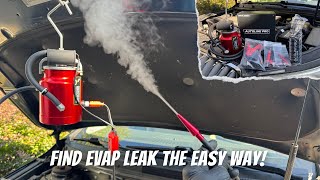
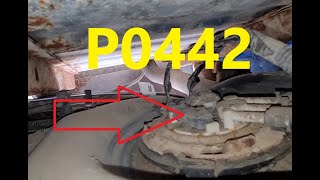
How to confirm: Visually inspect all accessible EVAP lines running from the fuel tank, to the charcoal canister, and to the purge valve in the engine bay. A smoke test is the most reliable way to find a small crack. 🎬 Watch: How to find leaks using a smoke machine.
Typical fix: Replace the cracked section of hose or re-secure the connection.
Est. part cost: $10-$50
Rare But Worth Checking
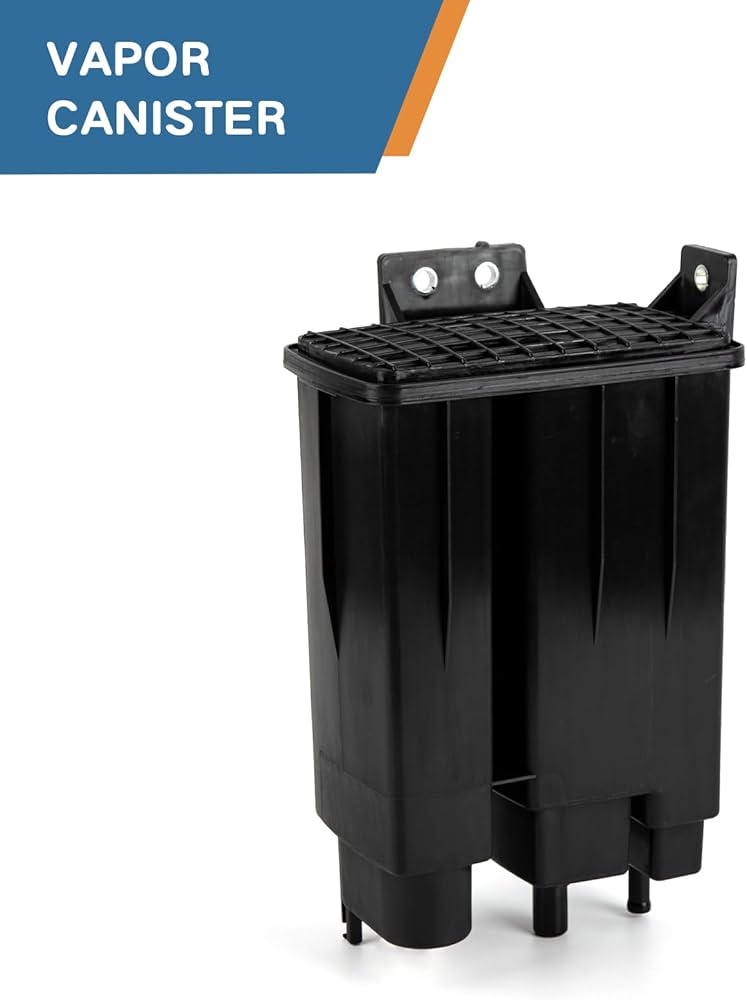
- Cracked EVAP Charcoal Canister: → Shop Vapor Canister The canister itself can develop a hairline crack, often near the mounting bolts from stress over time. More commonly, it fails internally when the fuel tank is habitually overfilled ('topped off'), which floods the charcoal bed with liquid fuel and ruins it.
- Leaking Fuel Filler Neck: → Shop Fuel Filler Neck Less common than a bad cap, the metal or plastic neck where the gas cap screws in can rust or crack, preventing a proper seal no matter how good the cap is.
- Fuel Pump Seal Damage: → Shop Fuel Pump While less common, manufacturer service bulletins such as Bulletin #PS567_R2 and Bulletin #TTV21I4 have noted that P0442 and P0456 codes can be triggered by damage to the fuel pump seal on related Kia platforms.
Diagnosis Steps
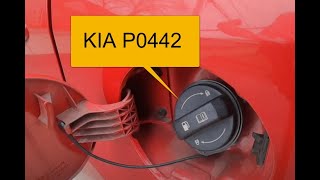
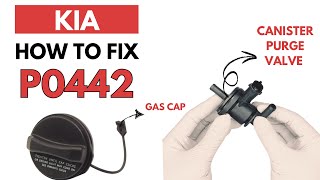
- Check the Gas Cap: Remove the gas cap, inspect the rubber seal for cracks or wear, and ensure the fuel filler neck is clean. Reinstall the cap, tightening it until it clicks several times. This solves the majority of P0442 cases. 🎬 Watch this complete guide to fixing Kia P0442 codes.
- Clear the Code: Use an OBD-II scanner to clear the P0442 code.
- Drive the Vehicle: Drive for a few days (50-100 miles) to allow the car's computer to run its EVAP system self-test. If the light stays off, the gas cap was the issue.
- Inspect Engine Bay Hoses: If the light returns, visually inspect the EVAP hoses around the engine and intake manifold for obvious cracks, disconnections, or brittleness.
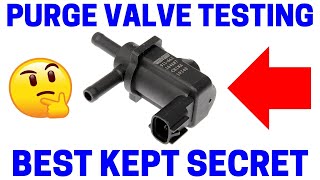
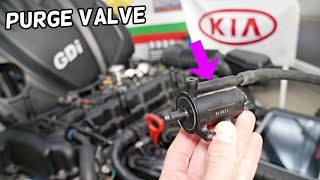
- Test the Purge Valve (PCSV): Locate the purge valve in the engine bay (on the 3.3T it is near the driver's side of the intake manifold). With the engine at idle, disconnect the hose leading from the valve to the engine and check for suction with your finger. There should be no vacuum. 🎬 See how to test your purge valve without any tools. If there is, the valve is stuck open and needs replacement.
- Perform a Smoke Test: If the leak source is still not found, the most effective method is a professional smoke test. A machine fills the EVAP system with a harmless, visible smoke under low pressure, making even the smallest leaks from hoses, the canister, or valves easy to spot. Manufacturer Bulletin #PS469 recommends a manual EVAP test if the MIL is illuminated with P0442 and the standard self-test results in "No Trouble Found" (NTF).
- Inspect Rear Components: If the smoke test points to the rear of the vehicle, inspect the charcoal canister for cracks (especially around mounting points) and test the canister close valve (CCV) for proper operation.
Parts You'll Likely Need
- Fuel Tank Cap
(OEM #31010-3L600U)— This is the most common failure point and the easiest part to replace. An OEM cap is strongly recommended for a proper seal. This part number is shared with other Hyundai/Kia/Genesis vehicles.
Trusted brands: Kia (Genuine OEM)
OEM price range: $25-$40
Aftermarket price range: $15-$25 - Canister Purge Valve (for 3.3L V6)
(OEM #28910-3L270)— This valve cycles frequently and can fail, getting stuck open or closed. It's a common cause if the gas cap is not at fault. Fitment confirmed for 2018-2023 Stinger 3.3L and 2019-2020 K900.
Trusted brands: Kia (Genuine OEM), Bosch
OEM price range: $55-$85
Aftermarket price range: $40-$70 - Canister Purge Valve (for 2.0L/2.5L)
(OEM #28910-2S000)— This valve serves the same function as on the V6 but may have a different part number. Confirm fitment with your VIN.
Trusted brands: Kia (Genuine OEM)
OEM price range: $90-$130
Aftermarket price range: $60-$100 - Canister Close Valve / Vent Valve
(OEM #31453-AA000)— This valve, located at the rear of the car, can stick or fail, causing a leak. It's less common than the purge valve but a known possibility.
Trusted brands: Kia (Genuine OEM)
OEM price range: $70-$100
Aftermarket price range: $50-$80
Related Codes That Often Appear With This One
- P0456 — This code indicates a 'very small' EVAP leak. The diagnostic process is nearly identical, and a problem might start as a P0456 and worsen into a P0442. A Stinger owner on Reddit reported this exact code before a dealer diagnosed a faulty purge valve.
- P0455 — This indicates a 'large' EVAP leak. If you see this, the gas cap is likely completely loose or a major hose is disconnected.
- P0441 — This code for 'Incorrect Purge Flow' often points directly to a malfunctioning canister purge valve, which can also cause a P0442 if it's stuck partially open.
Technical Service Bulletins (TSBs) & Recalls
- SC279 - ECM Software Update for Emissions Control Logic (2018-2021 2.0L)
- Bulletin #PS567_R2 - DTC P0456/P0442 with Fuel Pump Seal Damage
- Bulletin #PS469 - Manual Evaporative Emissions Test for Hard to Find/Small Leaks
- Bulletin #TTV21I4 - DTC P0456/P0442 with Fuel Pump Seal Damage (Reference Section 7)
Platform-Specific Known Issues
- Voluntary Emissions Service Campaign (SC279): Some 2018-2021 Stinger models with the 2.0L engine were eligible for an ECM software update to improve emissions control logic. While not a direct fix for a P0442 leak, it's a relevant emissions system update for the platform.
Mechanic-Grade Diagnostic Values
- Canister Purge Solenoid Valve (PCSV) Coil Resistance — expected: 18.5 - 22.5 Ω at 20°C (68°F) for some models, 22.0 - 26.0 Ω for others.. Failure: Resistance outside of the specified range indicates a faulty valve coil.
- Fuel Tank Pressure Sensor (FTPS) Signal Voltage (KOEO, Gas Cap Off) — expected: Approximately 2.5V. Failure: Voltage significantly different from 2.5V suggests a faulty sensor, provided the 5V reference and ground are good.
- Manual EVAP Test - FTPS Voltage under induced vacuum — expected: Voltage should be greater than 1.5V. Failure: If voltage drops below 1.5V while manually grounding the PCSV, it indicates a restriction in the EVAP system (e.g., clogged canister, rollover valve, or lines).
Scan Tool Commands That Help
- Kia GDS (Global Diagnostic System): EVAP Leakage Test — This function forces the vehicle's onboard EVAP leak test to run on command. It is used by technicians to verify a repair or to test the system's integrity without waiting for the automatic drive cycle monitor to complete. The tool can command the vent valve closed and monitor the fuel tank pressure sensor to check for a pressure drop.
- Kia GDS (Global Diagnostic System): Actuation Test — Allows a technician to individually command components like the Purge Control Solenoid Valve (PCSV) and Canister Close Valve (CCV) on or off. This is used to confirm if a valve is physically stuck or not responding to electronic commands.
Wiring & Ground Locations
- Engine Compartment Fuse Box — Located in the engine bay, typically on the driver's side.. Contains fuses and relays for various engine systems. A blown fuse for the PCSV or other EVAP components could cause a related fault, though typically a circuit code (like P0443) would appear, not a leak code.
- Instrument Panel Fuse Box — Located inside the cabin, usually accessible by removing a panel on the driver's side of the dashboard.. Contains fuses for various interior and control module functions. It's important to check for any blown fuses that might affect the Engine Control Module (ECM) or related systems.
- Rear Fuse Box — Located in the trunk area of the Stinger.. Manages electrical circuits for components located at the rear of the vehicle, which could include power to the Canister Close Valve (CCV) or other rear-mounted EVAP hardware.
OEM Part Supersession History
31410-J5500→31410-J5550— Part design change corresponding with the 2022 model year facelift.
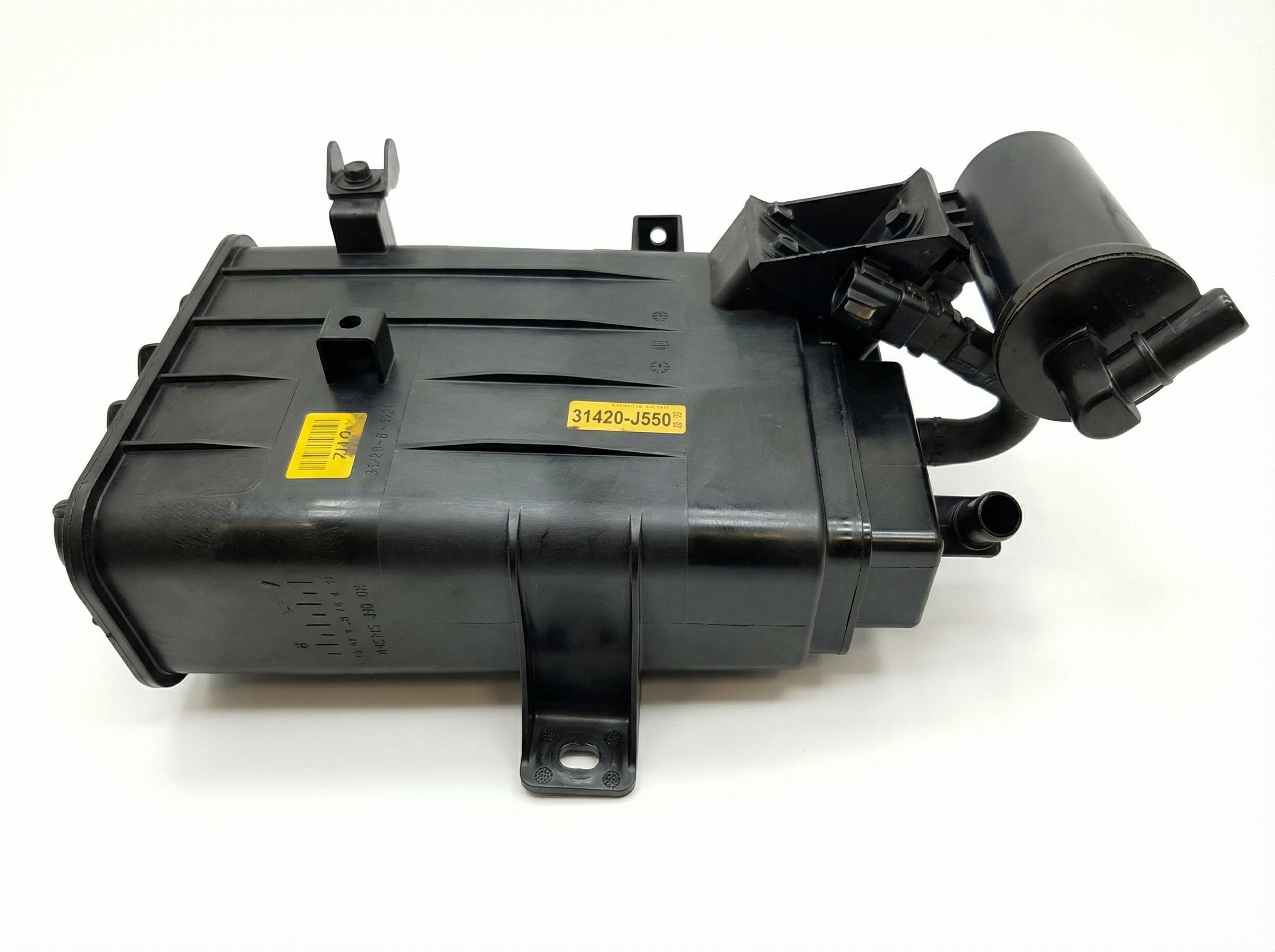
Heads up: The 2018-2021 (31410-J5500) and 2022-2023 (31410-J5550) vapor canisters are NOT interchangeable. Installing the wrong part will cause a Check Engine Light and EVAP system faults.
Model Year Variations Within This Range
- 2018-2021 vs 2022-2023: The vapor canister (charcoal canister) part number changed for the 2022 model year. Pre-facelift models (2018-2021) use part number 31410-J5500, while facelift models (2022-2023) use 31410-J5550. The parts are not cross-compatible.
- 2022-2023: The 2.0L Theta-II engine was replaced by the 2.5L Smartstream (Theta-III) engine. This may affect the part number and location of the canister purge valve (PCSV). The 2.5L engine may use PCSV P/N 28910-2S000.
Diagnostic Flowchart
Other Known Issues on This Vehicle
Issues unrelated to this code that are worth knowing about as an owner of this generation:
- Left Turbocharger Oil Feed Pipe Leak (3.3T) 🔴 High — Common enough to warrant a safety recall (SC300). The hose assembly can deteriorate and leak oil onto hot engine components. (Ref: Recall SC300 / NHTSA 24V-147)
- Paint Peeling/Chipping (Sunset Yellow) 🟠 Medium — A well-documented issue on early models with Sunset Yellow paint, where poor adhesion to the primer causes chipping and peeling. Kia offered repaints or buybacks to some owners. Other colors have also been anecdotally reported. (Ref: Not an official recall, but a known customer service campaign.)
- High Pressure Fuel Pump (HPFP) Failure 🔴 High → Shop Fuel Pump — A recall was issued for 2018-2021 models where the fuel control valve plunger could stick, causing over-pressurization and potential loss of motive power. (Ref: Recall SC218 / NHTSA 23V-634)
- HECU (Hydraulic Electronic Control Unit) Fire Risk 🔴 High — Affects 2018-2021 models. An electrical short within the HECU for the anti-lock brake system could cause an engine compartment fire, even when the car is parked. (Ref: Recall SC196 / NHTSA 20V-518)
- Excessive Oil Consumption (Theta II 2.0T) 🟠 Medium — Some 2.0L engines may experience excessive oil consumption, a known issue across various Hyundai/Kia models with this engine family. (Ref: TSB ENG222_R4)
- Various Rattles and Noises 🟡 Low — Owners report various interior and exterior rattles from areas like the headliner, trunk, or suspension components, which is common for a first-generation vehicle. (Ref: TSB BOD317 (Headliner Noise Reduction))
Used vs. New Parts: Buying Guide for This Vehicle
When a used part is the smart pick: For a P0442 code, used parts are generally not recommended for the common failure items. However, if a smoke test confirms a leak in a specific hard line or the fuel filler neck is found to be rusted/damaged, a used component from a rust-free donor vehicle can be a cost-effective solution. A used charcoal canister is a gamble, but may be considered if it can be thoroughly inspected for cracks and the donor vehicle has low mileage.
Donor-vehicle mileage cap: roughly under 50000 miles for the part to have meaningful remaining life.
What to inspect on the donor part:
- For canisters/hoses: Check for any hairline cracks, especially around mounting points and hose connections.
- Ensure all plastic is still flexible and not brittle.
- Verify the donor vehicle is from a dry, salt-free climate to minimize risk of corrosion and plastic degradation.
- Confirm the part number on the donor part matches your original part exactly, especially for the vapor canister due to the 2022 model year change.
OEM-only on this vehicle (don't cheap out):
- Fuel Tank Cap: Aftermarket caps are a very common cause of recurring P0442 codes due to improper sealing. Always use a genuine Kia cap (31010-3L600U).
- Canister Purge Valve (PCSV): The precise calibration and cycling of this valve are critical. Aftermarket versions can fail prematurely or not operate to the ECM's exact specifications.
- Canister Close Valve (CCV): Similar to the PCSV, the sealing integrity is paramount, making an OEM part the most reliable choice.
Aftermarket brands forum-validated for this vehicle:
- Bosch (for Canister Purge Valve, if available and confirmed as an OEM supplier)
Brands owners have reported issues with on this vehicle:
- Unbranded or 'white box' gas caps and electronic valves from online marketplaces.
Real Owner Stories
Aggregated from forums and TSBs cited above. Mileages and costs reflect what owners reported in those sources.
2021 Kia Stinger GT1 3.3T
Symptoms: Check engine light on for the 4th time due to a persistent small EVAP leak code.
What fixed it: The dealer replaced the canister purge valve (PCSV) to resolve the leak.
Source hint: https://www.reddit.com/r/kiastinger/comments/18l9v0j/check_engine_light_on_for_4th_time/
Documented NHTSA Reports
Reported EVAP Component Failures
An owner reported that after the check engine light illuminated, the dealer identified P0442 and P0455 codes, leading to the replacement of both the gas cap and the charcoal canister (NHTSA ODI #10150202). Another report describes a recurring P0442 code where the owner noted a previous recall for the fuel cap on a different Kia model, highlighting the cap as a frequent failure point (NHTSA ODI #10058467).
Related OBD-II Codes
Frequently Asked Questions
Does the Voluntary Emissions Service Campaign SC279 apply to my 2019 Kia Stinger 2.0L?
Can a P0442 code affect my Stinger's Idle Stop & Go (ISG) feature?
Where is the purge valve located on the Stinger 3.3T engine?
Should I use an aftermarket gas cap to fix this code?
Is the P0442 code related to the SC300 recall for the 3.3T engine?
Why is my Stinger difficult to pump gas into while having a P0442 code?
Helpful Videos
Used OEM Parts in Stock
New Aftermarket Parts Available


The information in this article is provided for general reference and educational purposes only. Vehicle specifications, procedures, and part compatibility can vary by production date, trim level, and region. Always consult your vehicle's factory service manual and verify part numbers before purchasing or performing repairs. Safety-critical components such as airbags, seat belts, and braking systems should be installed by a qualified professional.
- Kia Stinger:
- 🧭 Diagnostic Flowchart
- 🎬 Helpful Videos
- 🛍️ Shop This Part
- What's Unique About the 2018-2023 Kia Stinger
- Symptoms You May Notice
- Most Likely Causes
- Rare But Worth Checking
- Diagnosis Steps
- Parts You'll Likely Need
- Related Codes That Often Appear With This One
- Technical Service Bulletins (TSBs) & Recalls
- Platform-Specific Known Issues
- Mechanic-Grade Diagnostic Values
- Scan Tool Commands That Help
- Wiring & Ground Locations
- OEM Part Supersession History
- Model Year Variations Within This Range
- Other Known Issues on This Vehicle
- Used vs. New Parts: Buying Guide for This Vehicle
- Real Owner Stories
- 2021 Kia Stinger GT1 3.3T
- Documented NHTSA Reports
- Reported EVAP Component Failures
- Related OBD-II Codes
- Frequently Asked Questions
- 🎟️ Get 5% Off