

P0442 on 2006-2013 Lexus IS: EVAP Small Leak Causes and Fixes
On a 2006-2013 Lexus IS, code P0442 is most often caused by a loose or worn-out gas cap. Before attempting any other repairs, tighten the cap or replace it with a genuine OEM part for about $30. If that doesn't work, a professional smoke test is the next step to find the leak.
- Start with the simplest fix: tighten your gas cap. If the light comes back, spend the $30 on a new genuine Lexus gas cap before doing anything else.
- This code does not indicate an urgent mechanical problem, and you can continue to drive the car without fear of damaging the engine.
- Do not waste money on aftermarket gas caps, as many owners report they do not seal correctly and fail to resolve the code.
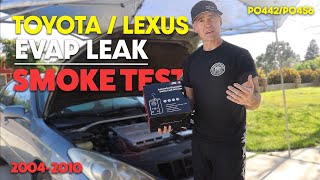
- If a new OEM gas cap doesn't fix the issue, a smoke test is the most efficient way to find the true source of the leak, saving time and money on guesswork.
What's Unique About the 2006-2013 Lexus IS
For the second-generation Lexus IS (IS250 and IS350), the P0442 code follows a familiar pattern seen across many Toyota and Lexus vehicles. The most common culprit is simple and inexpensive: the gas cap. Owners on forums frequently report that replacing a worn gas cap with a new, genuine Lexus part resolves the issue permanently. While other components can fail, the cap is the overwhelmingly likely starting point for this specific vehicle.
Symptoms You May Notice
- Check Engine Light is on.
- A faint fuel smell may be present, though this is not always the case.
- In rare cases where a vent valve is blocked, you may have difficulty refueling the car (the pump clicks off repeatedly).
- Replacing the oxygen (O2) sensors. O2 sensors are not part of the EVAP system and will not cause a P0442 code.
- Replacing the catalytic converter. This is an expensive exhaust component that has no connection to the EVAP system.
Most Likely Causes
- Loose or Faulty Gas Cap 🔴 High Probability → Shop Fuel Tank Cap The gas cap seal is a rubber O-ring that degrades over time with exposure to fuel vapors and temperature changes, losing its ability to create a perfect seal. This is the most common failure point for P0442 across all vehicles.
How to confirm: Ensure the cap is tightened until it clicks at least once. Inspect the rubber gasket on the cap for cracks, stiffness, or damage. If the light returns after tightening, replacing the cap is the easiest next step.
Typical fix: Replace the gas cap. It is highly recommended to use a genuine OEM Lexus cap 🎬 Watch: A step-by-step guide to the gas cap solution., as some aftermarket caps may not seal correctly, leading to the code returning.
Est. part cost: $25-$40 - Cracked or Disconnected EVAP Hose 🟡 Medium Probability Rubber and plastic hoses in the engine bay and under the vehicle become brittle with age and heat cycles, leading to small cracks, especially at connection points and bends.
How to confirm: Visually inspect all accessible EVAP lines, from the engine bay purge valve to the charcoal canister near the fuel tank. A professional smoke test is the definitive way to find a leak that isn't visually obvious.
Typical fix: Replace the specific cracked hose or re-secure a loose connection.
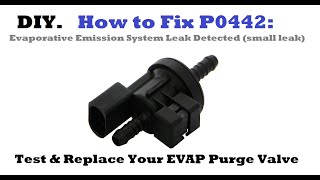
Est. part cost: $10-$50 - Faulty Purge Valve (VSV) ⚪ Low Probability → Shop Vapor Canister The purge valve (or Vapor Switching Valve - VSV) is an electronic solenoid that can fail mechanically, getting stuck slightly open and creating a leak path.
How to confirm: With the engine off, remove the valve and try to blow through it; it should be closed and allow no air to pass. You can also apply 12V power to its terminals; it should click open. If it's stuck open or doesn't operate with power, it's faulty.
Typical fix: Replace the purge valve assembly, typically located in the engine compartment.
Est. part cost: $50-$100 - Leaking Charcoal Canister ⚪ Low Probability → Shop Vapor Canister The plastic housing of the canister can develop hairline cracks due to age or physical impact from road debris. Consistently overfilling the fuel tank can also saturate the charcoal element and damage internal valves.
How to confirm: A smoke test is the most effective method. Smoke will be seen escaping from a crack in the canister body or one of its integrated components, like the vent valve.
Typical fix: Replace the entire charcoal canister assembly.
Est. part cost: $350-$500
Rare But Worth Checking
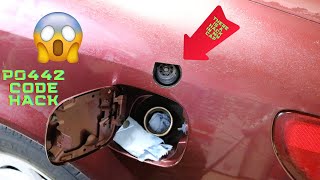
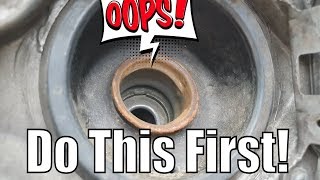
- Leaking Fuel Filler Neck: → Shop Fuel Filler Neck Rust or corrosion can form on the metal filler neck where the gas cap seals. This prevents even a new cap from sealing properly, causing a persistent P0442 code. A visual inspection of the neck's sealing surface is necessary.
- Faulty Vent Valve: The vent valve, often attached to the charcoal canister, can get stuck open or fail to seal, causing a leak. This is usually diagnosed with a smoke test or by applying power to test its operation, similar to the purge valve.
Diagnosis Steps
- Retrieve the P0442 code using an OBD-II scanner.
- Inspect the gas cap. Ensure it is tight and clicks when closed. Remove it and check the rubber seal for any cracks, tears, or signs of wear. If in doubt, replace it with an OEM part.
- Clear the code and drive the vehicle for a few days to see if the light returns. The EVAP monitor may take several drive cycles to run its self-test.
- If the light returns, perform a thorough visual inspection of all EVAP hoses and lines in the engine bay and under the car near the fuel tank. Look for obvious cracks, damage, or loose connections.
- If no visual faults are found, the most reliable next step is to have a professional perform a smoke test. This involves injecting pressurized, UV-dyed smoke into the EVAP system via the service port to pinpoint the exact location of the small leak.
- Based on the smoke test results, replace the leaking component, which could be a hose, purge valve, vent valve, or the charcoal canister itself.
Parts You'll Likely Need
- Fuel Tank Cap
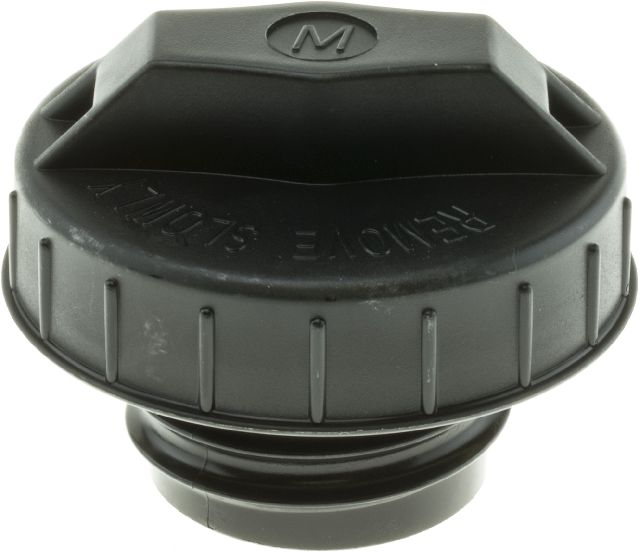
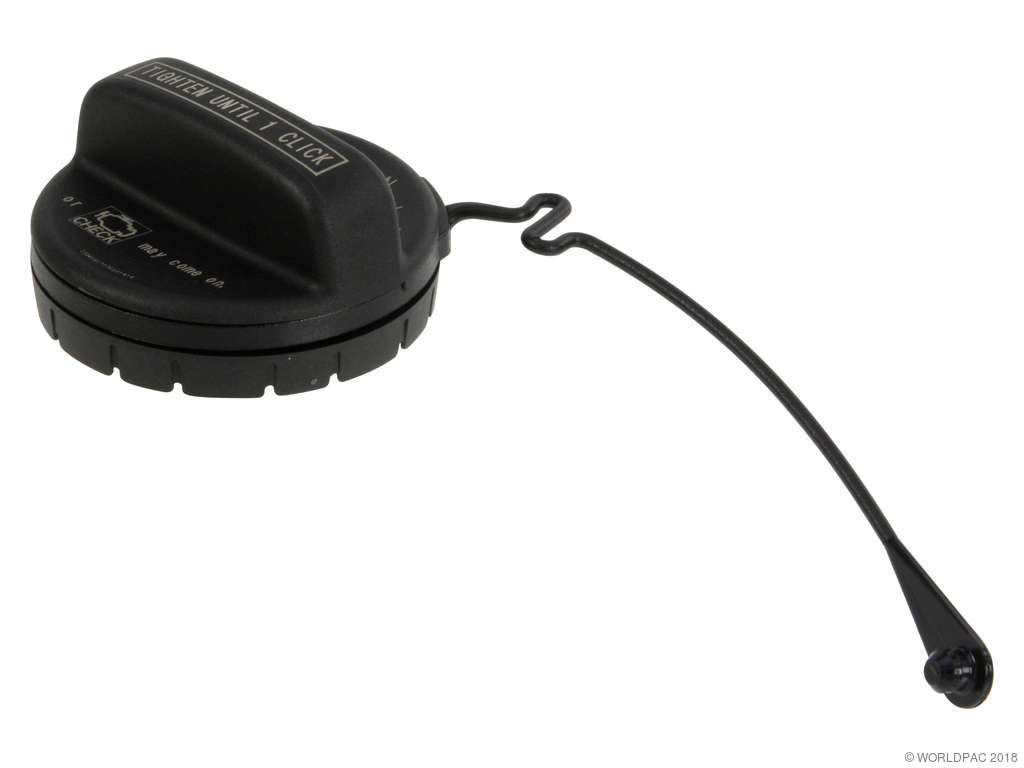
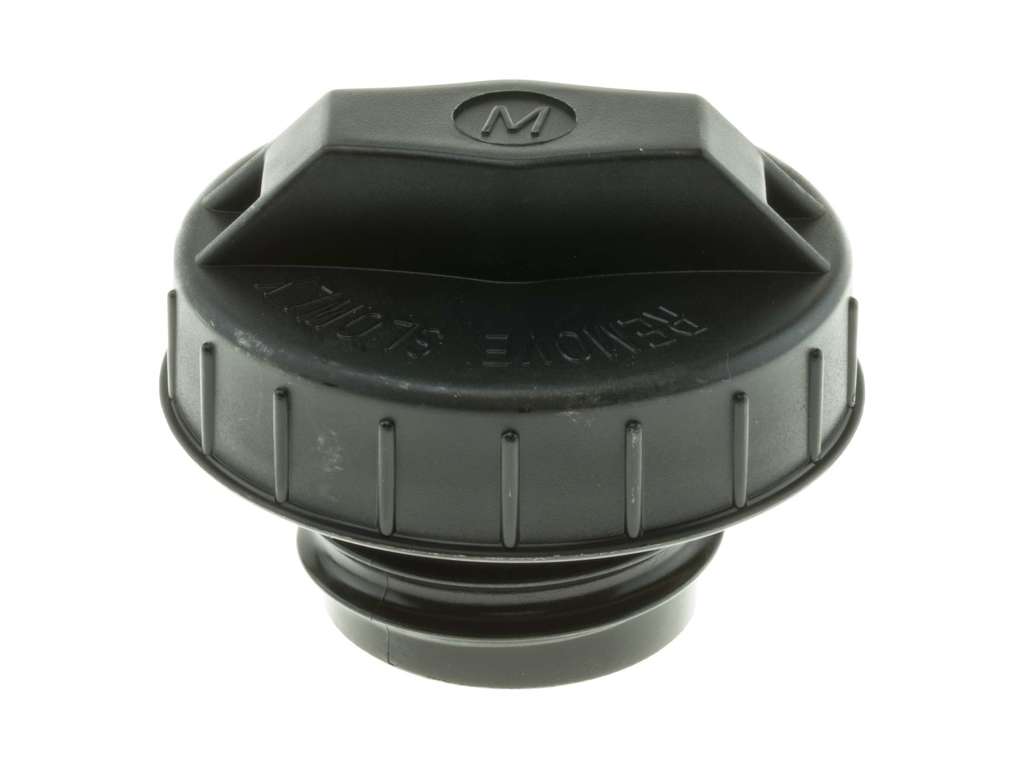
(OEM #77300-53010 (or superseded by 77300-06040))— This is the most common failure point for a P0442 code. The seal wears out over time, causing a small leak that the system detects.
Trusted brands: Lexus (OEM)
OEM price range: $25-$40
Aftermarket price range: $15-$25 - Charcoal Canister Assembly
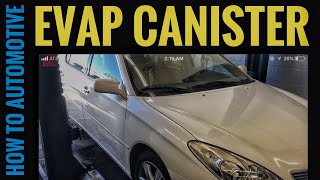
(OEM #77740-30360)— If the canister's plastic body cracks or an internal valve fails, it will cause a leak. This is a less common but significant potential cause, often found only with a smoke test. 🎬 See this walkthrough on how to replace the charcoal canister.
Trusted brands: Lexus (OEM)
OEM price range: $370-$520
Aftermarket price range: $200-$350
Technical Service Bulletins (TSBs) & Recalls
- TSIB EG002-07 / EG006-07: While not related to P0442, these TSBs exist for this vehicle generation to reflash the ECM for a rich running condition. This is an example of other software updates that may be available from a dealer.
Platform-Specific Known Issues
- Owner Experience: The Gas Cap is Almost Always the Fix: → Shop Fuel Tank Cap In a ClubLexus forum thread, a user reported a recurring P0442 code even after replacing the gas cap. After clearing the code, it returned after three weeks. After a second battery disconnect to clear the code, the light remained off for two months, suggesting that even with a new OEM cap, the system can be finicky and may require a few cycles to confirm the fix.
- Owner Experience: Inspecting Hoses: One owner on ClubLexus with a P0442 code first replaced the gas cap. When the light returned, they inspected vacuum hoses in the engine bay and under the car near the canister but found no visible cracks. This experience highlights that visual inspections may not be enough and a smoke test is often necessary for non-gas-cap related leaks.
Mechanic-Grade Diagnostic Values
- Canister Pump Module to Body Ground Resistance — expected: Below 1 Ω. Failure: 10 kΩ or higher indicates a bad ground or harness issue.
- Techstream EVAP Test - Canister and Tank Leakdown Rate — expected: Approx. 0.097 mmHg/sec. Failure: A higher value, such as 0.34 mmHg/sec, indicates a leak that will still trigger a P0456 (very small leak) and likely a P0442.
- Techstream EVAP Test - Tank Only Leakdown Rate — expected: Approx. 0.07 mmHg/sec. Failure: A significant decay rate when the canister is isolated points to a leak in the fuel tank, filler neck, or fuel pump gasket area.
Scan Tool Commands That Help
- Toyota Techstream: Evaporative System Check — This is the main utility to automatically run the entire EVAP leak test procedure. It commands valves, pulls a vacuum, and records pressure decay to identify leaks.
- Toyota Techstream: Activation Test -> Vent Valve Control — This bidirectional control allows a technician to manually close the EVAP system vent valve. This is a required step before performing a smoke test to seal the system.
- Toyota Techstream: Activation Test -> Purge VSV Control — Allows manual opening and closing of the purge valve to test its mechanical operation and to see if it's sticking, which can cause a leak.
- Toyota Techstream: Data List -> EVAP System — Used to monitor live data from the fuel tank pressure sensor to observe pressure changes during manual testing or while driving.
Wiring & Ground Locations
- A1, A2, A3 — Located at the left rear of the engine compartment.. These are primary engine bay ground points. A poor connection here could potentially affect the operation of the engine-bay-mounted Purge Valve (VSV).
- J/C A7, A8 — Located in the right kick panel area, behind the trim.. These are junction connectors for various interior and body electrical systems. While not directly tied to the EVAP system, a fault here can cause bizarre, unrelated electrical issues that could complicate diagnosis.
- Canister Pump Module Ground — The canister pump module, located near the fuel tank, has its own ground wire connected to the chassis.. A corroded or loose ground at the canister pump module can cause it to fail its self-test or operate incorrectly, leading to various EVAP codes, including P0442. The resistance should be less than 1 ohm to the chassis.
Real Owner Repair Stories
- YouTube channel 'Tuner with Kids' (2001-2005 Lexus IS300 (Same EVAP system principles apply)) — Persistent P0440 and P0442 codes.
❌ Tried (didn't work) Replacing the gas cap., Visual inspection of engine bay hoses.
✅ What actually fixed it The check valve assembly on top of the fuel tank (P/N 77390-53010) had developed a hairline crack. This part is only accessible by dropping the entire fuel tank. The crack was almost invisible but was the source of the small leak. - ClubLexus Forum (1999-2003 Lexus RX300) — P0442 code returned several months after replacing the gas cap.
❌ Tried (didn't work) Replacing the gas cap a second time.
✅ What actually fixed it The fuel filler neck itself had a leak. On older Lexus/Toyota models, the filler necks were not stainless steel and could corrode or crack over time, creating a leak path that a new gas cap cannot seal.
"I Checked Everything" — The Actual Cause
- In some cases reported on forums, a smoke test will not reveal a leak. This can happen if the leak is intermittent, such as a purge or vent valve that only sticks open under certain temperature or vacuum conditions. Another possibility is a hairline crack on a component (like the check valve on top of the fuel tank) that only opens and leaks under the specific negative pressure created by the onboard diagnostic test, not the positive pressure of a smoke test.
OEM Part Supersession History
77300-53010→77300-08010, 77300-50010 (itself replaces these)— Part consolidation and minor design updates across multiple Toyota/Lexus models.
Heads up: The pass 2 provided number 77300-06040 is a common cap for newer Toyota/Lexus models, but for the 2006-2013 IS, 77300-53010 is a more frequently cited original part. Always verify with VIN, but be aware that multiple cap designs exist and using the wrong one can cause the code.77740-30360→77740-30360— No supersession found.
Heads up: This part number appears to be consistent for the entire 2006-2013 generation and also fits other Lexus models like the GS and IS F.
Diagnostic Flowchart
Other Known Issues on This Vehicle
Issues unrelated to this code that are worth knowing about as an owner of this generation:
- Carbon Buildup on Intake Valves (IS250) 🔴 High — Very common on the IS250's 4GR-FSE direct-injection-only engine, often noticeable after 60,000 miles. Symptoms include rough idle, hesitation, and misfires. The IS350 is largely unaffected due to its dual injection system. (Ref: Lexus Customer Support Program (CSP) extended warranty to 9 years/unlimited miles for 2006-2010 models to cover engine cleaning or piston replacement.)
- Melting / Sticky Dashboard and Door Panels 🟠 Medium — Widespread issue on 2006-2008 models, especially in hot, humid climates. The dashboard and interior panels become sticky, shiny, and can crack. (Ref: Lexus Warranty Enhancement Programs (ZLD & ZLZ) were issued to cover replacement, though the primary coverage periods have expired.)
- Water Pump Failure 🟠 Medium — A common failure point, often occurring between 60,000-90,000 miles. Symptoms include a grinding/rumbling noise from the front of the engine, coolant leaks, and potential overheating.
- Sticking Rear Brake Calipers 🟡 Low — Rear brake caliper slide pins are known to seize, causing uneven pad wear and dragging brakes. (Ref: A recall was issued in some regions, but not all. Regular lubrication of the slide pins during brake service is the preventative measure.)
Used vs. New Parts: Buying Guide for This Vehicle
When a used part is the smart pick: A used charcoal canister assembly (OEM P/N 77740-30360) can be a cost-effective option, as a new OEM part is very expensive (over $450). Since it's a large plastic component with integrated valves, its failure is often due to a crack from impact or age, not wear. A used part from a dry, non-salt-belt region is a reasonable gamble.
Donor-vehicle mileage cap: roughly under 150000 miles for the part to have meaningful remaining life.
What to inspect on the donor part:
- Visually inspect the entire plastic housing for any hairline cracks, especially around mounting points and hose connections.
- Ensure all electrical connectors and hose nipples are intact and not broken or brittle.
- If possible, source from a vehicle that was not in a rear-end collision.
- Check the seller's return policy in case the part does not solve the issue.
OEM-only on this vehicle (don't cheap out):
- Fuel Tank Cap - Aftermarket gas caps are notoriously unreliable and a frequent cause of recurring P0442 codes. Always buy a genuine Lexus/Toyota OEM cap to ensure a perfect seal.
Brands owners have reported issues with on this vehicle:
- Any non-OEM gas cap brand should be avoided for this specific issue.
Real Owner Stories
Aggregated from forums and TSBs cited above. Mileages and costs reflect what owners reported in those sources.
2006-2013 Lexus IS
Symptoms: Check engine light (P0442) returned three weeks after replacing the gas cap.
What fixed it: A second battery disconnect to clear the code; the light then remained off for two months, suggesting the system is finicky with its self-tests.
Source hint: ClubLexus forum thread titled 'Got a P0442 CE light.' (2021)
2006-2013 Lexus IS
Symptoms: P0442 code present; owner replaced gas cap but the light returned.
What fixed it: The owner performed a visual inspection of vacuum hoses in the engine bay and near the canister but found no cracks, indicating a smoke test was the necessary next step.
Source hint: Vehicle Specific Issues: Owner Experience: Inspecting Hoses
2006-2013 Lexus IS
Symptoms: Check engine light code P0442.
What fixed it: Discussion suggested checking for rust on the filler neck or a sticking purge valve as secondary causes after the gas cap.
Source hint: ClubLexus.com: 'P0442 Check engine light code - Evap leak?' (2017)
Related OBD-II Codes
Frequently Asked Questions
Should I use an aftermarket gas cap to fix the P0442 code on my Lexus IS?
Does TSIB EG002-07 or EG006-07 address the P0442 EVAP leak on my 2006-2013 IS?
I replaced my gas cap but the P0442 code came back after three weeks. Is the new cap defective?
Can overfilling my gas tank cause P0442 on this vehicle?
Where is the purge valve (VSV) located on the 2nd Gen Lexus IS?
Is there a common engine issue on the IS250 I should be aware of while fixing this EVAP code?
Helpful Videos
We Have This Part in Stock


The information in this article is provided for general reference and educational purposes only. Vehicle specifications, procedures, and part compatibility can vary by production date, trim level, and region. Always consult your vehicle's factory service manual and verify part numbers before purchasing or performing repairs. Safety-critical components such as airbags, seat belts, and braking systems should be installed by a qualified professional.
- Lexus IS:
- 🧭 Diagnostic Flowchart
- 🎬 Helpful Videos
- 🛍️ Shop This Part
- What's Unique About the 2006-2013 Lexus IS
- Symptoms You May Notice
- Most Likely Causes
- Rare But Worth Checking
- Diagnosis Steps
- Parts You'll Likely Need
- Technical Service Bulletins (TSBs) & Recalls
- Platform-Specific Known Issues
- Mechanic-Grade Diagnostic Values
- Scan Tool Commands That Help
- Wiring & Ground Locations
- Real Owner Repair Stories
- "I Checked Everything" — The Actual Cause
- OEM Part Supersession History
- Other Known Issues on This Vehicle
- Used vs. New Parts: Buying Guide for This Vehicle
- Real Owner Stories
- 2006-2013 Lexus IS
- 2006-2013 Lexus IS
- 2006-2013 Lexus IS
- Related OBD-II Codes
- Frequently Asked Questions
- 🎟️ Get 5% Off