

P0442 on 2012-2024 Mazda CX-5: EVAP Small Leak Causes and Fixes
For a Mazda CX-5, the P0442 code is most often caused by a faulty canister vent valve located at the rear of the vehicle, or a simple loose gas cap. After checking the gas cap, the vent valve is the next most likely part to fail and require replacement. This is a common issue across many Mazda models.
- Always check your gas cap first. Make sure it's tight and the seal isn't cracked.
- If the gas cap is fine, the two most likely culprits are the canister vent valve (at the rear of the car) or the purge valve (in the engine bay).
- The canister vent valve is more likely to fail due to its exposure to the elements.
- If your car struggles to start only after you get gas, the purge valve is the primary suspect.
- If you can't find the leak by inspecting the main components, a professional smoke test is the most reliable way to find the source.
What's Unique About the 2012-2024 Mazda CX-5
While a loose gas cap is a common cause for P0442 on any car, Mazda vehicles, including the CX-5, appear to have a higher-than-average failure rate for the canister vent valve. This valve is located underneath the rear of the car, exposed to road debris, moisture, and salt, which can lead to its internal seals failing or the valve getting stuck. Owner forums and mechanic videos frequently point to this specific part as the culprit after the gas cap has been ruled out. The failure is so common that some owners on Mazdas247 forums report replacing it multiple times over the life of the vehicle. This trend is reflected in broader manufacturer data; for instance, TSB Bulletin #01-002-18-3417 notes that various Mazda models may experience MIL illumination with DTC P0442 stored in memory, requiring specific procedures to locate the evaporative system leak.
Generation note: The 2012-2024 year range covers two generations of the Mazda CX-5: the first generation (KE, 2012-2017) and the second generation (KF, 2017-2024). The principles of the EVAP system and the common failure points for code P0442, particularly the canister vent valve, are largely consistent across both generations and other Mazda models like the Mazda3 and Mazda5.
Symptoms You May Notice
- Check Engine Light is on
- A faint smell of fuel, particularly around the rear of the vehicle near the gas tank.
- In rare cases of a stuck-open purge valve, difficulty starting the engine immediately after refueling.
- Replacing the purge valve in the engine bay when the actual problem is the canister vent valve at the rear of the car. The vent valve's location makes it more prone to failure from the elements.
- Replacing other EVAP components without first ensuring the gas cap is an OEM part and sealing correctly.
Most Likely Causes
- Loose or Faulty Gas Cap 🔴 High Probability → Shop Fuel Tank Cap This is the most common cause on all vehicles. The cap's seal can wear out over time, or it may not have been tightened correctly after refueling. The rubber o-ring can become cracked and brittle.
How to confirm: Ensure the gas cap is tightened until it clicks at least once. Inspect the rubber O-ring on the cap for cracks, stiffness, or damage. Check the filler neck for rust or debris that could prevent a good seal. If the seal is compromised, the cap needs replacement.
Typical fix: Tighten or replace the gas cap. It is strongly recommended to use an OEM (Original Equipment Manufacturer) cap for best results, as some aftermarket caps have been reported to not seal properly.
Est. part cost: $15-$40 - Failed Canister Vent Valve (Solenoid) 🔴 High Probability → Shop Vapor Canister This valve is located under the rear of the car, exposing it to water and road grime, which causes corrosion and failure. It is a frequently cited cause for P0442 on Mazda platforms. Forum users report this part failing repeatedly over the vehicle's life.
How to confirm: The valve is located near the charcoal canister, often above the rear subframe. It is a normally open valve. To test, remove it from the vehicle. With no power applied, you should be able to blow through it. When 12 volts are applied to its terminals, it should click shut and no longer allow air to pass through. If you can still blow even a tiny amount of air through it when energized, it has failed.
Typical fix: Replace the canister vent valve assembly. Some owners have attempted cleaning the valve, but this fix is often temporary.
Est. part cost: $40-$90 - Failed Purge Valve (Solenoid) 🟡 Medium Probability → Shop Vapor Canister
How to confirm: The purge valve is located in the engine bay. It is a normally closed valve. Disconnect the valve and try to blow through it. If air passes through, the valve is stuck open and has failed. A symptom of a stuck-open purge valve is a long crank time or rough idle right after filling the gas tank.
Typical fix: Replace the purge valve.
Est. part cost: $50-$100 - Cracked or Disconnected EVAP Hoses ⚪ Low Probability
How to confirm: Visually inspect all accessible EVAP lines running from the fuel tank, to the charcoal canister, and to the purge valve in the engine bay. Look for any obvious cracks, brittle sections, or disconnected fittings. A definitive way to find a very small hose leak is with a professional smoke test, which pressurizes the system with visible smoke to pinpoint the exit point.
Typical fix: Replace the damaged section of hose or reconnect the fitting.
Est. part cost: $10-$50
Rare But Worth Checking
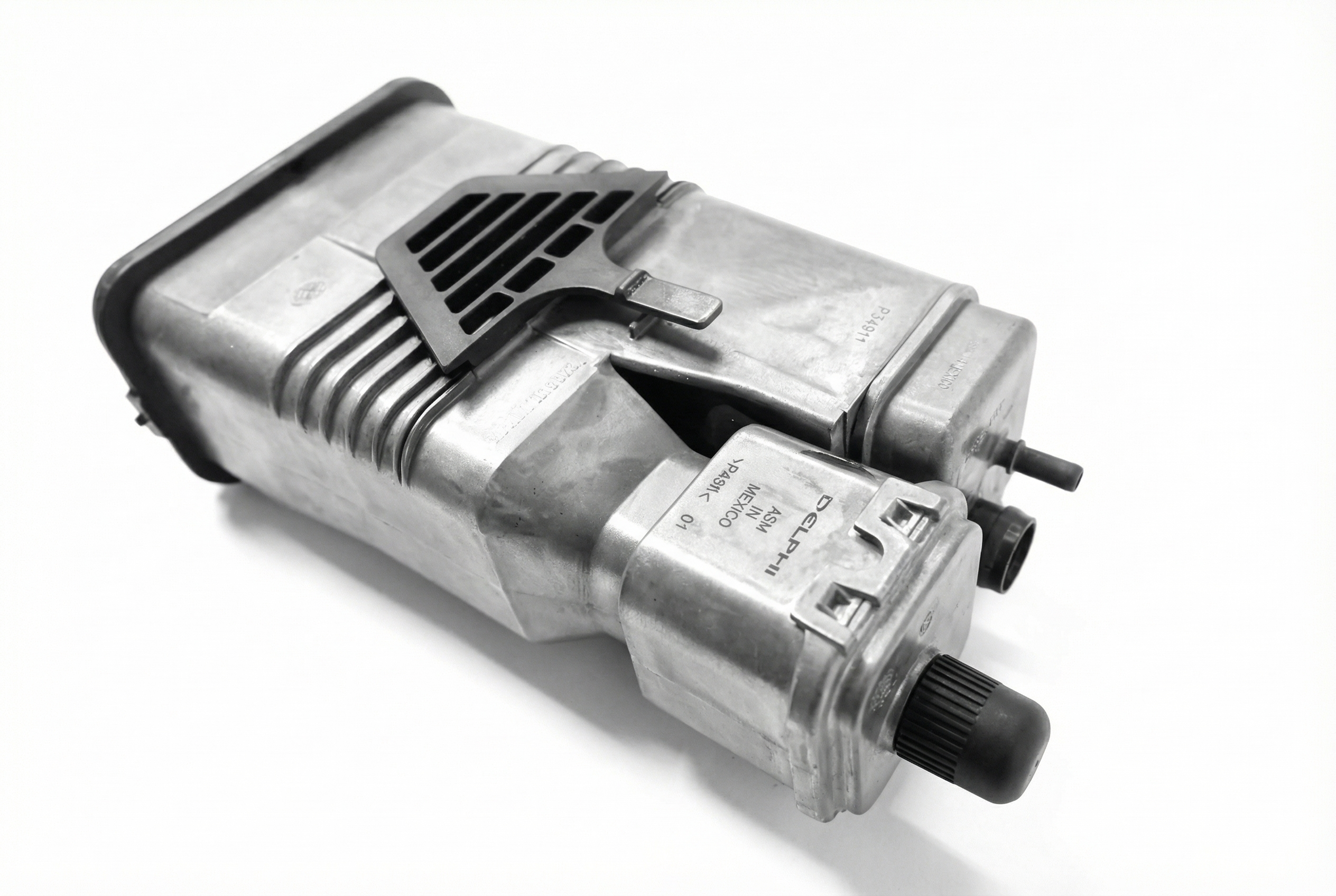
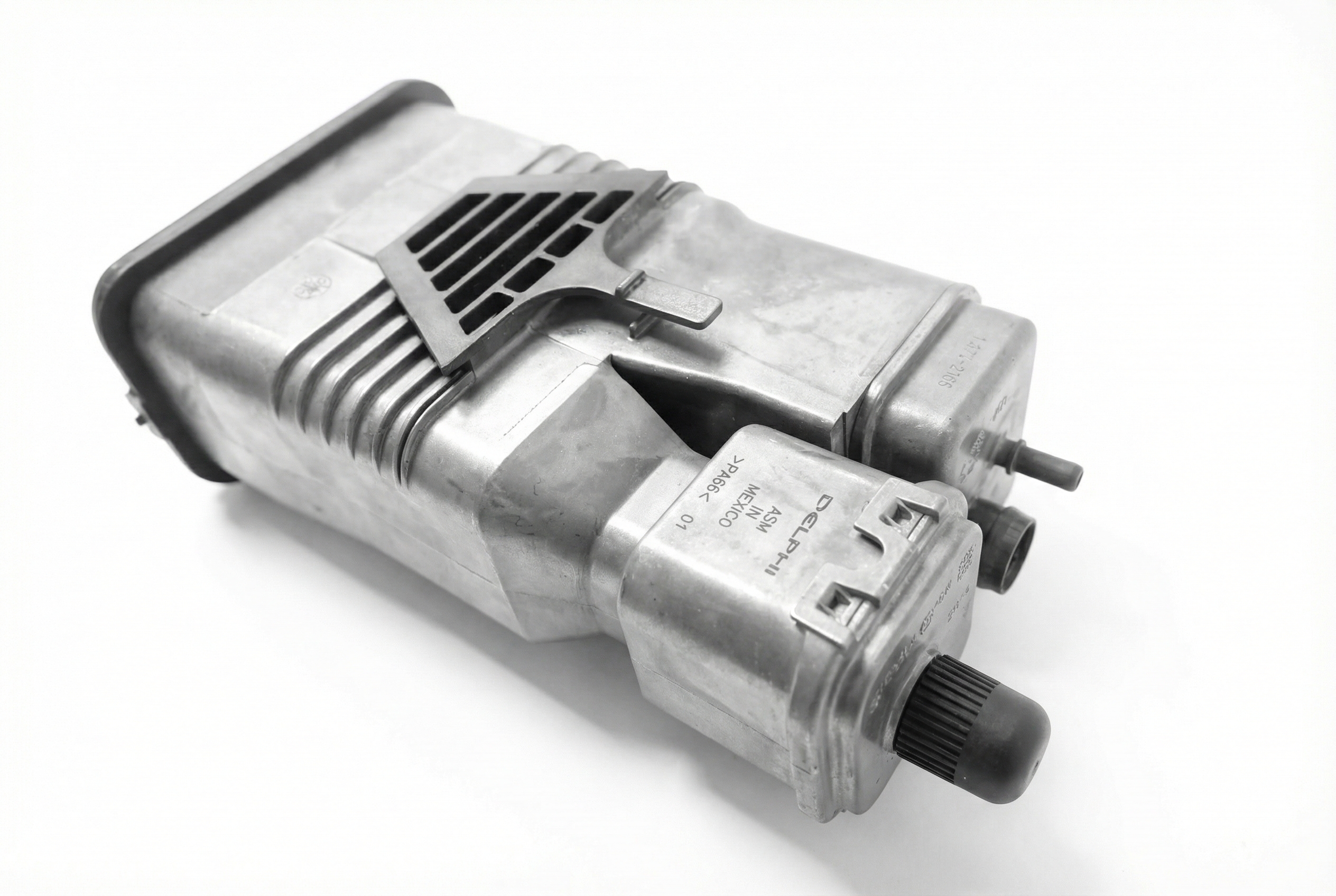
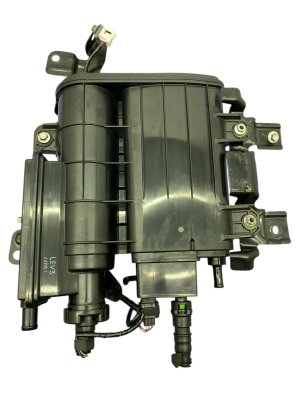
- Cracked Charcoal Canister: → Shop Vapor Canister Less common than valve failures, but the plastic body of the charcoal canister itself can develop hairline cracks over time, causing a leak.
- Leaking Fuel Pump Lock Ring: → Shop Fuel Pump On some older Mazda models like the Mazda3, a cracked fuel pump lock ring under the rear seat was a very common cause for P0442. While not as widely reported on the CX-5, it remains a possibility for a fuel smell and EVAP code. For example, NHTSA ODI #11439442 describes a failed fuel pump lock ring causing codes P0442 and P0455, accompanied by a strong smell of gasoline fumes around the rear of the car after driving.
Diagnosis Steps
- Check the Gas Cap: This is the first and easiest step. Ensure it is tight and clicks. Inspect the seal for damage. If in doubt, replace it with an OEM cap, clear the code, and drive for a few days to see if the light returns.
- Inspect for Obvious Damage: Perform a visual inspection of the EVAP hoses in the engine bay and under the vehicle near the fuel tank for any visible cracks or disconnections.
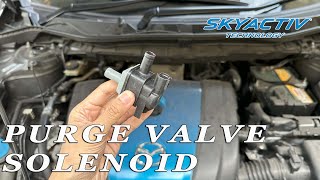
- Test the Purge Valve: Locate the purge valve in the engine bay. Disconnect it and attempt to blow air through it. If air passes, it's stuck open and needs replacement.
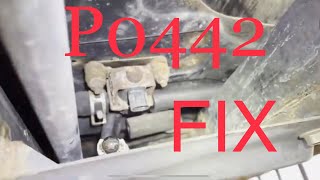
- Test the Canister Vent Valve: This is the most likely culprit after the gas cap. Locate the vent valve at the rear of the car. Remove it and test its function by applying 12V power. It should 🎬 Watch: A complete walkthrough of the P0442 diagnosis and fix. be open at rest (air passes) and closed with power (air does not pass). If it fails to close completely and allows even a small amount of air through, it needs replacement.
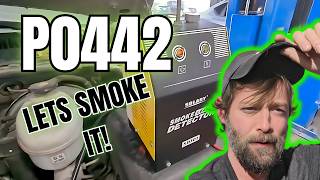
- Perform a Smoke Test: If the steps above do not reveal the leak, the most effective method is to have a professional technician perform a smoke test. This involves injecting pressurized smoke into the EVAP system to visually pinpoint the exact location of the small leak. 🎬 Watch: How to find a small EVAP leak using smoke.
Parts You'll Likely Need
- Gas Cap
(OEM #KDY5-42-250)— This is the most frequent and simplest fix. The seal wears out over time.
Trusted brands: Mazda (OEM)
OEM price range: $25-$40
Aftermarket price range: $15-$30 - Canister Vent Valve
(OEM #K031-42-930A (Note: Part numbers can vary, verify with VIN))— A very common failure point on Mazda vehicles due to its location under the rear of the car, exposed to the elements.
Trusted brands: Mazda (OEM), Dorman (e.g., 911-711), Standard Motor Products
OEM price range: $70-$120
Aftermarket price range: $40-$90 - Purge Solenoid Valve
(OEM #PE01-18-751 (Note: Part numbers can vary, verify with VIN))— This valve in the engine bay can get stuck open or closed, causing a leak or starting issues after refueling.
Trusted brands: Mazda (OEM), Bosch, Denso
OEM price range: $80-$130
Aftermarket price range: $50-$100
Related Codes That Often Appear With This One
- P0456 — P0456 indicates a 'Very Small Leak'. It's common to see it alongside P0442 as the computer may detect leaks of slightly different sizes during different tests, but both point to the same set of potential failures in the EVAP system.
- P0455 — P0455 indicates a 'Large Leak'. While less common to see with P0442, it can appear if a component fails intermittently, sometimes creating a small leak and other times a large one (e.g., a valve sticking open or a very bad gas cap seal).
Mechanic-Grade Diagnostic Values
- Purge Valve / Vent Valve Solenoid Coil Resistance — expected: 15 to 30 Ohms. Failure: A reading outside of this range indicates a faulty solenoid winding.
- Fuel Tank Pressure (FTP) Sensor Voltage — expected: Voltage should change when pressure is applied to the charcoal canister during a bench test.. Failure: If the voltage does not change when pressure is applied, the sensor (which is integrated with the canister) is faulty.
Scan Tool Commands That Help
- Mazda IDS, FORScan, or other advanced scan tool: EVAP System Leak Test / Canister Vent (CV) Solenoid Command — This bidirectional command is used to manually close the normally-open canister vent valve. This is a critical step before performing a smoke test, as it seals the system. If the valve is not commanded shut, smoke will simply exit through the vent, making the test useless.
- Mazda IDS, FORScan, or other advanced scan tool: Purge Solenoid Valve (PSV) Command — This command allows the technician to cycle the normally-closed purge valve on and off. While listening for an audible click is a basic test, this command allows for functional testing, such as checking if the valve is drawing the correct amperage or if it is sealing properly under vacuum when commanded closed.
Wiring & Ground Locations
- Canister Vent Valve Connector — At the rear of the vehicle, near the charcoal canister, often above the rear subframe.. This connector and its wiring are exposed to road debris and moisture, making them susceptible to corrosion or damage that can cause an open or shorted circuit for the vent valve, preventing it from closing and sealing the system for a leak test.
- Purge Valve Connector — In the engine bay, typically near the intake manifold.. A poor connection at the purge valve can prevent it from operating correctly, though it's less likely to cause a P0442 (small leak) than a mechanical failure of the valve itself.
Real Owner Repair Stories
- Mazdas247.com user 'dougsey' (2012 Mazda 5 (shares EVAP components with CX-5) with 109k miles) — Check Engine Light with code P0442.
❌ Tried (didn't work) Checking the gas cap (was not the issue).
✅ What actually fixed it The canister vent solenoid was the culprit. The user removed the original valve and tested it by applying 12V. Although it clicked, a tiny amount of air could still be blown through it when it should have been fully closed. Replacing the valve with a Dorman 911-711 part resolved the code. - Mazdas247.com user 'DC87' (2014 Mazda 5 with 107k miles) — P0442 code and difficulty starting after refueling.
❌ Tried (didn't work) Replacing the purge valve and vent valve., Replacing the gas cap.
✅ What actually fixed it The user found that the screw clamps on the engine's air intake hose were loose. After tightening the clamps and clearing the code, the starting issues and the P0442 code were resolved. This is an unusual fix, suggesting a vacuum leak was somehow influencing the EVAP test parameters. - NHTSA ODI #11187055 — An owner reported that their vehicle could not pass inspection because code P0442 kept appearing, noting it as a common problem with Mazda cars that the manufacturer needs to correct.
Model Year Variations Within This Range
- 2012-2017: This is the first generation, known by the chassis code 'KE'. It was initially launched with a 2.0L engine, with a more powerful 2.5L engine becoming available in 2014. The fundamental EVAP system design is consistent.
- 2017-2024: This is the second generation, known by the chassis code 'KF'. While it was a major redesign, the core principles of the Skyactiv-G engines and their emissions systems, including the EVAP system, remained very similar to the late first generation. Part numbers for common failure items like the purge and vent valves are often shared or are direct supersessions across both generations. A turbocharged engine was added in 2019, but its basic EVAP components are largely the same.
Diagnostic Flowchart
Other Known Issues on This Vehicle
Issues unrelated to this code that are worth knowing about as an owner of this generation:
- LED Daytime Running Light (DRL) Failure 🟠 Medium — Very common on the 2016 model year, but reported on others. The sealing gasket for the DRL wiring corrodes the circuit, causing flickering and eventual failure. (Ref: NHTSA Recall 20V063000 (for 2016 model year).)
- Infotainment 'Ghost Touch' 🟡 Low — Common on first-generation (KE) and early second-generation (KF) models. The touchscreen registers phantom inputs, causing random selections. Many owners fix this by disconnecting the touchscreen ribbon cable, relying solely on the commander knob. (Ref: Mazda issued a warranty extension for this issue on some models (e.g., SSPB6 for Mazda3), but not officially for all CX-5s.)
- Excessive Oil Consumption (2.5T & some NA) 🔴 High — Affects certain 2021+ models with 2.5L Turbo and some non-turbo engines. Caused by faulty exhaust valve stem seals, leading to low oil levels between changes. (Ref: Mazda TSB 01-011/22 describes the issue and repair procedure, which involves replacing the valve seals.)
- Carbon Buildup on Intake Valves (Skyactiv-G) 🟠 Medium — A known issue for all gasoline direct injection (GDI) engines, including Mazda's Skyactiv-G. Oil vapor from the PCV system bakes onto the intake valves. Can cause performance loss over time, typically after 60,000+ miles.
- Spontaneously Cracking Windshields 🟡 Low — A number of owner complaints, particularly for 2014-2017 models, describe windshields cracking without any apparent impact.
- Failure to Fully Shut Off 🟠 Medium — Primarily reported on 2013-2014 models. The engine turns off, but accessory power remains on, leading to a drained battery.
Used vs. New Parts: Buying Guide for This Vehicle
When a used part is the smart pick: For a major, expensive component like the charcoal canister assembly, a used part from a low-mileage, non-corroded donor vehicle can be a cost-effective option, especially since the fuel tank pressure sensor is often integrated into it. A used fuel filler neck from a dry-climate vehicle can also be a good choice if yours is rusted.
Donor-vehicle mileage cap: roughly under 75000 miles for the part to have meaningful remaining life.
What to inspect on the donor part:
- For canisters: Check for any visible cracks in the plastic housing.
- For filler necks: Ensure the sealing surface is perfectly smooth, with no rust, pitting, or warping.
- For any part: Look for a donor vehicle from a dry, southern climate to minimize the risk of corrosion-related failures.
OEM-only on this vehicle (don't cheap out):
- Gas Cap: This is the most critical sealing point and the most common cause of P0442. Forum and mechanic consensus strongly advises against aftermarket gas caps, which are known to cause sealing issues. Always use a genuine Mazda OEM cap.
Aftermarket brands forum-validated for this vehicle:
- Dorman (for Canister Vent Valve, e.g., 911-711): Frequently cited in forums as a reliable and cost-effective alternative to the OEM part.
- Standard Motor Products (for valves/solenoids): Generally considered a reputable OE-quality supplier.
Brands owners have reported issues with on this vehicle:
- No-name, unbranded gas caps from online marketplaces.
Real Owner Stories
Aggregated from forums and TSBs cited above. Mileages and costs reflect what owners reported in those sources.
2012 Mazda 5
Symptoms: P0442 Evap Leak code. Upon testing the old valve, it leaked a tiny amount of air through it in the closed position.
What fixed it: Replacement of the canister vent solenoid.
Source hint: Mazdas247.com: In a thread titled 'P0442 Evap Leak - Solved'
2014 Mazda 5
Symptoms: P0442 code present; owner confirmed the same failure mode as other Mazda platform users.
What fixed it: Replacement of the canister vent solenoid.
Source hint: Mazdas247.com: In a thread titled 'P0442 Evap Leak - Solved'
2012 Mazda 5
Symptoms: The P0442 and P0456 codes returned 4 years after the initial repair.
What fixed it: Replacing the vent solenoid again (recurring failure).
Source hint: Mazdas247.com: In a continuation of the same thread, page 2
Mazda CX-5
Symptoms: P0442 and P0456 engine codes along with a gas smell at the back of the vehicle.
What fixed it: The community suggested checking the gas cap first, then the vent or purge valves.
Source hint: Reddit r/CX5: A user with P0442 and P0456 codes reported a gas smell at the back of their CX-5
Related OBD-II Codes
Frequently Asked Questions
Is there a specific recall for my 2016 Mazda CX-5 that might be related to electrical issues or lights?
I have a P0442 on my CX-5 and smell gas near the rear; what is the most likely culprit?
Should I use an aftermarket gas cap to fix my P0442 code?
My CX-5 has trouble starting only after I fill up the gas tank. Is this related to P0442?
Is there a known issue with oil consumption on newer CX-5 models?
How can I test if the canister vent valve on my CX-5 has failed?
Helpful Videos
We Have This Part in Stock

The information in this article is provided for general reference and educational purposes only. Vehicle specifications, procedures, and part compatibility can vary by production date, trim level, and region. Always consult your vehicle's factory service manual and verify part numbers before purchasing or performing repairs. Safety-critical components such as airbags, seat belts, and braking systems should be installed by a qualified professional.
- Mazda CX-5:
- 🧭 Diagnostic Flowchart
- 🎬 Helpful Videos
- 🛍️ Shop This Part
- What's Unique About the 2012-2024 Mazda CX-5
- Symptoms You May Notice
- Most Likely Causes
- Rare But Worth Checking
- Diagnosis Steps
- Parts You'll Likely Need
- Related Codes That Often Appear With This One
- Mechanic-Grade Diagnostic Values
- Scan Tool Commands That Help
- Wiring & Ground Locations
- Real Owner Repair Stories
- Model Year Variations Within This Range
- Other Known Issues on This Vehicle
- Used vs. New Parts: Buying Guide for This Vehicle
- Real Owner Stories
- 2012 Mazda 5
- 2014 Mazda 5
- 2012 Mazda 5
- Mazda CX-5
- Related OBD-II Codes
- Frequently Asked Questions
- 🎟️ Get 5% Off