

P0442 on 2002-2008 Subaru Forester: EVAP Small Leak Causes and Fixes
On a 2002-2008 Subaru Forester, the P0442 code is most often caused by a rusted fuel filler neck, a very common issue for this generation. Before buying parts, check that the gas cap is tight. If the cap is fine, inspect the filler neck behind the right rear wheel for rust, as this is the most probable cause after the gas cap.
- For a P0442 on a 2002-2008 Forester, always check the gas cap first. Ensure it's tight and the seal is intact.
- The most likely cause on this specific vehicle is a rusted-out fuel filler neck. Inspect it thoroughly by removing the right rear wheel and splash guard.
- If the cap and filler neck are good, other causes include cracked EVAP hoses or a faulty purge valve.
- A smoke test is the most effective professional method to find the exact location of a hard-to-see leak.
- This code will cause an automatic failure on an emissions test, so it must be resolved to pass inspection.
What's Unique About the 2002-2008 Subaru Forester
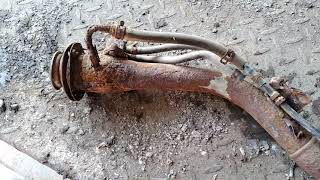
While any car can get a P0442 from a loose gas cap, the second-generation (SG) Forester and other Subarus from this era are particularly known for a specific failure: a rusted fuel filler neck. This metal pipe, which connects the gas cap to the fuel tank, is highly susceptible to corrosion, especially in regions that use road salt. Debris and moisture get trapped behind the plastic wheel well liner, causing the pipe to rust from the outside in, creating pinholes that trigger the P0442 code. This issue is so common that many owners and mechanics consider it the primary suspect after the gas cap has been ruled out.
Generation note: This range covers the last year of the first generation (SF, 2002) and the entire second generation (SG, 2003-2008). The most common cause, a rusted fuel filler neck, is a well-documented issue for the SG generation but can also affect the 2002 model and other Subarus of this era, including the Impreza.
Symptoms You May Notice
- Check Engine Light is on.
- A faint smell of fuel, possibly more noticeable after filling the tank or near the rear of the vehicle.
- Difficulty starting the engine immediately after refueling (this often points specifically to a faulty purge control valve that is stuck open).
- Cruise control may be disabled.
- Replacing the gas cap repeatedly when the actual problem is a rusted filler neck. Many owners replace the cap first, only to have the code return because the neck itself is perforated or the sealing surface is too rusty for even a new cap to seal.
Most Likely Causes
- Rusted Fuel Filler Neck 🔴 High Probability → Shop Fuel Filler Neck These models are known for poor corrosion resistance on the filler neck, especially in areas with road salt. Moisture and debris get trapped by the plastic splash shield, accelerating rust.
How to confirm: Remove the right rear wheel and the plastic splash guard. Visually inspect the entire metal filler neck for flaking rust, bubbling paint, or obvious holes. The bolts holding the shield may be rusted and break during removal. A smoke test will show smoke billowing from the rusted sections.
Typical fix: The filler neck must be replaced. 🎬 Watch: Step-by-step guide to replacing your rusted filler neck. It is often recommended to replace the associated shutoff valve and any connected small rubber hoses at the same time, as they may be brittle or difficult to transfer to the new pipe. The job can take 1-2 hours.
Est. part cost: $100-$250 - Loose or Faulty Gas Cap 🟡 Medium Probability → Shop Fuel Tank Cap
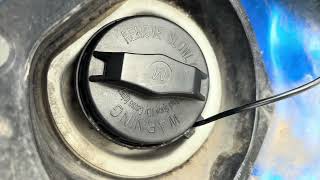
How to confirm: Ensure the cap is tightened until it clicks multiple times. If the code returns, inspect the cap's rubber O-ring for cracks, brittleness, or deformation. A worn seal will not hold pressure. Also, check the rim of the filler neck where the cap seals for any rust or debris that could prevent a proper seal.
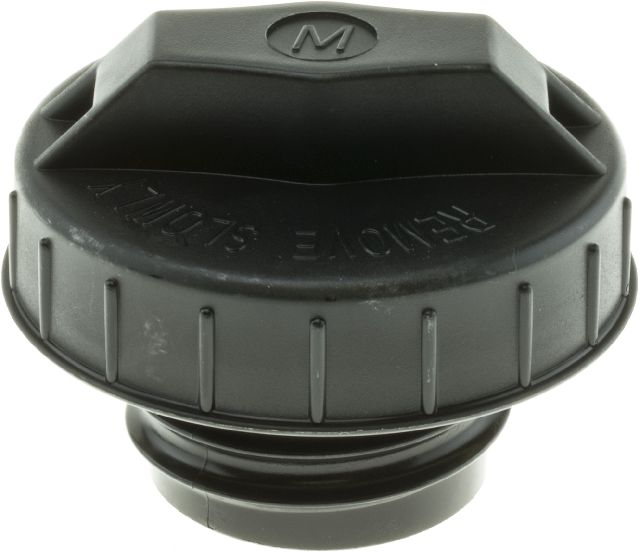
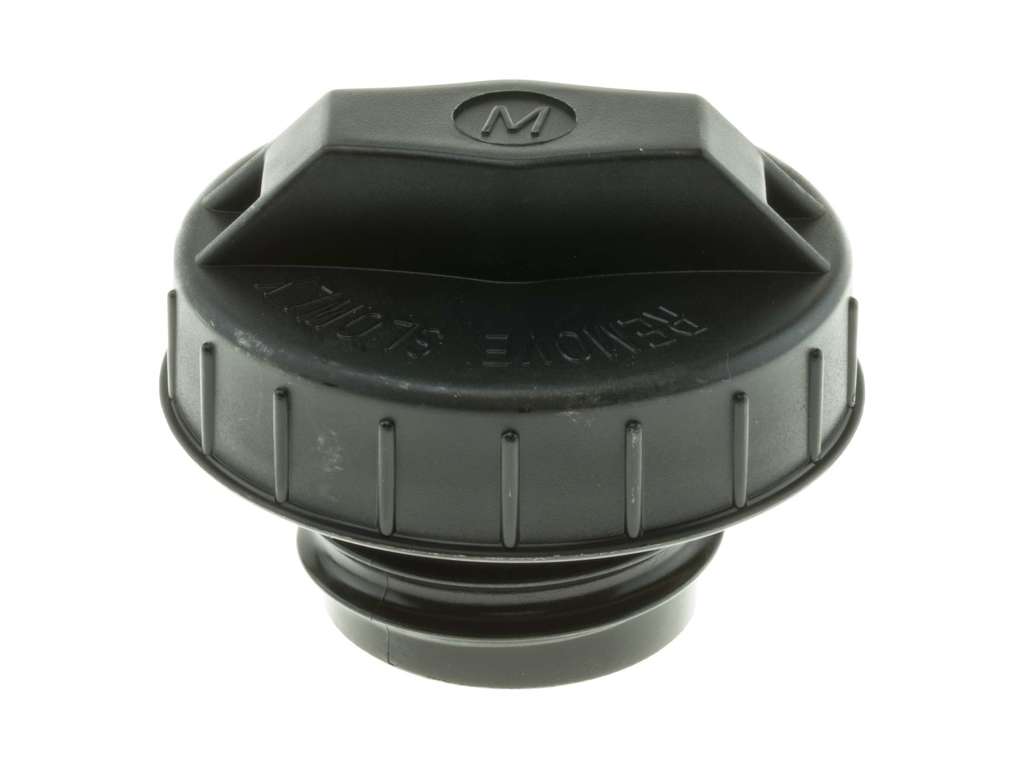
Typical fix: Replace the gas cap. Using an OEM (Original Equipment Manufacturer) cap is highly recommended as some aftermarket caps (like Stant) may not seal correctly and can cause the code to persist.
Est. part cost: $15-$40 - Cracked or Brittle EVAP Hoses 🟡 Medium Probability Over time, rubber hoses in the engine bay and under the car are exposed to heat and the elements, causing them to dry out and crack. A common failure point is the short hose running from the intake manifold to the purge solenoid.
How to confirm: Visually inspect all accessible EVAP hoses, particularly the small ones in the engine bay near the intake manifold and the larger ones around the charcoal canister at the rear of the vehicle. A smoke test is the most effective way to find a small hose leak.
Typical fix: Replace the cracked section of hose. This is often an inexpensive fix if the leak is accessible.
Est. part cost: $5-$30 - Faulty Purge Control Solenoid Valve ⚪ Low Probability → Shop Vapor Canister Purge Solenoid
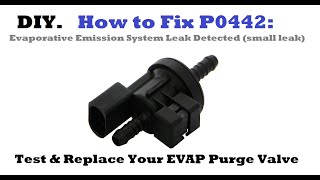
How to confirm: This valve is located in the engine bay, typically on top of the intake manifold. If it's stuck open, it can cause a leak code and often leads to difficulty starting after refueling. To test, remove the valve. It should be normally closed; if you can blow through it, it's bad. You can also apply 12V power to it and listen for a click.
Typical fix: Replace the purge control solenoid valve. This is a quick repair, often taking less than 20 minutes.
Est. part cost: $40-$90 - Faulty Vent Valve or Charcoal Canister ⚪ Low Probability → Shop Vapor Canister
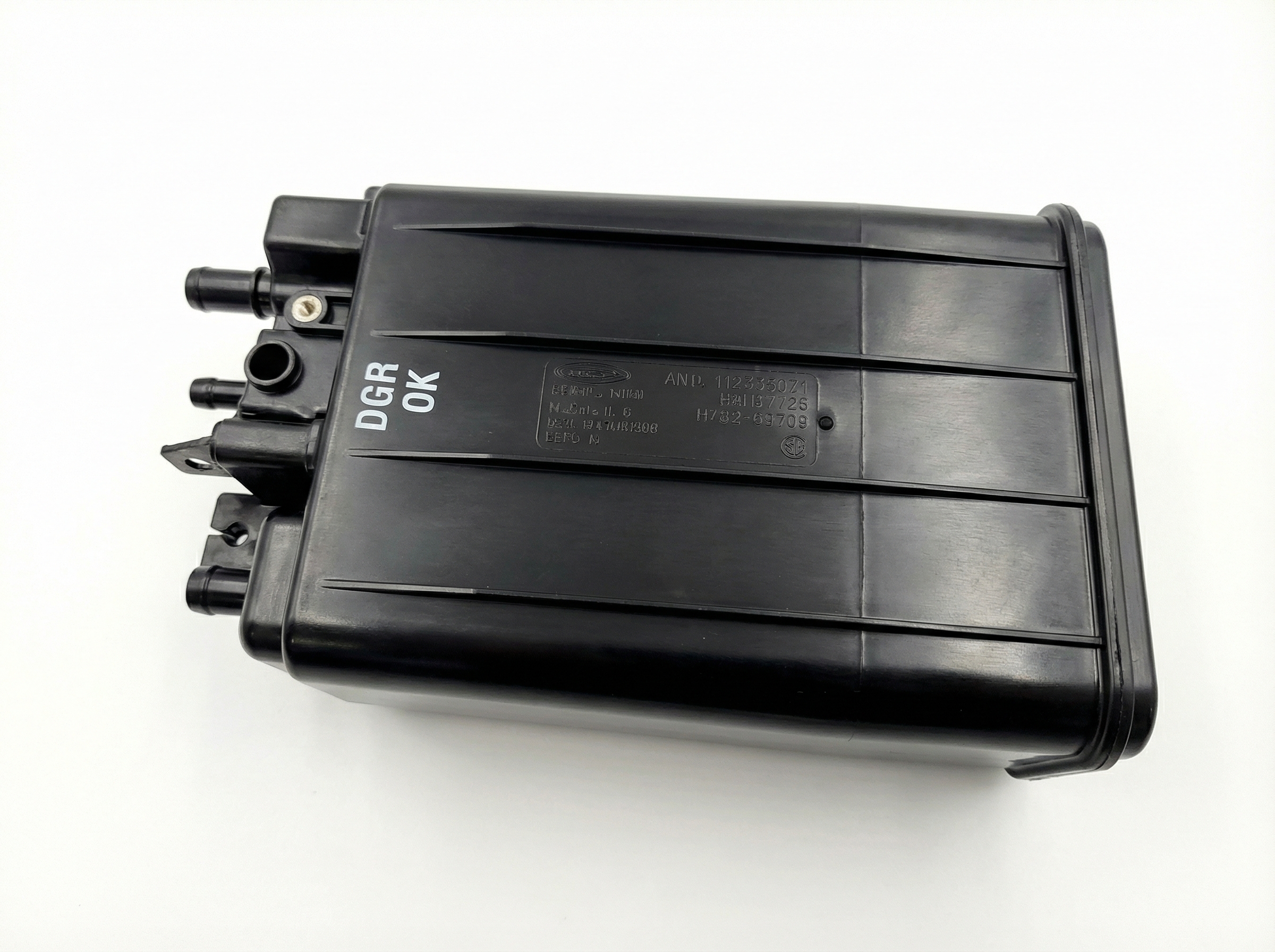
How to confirm: The vent valve is part of the charcoal canister assembly at the rear of the car, near the right rear tire. It can get stuck open due to dirt or internal failure, or the canister itself can crack. A smoke test will often reveal leaks in this area. The valve can be tested by applying 12V power; it should close and not allow air to pass through.
Typical fix: Replace the vent valve or the entire charcoal canister assembly if it is cracked or internally damaged.
Est. part cost: $150-$300
Rare But Worth Checking
- Leaking Fuel Pump Gasket: → Shop Fuel Pump If the fuel pump has recently been serviced, the large gasket under the access plate (beneath the rear seat/cargo floor) may not have sealed correctly. Rust on the tank's sealing surface can prevent a new gasket from sealing properly, leading to a leak detectable by a smoke test.
- Cracked fittings on top of the fuel tank: → Shop Fuel Tank In rare cases, plastic valve fittings on the top of the fuel tank can crack with age. This is very difficult to diagnose and repair as it requires dropping the entire fuel tank assembly for access.
- Corroded Fuel Tank Seams: → Shop Fuel Tank While less common than the filler neck, the fuel tank itself can develop leaks. NHTSA ODI #11535637 describes a situation where a vehicle developed a strong gas smell and leaked fuel when driven on an incline; the owner noted that steel tanks can rust where the seam of the tank is located, triggering a P0442 code.
Diagnosis Steps
- Read the code with an OBD-II scanner to confirm P0442 is present.
- Check the gas cap. Remove it, inspect the seal for damage, and retighten it until it clicks at least three times. Clear the code and drive for a few days to see if it returns.
- If the code comes back, perform a visual inspection. Safely raise the rear of the vehicle and remove the right rear wheel.
- Remove the 10mm bolts holding the plastic splash shield in the wheel well. Be prepared for these bolts to be rusty and potentially break.
- Thoroughly inspect the fuel filler neck for signs of rust, bubbling paint, or pinholes. Pay close attention to the areas where brackets are welded to the pipe and the underside of the pipe.
- While under the car, inspect the charcoal canister (located near the fuel tank) and all connected rubber hoses for visible cracks or damage.
- Move to the engine bay and inspect the small vacuum and EVAP hoses for cracks, especially the one running from the intake manifold to the purge solenoid.
- If no visual faults are found, the most reliable method to find the leak is a professional smoke test. A machine fills the EVAP system with a harmless, visible smoke, and the leak is identified wherever the smoke escapes. 🎬 See how a smoke test identifies leaks on this Subaru.
Parts You'll Likely Need
- Fuel Filler Neck
(OEM #42066AE03A (2002), FNSUB-02 (aftermarket for 03-04), 42075SA150 (2005-2008))— This is the most common failure point on 2002-2008 Foresters that causes a P0442 code, due to a design prone to rusting.
Trusted brands: Spectra Premium (FN600, FN669), Dorman (573-046), Subaru (OEM)
OEM price range: $200-$300
Aftermarket price range: $100-$180 - Fuel Cap
(OEM #42038AE01B)— A worn-out gas cap seal is a common cause for EVAP leaks on any vehicle and is the easiest part to replace first. An OEM cap is strongly recommended.
Trusted brands: Subaru (OEM), Stant, Gates
OEM price range: $25-$40
Aftermarket price range: $15-$25 - Canister Purge Solenoid / Valve
(OEM #16102AA300)— Can fail by sticking open or closed, causing a leak code and sometimes issues with starting after refueling.
Trusted brands: Denso, Bosch, Subaru (OEM)
OEM price range: $70-$120
Aftermarket price range: $40-$90
Related Codes That Often Appear With This One
- P0457 — This code specifically means 'EVAP System Leak Detected (Fuel Filler Cap Loose/Off)'. It is often triggered by the exact same causes as P0442, such as a bad cap or a rusted filler neck that prevents the cap from sealing.
- P0455 — This indicates a 'Large EVAP Leak'. A small crack in a hose or filler neck that triggers P0442 can worsen over time, eventually becoming large enough to trigger P0455.
- P0456 — This indicates a 'Very Small EVAP Leak'. It is closely related and can be caused by the same components, just a smaller leak path.
Platform-Specific Known Issues
- The fuel filler neck on this generation Forester is highly prone to rusting through, especially in states that use road salt. This is the number one vehicle-specific issue related to code P0442.
- A Reddit user on r/SubaruForester confirmed that replacing a faulty purge valve solenoid fixed both their P0442 code and a persistent issue
Mechanic-Grade Diagnostic Values
- EVAP Vent Valve Solenoid Coil Resistance — expected: 30 - 50 Ohms. Failure: A reading outside this range, such as 25-26 Ohms, is considered out of spec and warrants replacement, even if the valve seems to function.
- EVAP Purge Control Solenoid Valve Resistance — expected: Generally 15 - 30 Ohms for many vehicles, but should be verified for the specific part.. Failure: A reading significantly outside the expected range indicates an internal electrical fault in the solenoid.
Scan Tool Commands That Help
- Subaru Select Monitor (SSM): Evaporative System Leak Test — This is a dealer-level function used to initiate the vehicle's self-test for the EVAP system on command, rather than waiting for the drive cycle to complete. It pressurizes or pulls a vacuum on the system to check for leaks. The tool can also be used to command the vent and purge solenoids to close during a smoke test.
Wiring & Ground Locations
- GE (or GE-1) — Located on the right rear of the engine or left rear of the engine.. This is a primary engine ground. A poor connection here can cause erratic behavior in various engine sensors and solenoids, including those in the EVAP system.
- GB-3 — Located at the right kick panel.. This is a body ground point. The Engine Control Module (ECM), which controls the EVAP system, is located under the right side of the dash and relies on good chassis grounds in this area.
- Shield & Sensor Ground Joint Connector — Located under the right side of the dash, near the ECM.. This connector is critical for providing a clean ground reference for various sensors, including potentially the Fuel Tank Pressure sensor. Issues here can cause incorrect sensor readings, leading to false codes.
- ECU Ground — The ECU grounds through the intake manifold.. The entire engine control system, which makes the decision to set code P0442, relies on a solid ground path from the intake manifold to the chassis and battery. A compromised ground here can cause a wide range of phantom electrical issues.
Real Owner Repair Stories
- MrSubaru1387 on YouTube (2006 Subaru Forester) — P0442 small EVAP leak code.
❌ Tried (didn't work) Initial smoke test suggested a leak near the fuel pump module., Replaced the fuel pump module gasket, as it was old and had been disturbed during a recent fuel pump replacement. The code returned.
✅ What actually fixed it A second, more thorough smoke test revealed smoke originating from the top of the fuel tank itself, not the filler neck or canister area. The leak was from one of the plastic valve fittings on top of the tank, which had cracked with age. This is a major repair requiring the fuel tank to be dropped for access. - NHTSA ODI #11535637 — An owner reported a P0442 "evap leak small" code accompanied by a strong gas smell and gasoline leaking when the vehicle was driven on an incline. The owner noted that the steel tank appeared to be rusting at the seam.
"I Checked Everything" — The Actual Cause
- A faulty Fuel Tank Pressure (FTP) sensor can send incorrect readings to the ECM, making the computer believe there is a leak when the system is perfectly sealed. If a thorough smoke test reveals no leaks, and all valves test okay, the FTP sensor itself becomes a primary suspect. This is often missed because technicians are trained to hunt for physical leaks.
OEM Part Supersession History
42075SA030 (approx. 2003-2004)→42075SA150 (approx. 2005-2008)— Model year update/facelift. The parts are physically different and not interchangeable.
Heads up: The fuel filler neck for 2003-2004 models is different from the 2005-2008 models. It is critical to order the correct part for the specific model year.
Model Year Variations Within This Range
- 2002: The 2002 Forester is the final year of the first generation (SF). While it shares the P0442 problem, its fuel filler neck (OEM P/N 42066AE03A) and some EVAP components are different from the second generation (SG) 2003-2008 models.
- 2003-2004 vs 2005-2008: There was a facelift in 2006, but the key part change for this issue occurred for the 2005 model year. The fuel filler neck part number changed from one used in 2003-2004 to a new one for 2005-2008, indicating a design change.
- 2006-2008: Non-turbo engines received the Active Valve Lift System (AVLS) starting in 2006, which changed some engine bay component layouts, but the fundamental EVAP system causes for P0442 remained the same.
Diagnostic Flowchart
Other Known Issues on This Vehicle
Issues unrelated to this code that are worth knowing about as an owner of this generation:
- Head Gasket Failure 🔴 High — Very common on naturally aspirated 2.5L EJ25 engines, typically occurring between 100k-150k miles. The 2003+ models received an improved multi-layer steel (MLS) gasket but are still prone to external oil and coolant leaks. Turbo (XT) models are less affected as they used MLS gaskets from the start.
- Rear Wheel Bearing Failure 🟠 Medium — Premature failure of rear wheel bearings is a widely reported issue, often starting as a humming or roaring noise from the rear of the car that changes with speed. Onset can be as early as 60k miles but is common around 80k-120k miles.
- AVCS Solenoid / Oil Pressure Switch Leaks 🟡 Low — The oil control solenoids (for AVCS) or the oil pressure switch, located on the cylinder heads, can develop leaks. Oil can seep from the sensor/solenoid body itself or from its gasket. In some cases, oil can wick through the electrical connector into the wiring harness. (Ref: 02-170-17R (for later FA/FB engines, but demonstrates the wicking issue))
- Timing Belt Maintenance 🔴 High — The EJ25 is an interference engine. The timing belt has a replacement interval of 105,000 miles. If it breaks, catastrophic engine damage will occur. It is critical to replace the belt, tensioner, and idler pulleys at the recommended interval.
- Split Inner CV Boots 🟡 Low — The inner CV joint boots on the front axles are prone to splitting, which allows grease to escape and dirt to enter, eventually destroying the CV joint if not addressed. This is often found during routine maintenance.
Used vs. New Parts: Buying Guide for This Vehicle
When a used part is the smart pick: For this repair, a used fuel filler neck from a donor vehicle in a dry, salt-free climate (e.g., Arizona, California) can be a very smart buy. The failure mode is almost always external rust, so a part from a dry climate will likely have a long remaining life. Used solenoids and canisters are generally not recommended due to unknown history and internal wear.
Donor-vehicle mileage cap: roughly under 150000 miles for the part to have meaningful remaining life.
What to inspect on the donor part:
- For a fuel filler neck, demand clear photos of the entire pipe, especially the mounting brackets and the area that sits behind the splash shield.
- There should be no bubbling paint, flaking, or visible rust pitting. Original paint should still be intact.
- Confirm the donor vehicle's location/history to ensure it's from a rust-free region.
OEM-only on this vehicle (don't cheap out):
- Fuel Cap: This is the most critical part to buy OEM. Aftermarket caps, even from reputable brands like Stant, are notorious in Subaru forums for not sealing correctly and causing the P0442 code to persist or return.
Aftermarket brands forum-validated for this vehicle:
- Fuel Filler Neck: Spectra Premium and Dorman are widely available aftermarket options that owners have used successfully.
- Purge/Vent Solenoids: Denso (often the OEM supplier), Standard Motor Products (SMP), and Bosch are considered reliable aftermarket choices.
Brands owners have reported issues with on this vehicle:
- Generic/unbranded fuel caps from online marketplaces are a common source of recurring P0442 issues.
Real Owner Stories
Aggregated from forums and TSBs cited above. Mileages and costs reflect what owners reported in those sources.
2007 Subaru Forester
Symptoms: P0442 code and a persistent issue with the car being hard to start immediately after refueling.
What fixed it: Replacing the canister purge valve located in the engine bay.
Source hint: reddit.com/r/SubaruForester user report
2003-2008 Subaru Forester
Symptoms: P0442 code; found the fuel filler neck was rusted through behind the plastic shield.
What fixed it: Replacement of the fuel filler neck, associated shutoff valve, and small rubber hoses.
Source hint: blingstrom.com/subaru-fuel-filler-neck-replacement-03-08-forester
Pre-2009 Subaru Forester
Symptoms: EVAP codes caused by a rusted filler neck in a salt-belt state.
What fixed it: Replacing the rusted filler neck and the associated valve at the same time.
Source hint: reddit.com/r/subaru thread titled 'rusted filler neck'
Related OBD-II Codes
Frequently Asked Questions
Why does my 2002-2008 Forester have trouble starting only after I fill up the gas tank?
I've heard the fuel filler neck is a common problem on this generation. How can I check mine?
Can I use an aftermarket gas cap to fix the P0442 code on my Forester?
Are there any specific hoses I should check in the engine bay for leaks?
Why did my cruise control stop working at the same time the Check Engine Light came on?
Is the P0442 issue common to other Subaru models from this era?
Helpful Videos

Used OEM Parts in Stock
New Aftermarket Parts Available


The information in this article is provided for general reference and educational purposes only. Vehicle specifications, procedures, and part compatibility can vary by production date, trim level, and region. Always consult your vehicle's factory service manual and verify part numbers before purchasing or performing repairs. Safety-critical components such as airbags, seat belts, and braking systems should be installed by a qualified professional.
- Subaru Forester:
- 🧭 Diagnostic Flowchart
- 🎬 Helpful Videos
- 🛍️ Shop This Part
- What's Unique About the 2002-2008 Subaru Forester
- Symptoms You May Notice
- Most Likely Causes
- Rare But Worth Checking
- Diagnosis Steps
- Parts You'll Likely Need
- Related Codes That Often Appear With This One
- Platform-Specific Known Issues
- Mechanic-Grade Diagnostic Values
- Scan Tool Commands That Help
- Wiring & Ground Locations
- Real Owner Repair Stories
- "I Checked Everything" — The Actual Cause
- OEM Part Supersession History
- Model Year Variations Within This Range
- Other Known Issues on This Vehicle
- Used vs. New Parts: Buying Guide for This Vehicle
- Real Owner Stories
- 2007 Subaru Forester
- 2003-2008 Subaru Forester
- Pre-2009 Subaru Forester
- Related OBD-II Codes
- Frequently Asked Questions
- 🎟️ Get 5% Off