

P0443 on 2009-2015 BMW X1: EVAP Purge Valve Circuit Malfunction Causes and Fixes
For a 2009-2015 BMW X1 (E84), code P0443 almost always points to a failed EVAP purge valve, also known as the fuel tank breather valve. It's a common failure item across all engine platforms (N20, N52, N55), but is relatively inexpensive and easy to replace for a DIYer.
- P0443 is an electrical circuit code, not an EVAP leak code. Don't start by replacing the gas cap.
- The most likely cause on a 2009-2015 BMW X1 is a failed EVAP purge valve (solenoid), part number 13907618647.
- Diagnosis involves checking the valve's wiring, connector, and internal resistance before replacing the part.
- This is a very manageable DIY repair for most home mechanics with basic tools, especially on the N20 engine.
- Ignoring the code will lead to a failed emissions test and can cause minor drivability issues like rough idle.
What's Unique About the 2009-2015 BMW X1
The 2009-2015 BMW X1 belongs to the E84 generation, which is based on the E91 3-Series wagon platform. Across the common engines for this platform (like the 4-cylinder N20 and 6-cylinder N52/N55), the EVAP purge valve is a well-documented failure point that leads to code P0443. While the code definition is standard, the high frequency of the valve itself being the root cause is notable for these models. The part is often referred to by BMW as the 'fuel tank breather valve'. Its location can vary slightly depending on the engine, but the principle of operation and failure mode is identical.
Symptoms You May Notice
- Check Engine Light (SES - Service Engine Soon) is on.
- Rough engine idle, especially after refueling or when the engine is warm.
- Slight decrease in fuel economy.
- In some cases, a faint fuel odor may be present.
- Difficulty starting the engine, particularly after filling the gas tank.
- Replacing the gas cap. A faulty gas cap typically causes a P0455 or P0456 (EVAP leak) code, not a P0443 circuit code.
- Replacing other EVAP system components. Because P0443 is an electrical circuit code, the issue is almost always confined to the purge valve solenoid itself or its direct wiring and power supply.
Most Likely Causes
- Faulty EVAP Purge Valve (Fuel Tank Breather Valve) 🔴 High Probability → Shop Vapor Canister The internal solenoid of the valve is a common failure point on many BMW models of this era, either burning out electrically or getting mechanically stuck open or closed.
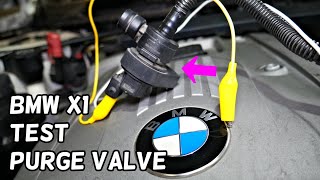
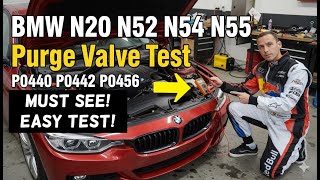
How to confirm: Test the valve's solenoid for resistance using a multimeter; it should be within a specific range (typically 20-40 ohms). You can also try applying 12V power from the battery to see if it clicks open and closed; the valve should be closed with no power applied. A more definitive test is to use a scan tool to command the valve open while checking for vacuum flow with a gauge or by blowing through it. 🎬 Watch: How to test BMW purge valves
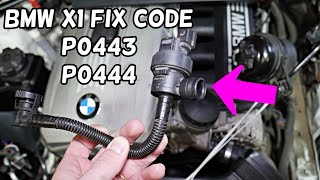
Typical fix: Replace the EVAP purge valve. On N52/N55 engines, it's often located under the intake manifold. On N20 engines, it is typically mounted directly on the intake manifold, making access easier.
Est. part cost: $40-$100 - Damaged Wiring or Connector 🟡 Medium Probability Engine bay heat and vibrations can cause wiring to become brittle or the connector's locking tab to break. The wiring harness runs near hot components and can sometimes melt or fray.
How to confirm: Visually inspect the wiring harness and connector going to the purge valve for any signs of cracking, fraying, melting, or corrosion. Use a multimeter to check for 12V power at the connector with the key on and check for continuity on the control wire back to the DME.
Typical fix: Repair the damaged section of the wiring harness or clean/replace the electrical connector.
Est. part cost: $5-$50
Rare But Worth Checking
- Blown Fuse: The EVAP system is often protected by a fuse. While not common to blow without another issue, it's a quick and easy check before replacing more expensive parts. Check the fuse diagram for your specific vehicle.
- Faulty Powertrain Control Module (DME): → Shop Engine Control Module (ECM) This is extremely rare. The DME is the last thing to suspect, only after all other possibilities (valve, wiring, fuses) have been exhaustively tested and ruled out. A DME failure would likely present other codes and symptoms as well.
Diagnosis Steps
- Scan the vehicle with an OBD-II scanner to confirm P0443 is the active code.
- Locate the EVAP purge valve. On N20 engines, it's often on the intake manifold. On N52/N55 engines, it may be tucked under the intake manifold.
- Visually inspect the EVAP purge valve and its electrical connector for any obvious damage, loose connections, or corrosion.
- Inspect the wiring harness leading to the valve for any signs of fraying, melting, or breaks.
- With the ignition on (engine off), use a multimeter to verify that one pin on the connector has 12V power.
- Disconnect the valve and measure the resistance across its two pins. Compare this to the manufacturer's specification (usually 20-40 ohms). An open circuit (infinite resistance) or short circuit (zero resistance) indicates a bad valve.
- If power and resistance are good, you can perform a functional test. With the valve disconnected from the car but power applied via jumper wires, it should click open. It should be closed and hold vacuum/pressure when no power is applied.
- If all tests point to the valve itself being faulty, replace it. Be careful with the plastic hose connections, as they can become brittle with age.
- After replacement, clear the codes with the OBD-II scanner and perform a drive cycle to ensure the Check Engine Light does not return.
Parts You'll Likely Need
- EVAP Purge Valve / Fuel Tank Breather Valve
(OEM #13907618647)— This is the most common failure point for the P0443 code on this platform. The internal solenoid fails electrically, causing a circuit malfunction.
Trusted brands: Bosch, Duralast, URO Parts, Genuine BMW
OEM price range: $80-$120
Aftermarket price range: $40-$70
Related Codes That Often Appear With This One
- P0444 — P0444 indicates 'Evaporative Emission System Purge Control Valve Circuit Open'. It's very similar to P0443 and often points to the same root causes, like a broken wire or a completely failed internal valve coil.
Platform-Specific Known Issues
- On N52 and N55 six-cylinder engines, the purge valve is often located under the intake manifold, requiring more disassembly to access 🎬 See this N52/E90 purge valve replacement walkthrough compared to the four-cylinder N20 engine where it is typically on top.
- The plastic vacuum lines connecting to the purge valve become very brittle over time. It is common for them to crack or break during removal, so care must be taken. It may be wise to have replacement lines on hand if the vehicle has high mileage.
Mechanic-Grade Diagnostic Values
- EVAP Purge Valve (TEV) Solenoid Resistance (N52/N55 Engine) — expected: 27-29 Ohms. Failure: A reading significantly higher than 29 Ohms (e.g., 190 Ohms) or an open circuit (infinite resistance) indicates a bad valve.
- EVAP Purge Valve (TEV) Solenoid Resistance (N20 Engine) — expected: 22-30 Ohms at room temperature.. Failure: A reading below 15 Ohms indicates a short, while a reading over 40 Ohms indicates an open circuit in the windings.
- Voltage at Purge Valve Connector (Pin 1 to Chassis Ground) — expected: Battery Voltage (approx. 12V) with ignition on, engine off.. Failure: No voltage, or significantly low voltage (e.g., 8.5V), points to a problem in the wiring harness, a blown fuse, or a poor ground connection upstream.
Hidden / Shadow Codes Worth Checking
- 2A15: DMTL, tank-venting valve, activation: short circuit to B+ or open circuit. This is a BMW-specific fault code that directly corresponds to the P0443/P0444 generic code. (see via BMW-specific diagnostic software like ISTA, INPA, or advanced professional scan tools.)
- 2A16: DMTL, tank-venting valve, activation: short circuit to ground. This is another BMW-specific fault pointing to a short in the purge valve's control circuit. (see via BMW-specific diagnostic software like ISTA, INPA, or advanced professional scan tools.)
Scan Tool Commands That Help
- ISTA or equivalent professional scan tool: Component Activation for the fuel tank breather valve (TEV). — This function is used to manually command the purge valve solenoid to open and close. While the command is active, a technician can listen for an audible 'click' from the valve and verify with a vacuum gauge or by blowing through the valve that it is physically opening and closing as commanded. This isolates the valve as the point of failure if it has proper power but does not actuate.
Wiring & Ground Locations
- Purge Valve Connector (X6324) — The 2-pin electrical connector attached directly to the EVAP purge valve solenoid.. This is the primary test point. Pin 1 should have battery voltage with the key on. Pin 2 is the ground-side control wire that is pulsed by the DME to activate the valve. A P0443 code is triggered when the DME detects an improper voltage or current reading on this circuit.
Real Owner Repair Stories
- Xoutpost.com forum user (2001 BMW X5 3.0i (E53 chassis, similar era technology)) — Persistent P0444 code (circuit open, closely related to P0443).
❌ Tried (didn't work) Replacing the purge valve with a new, aftermarket part from eBay did not solve the problem.
✅ What actually fixed it Replacing the aftermarket valve with a Genuine BMW part finally resolved the code. This highlights that the DME can be sensitive to the precise electrical characteristics of the solenoid, and some aftermarket parts may not be within the required tolerance. - Xoutpost.com forum user (BMW X5 (E53)) — P0443 code that kept returning.
❌ Tried (didn't work) Standard diagnostic procedures and part swaps.
✅ What actually fixed it The user reinstalled a cheap aftermarket valve, but this time cleared the code while the engine was running and the gas cap was removed. The code did not return. While electronically nonsensical, this anecdotal fix suggests that certain sequences of resetting adaptations can sometimes resolve stubborn codes.
OEM Part Supersession History
13907572236→13907618647— Standard part revision by BMW for improved reliability or manufacturing changes.
Diagnostic Flowchart
Other Known Issues on This Vehicle
Issues unrelated to this code that are worth knowing about as an owner of this generation:
- N20 Engine Timing Chain Guide Failure 🔴 High — Common in pre-2015 models, often manifesting as a whining noise between 1,500-2,500 RPM. Can occur around 70,000-100,000 miles. Failure can cause catastrophic engine damage. (Ref: BMW issued a limited warranty extension (not a recall) via SIB 11 03 17, extending coverage to 7 years/70,000 miles for this component.)
- Electric Water Pump Failure (N52/N55 engines) 🔴 High — Prone to failure without warning, often between 45,000 and 100,000 miles. Failure leads to rapid engine overheating.
- Oil Filter Housing Gasket (OFHG) Leak 🟠 Medium — Extremely common across all engine types. The rubber gasket hardens over time, causing oil to leak onto the serpentine belt and other components. Often occurs after 60,000 miles.
- Valve Cover and Gasket Leak 🟠 Medium — The plastic valve cover can crack and the gasket can become brittle, leading to oil leaks and a burning oil smell. This is a very common issue on many BMW engines of this era.
- Turbocharger Wastegate Rattle / Failure (N20/N55 engines) 🟠 Medium → Shop Turbocharger — Can occur on higher mileage vehicles, leading to reduced engine performance, boost pressure faults, and rattling noises.
Used vs. New Parts: Buying Guide for This Vehicle
When a used part is the smart pick: For an electronic solenoid that is a very common failure item, buying a used part is generally not recommended as it carries a high risk of being faulty or having limited remaining life. It should only be considered as a last resort or for temporary testing.
Donor-vehicle mileage cap: roughly under 50000 miles for the part to have meaningful remaining life.
What to inspect on the donor part:
- Ask the seller to provide a multimeter resistance reading; it must be within the 22-30 Ohm range.
- Visually inspect for cracks in the plastic housing, especially around the hose connections.
- Ensure the electrical connector pins are clean, straight, and free of corrosion.
OEM-only on this vehicle (don't cheap out):
- EVAP Purge Valve: Some owners report that only a Genuine BMW or OEM-supplier (Bosch) part will resolve the code, as the DME can be sensitive to the exact electrical resistance of the valve's solenoid.
Aftermarket brands forum-validated for this vehicle:
- Bosch (often the original OEM supplier)
Brands owners have reported issues with on this vehicle:
- URO Parts (general forum consensus suggests avoiding for electronic components due to higher failure rates)
- Unbranded, low-cost parts (often have incorrect electrical specifications, leading to persistent codes even when new)
Real Owner Stories
Aggregated from forums and TSBs cited above. Mileages and costs reflect what owners reported in those sources.
BMW X1 35i (N55 engine)
Symptoms: Oil filter housing gasket leak.
What fixed it: Repair performed by an independent shop.
Cost: $700-$1,800
Source hint: XBimmers (x-bimmers.com) thread titled 'E84 X1 35i oil pan gasket'
Related OBD-II Codes
Frequently Asked Questions
Where is the EVAP purge valve located on my BMW X1 with the N20 engine?
I have a 2011 X1 with the N55 engine; is the purge valve replacement difficult?
Can I use an aftermarket purge valve to fix the P0443 code?
Are there any specific parts I should have on hand before starting this repair on a high-mileage X1?
Is there a TSB for the timing chain issue on my N20 X1?
What resistance should I look for when testing the purge valve with a multimeter?
Helpful Videos
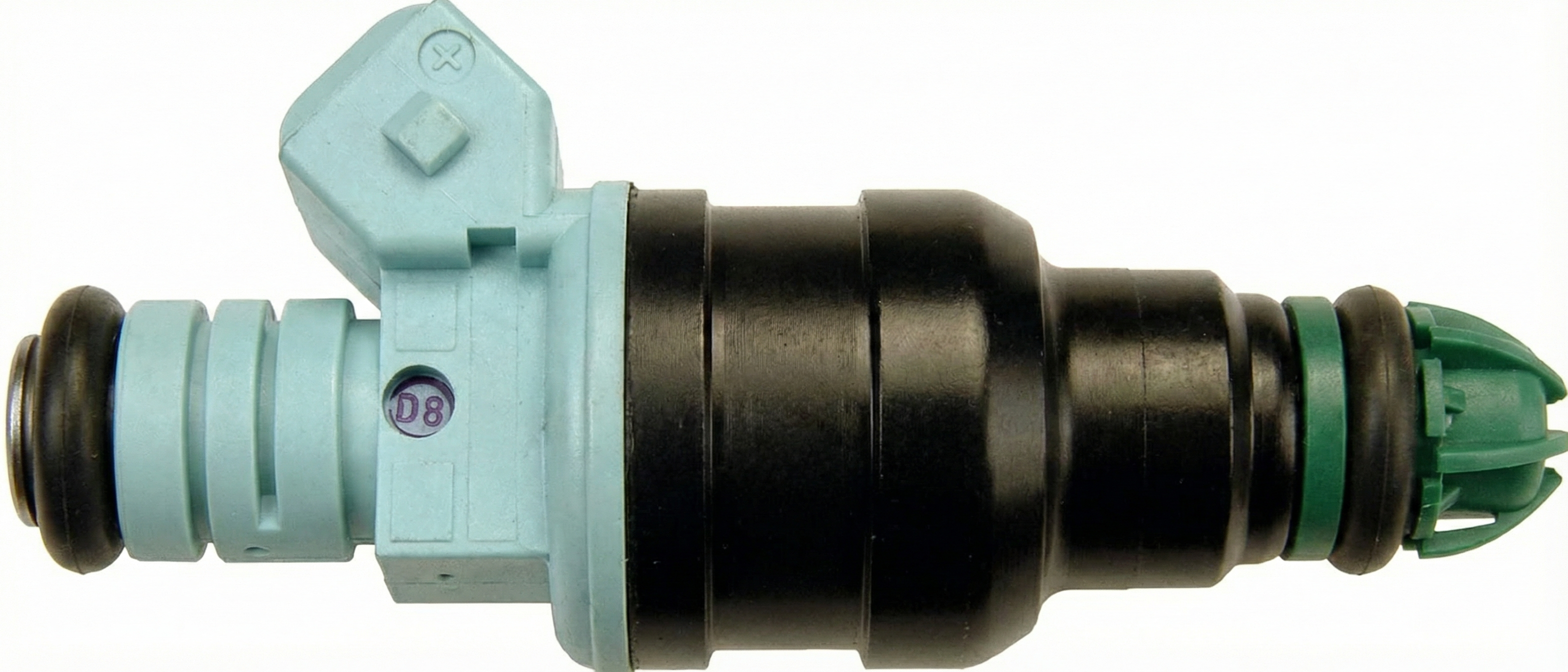
We Have This Part in Stock

The information in this article is provided for general reference and educational purposes only. Vehicle specifications, procedures, and part compatibility can vary by production date, trim level, and region. Always consult your vehicle's factory service manual and verify part numbers before purchasing or performing repairs. Safety-critical components such as airbags, seat belts, and braking systems should be installed by a qualified professional.
- BMW X1:
- 🧭 Diagnostic Flowchart
- 🎬 Helpful Videos
- 🛍️ Shop This Part
- What's Unique About the 2009-2015 BMW X1
- Symptoms You May Notice
- Most Likely Causes
- Rare But Worth Checking
- Diagnosis Steps
- Parts You'll Likely Need
- Related Codes That Often Appear With This One
- Platform-Specific Known Issues
- Mechanic-Grade Diagnostic Values
- Hidden / Shadow Codes Worth Checking
- Scan Tool Commands That Help
- Wiring & Ground Locations
- Real Owner Repair Stories
- OEM Part Supersession History
- Other Known Issues on This Vehicle
- Used vs. New Parts: Buying Guide for This Vehicle
- Real Owner Stories
- BMW X1 35i (N55 engine)
- Related OBD-II Codes
- Frequently Asked Questions
- 🎟️ Get 5% Off