

P0443 on 2010-2015 Chevrolet Camaro: EVAP Purge Valve Circuit Causes and Fixes
For a 2010-2015 Camaro, code P0443 almost always points to a failed EVAP Purge Solenoid Valve located on the engine's intake manifold. Expect to pay $25-$60 for a new valve, which is a straightforward DIY replacement with a 1/5 difficulty. Before replacing, always check the 10A 'EMISSIONS 1' fuse (#7) in the engine bay, as it's a shared circuit with the O2 sensors and a common point of failure.
- P0443 is an electrical circuit code, not an EVAP system leak code.
- The most likely cause is a failed EVAP Purge Solenoid Valve on the engine.
- Always check the #7 10A fuse in the engine bay, especially if you also have O2 sensor codes.
- The repair is very DIY-friendly, requiring basic hand tools and about 15-30 minutes.
What's Unique About the 2010-2015 Chevrolet Camaro
On the fifth-generation Camaro (2010-2015), with either the 3.6L V6 (LLT/LFX) or 6.2L V8 (LS3/L99) engines, the P0443 code is a very common and typically simple issue to resolve. The EVAP purge solenoid is conveniently located on the passenger side of the intake manifold for both engine types, making it easily accessible. While the part itself is a frequent failure point across many GM vehicles using these engines, forum discussions repeatedly highlight a shared fuse with the upstream O2 sensor heaters, which can sometimes be the underlying cause if multiple codes are present. Manufacturer Bulletin #PIP5552 notes that engineering has investigated conditions where the MIL illuminates specifically with P0443 or P0459 setting.
Symptoms You May Notice
- Check Engine Light is on
- Slightly rough idle, especially if the valve is stuck open
- Difficulty starting the engine immediately after refueling
- A subtle fuel odor
- Failing a state emissions/smog test
- Slight decrease in fuel economy
- Replacing the gas cap. A bad gas cap typically causes EVAP leak codes (like P0442 or P0455), not a circuit code like P0443.
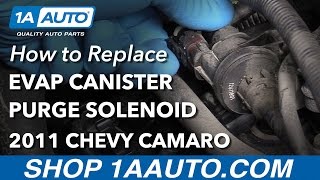
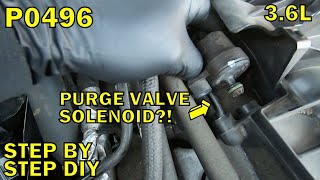
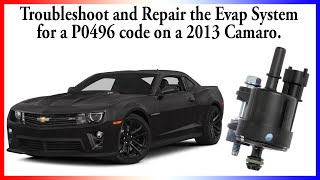
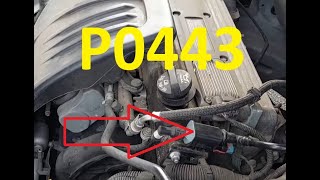
- Replacing the EVAP vent solenoid. The vent solenoid is a different part located near the charcoal canister by the fuel tank. P0443 specifically points to the purge valve circuit 🎬 Watch: Understanding the P0443 circuit code and common fixes on the engine.
Most Likely Causes
- Faulty EVAP Purge Solenoid Valve 🔴 High Probability → Shop Vapor Canister The solenoid is a common failure item across many GM vehicles of this era due to the internal coil failing (opening or shorting) over time. It is a well-documented issue on both the V6 and V8 Camaro engines.
How to confirm: With the engine off, disconnect the electrical connector and measure the resistance across the two pins of the solenoid with a multimeter. A healthy solenoid should read between 20-30 ohms. A reading of infinite resistance (open) or near-zero resistance (short) confirms a bad solenoid. You can also try applying 12V and ground to the pins to see if it clicks open and closed.
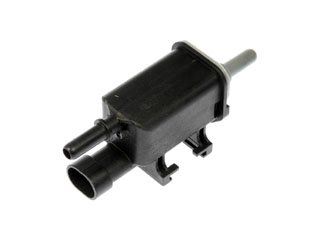
Typical fix: Replace the EVAP purge solenoid valve. It is mounted with a single 10mm bolt and has two quick-disconnect hose fittings and one electrical connector.
Est. part cost: $25 - $60 - Blown Fuse 🟡 Medium Probability On the 5th-gen Camaro, the EVAP purge solenoid shares a fuse with the upstream O2 sensor heaters (Fuse #7, a 10A fuse in the engine bay fuse box, often labeled 'EMISSIONS 1'). A short in any of these components or their wiring can blow the fuse, causing P0443 along with O2 sensor heater codes (P0030, P0050, P0135, P0155). Manufacturer Bulletin #PIT5336 confirms that technicians may find the Emission 1 Fuse open in conjunction with P0443 and various O2 sensor codes, requiring an inspection for damaged wires on the engine harness.
How to confirm: Check the #7 (10A) fuse in the engine compartment fuse box. If it is blown, you have found the immediate issue. The next step is to find the short that caused it to blow.
Typical fix: Replace the fuse. If it blows again, inspect the wiring harnesses for the purge solenoid and both upstream O2 sensors for any signs of chafing or melting against the engine or exhaust. A user on a Mazda forum with the same P0443 and O2 sensor codes found fried wiring near a connector was the cause. Disconnect each component one by one to isolate the short.
Est. part cost: $1 - $5 - Damaged Wiring or Connector ⚪ Low Probability
How to confirm: Visually inspect the wiring harness and connector leading to the purge solenoid for any cracks, corrosion, or loose pins. Use a multimeter to check for 12V power on one wire (typically pink/black) with the key on. The other wire (typically dark green/white) is the control wire, which the PCM pulses to ground to activate the solenoid. Check for continuity on the control wire back to the PCM.
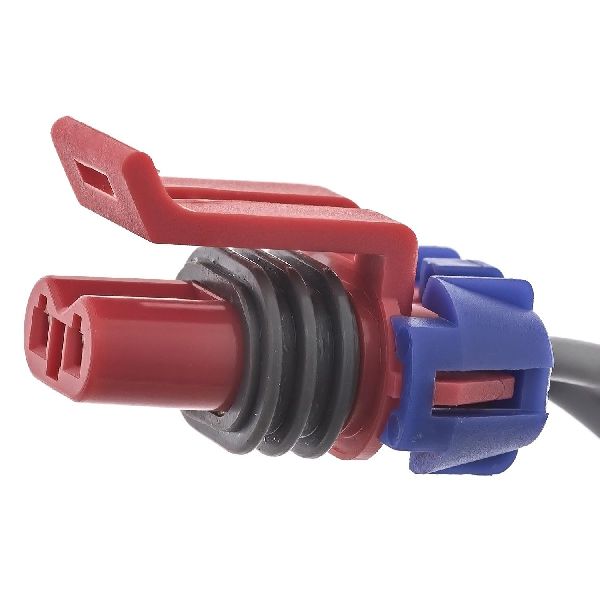
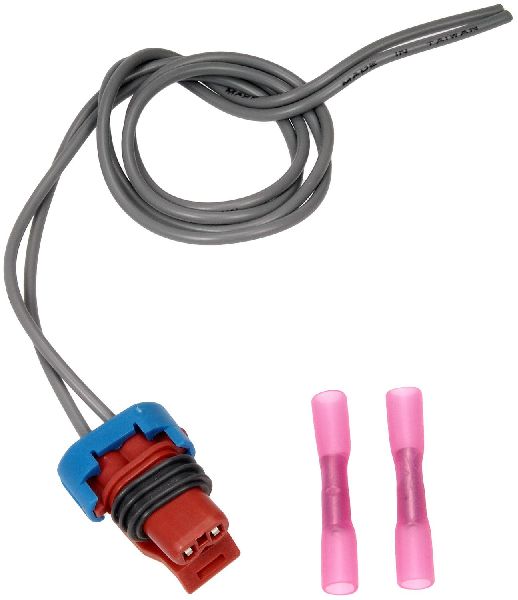
Typical fix: Repair the broken/corroded wire or replace the connector pigtail. Use high-temperature electrical tape for repairs in the engine bay.
Est. part cost: $10 - $30
Rare But Worth Checking
- Faulty Powertrain Control Module (PCM): → Shop Engine Control Module (ECM) This is extremely rare. The PCM should only be considered after all other possibilities (solenoid, wiring, fuses) have been exhaustively tested and ruled out. A faulty PCM driver circuit can cause the P0443 code, but this is the least likely scenario.
Diagnosis Steps
- Retrieve all stored trouble codes with an OBD-II scanner. Note if any O2 sensor heater codes (P0030, P0050, etc.) are present alongside P0443.
- Check fuse #7 (10A) in the engine compartment fuse box. If it's blown, this is a strong indicator of a short circuit in the shared wiring for the purge solenoid or O2 sensors.
- Locate the EVAP purge solenoid on the passenger side of the intake manifold.
- Visually inspect the solenoid, its electrical connector, and the nearby wiring for any obvious signs of damage, melting, or corrosion.
- Disconnect the electrical connector. With the ignition on, use a multimeter to verify that one of the pins in the connector has 12V (usually a pink/black wire).
- Measure the resistance of the two pins on the solenoid itself. A healthy solenoid will have a specific resistance (typically between 20-30 ohms). An open circuit (infinite resistance) or a short circuit (near zero resistance) means the solenoid has failed and needs replacement.
- If the fuse, wiring, and solenoid resistance all check out, the problem may be intermittent or could be a rare fault in the PCM's driver circuit.
- Clear the codes and perform a drive cycle to see if the code returns.
Parts You'll Likely Need
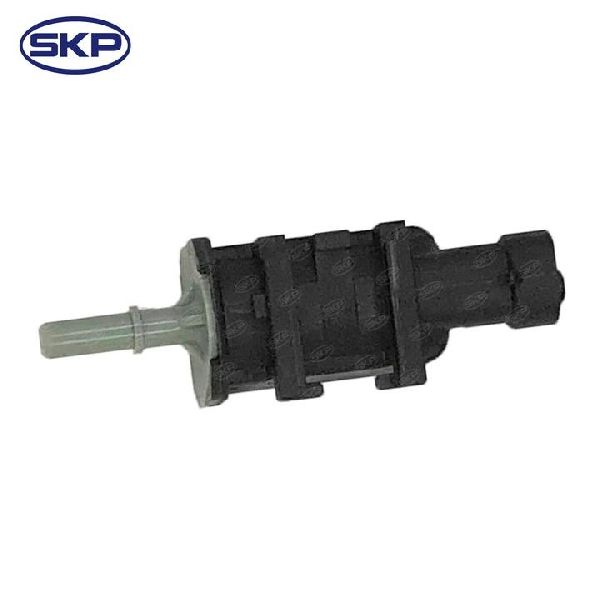
- Vapor Canister Purge Solenoid Valve
(OEM #12610560 (may be superseded by 12690512, 12661763, or 55593172))— This is the most common failure point for a P0443 code. The internal coil winding fails, creating an open or short in the circuit that the PCM detects.
Trusted brands: ACDelco (OEM), Delphi, Dorman (P/N 911-082)
OEM price range: $40-$60
Aftermarket price range: $25-$45
Related Codes That Often Appear With This One
- P0030 — This code (HO2S Heater Control Circuit Bank 1 Sensor 1) can appear with P0443 because the EVAP purge solenoid and the upstream O2 sensor heaters share the same power fuse on this vehicle.
- P0050 — This code (HO2S Heater Control Circuit Bank 2 Sensor 1) can appear with P0443 because the EVAP purge solenoid and the upstream O2 sensor heaters share the same power fuse on this vehicle.
Platform-Specific Known Issues
- A blown #7 fuse in the engine bay is a known issue that can trigger P0443 along with O2 sensor heater codes. This is often caused by the wiring harness for one of these components chafing against a metal part and shorting to ground.
Mechanic-Grade Diagnostic Values
- EVAP Purge Solenoid Coil Resistance — expected: 20 to 30 Ohms. Failure: A reading of infinite resistance (open circuit) or near-zero resistance (short circuit).
- Voltage at Purge Solenoid Connector (Ignition On, Engine Off) — expected: One pin should have battery voltage (~12V+). The other pin is the ground control wire from the PCM.. Failure: No voltage on the power pin suggests a blown fuse or a break in the power supply wire from the fuse box.
- Scan Tool Live Data - EVAP Purge Command (EVAP_PCT) — expected: Should be 0% at idle when the engine is cold. The PCM will command it to a percentage (e.g., 15-50%) after the engine reaches operating temperature and certain drive conditions are met.. Failure: If the command percentage changes but the valve doesn't click or fuel trims don't respond, the valve is likely faulty. If the command percentage never leaves 0%, the PCM may not be enabling the test, or there could be a PCM issue.
Scan Tool Commands That Help
- GDS2 / Tech2 / High-End Bidirectional Scanner (Autel/Snap-on): EVAP Purge/Seal or EVAP Purge Solenoid Output Control — This command allows the technician to manually open and close the purge solenoid while the engine is running or off. You should hear an audible click from the solenoid each time it's commanded. This directly tests the functionality of the solenoid, its wiring, and the PCM's driver circuit, bypassing the normal automatic operation. 🎬 Watch: Using a scan tool to troubleshoot the EVAP system
Wiring & Ground Locations
- G102 — Located at the left rear of the engine on the cylinder head (V8 models).. This is a primary ground for the ignition coils, but ensuring all major engine grounds are clean and secure is a critical step in diagnosing any electrical fault, as a poor ground can cause unpredictable voltage issues across multiple components.
- G103 / G104 (V8) — Located on the front/side of the passenger side cylinder head on V8 models.. These are major engine block grounds. A loose or corroded ground here can cause erratic behavior in sensors and solenoids controlled by the PCM, including the EVAP purge solenoid.
- Purge Solenoid Connector — On the EVAP purge solenoid itself, passenger side of the intake manifold.. Pin A (typically Pink/Black wire) is the 12V+ ignition feed from the fuse. Pin B (typically Dark Green/White wire) is the ground-side control wire from the PCM. Testing for voltage at Pin A and continuity to ground on Pin B (with PCM disconnected) are key diagnostic steps.
Real Owner Repair Stories
- Mazda Forum user with identical GM-style shared circuit issue (2004 Mazda Tribute V6 (Note: While not a Camaro, the electrical principle is identical)) — P0443 code present along with codes for all four oxygen sensors. The HEGO (O2 sensor) fuse would blow instantly when the ignition was turned on.
❌ Tried (didn't work) Disconnecting each O2 sensor one by one to see if the fuse would stop blowing.
✅ What actually fixed it The user found a short to ground in the wiring harness. For 6-8 inches from one of the O2 sensor connectors, the wires were fried. Splicing in a new connector and wire fixed the short, stopped the fuse from blowing, and resolved the P0443 and O2 sensor codes.
OEM Part Supersession History
12610560→12690512, 12661763, 55593172, and most recently 12737252— Standard part evolution, potential improvements in materials or coil design.
Heads up: All listed part numbers are generally cross-compatible for this application. However, always verify fitment with a VIN as connector shapes or bracket designs can have minor running changes.
Model Year Variations Within This Range
- 2010-2011 (V6): These models use the 3.6L LLT V6 engine, which features an aluminum intake manifold and a Bosch ECM. The EVAP purge solenoid and its function remain the same as later years.
- 2012-2015 (V6): These models use the updated 3.6L LFX V6 engine. Key differences include a composite (plastic) intake manifold, integrated exhaust manifolds (making traditional headers incompatible), and a Delphi ECM. While the P0443 diagnosis is identical, be aware of these engine differences when working in the area. For example, an intake manifold spacer designed for an LLT will not fit an LFX.
Diagnostic Flowchart
Other Known Issues on This Vehicle
Issues unrelated to this code that are worth knowing about as an owner of this generation:
- Premature Timing Chain Wear (V6 Engines) 🔴 High — Common on 3.6L LLT (2010-2011) and to a lesser extent LFX (2012-2015) engines, often appearing between 60,000-100,000 miles. Linked to extended oil change intervals. (Ref: GM issued warranty extensions for some models, but no universal recall. TSBs exist for diagnosis (e.g., checking for codes P0008, P0017).)
- Torque Converter Shudder (Automatic Transmission) 🟠 Medium — Common on models with 6-speed (6L50/6L80) and 8-speed automatic transmissions. Owners report a vibration or shudder at low speeds (around 40-50 mph). (Ref: TSB #18-NA-355 and #15435 address this issue, often recommending a fluid flush with a specific fluid type or torque converter replacement.)
- Ignition Switch Recall (Switchblade Key) 🔴 High — Affected all 2010-2014 Camaros. The driver's knee could bump the key fob, causing the engine to shut off while driving. (Ref: GM Recall #14294. The fix was to replace the integrated switchblade key with a separate key and remote fob.)
- Starter Motor Heat Soak 🟡 Low — Owners report intermittent no-start conditions after the engine is hot, which resolves after cooling down. The starter's proximity to the exhaust is believed to be the cause.
- AFM Lifter Failure (V8 L99 Engine) 🟠 Medium — The L99 V8 in automatic SS models features Active Fuel Management (AFM). The AFM lifters are a known failure point, causing a ticking noise and potential misfires. (Ref: A TSB was issued acknowledging the issue and providing a repair procedure involving lifter replacement.)
Used vs. New Parts: Buying Guide for This Vehicle
When a used part is the smart pick: A used EVAP purge solenoid from a junkyard is a reasonable choice for this repair. It is not a safety-critical component, is easy to access, and is inexpensive. Given the high failure rate, it's a low-risk part to buy used.
Donor-vehicle mileage cap: roughly under 60000 miles for the part to have meaningful remaining life.
What to inspect on the donor part:
- Inspect the plastic housing for any cracks or signs of heat damage.
- Check the electrical connector pins for corrosion or bending.
- If possible, bring a multimeter and check the resistance. It should be between 20-30 Ohms.
- Ensure the quick-disconnect hose ports are not broken or cracked.
OEM-only on this vehicle (don't cheap out):
- For this P0443 repair, no parts are strictly OEM-only.
Aftermarket brands forum-validated for this vehicle:
- ACDelco (OEM supplier)
- Delphi
- Dorman (P/N 911-082 is a widely cited replacement)
Brands owners have reported issues with on this vehicle:
- Unnamed, no-brand parts from online marketplaces can have a high premature failure rate. While they may work initially, their internal coil windings or seals may not meet OEM durability standards.
Real Owner Stories
Aggregated from forums and TSBs cited above. Mileages and costs reflect what owners reported in those sources.
2010-2015 Chevrolet Camaro
Symptoms: Check Engine Light (CEL) appeared; OnStar confirmed code P0443 regarding the EVAP purge circuit.
What fixed it: The owner scheduled an appointment to diagnose the EVAP purge circuit, considering whether to revert an aftermarket intake to stock before service.
Source hint: Camaro5.com thread titled 'Hi all, I got the dreaded CEL yesterday...'
2010-2015 Chevrolet Camaro
Symptoms: P0443 code present along with O2 sensor codes; discovered a blown fuse.
What fixed it: Replaced the blown fuse and repaired a chafed wire in the harness that was shorting against a metal part.
Source hint: Camaro5.com - Thread: 'Help identifying retaining clip on Fuel Line / EVAP for P0443 code'
2010-2015 Chevrolet Camaro
Symptoms: Code P0443 persisted even after the purge valve was replaced.
What fixed it: The failure to fix the code with a new valve pointed toward a wiring harness issue or a fault in the PCM driver circuit.
Source hint: Camaro5.com - Thread: 'Code p0443'
Documented NHTSA Reports
NHTSA ODI #11632222
Symptoms: Check Engine Light and "Reduced Propulsion" message on the dashboard. Fault codes included P0443, P0030, P0135, and P0597.
What fixed it: An owner reported finding a blown fuse [F03] for the EGR valve, likely caused by the EGR valve sticking.
NHTSA ODI #11448862
Symptoms: Console message stating "engine offline" with a long list of error codes including P0443, P0030, P0135, and P0458.
What fixed it: This report highlights a complex electrical failure where multiple emissions and heater circuit codes appear simultaneously, often pointing to a shared power supply issue.
NHTSA ODI #11681144
Symptoms: Failure to circulate coolant properly accompanied by a list of CEL codes including P0443, P0030, P0135, and P06DB.
What fixed it: The owner noted this as a recurring issue involving multiple circuit-related fault codes across the emissions and propulsion systems.
Related OBD-II Codes
Frequently Asked Questions
Where is the EVAP purge solenoid located on my 2010-2015 Camaro?
My Camaro has P0443 along with O2 sensor codes P0030 and P0050. Are these related?
What should the resistance be for a healthy purge solenoid on a 3.6L V6 Camaro?
Is there a recall for the ignition switch on my 2012 Camaro that might be related to electrical issues?
I'm seeing P0443 and also have a vibration at 45 mph. Are they connected?
Can I use the purge solenoid from a Cadillac CTS or Chevy Traverse on my Camaro?
Diagnostic Flowchart
Helpful Videos
Used OEM Parts in Stock
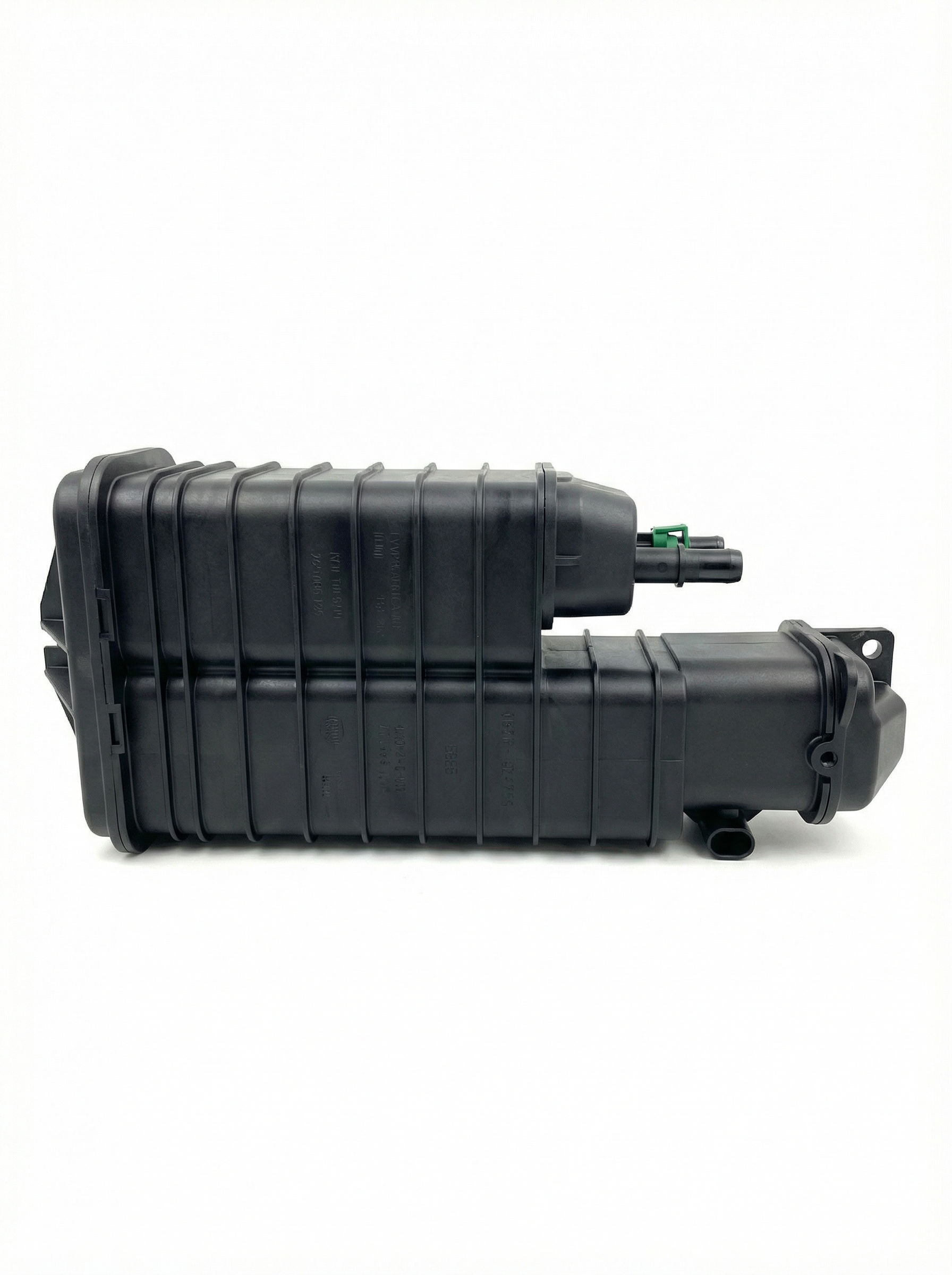
New Aftermarket Parts Available


The information in this article is provided for general reference and educational purposes only. Vehicle specifications, procedures, and part compatibility can vary by production date, trim level, and region. Always consult your vehicle's factory service manual and verify part numbers before purchasing or performing repairs. Safety-critical components such as airbags, seat belts, and braking systems should be installed by a qualified professional.
- Chevrolet Camaro:
- 🧭 Diagnostic Flowchart
- 🎬 Helpful Videos
- 🛍️ Shop This Part
- What's Unique About the 2010-2015 Chevrolet Camaro
- Symptoms You May Notice
- Most Likely Causes
- Rare But Worth Checking
- Diagnosis Steps
- Parts You'll Likely Need
- Related Codes That Often Appear With This One
- Platform-Specific Known Issues
- Mechanic-Grade Diagnostic Values
- Scan Tool Commands That Help
- Wiring & Ground Locations
- Real Owner Repair Stories
- OEM Part Supersession History
- Model Year Variations Within This Range
- Other Known Issues on This Vehicle
- Used vs. New Parts: Buying Guide for This Vehicle
- Real Owner Stories
- 2010-2015 Chevrolet Camaro
- 2010-2015 Chevrolet Camaro
- 2010-2015 Chevrolet Camaro
- Documented NHTSA Reports
- NHTSA ODI #11632222
- NHTSA ODI #11448862
- NHTSA ODI #11681144
- Related OBD-II Codes
- Frequently Asked Questions
- 🎟️ Get 5% Off