

P0443 on 2005-2010 Chevrolet Cobalt: EVAP Purge Valve Circuit Causes and Fixes
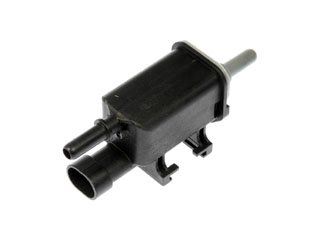
For the 2005-2010 Chevy Cobalt, code P0443 almost always points to a failed EVAP Purge Solenoid Valve. It's an inexpensive part, typically under $40, and is very easy to replace in about 15 minutes, making it a great DIY fix.
- P0443 on a Cobalt is an electrical circuit code, not a system leak code.
- The most likely cause by a wide margin is a bad EVAP Purge Solenoid Valve.
- The repair is very simple, requires basic tools, and can be done in under 15 minutes by a DIYer.
- Do not replace the gas cap or the vent solenoid near the tank for this specific code; focus on the purge solenoid in the engine bay.
What's Unique About the 2005-2010 Chevrolet Cobalt
On the first-generation Chevrolet Cobalt, the P0443 code is a very common and straightforward issue. The EVAP purge solenoid is known to fail frequently, but it is conveniently located on the driver's side of the engine, making it one of the easiest and most common DIY repairs for Cobalt owners. Unlike some vehicles where wiring is a common problem, on the Cobalt, the valve itself is the overwhelming cause of the P0443 code.
Symptoms You May Notice
- Check Engine Light is on
- Rough idle, especially when the engine is warm
- Difficulty starting the engine immediately after refueling
- Slightly reduced fuel economy
- Strong fuel smell from the exhaust due to a rich condition
- Replacing the gas cap. A bad gas cap typically causes EVAP leak codes (like P0442 or P0455), not a circuit code like P0443.
- Replacing the EVAP Vent Solenoid. The vent solenoid is a different part located near the fuel tank and charcoal canister. It will typically set a different code, such as P0449.
Most Likely Causes
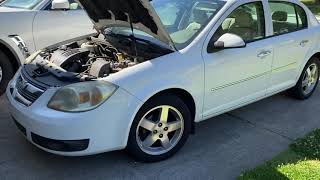
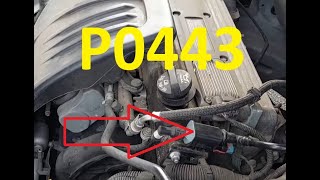
- Failed EVAP Purge Solenoid Valve 🔴 High Probability → Shop Vapor Canister The part is known to fail electrically over time due to heat cycles in the engine bay. The internal coil winding can break (open circuit) or short out, causing the PCM to detect a circuit malfunction. 🎬 Watch: Understanding the causes and fixes for the P0443 code.
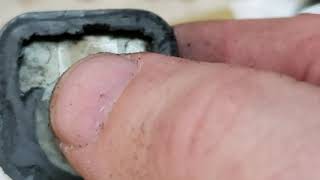
How to confirm: Use a multimeter to check the resistance across the two pins on the solenoid. A good solenoid should have a resistance between 15 and 40 Ohms. An infinite resistance reading (OL) indicates an open circuit, and a reading near zero indicates a short. Both confirm a bad solenoid. Alternatively, with the engine off, remove the solenoid and try to blow through it; if air passes, it is stuck open and faulty. 🎬 See how to test a purge valve and recognize symptoms.
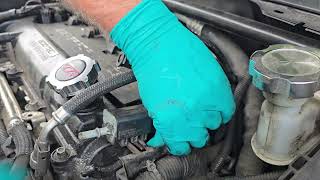
Typical fix: Replace the EVAP Purge Solenoid Valve. It is mounted on the driver's side of the cylinder head and is easily accessible after removing the plastic engine cover. 🎬 Watch: A quick walkthrough of the purge valve replacement.
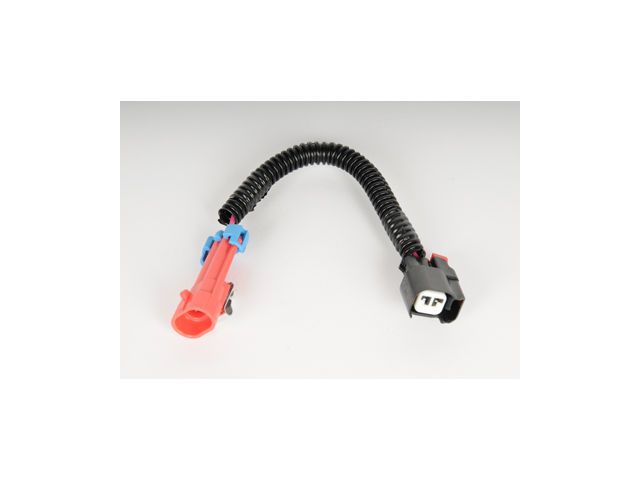
Est. part cost: $20-$50 - Wiring or Connector Issue ⚪ Low Probability While less common than valve failure, the wiring harness connector can become brittle or corroded, or the wires can chafe against the engine or mounting bracket. The two-pin connector pigtail is part number 1P1479 (Wells).
How to confirm: Visually inspect the wiring harness and connector leading to the purge solenoid for any signs of damage, corrosion, or loose pins. Use a multimeter to check for 12V power on the power wire (typically pink/black) and a ground signal on the control wire (typically green/white) at the connector with the key on.
Typical fix: Repair the damaged section of wiring or clean/replace the connector pigtail.
Est. part cost: $10-$30
Rare But Worth Checking
- Blown Fuse: The EVAP system is protected by a fuse in the underhood fuse block. On a Cobalt, this is often the 'EMISSION' fuse (10A). While it's rare for it to blow without another underlying issue (like a shorted wire), it's a quick and easy check that can save you from buying unnecessary parts. A blown emissions fuse may also set a P0102 (MAF sensor) code simultaneously.
- Faulty Powertrain Control Module (PCM): → Shop Engine Control Module (ECM) This is extremely rare. The PCM's internal driver for the purge solenoid circuit can fail. This should only be considered after all other possibilities (valve, wiring, fuse) have been exhaustively ruled out by testing the circuit directly at the PCM connector.
Diagnosis Steps
- Confirm the presence of the P0443 code using an OBD-II scanner.
- Remove the plastic engine cover to access the EVAP purge solenoid, located on the driver's side of the cylinder head.
- Inspect the electrical connector and wiring going to the solenoid for any visible damage, corrosion, or looseness.
- If the wiring looks good, disconnect the electrical connector. Set a multimeter to Ohms (Ω) and measure the resistance between the two pins on the solenoid itself. A reading between 15-40 Ohms is good. A reading of 'OL' (open) or near 0 Ohms (short) means the solenoid is bad and needs replacement.
- If the solenoid tests good, check for power at the connector. With the ignition on, one wire (usually pink/black) should have battery voltage (~12V).
- If power is present, the final check is the ground signal from the PCM. This is best done with a scan tool that can command the solenoid on and off while monitoring the circuit voltage.
- Check the 'EMISSION' fuse (10A) in the underhood fuse box to ensure it is not blown.
- Based on the findings, replace the faulty component, which is most often the purge solenoid itself.
Parts You'll Likely Need
- Vapor Canister Purge Solenoid Valve
(OEM #12597567 (replaces 12581282, 12606684))— This is the most common failure point for the P0443 code on this vehicle. The internal coil fails, causing an electrical circuit malfunction.
Trusted brands: ACDelco (GM Genuine) 12597567, ACDelco (Professional) 214-1105, Dorman 911-030, Standard Motor Products CP470, Wells PV424
OEM price range: $30-$50
Aftermarket price range: $20-$40
Platform-Specific Known Issues
- Some TSBs for similar GM vehicles mention the possibility of the wiring harness rubbing against the solenoid's metal mounting bracket, causing a short. It is worth inspecting this area for any chafing when replacing the part.
- Manufacturer TSB Bulletin #PIP5552 notes that engineering has investigated conditions where P0443 or P0459 set, causing a Malfunction Indicator Lamp (MIL) illumination.
- According to TSB Bulletin #PIT5336, technicians may find the Emission 1 Fuse is open in conjunction with P0443; this bulletin advises inspecting and repairing any wire damage on the engine harness.
Mechanic-Grade Diagnostic Values
- EVAP Purge Solenoid Coil Resistance — expected: 15 to 40 Ohms. Failure: Infinite resistance (Open Loop) or near-zero Ohms (short circuit) indicates a failed solenoid.
- Voltage at Purge Solenoid Connector (Key On, Engine Off) — expected: Approximately 12V (Battery Voltage) on the Pink/Black wire (Pin B) to ground.. Failure: No voltage indicates a blown fuse or an open in the power supply circuit from the underhood fuse block.
- Continuity of Control Circuit — expected: Less than 5.0 Ohms between the solenoid connector (Pin A, Green/White wire) and the PCM C2 connector (Pin 48).. Failure: High or infinite resistance indicates a break in the control wire.
Scan Tool Commands That Help
- Tech 2 / GDS2: Active Test: EVAP Purge/Seal — This function allows the technician to command the EVAP Purge Solenoid ON and OFF to verify its operation. While monitoring the circuit with a multimeter, you can confirm the PCM is sending the ground signal and that the solenoid clicks when activated. This is crucial for distinguishing a wiring/PCM issue from a failed solenoid.
Wiring & Ground Locations
- EVAP Purge Solenoid Connector — On the driver's side of the engine, mounted to the cylinder head.. This is the primary connection point to test. Pin A (Green/White wire) is the control circuit from the PCM. Pin B (Pink/Black wire) is the 12V ignition power supply from the 'EMISSION' fuse.
- PCM Connector C2, Pin 48 — The Engine Control Module (ECM/PCM) is in the left side of the engine compartment, in front of the underhood fuse block. C2 is the center connector.. This is the specific pin on the PCM that provides the ground signal to control the EVAP purge solenoid. Testing for continuity between this pin and Pin A at the solenoid connector will confirm if the control wire is intact.
- G107 — On the lower left front of the transmission case.. This is a primary engine/transmission ground. While not directly for the purge solenoid circuit, a poor connection here can cause a variety of erratic electrical issues and codes, so it's worth checking if multiple strange codes are present.
- Underhood Fuse Block — In the engine compartment, on the driver's side, near the strut tower.. This block contains the 'EMISSION' 10A fuse that provides power to the EVAP purge solenoid. A blown fuse will cause P0443.
Real Owner Repair Stories
- The Chevrolet Cobalt SS Forum (Chevrolet Cobalt (year not specified)) — Check Engine Light with codes P0102 (MAF Circuit Low) and P0443 (EVAP Purge Circuit).
❌ Tried (didn't work) Clearing the codes (they returned within minutes).
✅ What actually fixed it The user found and replaced a blown 'emissions' fuse in the underhood fuse block, which resolved both codes. - YouTube channel 'Fix It Carter' (2003 Chevy Silverado (similar GM wiring)) — Check Engine Light with code P0443.
❌ Tried (didn't work) Previous owner had already replaced the purge solenoid valve.
✅ What actually fixed it A broken wire was found in the harness right at a junction near the solenoid. Repairing the broken wire fixed the code. This highlights the need to inspect wiring even if the part is new.
OEM Part Supersession History
12581282→12597567, which was later superseded by 12735397— Standard part evolution for improved reliability or manufacturing changes. The core function and fitment for the Cobalt remain the same across these numbers.
Diagnostic Flowchart
Other Known Issues on This Vehicle
Issues unrelated to this code that are worth knowing about as an owner of this generation:
- Electric Power Steering (EPS) Failure 🔴 High — Very common. Can occur at any mileage, leading to a sudden loss of power assist at low speeds. (Ref: NHTSA Recall #10V073000. GM will replace the electric power steering motor.)
- Defective Ignition Switch 🔴 High — Widespread, affecting 2005-2007 models most critically. The switch can move out of the 'Run' position if bumped or with a heavy keychain, shutting off the engine and disabling airbags. (Ref: NHTSA Recall #14V047000. This was a highly publicized and dangerous defect.)
- Fuel Leaks from Fuel Pump Module or Lines 🔴 High — Common, especially on 2006-2010 models. Can be caused by a cracked plastic port on the fuel pump module (in warm climates) or corrosion of the fuel lines near the rear wheel well. (Ref: NHTSA Recalls #09V419000 and #12V459000 for the fuel pump module. An investigation (PE20-009) was opened for corroded fuel lines.)
- Key Can Be Removed When Not in 'Off' Position 🟠 Medium — Common across all model years. Creates a rollaway risk if the vehicle is not properly in Park (automatic) or in gear with the parking brake set (manual). (Ref: NHTSA Recall #14V171000. Dealers replace the ignition lock cylinder and/or keys.)
Used vs. New Parts: Buying Guide for This Vehicle
When a used part is the smart pick: Given the low cost of a new aftermarket part (often $20-$30), buying a used purge solenoid is generally not recommended. The failure is electrical and age-related, so a used part has a high chance of failing soon. A used part only makes sense if it's nearly free and you can test its resistance (15-40 Ohms) before purchase.
Donor-vehicle mileage cap: roughly under 50000 miles for the part to have meaningful remaining life.
What to inspect on the donor part:
- Check the plastic housing for cracks or heat damage.
- Ensure the electrical connector pins are clean, straight, and free of corrosion.
- If possible, use a multimeter to confirm resistance is within the 15-40 Ohm range.
OEM-only on this vehicle (don't cheap out):
- For this P0443 repair, there are no parts that must be OEM. Reputable aftermarket solenoids are widely available and considered reliable.
Aftermarket brands forum-validated for this vehicle:
- ACDelco (Professional series)
- Standard Motor Products (SMP)
- Dorman
Brands owners have reported issues with on this vehicle:
- No-name, unbranded parts from online marketplaces should be avoided, as quality control can be inconsistent.
Documented NHTSA Reports
NHTSA ODI #11632222
Symptoms: Check Engine Light is on and a "Reduced Propulsion" message appeared on the dash. Fault codes included P0443, P0030, P0031, P0054, P0135, P0403, P0405, P0458, P0489, P0597, P0598, P06DA, and P06DB.
What fixed it: A technician found a blown fuse [F03] for the EGR valve, likely caused by a sticking EGR valve.
NHTSA ODI #11448862
Symptoms: A message on the console stated "engine offline" with several error codes found, including P0443, P0031, P0054, P0030, P0135, P0403, P0405, P0458, P0489, P0597, P0598, P06DA, and P06DB.
NHTSA ODI #11681144
Symptoms: Failure to circulate coolant properly accompanied by a long list of CEL codes, including P0443, P06DB, P0030, P0031, P0403, P0405, P0458, P0489, P0597, P0598, P06DA, P0AC4, P0135, and P16E0.
Real Owner Stories
Aggregated from forums and TSBs cited above. Mileages and costs reflect what owners reported in those sources.
Chevrolet Cobalt SS
Symptoms: Car will not idle, runs very rough for 20 seconds then shuts off, strong fuel smell from exhaust, running rich. Threw code P0443.
What fixed it: Replacing the purge valve on the intake manifold.
Source hint: The Chevrolet Cobalt SS Forum - 'P0443 and car will not idle after code cleared'
Chevrolet Cobalt
Symptoms: Rough idle, CEL codes P0102 and P0443 after scraping the catalytic converter on a driveway.
What fixed it: Replacing a blown 'emissions' fuse, which also powered the MAF sensor.
Source hint: Cobalt SS Network thread 'CEL p0102 and p0443'
2005-2010 Chevrolet Cobalt 2.2L L61
Symptoms: Multiple codes including P0030, P0036, P0102, and P0443 after performing work on the vehicle's exhaust system.
What fixed it: The issue was traced back to a blown 15A ECM/EMIS fuse in the under-hood fuse box.
Source hint: go-parts.com P0030 on 2005-2010 Chevrolet Cobalt 2.2L
Related OBD-II Codes
Frequently Asked Questions
Where is the EVAP purge solenoid located on my 2005-2010 Chevrolet Cobalt?
Can a blown fuse cause the P0443 code on my Cobalt?
Why does my Cobalt struggle to start specifically after I fill up the gas tank?
What is the correct resistance for a healthy purge solenoid on this vehicle?
Is there a specific wiring issue I should look for when diagnosing P0443 on a Cobalt?
Does the P0443 code relate to the major ignition switch or power steering recalls on my Cobalt?
Helpful Videos
Used OEM Parts in Stock
New Aftermarket Parts Available


The information in this article is provided for general reference and educational purposes only. Vehicle specifications, procedures, and part compatibility can vary by production date, trim level, and region. Always consult your vehicle's factory service manual and verify part numbers before purchasing or performing repairs. Safety-critical components such as airbags, seat belts, and braking systems should be installed by a qualified professional.
- Chevrolet Cobalt:
- 🧭 Diagnostic Flowchart
- 🎬 Helpful Videos
- 🛍️ Shop This Part
- What's Unique About the 2005-2010 Chevrolet Cobalt
- Symptoms You May Notice
- Most Likely Causes
- Rare But Worth Checking
- Diagnosis Steps
- Parts You'll Likely Need
- Platform-Specific Known Issues
- Mechanic-Grade Diagnostic Values
- Scan Tool Commands That Help
- Wiring & Ground Locations
- Real Owner Repair Stories
- OEM Part Supersession History
- Other Known Issues on This Vehicle
- Used vs. New Parts: Buying Guide for This Vehicle
- Documented NHTSA Reports
- NHTSA ODI #11632222
- NHTSA ODI #11448862
- NHTSA ODI #11681144
- Real Owner Stories
- Chevrolet Cobalt SS
- Chevrolet Cobalt
- 2005-2010 Chevrolet Cobalt 2.2L L61
- Related OBD-II Codes
- Frequently Asked Questions
- 🎟️ Get 5% Off