

P0443 on 2004-2012 Chevrolet Colorado: EVAP Purge Valve Circuit Causes and Fixes
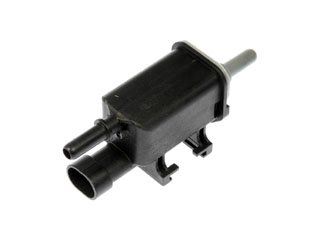
On a 2004-2012 Colorado, P0443 almost always means the EVAP Purge Solenoid has failed. It's located behind the driver's side front wheel well, making replacement a bit involved. Expect to pay $25-$70 for an aftermarket part or $70-$100 for an OEM part (ACDelco 214-1680 / 12597567).
- P0443 on a 2004-2012 Colorado points to an electrical fault with the EVAP Purge Solenoid, not a system leak.
- The most likely fix is replacing the purge solenoid valve itself.
- The valve is located behind the driver's side front wheel well, not under the hood. Access requires removing the wheel and fender liner.
- Ensure you are buying the 'Purge Valve' (OEM #12597567 or ACDelco #214-1680), not the 'Vent Valve' which is a different part in a different location.
- Before replacing the part, check its wiring and connector for damage, as this is a common secondary cause.
What's Unique About the 2004-2012 Chevrolet Colorado
Unlike many other GM trucks where the purge valve is easily found on top of the engine, the first-generation Chevrolet Colorado has it tucked away. It is mounted to the side of the engine block, accessible only after removing the driver's side front wheel and fender liner. This location makes the job more complex than a typical under-hood repair and can lead to misdiagnosis if a technician only looks in the common spots. This placement is shared with its platform mates, the GMC Canyon and Hummer H3.
Symptoms You May Notice
- Check Engine Light is on
- Rough or unstable idle
- Difficulty starting the engine, especially after refueling
- Slight decrease in fuel economy
- A faint fuel odor (less common)
- Engine wants to die out on startup then recovers
- Replacing the gas cap. A loose or faulty gas cap typically causes large leak codes like P0455, not a P0443 circuit code.
- Replacing the EVAP Vent Solenoid. This is a different part located at the rear of the truck by the charcoal canister. It commonly causes a P0449 code, not P0443.
Most Likely Causes
- Faulty EVAP Purge Solenoid Valve 🔴 High Probability → Shop Vapor Canister The solenoid is an electromechanical part that wears out over time from constant use (duty cycling) and exposure to fuel vapors and engine bay conditions. It is a very common failure item on this platform.
How to confirm: After locating the valve, check for resistance across its two electrical pins with a multimeter; a good valve should measure between 15-30 Ohms. An open circuit (infinite resistance) or a short (zero resistance) indicates failure. You can also apply 12V power and ground to the pins to see if the solenoid clicks; if it doesn't click, it's bad. Another test is to blow through it; when unpowered, it should be closed and not allow air to pass.
Typical fix: Replace the EVAP purge solenoid valve.
Est. part cost: $25-$100 - Damaged Wiring or Connector 🟡 Medium Probability The wiring harness runs into the wheel well area, making it susceptible to damage from road debris, moisture, or chafing against the frame or fender liner over time. Rodents can also chew through the wires in this location.
How to confirm: Visually inspect the wiring harness leading to the purge valve for any breaks, chafing, or corrosion. Unplug the connector and check for corroded or bent pins. Use a multimeter or test light to check for 12V power at the connector's power wire (Pink wire, Terminal A) with the key on.
Typical fix: Repair the damaged section of wire or replace the connector pigtail.
Est. part cost: $5-$30 - Blown Fuse ⚪ Low Probability
How to confirm: Check the fuse box diagram in your owner's manual for the fuse related to emissions components. For 2004-2005 models, this is fuse #27 labeled 'ERLS, Map Sensor, Can Purge Solenoid' in the under-hood fuse box. Pull the fuse and visually inspect if it has blown. A blown fuse often indicates a short circuit in the wiring that needs to be found.
Typical fix: Replace the blown fuse. If it blows again, a short circuit exists in the system that must be found.
Est. part cost: $1-$5
Rare But Worth Checking
- Faulty Powertrain Control Module (PCM): → Shop Engine Control Module (ECM) This is very rare. The PCM driver for the circuit can fail, but this should be the last resort after all other possibilities, including the valve and wiring, have been exhaustively tested and ruled out.
Diagnosis Steps
- Scan for codes to confirm P0443 is the primary code. 🎬 Watch: Diagnostic tips for fixing P0443 and P0444 codes
- Park on a level surface, chock the rear wheels, and safely jack up the front driver's side of the truck, securing it with a jack stand.
- Remove the driver's side front wheel.
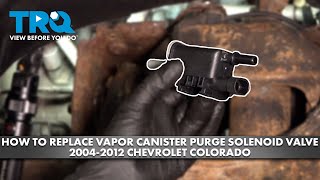
- Remove the plastic push-pins and pull back the fender liner 🎬 See how to access the valve behind the fender liner to expose the engine area behind it.
- Locate the purge solenoid valve. It will have an electrical connector and two EVAP lines attached.
- Inspect the electrical connector and wiring for any visible damage, corrosion, or loose connections.
- If the wiring looks good, disconnect the connector. Use a multimeter to test the solenoid's resistance. A reading outside the typical specification of 15-30 ohms indicates a bad solenoid.
- Test for power at the harness connector. The Pink wire (Terminal A) should have 12V with the ignition on. The other wire (Dark Green/White) is the control wire that the PCM pulses to ground.
- If the solenoid and power supply test good, the issue may be in the ground-side wire running back to the PCM or, rarely, the PCM itself.
Parts You'll Likely Need
- Vapor Canister Purge Solenoid Valve
(OEM #12597567 (supersedes 214-1680))— This is the component that fails most frequently, causing the P0443 electrical circuit code.
Trusted brands: ACDelco (GM Genuine), Dorman, Standard Motor Products (SMP)
OEM price range: $70-$100
Aftermarket price range: $25-$70
Related Codes That Often Appear With This One
- P0444 — This code indicates an 'open' in the purge circuit, which is a more specific version of the general P0443 fault.
- P0445 — This code indicates a 'short' in the purge circuit, another specific version of the general P0443 fault.
- P0496 — Indicates 'EVAP Flow During a Non-Purge Condition.' This can happen if the purge valve fails by physically sticking open, which can occur alongside the P0443 electrical fault.
Platform-Specific Known Issues
- source — A user on a Reddit forum described a year-long issue where the truck would nearly stall on startup after sitting for a few hours, then recover. While their issue was ultimately traced to a bad ignition coil, similar symptoms can be caused by a faulty purge valve sticking open and causing a rich condition on startup.
Technical Service Bulletins (TSBs) & Recalls
- TSB Bulletin #PIP5552 — This preliminary information notes a concern where the Malfunction Indicator Lamp (MIL) illuminates with code P0443 or P0459 setting, indicating that engineering has investigated this specific circuit condition.
- TSB Bulletin #PIT5336 — While documented for other GM models like the Traverse, this bulletin highlights that a P0443 code may be accompanied by an open "Emission 1" fuse. Technicians are advised to inspect and repair any wire damage on the engine harness.
Mechanic-Grade Diagnostic Values
- EVAP Purge Solenoid Coil Resistance — expected: 15-30 Ohms. Failure: An open circuit (infinite ohms) or a shorted circuit (near zero ohms). Some sources give a wider general range of 12-130 ohms for all purge valves, but 15-30 is more specific to GM.
- Voltage at Purge Solenoid Connector (Key On, Engine Off) — expected: Battery Voltage (~12V) on the Pink wire (Terminal A).. Failure: No voltage indicates a blown fuse or a break in the power wire from the fuse block.
- Ground Signal at Purge Solenoid Connector (Engine Running) — expected: A fluctuating or pulsing ground signal on the Dark Green/White wire (Terminal B) when commanded by the PCM. This is best observed with a test light connected to battery positive, which will flash.. Failure: No ground signal suggests a break in the wire to the PCM or a faulty PCM driver.
Scan Tool Commands That Help
- Tech2 / GDS2 (or equivalent professional scanner): EVAP Purge/Seal or EVAP Purge Solenoid Output Control — This bidirectional command allows a technician to manually command the purge solenoid ON and OFF (or to a specific duty cycle percentage) to verify its operation. You should hear an audible click from the solenoid when commanded. It also allows for testing the integrity of the control circuit; if the valve is commanded on but doesn't activate, you can then test the wiring to see if the command signal is reaching the valve.
Wiring & Ground Locations
- EVAP Purge Solenoid Connector — On the EVAP Purge Solenoid, located behind the driver's side front wheel well, mounted to the engine block.. This is the primary connection point to test. Terminal A (Pink wire) is 12V+ power. Terminal B (Dark Green/White wire) is the ground control from the PCM.
- Fuse #27 (2004-2005 models) — In the under-hood fuse block, located on the driver's side of the engine compartment.. This fuse supplies power to the Canister Purge Solenoid. If it's blown, the solenoid will have no power, triggering P0443.
- PCM Connector — The Powertrain Control Module is located on the driver's side of the engine bay, near the firewall.. The Dark Green/White control wire runs from the purge solenoid directly to a pin on the PCM. A continuity test between the solenoid connector and the corresponding PCM pin can rule out a broken wire.
Real Owner Repair Stories
- Reddit user in r/chevycolorado (2016 GMC Canyon 3.6L V6 (Next generation, but same P0443 principle)) — P0443 and P0458 codes.
❌ Tried (didn't work) Cleaning the gas cap., Replacing the purge valve (the code returned after a few months).
✅ What actually fixed it The user tested the new purge valve and found it had infinite resistance (open circuit), indicating the replacement part had failed prematurely. Replacing the valve a second time resolved the issue. - Ask a GM Technician forum user (2008 Chevrolet Colorado) — P0443 Check Engine Light.
❌ Tried (didn't work) Clearing the code (it returned quickly).
✅ What actually fixed it After confirming 12V power at the pink wire of the solenoid connector, the user replaced the EVAP purge solenoid valve, which fixed the problem. The technician on the forum guided them through the electrical test.
Documented NHTSA Reports
- NHTSA ODI #11632222 — An owner reported a "Reduced Propulsion" message and a blown fuse [F03] alongside code P0443, which was attributed to a sticking EGR valve causing the fuse to fail.
- NHTSA ODI #11448862 — A report describes a vehicle where the console stated the engine was offline, with P0443 appearing among a long list of electrical and emissions codes despite the vehicle having low mileage.
- NHTSA ODI #11681144 — An owner documented a failure to circulate coolant properly accompanied by a Check Engine Light and a series of codes including P0443, P06DB, and P0030.
OEM Part Supersession History
214-1680 (ACDelco)→12597567 (GM)— Standard part number update and consolidation across GM platforms.
Heads up: The parts are directly interchangeable. ACDelco 214-1680 is the service part number for GM 12597567.
Model Year Variations Within This Range
- 2004-2008 vs 2009-2012: While the part and its location are the same, the specific fuse box layout and numbering can have minor variations. For example, on 2004-2005 models, the fuse is explicitly labeled as #27 for the 'Can Purge Solenoid'. On later models, it may be grouped under a more generic 'EMIS' or 'ECM' fuse. Always consult the specific diagram for your model year.
Diagnostic Flowchart
Other Known Issues on This Vehicle
Issues unrelated to this code that are worth knowing about as an owner of this generation:
- PassLock Anti-Theft System Failure 🔴 High — Very common across all years. Causes a 'crank, no-start' condition where the truck is disabled for 10 minutes.
- Cracked Exhaust Manifold (especially I5 engines) 🟠 Medium — Common, especially on the 3.5L and 3.7L I5 engines, often occurring around 100,000 miles.
- Worn Valve Seats / Cylinder Head Issues (I5 engines) 🔴 High — A known issue, particularly on 2004-2007 3.5L engines, but can affect later 3.7L models as well. Can occur under 100k miles. (Ref: There is a TSB regarding performing a leakdown test to confirm.)
- Failing Fan Clutch 🟠 Medium — Common failure part as the trucks age.
- Faulty Fuel Level Sensor 🟡 Low — Widespread issue across the generation.
- Blower Motor Resistor Failure 🟡 Low — Extremely common failure item.
Used vs. New Parts: Buying Guide for This Vehicle
When a used part is the smart pick: A used OEM (ACDelco) purge solenoid from a low-mileage donor vehicle can be a cost-effective option, as the failure is typically due to wear over time rather than a fundamental design flaw. Given the low cost of new aftermarket parts, a used part is only logical if it's significantly cheaper or more readily available.
Donor-vehicle mileage cap: roughly under 80000 miles for the part to have meaningful remaining life.
What to inspect on the donor part:
- Test the resistance with a multimeter before purchase; it should be within the 15-30 Ohm range.
- Ensure the plastic housing has no cracks or damage.
- Check that the electrical connector pins are clean, straight, and free of corrosion.
- Try to blow through the valve; no air should pass when it is unpowered.
Aftermarket brands forum-validated for this vehicle:
- ACDelco (OEM)
- Standard Motor Products (SMP)
- Dorman (Generally acceptable for this part, though some users report mixed results with other Dorman electrical components)
Brands owners have reported issues with on this vehicle:
- No-name, unbranded parts from online marketplaces can have high failure rates or incorrect resistance values out of the box.
Real Owner Stories
Aggregated from forums and TSBs cited above. Mileages and costs reflect what owners reported in those sources.
2008 Chevy Colorado 3.7L I5
Symptoms: The truck would nearly stall on startup after sitting for a few hours, then recover. The owner also noted general startup and idling issues.
What fixed it: While the owner initially investigated EVAP faults, the specific issue in this instance was traced to a bad ignition coil, though they noted the purge valve sticking open causes nearly identical rich-condition startup symptoms.
Source hint: Reddit r/chevycolorado thread titled 'Need help 2008 3.7 i5'
2004-2012 Chevrolet Colorado
Symptoms: Check engine light with code P0443 and difficulty accessing the part due to its tricky location.
What fixed it: Replacing the purge solenoid valve located behind the driver's side wheel well.
Source hint: 355nation.net / coloradofans.com forum threads
Related OBD-II Codes
Frequently Asked Questions
Where is the EVAP purge solenoid located on my 2004-2012 Chevrolet Colorado?
Can I test the purge solenoid on my Colorado with a multimeter before buying a new one?
Is there a specific fuse I should check for P0443 on my 2004-2005 Colorado?
Why does my truck struggle to start specifically after I fill up the gas tank?
Which wire should have power at the purge solenoid connector?
Is there a TSB for the rough idle issues on the I5 engine models?
Helpful Videos
Used OEM Parts in Stock

New Aftermarket Parts Available


The information in this article is provided for general reference and educational purposes only. Vehicle specifications, procedures, and part compatibility can vary by production date, trim level, and region. Always consult your vehicle's factory service manual and verify part numbers before purchasing or performing repairs. Safety-critical components such as airbags, seat belts, and braking systems should be installed by a qualified professional.
- Chevrolet Colorado:
- 🧭 Diagnostic Flowchart
- 🎬 Helpful Videos
- 🛍️ Shop This Part
- What's Unique About the 2004-2012 Chevrolet Colorado
- Symptoms You May Notice
- Most Likely Causes
- Rare But Worth Checking
- Diagnosis Steps
- Parts You'll Likely Need
- Related Codes That Often Appear With This One
- Platform-Specific Known Issues
- Technical Service Bulletins (TSBs) & Recalls
- Mechanic-Grade Diagnostic Values
- Scan Tool Commands That Help
- Wiring & Ground Locations
- Real Owner Repair Stories
- Documented NHTSA Reports
- OEM Part Supersession History
- Model Year Variations Within This Range
- Other Known Issues on This Vehicle
- Used vs. New Parts: Buying Guide for This Vehicle
- Real Owner Stories
- 2008 Chevy Colorado 3.7L I5
- 2004-2012 Chevrolet Colorado
- Related OBD-II Codes
- Frequently Asked Questions
- 🎟️ Get 5% Off