

P0443 on 2004-2008 Chrysler Pacifica: EVAP Purge Solenoid Circuit Causes and Fixes
For a 2004-2008 Chrysler Pacifica, code P0443 almost always points to a failed EVAP purge solenoid. This is an electrical circuit code, not a leak code. Replacing the solenoid is a simple DIY job, with the part costing between $30 and $70. It is crucial to verify the correct part for your model year, as there are two different designs.
- P0443 is an electrical circuit code, not a leak code. Do not start by replacing the gas cap.
- The most likely cause is a failed EVAP purge solenoid located in the engine bay.
- There are two different part numbers for the solenoid depending on your vehicle's year. Verify the correct part number before purchasing: 4669569 for 2004-2006 models and 4891741AA (or its successor 4891741AC) for 2007-2008 models.
- This is a very DIY-friendly repair that can be done with basic hand tools in under an hour.
What's Unique About the 2004-2008 Chrysler Pacifica
The 2004-2008 Chrysler Pacifica uses a fairly standard EVAP system, and like many Chrysler vehicles of this era, the purge solenoid is a common failure item. There are two different purge solenoid designs used across this year range, so it is critical to get the correct part for your specific year and engine. While leak codes (like P0455/P0456) on this vehicle are sometimes caused by a cracked nipple on the fuel pump module, the P0443 circuit code is more straightforward and almost always leads back to the purge solenoid in the engine bay.
Symptoms You May Notice
- Check Engine Light is on
- Slightly rough idle
- Minor decrease in fuel economy
- Possible fuel odor
- Difficulty starting the engine, especially after refueling
- Replacing the gas cap. P0443 is an electrical circuit code, not a leak code. A bad gas cap will typically cause codes like P0455 or P0457.
Most Likely Causes
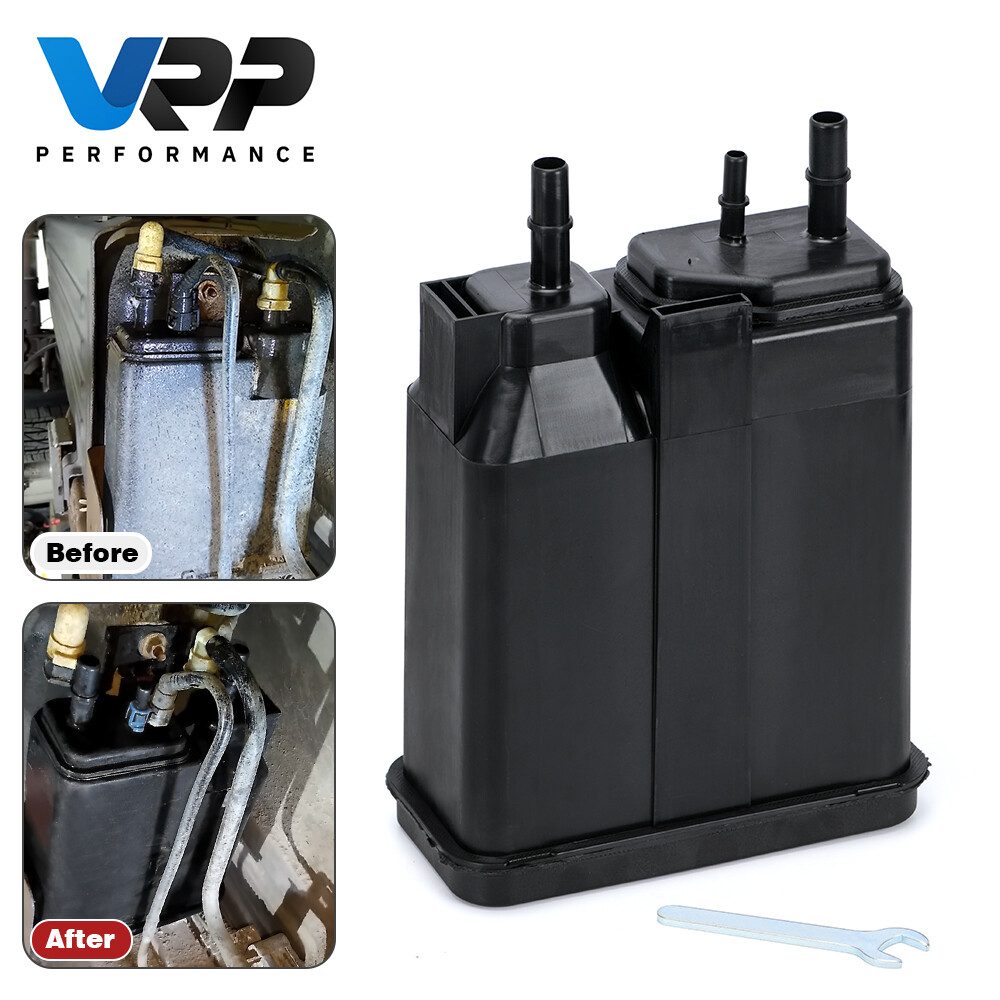
- Failed EVAP Purge Solenoid 🔴 High Probability → Shop Vapor Canister The solenoid is an electromechanical part that cycles thousands of times and is a common failure item across most Chrysler models from this period. It is responsible for controlling the flow of fuel vapors from the charcoal canister to the engine.
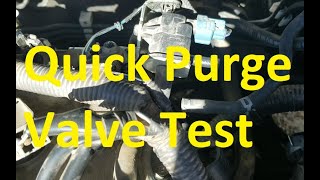
How to confirm: Locate the solenoid in the engine bay, typically mounted near the intake manifold with two hoses and an electrical connector. With the engine off, disconnect the hoses and try to blow through it; it should be closed (no air passes). Apply 12V directly to the solenoid's pins with jumper wires; it should make an audible click and open, allowing air to pass. If it fails either test, it is bad. 🎬 Watch: How to test an EVAP purge valve without tools A multimeter can also be used to test the coil's resistance, which should be between 14 and 30 ohms.
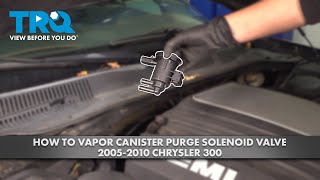
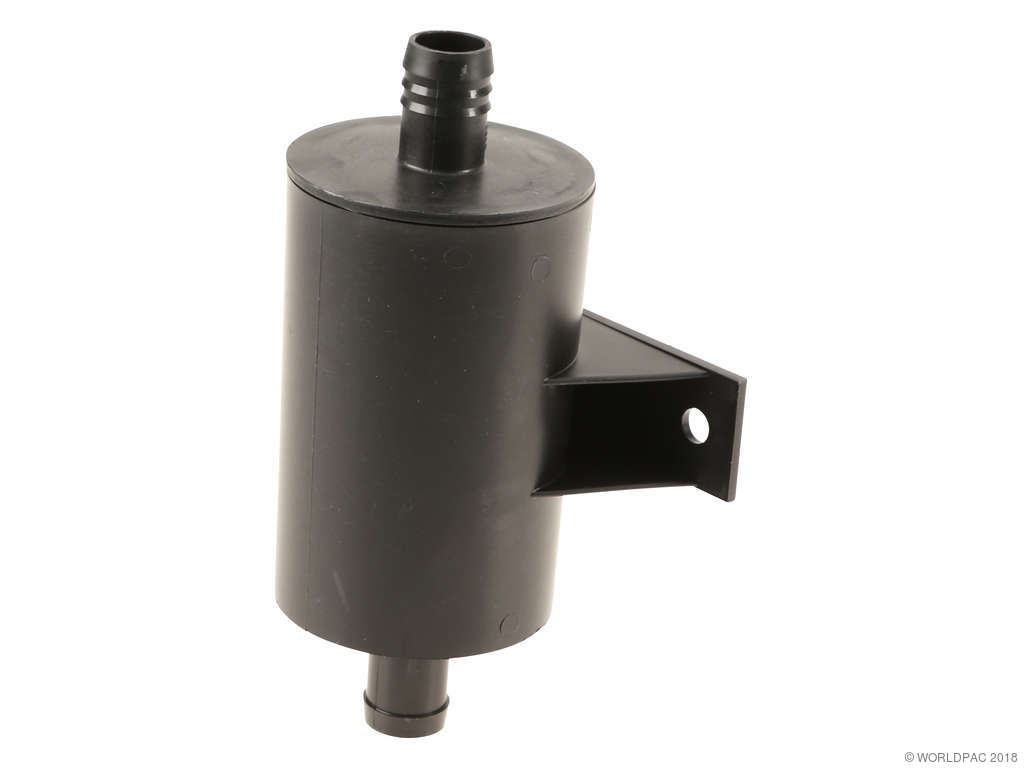
Typical fix: Replace the purge solenoid. This is a simple repair involving disconnecting the electrical plug, two hoses, and removing the solenoid from its mounting bracket.
Est. part cost: $30-$70 - Damaged Wiring or Connector 🟡 Medium Probability Engine bay heat and vibrations can cause wires to become brittle and crack or connectors to become loose or corroded over time. Rodents can also chew through wires.
How to confirm: Visually inspect the wiring harness leading to the purge solenoid for any signs of cracking, chafing, melting, or tape that might indicate a previous repair. Check that the connector is fully seated and that the pins inside are clean and not corroded. Use a multimeter to check for 12V power at the connector with the key on. The other wire is a ground controlled by the PCM.
Typical fix: Repair the damaged section of wire or clean the connector pins. If the connector itself is broken, it may need to be replaced.
Est. part cost: $5-$25
Rare But Worth Checking
- Blown Fuse: The purge solenoid circuit is protected by a fuse. While not common, it's a quick and easy check before replacing more expensive parts. Check the fuse box diagram for the fuse related to emissions components.
- Faulty Powertrain Control Module (PCM): → Shop Engine Control Module (ECM) This is the least likely cause. The internal driver circuit in the PCM that controls the solenoid can fail. This should only be considered after the solenoid and its entire circuit have been thoroughly tested and confirmed to be good. Some shops have noted that on Chrysler vehicles, a faulty PCM driver can be the culprit after a new purge valve doesn't fix the issue.
Diagnosis Steps
- Read the code with an OBD-II scanner to confirm P0443 is present.
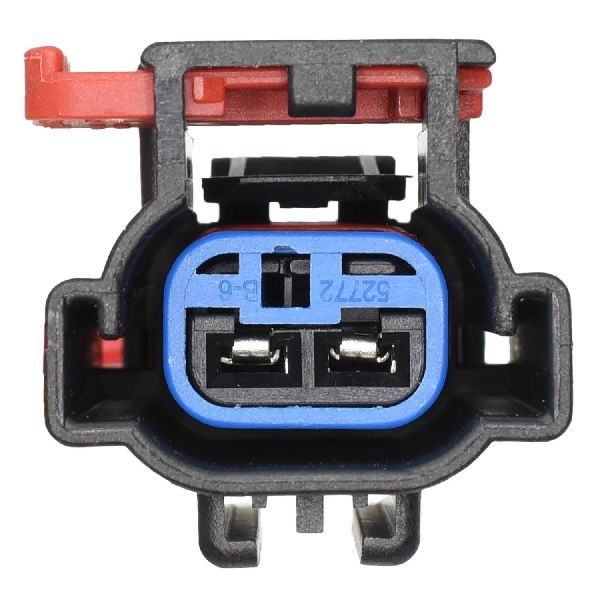
- Locate the EVAP purge solenoid in the engine bay. It will have two hoses and a two-wire electrical connector. It is generally mounted on or near the intake manifold.
- Inspect the electrical connector and wiring harness for any visible damage, corrosion, or loose connections.
- Disconnect the connector. With the ignition on, use a multimeter to verify that one pin has battery voltage (around 12V). The other pin is the ground side, which is controlled (pulsed) by the PCM.
- Test the solenoid itself. With the solenoid disconnected, try blowing through it. No air should pass. Then, use jumper wires to apply 12V and ground to the two pins on the solenoid. It should make an audible click and allow air to pass. If it fails either of these tests, the solenoid is faulty and needs to be replaced. Alternatively, measure the resistance across the solenoid's pins; a reading between 14-30 ohms is considered good.
- If the solenoid tests good and the wiring appears intact, the final step would be to check for continuity on the ground control wire between the solenoid connector and the PCM. A break in this wire will also set P0443. 🎬 Watch: Diagnosing a P0443 circuit malfunction A resistance of less than 5.0 ohms is expected on this wire. If the wiring is good, the fault may be within the PCM, which is rare but possible.
Parts You'll Likely Need
- Vapor Canister Purge Solenoid (2004-2006)
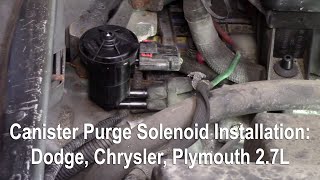
(OEM #4669569)— This is the correct solenoid for the earlier 3.5L and 3.8L V6 engines and is the most common failure part for code P0443. 🎬 See this step-by-step Chrysler purge solenoid replacement This part is also used on many other Chrysler products from the era, including the PT Cruiser and some Jeeps.
Trusted brands: Mopar, Dorman (911-202), Standard Motor Products
OEM price range: $60-$80
Aftermarket price range: $30-$55 - Vapor Canister Purge Solenoid (2007-2008)
(OEM #4891741AA)— This is the correct solenoid for the later 3.8L and 4.0L V6 engines. It has a different design from the earlier part. This part number has been superseded by 4891741AC.
Trusted brands: Mopar, Dorman, Wells
OEM price range: $50-$70
Aftermarket price range: $25-$50
Related Codes That Often Appear With This One
- P0441 — P0441 indicates incorrect purge flow. A purge solenoid that is electrically faulty (P0443) cannot open or close correctly, leading to a flow performance code.
- P0444 — P0444 indicates the purge control valve circuit is open. This is a more specific version of the P0443 circuit fault and often points directly to a broken wire, bad connector, or failed solenoid coil.
Mechanic-Grade Diagnostic Values
- EVAP Purge Solenoid Coil Resistance — expected: 14 to 30 Ohms. Failure: An infinite reading (Open Loop) or near-zero ohms (short circuit) indicates a failed solenoid coil.
- Purge Solenoid Connector Power Wire Voltage (Key On, Engine Off) — expected: ~12 Volts (Battery Voltage). Failure: Voltage significantly below 10V suggests a problem in the power supply circuit (fuse, relay, or wiring), not the valve itself.
- Purge Solenoid Control Wire Continuity to PCM — expected: Less than 5.0 Ohms. Failure: A reading higher than 5.0 Ohms or an open circuit (OL) indicates a break in the wire between the solenoid connector and the PCM.
Scan Tool Commands That Help
- Chrysler wiTECH or equivalent professional scanner: EVAP Purge Solenoid Actuation / Duty Cycle Test — This command allows a technician to manually cycle the solenoid on and off to listen for an audible click, confirming mechanical operation without having to apply 12V manually. It also allows for testing the control circuit wire for a pulsed ground signal from the PCM while the command is active.
Real Owner Repair Stories
- YouTube video on a 1998 Mercury Sable (demonstrates a common Chrysler/Ford issue) (1998 Mercury Sable) — P0443 code, plus rich running codes on both banks.
❌ Tried (didn't work) Initial diagnosis pointed towards the purge solenoid itself.
✅ What actually fixed it The PCM had an internal short to ground, which held the purge valve open constantly. This caused a continuous flow of fuel vapors, leading to the rich condition. Replacing the PCM resolved all codes and symptoms.
OEM Part Supersession History
4891741AA→4891741AC— Standard part revision and update by the manufacturer.
Heads up: The new part number (4891741AC) is a direct replacement for the old one and is fully compatible with all vehicles that used the original part.
Diagnostic Flowchart
Other Known Issues on This Vehicle
Issues unrelated to this code that are worth knowing about as an owner of this generation:
- Engine Cradle / Subframe Rust and Corrosion 🔴 High — Very common, especially in 'salt belt' states. Can become structurally unsafe, with mechanics noting the engine could potentially fall. Numerous complaints and a class-action lawsuit have been filed regarding this issue. (Ref: Chrysler issued limited warranty extensions and TSBs, but they were controversially restricted to very specific build dates and regions, leaving many owners without coverage.)
- Excessive Oil Consumption (3.8L V6) 🟠 Medium — A known characteristic of the 3.8L V6 engine, often developing at higher mileage. Consumption of 1 quart per 1,000 miles is considered 'acceptable' by Chrysler.
- Motor Mount Failure 🟠 Medium — The hydraulic engine mounts are prone to leaking and collapsing over time, leading to engine vibration and noise. This is often discovered when diagnosing the subframe rust issue.
- Broken Rocker Arm Shaft Retaining Pin (3.5L V6) 🟠 Medium — Can occur around 100,000 miles, causing a distinct ticking noise from the engine as the shaft spins and blocks oil flow.
Used vs. New Parts: Buying Guide for This Vehicle
When a used part is the smart pick: A used OEM purge solenoid from a low-mileage donor vehicle can be a cost-effective alternative to a new aftermarket part, especially if OEM performance is desired without the cost. Given the simple electromechanical nature of this part, a used one is a reasonable gamble.
Donor-vehicle mileage cap: roughly under 80000 miles for the part to have meaningful remaining life.
What to inspect on the donor part:
- Check for cracks in the plastic housing.
- Ensure the electrical connector pins are clean, straight, and free of corrosion.
- Inspect the hose ports for any blockages or debris.
- If possible, test the resistance with a multimeter before purchase; it should be between 14-30 ohms.
OEM-only on this vehicle (don't cheap out):
- Powertrain Control Module (PCM) - Due to the need for VIN-specific programming, a used PCM is often not a straightforward swap and a new or professionally refurbished, programmed unit is recommended.
Aftermarket brands forum-validated for this vehicle:
- Standard Motor Products (SMP)
- Wells
Brands owners have reported issues with on this vehicle:
- While Dorman is a common aftermarket brand with wide availability and some innovative 'OE FIX' parts, their general quality can be inconsistent. For a critical emissions component like a purge solenoid, some technicians prefer to use OEM or trusted brands like SMP over entry-level Dorman parts to avoid premature failure.
Real Owner Stories
Aggregated from forums and TSBs cited above. Mileages and costs reflect what owners reported in those sources.
2004 Pacifica
Symptoms: The owner's wife reported the Check Engine light came on while driving home; a scanner confirmed code P0443 EVAP purge flow fault.
What fixed it: A forum member suggested checking the wiring connection to the evap purge solenoid, though the owner did not confirm the final component replaced.
Source hint: Chrysler Forum - "Code P0443 EVAP purge flow fault"
2008 Pacifica — 199548 miles
Symptoms: Check engine light with code P0443.
What fixed it: Replaced the PCM (Powertrain Control Module), which solved the code but caused the fuel gauge to stop working.
Source hint: Chrysler Pacifica: P0443 - Opinautos
Related OBD-II Codes
Frequently Asked Questions
Where is the EVAP purge solenoid located on my 2004-2008 Pacifica?
Can I use a multimeter to test if my Pacifica's purge solenoid is bad?
Is the P0443 code related to the common engine cradle rust issue on this vehicle?
Why does my Pacifica have trouble starting specifically after I fill up the gas tank?
Are there specific aftermarket brands I should use or avoid for this repair?
Could a bad PCM be causing the P0443 code on my 2008 Pacifica?
Helpful Videos

Used OEM Parts in Stock
New Aftermarket Parts Available


The information in this article is provided for general reference and educational purposes only. Vehicle specifications, procedures, and part compatibility can vary by production date, trim level, and region. Always consult your vehicle's factory service manual and verify part numbers before purchasing or performing repairs. Safety-critical components such as airbags, seat belts, and braking systems should be installed by a qualified professional.
- Chrysler Pacifica:
- 🧭 Diagnostic Flowchart
- 🎬 Helpful Videos
- 🛍️ Shop This Part
- What's Unique About the 2004-2008 Chrysler Pacifica
- Symptoms You May Notice
- Most Likely Causes
- Rare But Worth Checking
- Diagnosis Steps
- Parts You'll Likely Need
- Related Codes That Often Appear With This One
- Mechanic-Grade Diagnostic Values
- Scan Tool Commands That Help
- Real Owner Repair Stories
- OEM Part Supersession History
- Other Known Issues on This Vehicle
- Used vs. New Parts: Buying Guide for This Vehicle
- Real Owner Stories
- 2004 Pacifica
- 2008 Pacifica — 199548 miles
- Related OBD-II Codes
- Frequently Asked Questions
- 🎟️ Get 5% Off