

P0443 on 2011-2014 Ford F-150 3.7L V6: EVAP Purge Valve Circuit Causes and Fixes
For the 2011-2014 F-150, code P0443 is almost always caused by a failed EVAP purge valve located on top of the engine. It's an electrical fault, not a leak. A replacement Motorcraft valve costs about $50-$70 and is a simple 15-minute DIY fix.
- P0443 is an electrical circuit code, not a leak code. Do not start by replacing the gas cap or performing a smoke test.
- The most likely culprit is the EVAP purge valve itself, which is a very common failure item on this truck.
- Before replacing the valve, check for other circuit codes (like for O2 sensors or VCT solenoids). If present, the problem is almost certainly a shared blown fuse, likely F95 in the under-hood fuse box.
- A visual inspection of the wiring harness near the purge valve connector for chafing or rodent damage is a critical and easy first step.
What's Unique About the 2011-2014 Ford F-150
On the 12th generation F-150 (2009-2014), the EVAP purge valve is a very common failure item across all engine options, including the 3.7L V6. Its location on top of the engine makes it susceptible to heat and vibration but also extremely accessible for a quick DIY replacement. Additionally, Ford issued a recall (18S32) for a stuck purge valve that could lead to fuel tank deformation, which includes these model years and is addressed with a PCM software update and potential valve replacement. The soy-based insulation used in the wiring harness can also attract rodents, making chewed wires a specific possibility.
Symptoms You May Notice
- Check Engine Light is on
- Slightly rough idle
- Difficulty starting the engine, particularly right after filling the gas tank 🎬 Watch: Why your F-150 struggles to start after refueling.
- Audible rapid clicking from the purge valve area
- Reduced fuel economy
- Inaccurate or erratic fuel gauge indication or inaccurate distance to empty (DTE), as noted in reports like NHTSA ODI #11443669.
- Replacing the gas cap. A bad gas cap causes EVAP leak codes (like P0455 or P0457), not an electrical circuit code like P0443.
- Replacing the EVAP canister vent solenoid. This part is located near the fuel tank and has its own specific trouble code (P0446).
- Performing a smoke test. A smoke test is used to find physical leaks in the EVAP system, but P0443 is an electrical fault.
Most Likely Causes
- Faulty EVAP Purge Valve/Solenoid 🔴 High Probability → Shop Vapor Canister The part is a common failure item on this platform due to heat and vibration from its location on the engine.
How to confirm: Disconnect the electrical connector and measure the resistance across the two pins on the valve with a multimeter. A reading of roughly 14-30 ohms is expected, though some sources cite a wider range up to 50 ohms. An infinite reading (open) or near-zero reading (short) confirms a bad valve. You can also try to blow air through it; it should be closed (no air passes) when de-energized.
Typical fix: Replace the EVAP purge valve assembly.
Est. part cost: $45-$70 for a Motorcraft part, $110-$180 for a Ford OEM part. - Damaged Wiring or Connector 🟡 Medium Probability The wiring harness is routed in the engine bay where it can be susceptible to heat damage, chafing on brackets, or rodent damage due to soy-based wire insulation.
How to confirm: Visually inspect the wiring harness leading to the purge valve for any breaks, chafing, or signs of being chewed. With the key on, use a multimeter to confirm one of the pins in the connector has battery voltage.
Typical fix: Repair the broken or shorted wire. If the connector is damaged, replace the connector pigtail.
Est. part cost: $10-$25 for a new connector pigtail. - Blown Fuse ⚪ Low Probability The EVAP purge valve shares a power circuit with other components like the VCT solenoids and O2 sensor heaters. A short in any of these components can blow the shared fuse.
How to confirm: Check for other circuit-related codes (e.g., P0010, P0013, P0135). Inspect the fuse for the EVAP system in the under-hood fuse box. Forum users and videos specifically point to fuse #95 in the power distribution box for causing this issue.
Typical fix: Replace the blown fuse. If the fuse blows again immediately, you must diagnose the short circuit in the wiring or one of the connected components.
Est. part cost: $1-$5
Rare But Worth Checking
- Faulty Powertrain Control Module (PCM): → Shop Engine Control Module (ECM) This is extremely rare. The PCM's internal driver for the purge valve circuit can fail. This should only be considered after the valve, wiring, and fuses have all been proven to be good.
Diagnosis Steps
- Read the codes with an OBD-II scanner and confirm P0443 is present. 🎬 See how to diagnose a P0443 circuit malfunction code. Note any other codes.
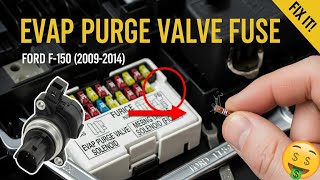
- If multiple circuit codes are present (e.g., P0010, P0135), immediately inspect the shared fuse in the under-hood fuse box, specifically checking location F95. 🎬 Watch: How to find and replace the EVAP solenoid fuse. Manufacturer Bulletin #TSB 16-0163 notes that P0443 can appear alongside a wide range of other codes including P0010, P0135, and P0141, requiring specific service procedures to correct.
- Locate the purge valve on the top front of the engine.
- Visually inspect the electrical connector and the first 6-8 inches of wiring for any obvious damage, chafing, or rodent activity. Pay close attention to where the harness may rub against brackets.
- Disconnect the connector. With the ignition on (engine off), use a multimeter to verify that one of the two pins in the harness connector has battery voltage (approx. 12V).
- With the connector still off, measure the resistance between the two pins on the purge valve itself. A good valve will read between 14 and 30 ohms. An infinite reading means the coil is open; a reading near zero means it's shorted. Either case requires valve replacement.
- If wiring has voltage and the valve's resistance is good, the issue may be in the ground control wire running back to the PCM, or a rare PCM failure.
Parts You'll Likely Need
- Vapor Canister Purge Valve
(OEM #BL3Z-9C915-A)— This is the most common failure point for code P0443 on this vehicle. The internal solenoid coil fails, creating an open or short circuit.
Trusted brands: Motorcraft (CX-2409), Standard Motor Products (SMP), Dorman
OEM price range: $110-$180
Aftermarket price range: $45-$70
Related Codes That Often Appear With This One
- P1450 — A purge valve that is stuck open (a potential cause of the P0443 circuit fault) can prevent the fuel tank from venting properly, causing excessive vacuum and triggering P1450. This is the exact scenario described in Ford's Recall 18S32. NHTSA ODI #11633558 and #11427851 both document P0443 appearing simultaneously with P1450.
- P0010, P0013, P0020, P0023, P0135, P0141, P0155, P0161 — These are all circuit codes for other engine components (VCT solenoids, O2 sensor heaters). If they appear with P0443, it strongly indicates a blown fuse (likely F95) that is common to all of these parts.
- P0420, P0452, P0456, P0460, P2196 — As noted in NHTSA ODI #11427851, these codes may also accompany P0443 during an EVAP system failure.
Technical Service Bulletins (TSBs) & Recalls
- Recall 18S32 / 18V735: PCM software may not adequately detect a stuck-open canister purge valve, which can lead to excessive fuel tank vacuum and potential engine stalling.
- Bulletin #TSB 16-0163: Addresses conditions where P0443 is present alongside multiple other DTCs (such as P0010, P0135, P0141, and P0300), requiring a specific service procedure to correct the electrical faults.
Platform-Specific Known Issues
- Recall 18S32 / NHTSA 18V735 was issued for a canister purge valve (CPV) that could stick open, leading to excessive vacuum in the fuel system, potential fuel tank deformation, inaccurate fuel gauge readings, and engine stalling. The fix involves a PCM software update and, if needed, replacement of the CPV.
Mechanic-Grade Diagnostic Values
- EVAP Purge Valve Connector - Power Pin Voltage — expected: Approximately 12V (Battery Voltage) with Key On, Engine Off.. Failure: No voltage or significantly low voltage points to a blown fuse (F95) or a break in the power wire.
- EVAP Purge Valve Connector - Ground Pin (Control) — expected: The PCM supplies a ground to activate the valve. With a test light connected to battery positive, the light should flash or illuminate when the PCM is commanded to open the valve via a scan tool.. Failure: No flashing/illumination when commanded indicates a break in the control wire to the PCM or a faulty PCM driver.
- Scan Tool PID: EVAPCP (EVAP Canister Purge Duty Cycle) — expected: Should read 0% at idle/startup when commanded closed. The percentage will increase as the PCM commands purge flow.. Failure: The value does not match the commanded state, indicating a circuit or valve problem.
- Scan Tool PID: EVMV (EVAP Purge Valve Monitor) — expected: When commanded closed, EVMV should be 0 mA and voltage should be near battery voltage. When commanded fully open (100% duty cycle), EVMV should be ~1,000 mA and voltage should drop by at least 3 volts.. Failure: Readings do not match the commanded state, confirming a circuit or component fault.
Scan Tool Commands That Help
- Ford IDS (Integrated Diagnostic System): Vapor Management Valve / Canister Purge Valve Control — This is a bidirectional control that allows a technician to manually command the purge valve open and closed (or to a specific percentage). It is the definitive test to determine if the valve is physically working. While commanding the valve open, a technician can listen for a click and watch for a change in fuel trims or engine vacuum to confirm its operation, separating a bad valve from a wiring issue.
Wiring & Ground Locations
- EVAP Purge Valve Connector — On top of the engine's intake manifold, near the throttle body.. This is the primary connection point for testing. It has two pins.
- Pin 1 (Control Wire) — On the EVAP purge valve connector harness side.. This is the EVAPCP (EVAP Canister Purge) wire. It is the ground-side control wire that runs back to the PCM. A break in this wire will cause an open circuit fault.
- Pin 2 (Power Wire) — On the EVAP purge valve connector harness side. The wire is typically Red with a Yellow stripe (RD/YE).. This is the VPWR (Vehicle Power) wire that supplies battery voltage to the valve. It receives power from fuse F95 in the under-hood fuse box. No voltage here is a primary indicator of a blown fuse or an open in the power feed wire.
- Fuse F95 — In the under-hood power distribution box (fuse box).. This 25A fuse provides power to the EVAP purge valve, VCT solenoids, and O2 sensor heaters. When it blows, multiple circuit codes (P0443, P0010, P0135, etc.) will appear simultaneously.
Real Owner Repair Stories
- Go-Parts.com Blog / F150Forum.com (2011 F-150 3.7L V6) — Check engine light with code P0443.
❌ Tried (didn't work) Not specified, but the owner diagnosed an electrical fault.
✅ What actually fixed it Found a bare wire rubbing on a metal bracket about 6 inches from the purge valve plug. The owner repaired the wire and replaced the connector pigtail to resolve the code. - Ford F150 Forum (2016 F-150 3.5L EcoBoost (similar shared fuse architecture)) — Sluggishness, lack of acceleration, and multiple codes: P0443, P0010, P0013, P0020, P0023, P0135 & P0141.
❌ Tried (didn't work) Replaced EVAP purge valve, Swapped camshaft sensors
✅ What actually fixed it After advice on the forum to check for a shared power issue, the owner found and replaced a blown 25A fuse in position 95 of the under-hood fuse box. This single fuse fixed all the codes. - NHTSA ODI #11725076 — An owner reported that the check engine light comes on often due to issues when getting fuel, specifically citing code P0443 for the evap purge control valve "a" circuit.
When the Usual Fixes Don't Work
- In a case reported on a forum, a user replaced the purge valve twice for a P0443 code, but the code kept returning. The user suspected a PCM failure, highlighting that simply replacing the most common part isn't always the fix, and a deeper electrical diagnosis (wiring, connectors, PCM driver) is necessary when the code persists.
OEM Part Supersession History
Not specified, but BL3Z-9C915-A is the primary replacement.→The Motorcraft service part is CX-2409. Some parts sites also list CX2400 as an alternate name for the OEM part.— Standard part lifecycle and service part branding.
Heads up: Some aftermarket replacements may use plastic fittings where the original part used metal, though this does not typically affect function. Be aware that many part numbers like AU5Z-9C915-B are for other Ford vehicles and may not be correct for the F-150 despite looking similar.
Diagnostic Flowchart
Other Known Issues on This Vehicle
Issues unrelated to this code that are worth knowing about as an owner of this generation:
- Transmission Lead Frame Failure (Sudden Downshift) 🔴 High — Common enough to trigger a recall (19S07) and extended warranty program (16M02). Affects trucks with the 6R80 6-speed automatic transmission, causing an unexpected downshift to 1st gear at speed. (Ref: Recall 19S07, Customer Satisfaction Program 16M02)
- Electronic Power Assist Steering (EPAS) Failure 🔴 High — A widely reported issue where the electric power steering rack fails suddenly, resulting in a complete loss of power assist. It is an expensive repair as the entire steering rack assembly typically needs replacement.
- Internal Water Pump Failure (Transverse Engines Only) 🔴 High — This is a catastrophic failure mode for *transverse-mounted* 3.7L V6 engines (e.g., Ford Edge, Lincoln MKX), where the timing-chain-driven water pump fails and leaks coolant directly into the engine oil. The F-150's RWD layout uses a traditional, less problematic external water pump. (Ref: TSB exists for some models)
- Brake Vacuum Pump / Booster Issues 🟠 Medium — Some owners report issues with either a vacuum pump that leaks oil or a failing brake booster, leading to a hard brake pedal and reduced stopping power.
- Cracked/Leaking Plastic Coolant Fittings 🟡 Low — Over time, plastic components in the cooling system, such as the coolant reservoir nipple or hose elbows, can become brittle and crack, leading to coolant leaks. This is considered a maintenance item to watch for as the vehicle ages.
Used vs. New Parts: Buying Guide for This Vehicle
When a used part is the smart pick: A used OEM purge valve from a low-mileage donor vehicle is a reasonable choice. The part is external to the engine, easy to access, and not a major mechanical wear item. Its failure mode is typically electrical (coil burnout) rather than from mileage-based wear.
Donor-vehicle mileage cap: roughly under 75000 miles for the part to have meaningful remaining life.
What to inspect on the donor part:
- Ensure the electrical connector pins are clean, straight, and free of corrosion.
- Check the plastic housing for cracks or heat damage.
- Verify the O-ring that seals against the intake manifold is present and not dried out or cracked.
- If possible, test the resistance with a multimeter before purchase; it should be within the 14-30 ohm range.
OEM-only on this vehicle (don't cheap out):
- Powertrain Control Module (PCM) - Due to the need for VIN-specific programming, a used PCM is not a simple plug-and-play solution and should be sourced from specialized suppliers who can program it for your vehicle.
Aftermarket brands forum-validated for this vehicle:
- Motorcraft (CX-2409) is the OEM service part and the most recommended.
- Standard Motor Products (SMP) is a well-regarded aftermarket brand for electrical components and offers a replacement connector pigtail (S2840).
Brands owners have reported issues with on this vehicle:
- No specific brands are consistently cited as problematic, but ultra-cheap, unbranded parts from online marketplaces carry a higher risk of premature failure or being out-of-spec.
Real Owner Stories
Aggregated from forums and TSBs cited above. Mileages and costs reflect what owners reported in those sources.
2011 Ford F-150 3.7L V6
Symptoms: Found a bare wire rubbing on a metal bracket which caused the circuit issue.
What fixed it: Repaired the damaged wiring harness.
Source hint: go-parts.com/blog
2011-2014 Ford F-150 3.7L V6
Symptoms: Multiple circuit codes including P0443 and O2 heater codes appearing simultaneously.
What fixed it: Replaced a single blown 25A fuse in position 95.
Source hint: f150forum.com - Thread 'Code P0443'
2012 Ford Mustang 3.7L V6
Symptoms: Intermittent vacuum leak hiss along with code P0443 and other related codes.
What fixed it: Diagnosed as a common EVAP/purge valve issue shared across the 3.7L platform.
Source hint: Reddit.com/r/Cartalk - '2012 Mustang'
Ford Owner Report (NHTSA ODI #11633558)
Symptoms: Multiple default codes including P0443, P1450, and P0456 appeared after a diagnostic test.
What fixed it: Inspection at a dealership identified an Evap system related disconnect on the line.
Source hint: NHTSA ODI #11633558
Related OBD-II Codes
Frequently Asked Questions
Is there a recall for the purge valve on my 2011-2014 Ford F-150?
Why does my F-150 3.7L struggle to start only after I fill up the gas tank?
I have P0443 along with P0010 and P0135. Could these be related?
Where is the purge valve located on the 3.7L V6 engine?
Can I just replace the fuse if it's blown?
What should the resistance be when testing the F-150 purge valve?
Helpful Videos

Used OEM Parts in Stock

New Aftermarket Parts Available


The information in this article is provided for general reference and educational purposes only. Vehicle specifications, procedures, and part compatibility can vary by production date, trim level, and region. Always consult your vehicle's factory service manual and verify part numbers before purchasing or performing repairs. Safety-critical components such as airbags, seat belts, and braking systems should be installed by a qualified professional.
- Ford F-150:
- 🧭 Diagnostic Flowchart
- 🎬 Helpful Videos
- 🛍️ Shop This Part
- What's Unique About the 2011-2014 Ford F-150
- Symptoms You May Notice
- Most Likely Causes
- Rare But Worth Checking
- Diagnosis Steps
- Parts You'll Likely Need
- Related Codes That Often Appear With This One
- Technical Service Bulletins (TSBs) & Recalls
- Platform-Specific Known Issues
- Mechanic-Grade Diagnostic Values
- Scan Tool Commands That Help
- Wiring & Ground Locations
- Real Owner Repair Stories
- When the Usual Fixes Don't Work
- OEM Part Supersession History
- Other Known Issues on This Vehicle
- Used vs. New Parts: Buying Guide for This Vehicle
- Real Owner Stories
- 2011 Ford F-150 3.7L V6
- 2011-2014 Ford F-150 3.7L V6
- 2012 Ford Mustang 3.7L V6
- Ford Owner Report (NHTSA ODI #11633558)
- Related OBD-II Codes
- Frequently Asked Questions
- 🎟️ Get 5% Off