

P0443 on 2011-2019 Ford Fiesta: EVAP Purge Valve Circuit Causes and Fixes
On a 2011-2019 Ford Fiesta, code P0443 is almost always caused by a failed EVAP purge valve or a broken wire at its connector. The purge valve is a common failure item, is inexpensive (~$25-$50 for the part), and is easy to replace for a DIYer. Before replacing parts, check the wiring right at the valve's connector, as it's a known weak point.
- P0443 on a Ford Fiesta points to an electrical fault in the purge valve circuit, not a system leak.
- The most likely cause is a bad purge valve itself, which is a cheap and easy part to replace.
- Before replacing the valve, always inspect the wiring at the connector for breaks, as this is the second most common cause.
- Do not start by replacing the gas cap, as it is unrelated to this specific circuit code.
- This is a very DIY-friendly repair that can be completed in under 30 minutes with basic tools.
What's Unique About the 2011-2019 Ford Fiesta
The 2011-2019 Ford Fiesta (US Generation Mk6) uses a canister purge valve that is a very common failure point, a trend seen across many Ford models from this era. While there isn't a specific recall for the Fiesta for this code, the closely related Ford Focus had a major recall (18S32) and multiple Technical Service Bulletins (TSBs) for a faulty purge valve that could deform the fuel tank. This indicates a high probability that the valve itself is the culprit when P0443 appears on a Fiesta. Forum discussions for the Fiesta specifically confirm the high failure rate of both the valve and its electrical pigtail.
Symptoms You May Notice
- Check Engine Light is on
- Slightly rough idle
- Difficulty starting, especially after refueling (if the valve is stuck open)
- Faint fuel odor (less common)
- Slight decrease in fuel economy
- Inaccurate or erratic fuel gauge indication or distance to empty (DTE) readings, as noted in reports like NHTSA ODI #11443669.
- Replacing the gas cap. Gas cap issues typically cause large leak codes like P0455 or small leak codes like P0456, not a circuit code like P0443.
Most Likely Causes
- Failed EVAP Canister Purge Valve 🔴 High Probability → Shop Vapor Canister This specific part has a high failure rate on Ford vehicles of this vintage, as evidenced by owner forums and recalls on similar models like the Focus. The internal solenoid coil can fail, creating an open or short circuit detected by the PCM.
How to confirm: With the engine off, disconnect the valve and test its resistance with a multimeter; an open circuit (infinite resistance) or short (zero resistance) indicates failure. A typical resistance for a good valve is between 20-30 ohms. Alternatively, you can apply 12V and ground to the pins; a healthy valve will make an audible click. The valve should also be closed by default; if you can blow air through it when it's disconnected, it's stuck open and has failed mechanically.
Typical fix: Replace the purge valve and its associated hoses if they are brittle. It is often sold as an assembly with the hoses. 🎬 See this step-by-step guide on replacing the purge valve assembly.
Est. part cost: $25-$75 - Broken Wire at Purge Valve Connector 🟡 Medium Probability → Shop Vapor Canister The wiring harness makes a sharp bend near the connector, and engine vibration can cause the wires to fatigue and break internally over time, often right at the back of the connector. This is a well-documented failure point in owner forums and repair videos.
How to confirm: Visually inspect the wires going into the purge valve connector. Gently wiggle and pull on each wire; a broken wire may stretch or pull out completely. With the key on (engine off), use a multimeter to check for 12V power on one wire and a ground signal on the other. The power wire is often Yellow/Blue or a similar color, while the control wire (ground from PCM) varies.
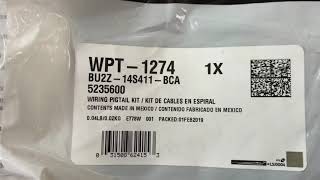
Typical fix: Repair the broken wire using a new pigtail connector (Motorcraft WPT-1293 is a common example) by soldering the new connector in and protecting it with heat shrink tubing.
Est. part cost: $20-$40 for a pigtail - Blown Fuse ⚪ Low Probability
How to confirm: Check your owner's manual for the fuse box diagram. In the engine compartment fuse box, locate the fuse for the EVAP system. For many Fiesta models, this is fuse F26 (7.5A), which powers the 'Canister purge valve'.
Typical fix: Replace the blown fuse. If the new fuse blows immediately, it indicates a short circuit in the wiring or the purge valve itself that must be found and repaired.
Est. part cost: $1-$5
Rare But Worth Checking
- Faulty Powertrain Control Module (PCM): → Shop Engine Control Module (ECM) This is extremely rare. The PCM's internal driver for the purge valve circuit can fail, but this should only be considered after all other possibilities (valve, wiring, fuses) have been exhaustively ruled out.
Diagnosis Steps
- Read the code: Use an OBD-II scanner to confirm P0443 is the primary code present.
- Locate the purge valve: Open the hood and find the purge valve. On the Fiesta, it's in the engine bay, mounted near the intake manifold with two hoses and an electrical connector.
- Inspect the wiring: This is a critical step. Carefully examine the electrical connector and the wires leading to it. Gently tug on the wires to check for breaks inside the insulation, especially right at the connector where they bend.
- Check for power: Turn the ignition to 'ON' without starting the engine. Disconnect the purge valve connector and use a multimeter to verify that one of the pins has battery voltage (approx. 12 volts).
- Test the valve: If power is present at the connector, the valve is the next suspect. Disconnect the valve and test its internal resistance with a multimeter. A reading of infinity (OL) or zero indicates a failed coil. A good coil should have a resistance typically in the 20-30 ohm range. You can also try applying a 12V power source directly to the valve's pins to see if it clicks open and closed.
- Check for blockage: With the valve removed, ensure the hoses are not cracked, brittle, or blocked.
- Check the fuse: If there is no power at the connector, locate and inspect the relevant fuse (e.g., F26 in the engine bay fuse box) before troubleshooting the wiring further.
- Replace the faulty component: Based on your findings, replace the purge valve/hose assembly or repair the wiring with a new pigtail connector.
- Clear the code: After the repair, use the OBD-II scanner to clear the trouble code and turn off the Check Engine Light. Drive the vehicle to allow the computer to re-run its self-tests.
Parts You'll Likely Need
- Vapor Canister Purge Valve
(OEM #C1BZ-9C915-A)— This is the most common component to fail and cause the P0443 code. It can fail electrically (triggering the code directly) or mechanically (sticking open/closed).
Trusted brands: Motorcraft, Dorman (911-779), Standard Motor Products (CP757)
OEM price range: $40-$60
Aftermarket price range: $25-$45 - Purge Valve Connector Pigtail
(OEM #WPT-1293 (Motorcraft))— The wires frequently break right at the connector, necessitating a replacement pigtail to be spliced in.
Trusted brands: Motorcraft, Dorman (645-207)
OEM price range: $25-$40
Aftermarket price range: $15-$30
Related Codes That Often Appear With This One
- P0444 — P0444 ('Purge Control Valve Circuit Open') is a more specific version of P0443 and is often set for the exact same reasons, like a broken wire or failed valve solenoid.
- P1450 — P1450 ('Unable to Bleed Up Fuel Tank Vacuum') is a common companion code on Fords. A stuck-open or malfunctioning purge valve (a common cause of P0443) can cause excessive vacuum in the tank, triggering P1450. Ford issued TSBs for other models (like 16-0055 for the Focus) to address P1450 by replacing the purge valve and updating PCM software. 🎬 Watch: How to fix code P1450 by replacing the purge valve. NHTSA ODI #11633558 also notes P1450 appearing alongside P0443 and other EVAP codes.
- P0456 — This code for a very small EVAP leak can sometimes be triggered in conjunction with P0443, as seen in NHTSA ODI #11427851.
Platform-Specific Known Issues
- A user on fiestastforum.com with a 2016 Fiesta ST reported getting a P0443 code. After replacing the purge valve assembly, the code returned. The ultimate fix was re-checking all the green clip-on hose connectors, as one was not fully seated, causing a vacuum issue that the system interpreted as a fault.
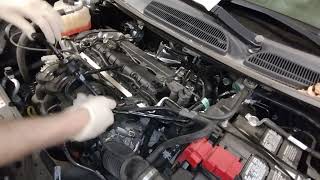
- A YouTube video by 'The G Automotive and More' documents a 2014 Fiesta where both wires had broken off inside the connector for the purge valve. The fix was to solder on a new pigtail connector (part number shown in video). This highlights the fragility of the wiring at this specific point. 🎬 Watch: This video shows how to repair those broken connector wires.
- Manufacturer Bulletin #TSB 16-0163 for related Ford models includes P0443 in a list of codes that may require specific service procedure steps to correct the condition, indicating the code is part of a broader pattern of electrical or sensor issues in this era of Ford engines.
Mechanic-Grade Diagnostic Values
- Vapor Canister Purge Valve Solenoid Resistance — expected: 20 - 30 Ohms. Failure: A reading of infinite resistance (Open Loop) or near-zero resistance (Short Circuit) indicates a failed solenoid coil.
- Purge Valve Connector - Power Wire Voltage (Key On, Engine Off) — expected: ~12 Volts (Battery Voltage). Failure: No voltage or significantly low voltage points to a blown fuse or a break in the power supply wire.
- Purge Valve Connector - Control Wire Voltage (Key On, Engine Off, Valve Commanded OFF) — expected: ~12 Volts (Battery Voltage). Failure: A reading near 0V suggests a short to ground on the control wire or a faulty PCM driver.
- Scan Tool PID EVMV (EVAP Purge Valve Current) — expected: 0 mA when closed, 1,000 mA when fully open (100% duty cycle). Failure: Readings that do not correspond to the commanded state indicate a circuit or valve fault.
- Scan Tool PID EVAPCP (EVAP Canister Purge Duty Cycle) — expected: 0% when closed, 100% when fully open. Failure: If the PCM commands a duty cycle but the valve does not respond (verified by voltage/current checks), the valve or wiring is faulty.
Scan Tool Commands That Help
- Ford IDS (Integrated Diagnostic System) or equivalent professional scanner: EVAP System Test — This is an automated test that commands the EVAP system components, including the purge valve, to check for leaks and proper function. It's a comprehensive first step in software-based diagnosis.
- Ford IDS or capable bidirectional scanner (e.g., FOXWELL NT510 Elite, XTOOL D7): Active Test / Bidirectional Control for Canister Purge Valve (CPV) — This allows a technician to manually command the purge valve open and closed (or vary its duty cycle) while monitoring circuit voltage or listening for the valve to click. It's used to isolate a failure to the valve itself or the wiring after a general P0443 code is set.
Wiring & Ground Locations
- Fuse F26 (Engine Compartment Fuse Box) — Located in the fuse box in the engine bay.. This 7.5A fuse provides power to the canister purge valve. If this fuse is blown, the valve will have no power, causing a P0443 circuit code.
- G108 — Engine compartment, on the chassis frame rail.. This is a primary ground point in the engine bay. While not exclusive to the purge valve, a corroded or loose connection at G108 can cause intermittent electrical issues for various engine sensors and actuators, potentially including the EVAP system.
- Purge Valve Connector (C140) — Connected directly to the EVAP purge valve on top of the engine.. This is the most common point of failure for wiring. The wires, particularly the Yellow/Violet (YE-VT) power wire and the control wire from the PCM, can break inside the insulation right at the back of the connector.
Real Owner Repair Stories
- Fiesta ST Forum (2016 Ford Fiesta ST) — Check Engine Light with code P1450 (Unable to Bleed Up Fuel Tank Vacuum) and stalling/jutting after refueling.
❌ Tried (didn't work) Initially tried just replacing the purge valve solenoid itself without the full hose assembly.
✅ What actually fixed it Replacing the entire purge valve and line assembly (Ford Part D2BZ-9C047-E) resolved all symptoms. The user noted that swapping the lines was difficult and recommended buying the complete assembly. An oil change was also performed due to suspected fuel contamination in the oil from the faulty valve.
Documented NHTSA Reports
- An owner reported in NHTSA ODI #11725076 that their vehicle's check engine light came on frequently due to the P0443 EVAP purge control valve "A" circuit fault, often occurring after getting fuel.
- NHTSA ODI #11633558 describes a diagnostic inspection where multiple codes including P0443 and P1450 were found, leading to a diagnosis of a disconnected line in the EVAP system.
- According to NHTSA ODI #11427851, the P0443 code can appear alongside a malfunctioning indicator lamp and a suite of other codes including P0420, P1450, and P0456.
OEM Part Supersession History
Unknown→C1BZ-9C915-A— Standard part evolution and design updates by Ford.
Heads up: The full hose assembly part number differs for 2016+ models. Some owners of 2016+ models retrofit the 2014-2015 style EVAP lines to work with aftermarket intakes that lack specific bypass valve adapters.
Model Year Variations Within This Range
- 2016-2019: The EVAP harness, connections, and purge solenoid design were changed for the 2016 model year. This later design is frequently cited in forums as being prone to the failures that cause P0443 and the related P1450 code.
Diagnostic Flowchart
Other Known Issues on This Vehicle
Issues unrelated to this code that are worth knowing about as an owner of this generation:
- DPS6 'PowerShift' Dual-Clutch Automatic Transmission Failure 🔴 High — Extremely common on 2011-2019 models with automatic transmission. Issues include shuddering, hesitation, jerking, and complete loss of engagement. (Ref: Subject of multiple class-action lawsuits and extended warranty programs, but no all-encompassing safety recall.)
- Faulty Door Latches 🔴 High — Widespread on 2011-2014 models, leading to doors not latching correctly or opening while driving. (Ref: Ford Safety Recalls 15S16, 16S30, and a follow-up 20S30 for vehicles where the repair may have been done improperly.)
- Clicking/Failed HVAC Blend Door Actuator 🟠 Medium — Very common across all years. Presents as a repetitive clicking or tapping sound from behind the dashboard upon starting the car, caused by stripped plastic gears inside the actuator.
- Engine Overheating due to Coolant System Faults 🔴 High — Affects certain models, particularly 1.6L GTDI engines in 2014-2015 ST models. Can be caused by coolant leaks leading to a cracked cylinder head. (Ref: Ford Safety Recall 17S09 (NHTSA 17V-209))
- Faulty Rear-View Camera 🟡 Low — Common on 2019 models, causing an intermittent or blank image when in reverse. (Ref: Ford Safety Recall 23V-775)
Used vs. New Parts: Buying Guide for This Vehicle
When a used part is the smart pick: For this specific repair, buying a used purge valve is strongly discouraged. The part has a very high failure rate across this vehicle generation, and a used part from a salvage yard is likely to have a short remaining lifespan or could be faulty upon installation.
Donor-vehicle mileage cap: roughly under 40000 miles for the part to have meaningful remaining life.
What to inspect on the donor part:
- If buying used is unavoidable, visually inspect the plastic housing for cracks or heat damage.
- Check that the electrical connector pins are clean, straight, and free of corrosion.
- Ensure the hose connection points are not brittle or cracked.
Aftermarket brands forum-validated for this vehicle:
- Motorcraft (OEM)
- Dorman (specifically P/N 911-779, often cited for its splice-in convenience)
- Standard Motor Products (SMP)
Brands owners have reported issues with on this vehicle:
- Some users have reported premature failure with unbranded, extremely low-cost valves found on online marketplaces. One review for a Dorman part mentioned it failed after 50 miles, suggesting potential quality control issues even with known brands, though many others report success.
Real Owner Stories
Aggregated from forums and TSBs cited above. Mileages and costs reflect what owners reported in those sources.
2016 Ford Fiesta ST
Symptoms: P0443 code persisted even after the purge valve assembly was replaced.
What fixed it: Re-checking and fully seating all green clip-on hose connectors; one was not fully seated, causing a vacuum issue.
Source hint: fiestastforum.com thread titled 'P0443 engine code after replacing purge valve'
2014 Ford Fiesta 1.6L
Symptoms: Check engine light with P0443; both wires had broken off inside the connector for the purge valve.
What fixed it: Soldering on a new pigtail connector.
Source hint: YouTube video by 'The G Automotive and More'
2015 Ford Fiesta ST
Symptoms: P0443 engine code; community suggested that replacing the valve alone might not fix it if the wiring harness is damaged.
What fixed it: Inspecting the wiring harness and connector for breaks (as recommended by the community when a new valve fails to clear the code).
Source hint: Reddit r/FiestaST thread 'p0443_engine-code_after_replacing_purge_valve'
Related OBD-II Codes
Frequently Asked Questions
Is there a specific fuse I should check for the EVAP system on my Ford Fiesta?
My 2014 Fiesta has a P0443 code; is there a known wiring issue I should look for?
What is the specific Motorcraft pigtail part number needed to repair the purge valve connector?
Does the Ford Focus recall for EVAP issues apply to my Fiesta?
Can I test the purge valve on my 2011-2019 Fiesta with a multimeter?
Why does my Fiesta have trouble starting only after I fill up the gas tank?
Helpful Videos

Used OEM Parts in Stock
New Aftermarket Parts Available


The information in this article is provided for general reference and educational purposes only. Vehicle specifications, procedures, and part compatibility can vary by production date, trim level, and region. Always consult your vehicle's factory service manual and verify part numbers before purchasing or performing repairs. Safety-critical components such as airbags, seat belts, and braking systems should be installed by a qualified professional.
- Ford Fiesta:
- 🧭 Diagnostic Flowchart
- 🎬 Helpful Videos
- 🛍️ Shop This Part
- What's Unique About the 2011-2019 Ford Fiesta
- Symptoms You May Notice
- Most Likely Causes
- Rare But Worth Checking
- Diagnosis Steps
- Parts You'll Likely Need
- Related Codes That Often Appear With This One
- Platform-Specific Known Issues
- Mechanic-Grade Diagnostic Values
- Scan Tool Commands That Help
- Wiring & Ground Locations
- Real Owner Repair Stories
- Documented NHTSA Reports
- OEM Part Supersession History
- Model Year Variations Within This Range
- Other Known Issues on This Vehicle
- Used vs. New Parts: Buying Guide for This Vehicle
- Real Owner Stories
- 2016 Ford Fiesta ST
- 2014 Ford Fiesta 1.6L
- 2015 Ford Fiesta ST
- Related OBD-II Codes
- Frequently Asked Questions
- 🎟️ Get 5% Off