

P0443 on 2005-2014 Ford Mustang: EVAP Purge Valve Circuit Malfunction Causes and Fixes
For a 2005-2014 Ford Mustang, code P0443 almost always points to a failed EVAP canister purge valve. It's an affordable part, typically costing $30-$70, and is very easy to replace yourself in about 15 minutes with basic tools. This code indicates an electrical fault, not a system leak.
- P0443 is an electrical circuit code, not a leak code. Don't waste money on a new gas cap.
- The most likely cause is a bad vapor canister purge valve, which is a simple and inexpensive part to replace.
- The purge valve is located in the engine bay and is easily accessible on all 2005-2014 Mustang models.
- If a new purge valve doesn't fix the code, carefully inspect the wiring and connector for damage, especially after recent engine work, before considering a PCM issue.
What's Unique About the 2005-2014 Ford Mustang
On the S197 generation Mustang (2005-2014), the vapor canister purge valve is a common failure point due to age and heat cycles. Unlike EVAP leak codes (like P0455 or P0456), P0443 specifically points to an electrical fault, making diagnosis more direct. The valve is conveniently located in the engine bay for all engine types (V6, GT, and Shelby models), making it a straightforward DIY repair for most owners. The issue is so common that many owners report replacing it as a regular maintenance item. Sometimes, modifications like installing an aftermarket cold air intake or intake manifold can lead to this code if the valve's wiring harness is damaged or not reconnected properly.
Symptoms You May Notice
- Check Engine Light is on
- Rough idle, especially after refueling or if the valve is stuck open
- Slightly decreased fuel economy
- Difficulty starting the engine after filling the gas tank
- Audible clicking or buzzing from the purge valve
- Engine hesitation or stumbling on acceleration
- A strong fuel odor near the vehicle in some cases
- Inaccurate or erratic fuel gauge indication or inaccurate distance to empty (DTE) readings, as noted in reports like NHTSA ODI #11443669
- Replacing the gas cap. A bad gas cap will cause an EVAP leak code (like P0455, P0456, or P0457), not a circuit code like P0443.
- Replacing the EVAP vent solenoid. The vent solenoid is located near the charcoal canister at the rear of the vehicle and has its own set of diagnostic codes (e.g., P0446). P0443 points specifically to the purge valve circuit in the engine bay.
Most Likely Causes
- Faulty EVAP Canister Purge Valve (Solenoid) 🔴 High Probability → Shop Vapor Canister The purge valve is an electromechanical part that cycles thousands of times. Over time, the internal coil can burn out or the valve mechanism can stick, leading to an electrical fault detected by the PCM. It is a widely reported failure item across all S197 Mustang engine variants.
How to confirm: Locate the valve in the engine bay. With the engine running, disconnect the electrical connector. You can test for a stuck-open valve by disconnecting the vacuum hose from the intake side and feeling for suction with your finger; there should be no suction if the valve is working correctly and de-energized. To test the coil, remove the valve and apply 12V from the battery to its two pins; a healthy valve will make an audible click. You can also measure the resistance across the pins with a multimeter; a reading of 14-30 ohms is typical, while an open circuit (infinite resistance) or short (zero resistance) indicates a failed coil.
Typical fix: Replace the vapor canister purge valve. It is typically held on by one or two 8mm bolts and has one electrical connector and two hose connections with simple clips.
Est. part cost: $30-$70 - Damaged Wiring or Connector 🟡 Medium Probability Engine bay heat can make wires and plastic connectors brittle over time. Wires can chafe against other components, especially after maintenance or modifications like an intake manifold swap. Rodents can also chew on wiring. Manufacturer service bulletin #TSB 16-0163 highlights that P0443 can occur alongside a wide array of other circuit codes, suggesting that wiring harness integrity is critical for the PCM to monitor the purge circuit correctly.
How to confirm: Visually inspect the wiring harness leading to the purge valve for any signs of cracking, melting, chafing, or breaks. Pay close attention to the area right behind the connector. Check that the connector is fully seated and that the pins inside are clean and not corroded or bent. Use a multimeter to check for battery voltage on the power wire (typically red) with the key on, and check for continuity on the ground/control wire back to the PCM.
Typical fix: Repair the damaged section of wire with a new piece of wire and butt connectors or solder with heat shrink. If the connector is broken, it can be replaced with a new pigtail connector (available at most auto parts stores).
Est. part cost: $10-$30 - Blown Fuse ⚪ Low Probability A short circuit in the purge valve or its wiring can cause the related fuse to blow. On the 2005-2009 Mustang, this is often Fuse F47 in the engine bay fuse box (Smart Junction Box).
How to confirm: Consult your owner's manual to identify the fuse that protects the EVAP system circuit (e.g., Fuse F47). Pull the fuse and visually inspect if the internal filament is broken. Confirm with a multimeter set to continuity.
Typical fix: Replace the blown fuse with a new one of the same amperage. If the new fuse blows immediately, a short circuit is present and needs to be diagnosed before proceeding.
Est. part cost: $1-$5
Rare But Worth Checking
- Faulty Powertrain Control Module (PCM): → Shop Engine Control Module (ECM) This is extremely rare. The PCM should only be considered after all other possibilities, including the valve and its entire circuit, have been thoroughly tested and ruled out. A faulty driver circuit within the PCM can prevent it from properly controlling and monitoring the valve. This is a last resort diagnosis.
Diagnosis Steps
- Read the code with an OBD-II scanner to confirm P0443 is present. Note any other codes. As seen in NHTSA ODI #11633558, P0443 often appears with other EVAP codes like P0456 or P1450, which may indicate a broader system issue.
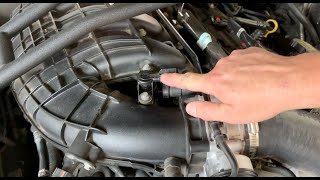
- Locate the vapor canister purge valve. On 2005-2010 models, it's typically on the driver's side inner fender, near the strut tower. 🎬 Watch: 2005-2009 Mustang purge valve replacement walkthrough On 2011-2014 models, it's on the driver's side of the engine, near the intake manifold. 🎬 See how to replace the valve on 2011-2014 models
- Inspect the electrical connector and wiring going to the valve. Look for any obvious damage, corrosion, or loose connections. Wiggling the harness while the engine is running might reveal an intermittent fault.
- With the ignition on and engine off, disconnect the connector. Use a multimeter to check for battery voltage on one of the pins (usually the red wire). If no voltage is present, check the associated fuse (e.g., F47 in the engine bay fuse box for 2005-2009 models). If the fuse is good, trace the power wire for a break.
- If voltage is present, the issue is likely the valve or the control side of the circuit. Test the valve's internal coil by measuring resistance between its two pins. A reading outside the 14-30 ohm range suggests a faulty valve. Alternatively, apply 12V directly to its terminals; it should make an audible click.
- If the valve tests good, the problem may be in the ground-side control wire going back to the PCM or the PCM itself (which is rare). Check this wire for continuity back to the PCM connector.
- If all wiring and fuses are good, and the valve does not actuate with direct power or its resistance is out of spec, the purge valve is faulty and should be replaced.
Parts You'll Likely Need
- Vapor Canister Purge Valve
(OEM #4R3Z9C915AA (2005-2006), 7U5Z9C915F (2007-2010), AU5Z9C915B / AU5Z9C915E (2011-2014, E is the latest revision of B))— This is the most common failure item for code P0443. The internal coil winding fails or the valve gets stuck, causing an electrical fault.
Trusted brands: Motorcraft, Dorman, Standard Motor Products
OEM price range: $50-$80
Aftermarket price range: $25-$60
Related Codes That Often Appear With This One
- P0444 — This code indicates 'Purge Control Circuit Open', which is a more specific version of the P0443 general circuit fault, often pointing to a broken wire or unplugged connector.
- P0445 — This code indicates 'Purge Control Circuit Shorted', another specific fault that falls under the P0443 umbrella, often caused by melted or chafed wiring.
- P1450 — This code indicates 'Unable to Bleed Up Fuel Tank Vacuum' and is frequently seen alongside P0443 in Ford vehicles, as noted in NHTSA ODI #11427851.
- P0135, P0141, P0155, P0161 — These are O2 sensor heater circuit malfunction codes. Seeing them together with P0443 can sometimes indicate a broader electrical or fuse box issue, as these components may share a power source or be affected by a common electrical problem.
Platform-Specific Known Issues
- On 2011+ models with aftermarket intake manifolds (like the Boss 302 or GT350), the purge valve is relocated. This process can sometimes lead to a damaged wire or a connector that isn't fully seated, triggering P0443.
- On cars that have had header installations, the proximity of the new exhaust pipes can sometimes melt the EVAP wiring if it's not properly secured, causing a short and the P0443 code.
Mechanic-Grade Diagnostic Values
- Purge Valve Coil Resistance — expected: 14-35 Ohms. More specifically, 20-30 Ohms is a common range.. Failure: Infinite resistance (open circuit) or near-zero resistance (short circuit).
- Purge Valve Connector Power Pin Voltage (Key On, Engine Off) — expected: Should be equal to battery voltage (~11-14V).. Failure: Significantly lower or zero voltage indicates a problem with the power supply wire or the fuse.
- Purge Valve Connector Control Pin Voltage (Back-probed, Engine Running) — expected: When valve is commanded OFF, voltage should be near battery voltage. When commanded ON, voltage should drop to near 0V as the PCM provides ground.. Failure: Voltage does not change when commanded, or is always at 0V (short to ground) or always at battery voltage (open in control circuit or faulty PCM driver).
- Ford Scan Tool PID: EVAPCP (Duty Cycle) — expected: 0% when closed, up to 100% when commanded fully open.. Failure: The PCM will set P0443 if the monitored circuit state does not match the commanded duty cycle.
- Ford Scan Tool PID: EVMV (Current) — expected: 0 mA when closed (0% duty cycle). 1,000 mA when commanded fully open (100% duty cycle).. Failure: A mismatch between the commanded state and the measured current/voltage drop will trigger the code.
Scan Tool Commands That Help
- Ford IDS (or high-end aftermarket scanner): Output State Control for EVAP Purge Valve / EVAP System Test — This bidirectional command allows a technician to manually open and close the purge valve while monitoring the circuit voltage or the EVAPCP PID. This directly tests the valve's response, the wiring integrity, and the PCM's ability to control the circuit, isolating the faulty component without guesswork.
Wiring & Ground Locations
- G104 — On the left (driver's side) front fender apron, located behind the battery.. This is one of the two primary ground points for the Powertrain Control Module (PCM) on 2005-2009 Mustangs. A corroded or loose G104 can cause erratic PCM behavior and trigger various circuit codes, including P0443.
- G201 — In the passenger side kick panel area, directly below the PCM.. This is the second primary ground for the PCM on 2005-2009 Mustangs. A fault at this location can directly impact the PCM's internal grounding and its ability to control output circuits like the purge solenoid driver.
- Engine to Firewall Ground Strap — Connects from a stud on the back of the driver's side cylinder head to a point on the firewall.. While not a direct PCM ground, this strap ensures the entire engine block has a solid ground path to the chassis. A poor connection here can cause current to seek alternative paths, potentially creating voltage offsets that interfere with sensor and actuator readings, including the purge valve circuit monitor.
Real Owner Repair Stories
- YouTube user 'ScannerDanner' (1998 Mercury Sable (similar Ford EVAP system logic)) — P0443 code, rich running condition (Bank 1 and 2 rich codes).
❌ Tried (didn't work) Initial diagnosis pointed towards the purge valve or wiring.
✅ What actually fixed it The PCM had an internal short to ground, causing the purge valve driver circuit to be active at all times. This held the purge valve open constantly. Replacing the PCM resolved the P0443 and the rich condition. - Retrorestore YouTube Channel (Ford Mondeo MK3 (demonstrates common Ford diagnostic confusion)) — P0443 Check Engine Light.
❌ Tried (didn't work) Took car to a Ford garage, who performed a vacuum test on the valve and declared it 'fine'.
✅ What actually fixed it The owner suspected the garage was wrong because P0443 is an electrical code, not a vacuum code. They replaced the purge valve despite the garage's advice, which fixed the problem. This proved the valve's internal coil had failed electrically, a fault a vacuum test cannot detect.
Documented NHTSA Reports
- An owner reported in NHTSA ODI #11725076 that they experienced the check engine light coming on frequently for the P0443 evap purge control valve "a" circuit, noting that the issue occurred specifically after getting fuel.
- NHTSA ODI #11633558 describes a situation where a vehicle displayed multiple default codes including P0443 and P0456; upon inspection at a dealership, the diagnosis revealed an EVAP system related disconnect on the line.
"I Checked Everything" — The Actual Cause
- P0443 is an electrical circuit malfunction code, not an EVAP leak code (like P0455/P0456). A smoke test is designed to find physical leaks in the EVAP hoses and components. Therefore, it is expected for a vehicle with only a P0443 code to pass a smoke test perfectly. The fault lies within the electrical components: the purge valve's internal coil, the wiring harness, the fuse, or the PCM's driver circuit. Technicians who misinterpret P0443 as a leak code will waste time performing a smoke test, find no leaks, and be left confused. The actual cause is an electrical failure that must be diagnosed with a multimeter or a scan tool's bidirectional controls.
OEM Part Supersession History
AU5Z-9C915-A→AU5Z-9C915-E— Ford has released multiple revisions of this part to improve durability and sealing.
Heads up: The full supersession chain is A -> B -> C -> D -> E. All are interchangeable for 2011-2014 models, with 'E' being the latest, most robust version.4R3Z9C915AA→7U5Z9C915F (for later models)— Part design change after 2006 model year.
Heads up: The 2005-2006 valve (also called a Vacuum Management Valve) includes an EVAP system test port under a green cap. The 2007-2010 valve does not have this port. While they may be electrically similar, installing a 2007+ valve on a 2005-2006 car results in the loss of this diagnostic test port.
Model Year Variations Within This Range
- 2005-2006: The purge valve (called a VMV) is located on the driver's side inner fender and includes an integrated EVAP system test port. Part number is 4R3Z9C915AA.
- 2007-2010: The purge valve (called a CPV) is in a similar location but does NOT have the integrated test port. Part number is 7U5Z-9C915-F.
- 2011-2014: The purge valve is relocated to the driver's side of the engine itself, near the intake manifold. The part number is AU5Z-9C915-B, which has been superseded multiple times, with the latest version being AU5Z-9C915-E.
Diagnostic Flowchart
Other Known Issues on This Vehicle
Issues unrelated to this code that are worth knowing about as an owner of this generation:
- Water Leak into Passenger Footwell 🔴 High — Very common across all years. Clogged cowl drains under the windshield allow water to overflow through the cabin air filter opening, potentially damaging the Smart Junction Box (SJB) and other electronics. (Ref: TSB 07-14-6 describes sealing procedures for the cowl area on early models, but the drain-clogging issue persists on all years.)
- 4.6L 3V Spark Plug Breakage 🔴 High — Affects 2005 to mid-2008 models with the 4.6L 3V V8. The original two-piece spark plug design can cause the lower portion to seize in the cylinder head and break off during removal, requiring a special extraction tool. (Ref: TSB 08-7-6 outlines the specific, careful procedure for removal and the tools needed for extraction.)
- MT82 Manual Transmission Problems (2011-2014) 🟠 Medium — Common on 2011-2014 GT and V6 models. Issues include high-RPM lockout (especially 2nd to 3rd gear), grinding, and premature synchronizer/shift fork wear. A class-action lawsuit was filed regarding these issues. (Ref: Multiple TSBs exist, but no recall was issued. Fixes often involve aftermarket shifters, clutches, or transmission rebuilds.)
- Aluminum Hood Corrosion/Bubbling Paint 🟠 Medium — Widespread issue where corrosion forms on the underside of the hood, typically at the leading edge seam, causing paint to bubble and peel. (Ref: TSB 19-2026 addresses the corrosion concern on aluminum body panels, often recommending panel replacement.)
- TR3650 Manual Transmission Noises (2005-2010) 🟡 Low — Some early models (pre-2005/01/15) could exhibit a growl or grinding noise in 2nd or 3rd gear during deceleration. (Ref: TSB 05-8-8)
- Rear Axle Whine/Chatter 🟡 Low — Some vehicles may exhibit a whining noise from the rear axle or a chatter/shudder from the limited-slip differential during low-speed turns. (Ref: TSB 05-7-3 (axle whine on early builds), TSB 06-21-6 (LSD chatter, requires friction modifier).)
Used vs. New Parts: Buying Guide for This Vehicle
When a used part is the smart pick: For this specific repair, buying a used purge valve is not recommended. The part is an electromechanical solenoid with a finite lifespan that fails from internal wear and heat cycles. The cost of a new OEM or quality aftermarket part is low enough that the risk of a used part failing shortly after installation outweighs the minimal cost savings.
Donor-vehicle mileage cap: roughly under 50000 miles for the part to have meaningful remaining life.
What to inspect on the donor part:
- If buying used is unavoidable, source from a vehicle with the lowest possible mileage.
- Check for any cracks in the plastic housing or connector.
- Ensure the hose ports are not broken or cracked.
- Test the resistance with a multimeter before purchase; it should be within the 14-30 ohm range.
Aftermarket brands forum-validated for this vehicle:
- Motorcraft (OEM)
- Standard Motor Products (SMP)
Brands owners have reported issues with on this vehicle:
- Dorman: While widely available and sometimes effective, some owners in forums have reported premature failure of Dorman purge valves for this application, requiring replacement after a few months.
- Unbranded/generic parts from online marketplaces: Quality control is often non-existent, leading to a high probability of early failure.
Real Owner Stories
Aggregated from forums and TSBs cited above. Mileages and costs reflect what owners reported in those sources.
2011-2014 Mustang GT
Symptoms: The owner received a P0443 code immediately after performing an intake manifold swap.
What fixed it: The issue was identified as a pinched or disconnected wire to the relocated purge valve during the manifold installation.
Source hint: S197Forum.com thread titled 'p0443'
2015+ Mustang (S550 platform)
Symptoms: The owner experienced the P0443 code twice. The first time was a valve failure; the second time involved an intermittent short.
What fixed it: Repairing a wire that had chafed through its insulation right near the connector.
Source hint: Mustang6G.com thread titled 'P0443 Code - Purge Control Valve - Need some advice'
2005-2014 Mustang
Symptoms: A persistent P0443 code remained even after replacing the purge valve three times. Power was present at the plug but the valve would not activate.
What fixed it: Tracing the control wire back to the PCM to find a fault in the ground-side circuit.
Source hint: StangNet thread titled 'P0443 - what to do with this nightmare'
Related OBD-II Codes
Frequently Asked Questions
Where is the purge valve located on my 2007 Mustang compared to a 2012 model?
I just installed a Boss 302 intake manifold on my GT and now have a P0443 code. What happened?
Which fuse should I check for the EVAP system on my 2006 Mustang?
Could my aftermarket headers be causing this electrical code?
How can I tell if the purge valve itself is bad using a multimeter?
Does the 4.6L 3V spark plug issue mentioned in TSB 08-7-6 relate to my P0443 code?
Helpful Videos
Used OEM Parts in Stock
New Aftermarket Parts Available


The information in this article is provided for general reference and educational purposes only. Vehicle specifications, procedures, and part compatibility can vary by production date, trim level, and region. Always consult your vehicle's factory service manual and verify part numbers before purchasing or performing repairs. Safety-critical components such as airbags, seat belts, and braking systems should be installed by a qualified professional.
- Ford Mustang:
- 🧭 Diagnostic Flowchart
- 🎬 Helpful Videos
- 🛍️ Shop This Part
- What's Unique About the 2005-2014 Ford Mustang
- Symptoms You May Notice
- Most Likely Causes
- Rare But Worth Checking
- Diagnosis Steps
- Parts You'll Likely Need
- Related Codes That Often Appear With This One
- Platform-Specific Known Issues
- Mechanic-Grade Diagnostic Values
- Scan Tool Commands That Help
- Wiring & Ground Locations
- Real Owner Repair Stories
- Documented NHTSA Reports
- "I Checked Everything" — The Actual Cause
- OEM Part Supersession History
- Model Year Variations Within This Range
- Other Known Issues on This Vehicle
- Used vs. New Parts: Buying Guide for This Vehicle
- Real Owner Stories
- 2011-2014 Mustang GT
- 2015+ Mustang (S550 platform)
- 2005-2014 Mustang
- Related OBD-II Codes
- Frequently Asked Questions
- 🎟️ Get 5% Off