

P0443 on 1998-2001 Ford Ranger 2.5L: EVAP Purge Valve Circuit Fixes
For a 1998-2001 Ford Ranger with the 2.5L engine, code P0443 almost always points to a failed EVAP Purge Valve Solenoid. It's an affordable part, typically costing $30-$60 for an aftermarket replacement (OEM Part F87Z-9C915-AA), and is a simple 10-minute DIY fix located behind the battery.
- P0443 on a 1998-2001 Ranger 2.5L points to an electrical issue with the EVAP Purge Valve, not a system leak.
- The most likely culprit is the purge valve solenoid itself, which is an inexpensive and easy part to replace.
- Diagnosis is straightforward: check the fuse, check for power at the connector, and test the valve's operation with a 12V source or a vacuum pump.
- Do not waste money replacing the gas cap or charcoal canister for this specific code.
- The repair is very DIY-friendly and can typically be completed in under 15 minutes with basic tools.
What's Unique About the 1998-2011 Ford Ranger
The user-specified year range of 1998-2011 for the Ford Ranger is broad, but the 2.5L Lima I4 engine was only available from 1998 through mid-2001. On these specific models, the EVAP system is relatively simple. The P0443 code is very common and overwhelmingly caused by the failure of the purge valve solenoid itself. The solenoid is located in an easy-to-access spot in the engine bay, typically mounted on a bracket behind the battery and next to the ignition coil pack. Unlike some vehicles where this code can lead to a complex diagnosis of vacuum leaks, on the 2.5L Ranger, the fix is typically a direct part replacement.
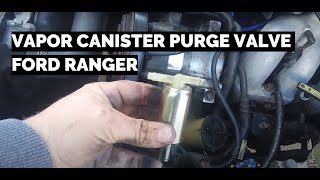
🎬 Watch: Step-by-step tutorial for replacing the purge valveGeneration note: The 1998-2011 year range covers the third generation of the North American Ford Ranger. However, the specified 2.5L I4 engine was only used from 1998 to mid-year 2001. This guide is specific to those 1998-2001.5 models.
Symptoms You May Notice
- Check Engine Light is on.
- Slightly rough idle in some cases, especially after refueling or at a stop.
- Possible decrease in fuel economy as fuel vapors are not being properly recycled.
- A strong fuel odor may be present in rare cases if the valve is stuck open.
- Inaccurate or erratic fuel gauge indication or inaccurate distance to empty (DTE) readings, as noted in reports like NHTSA ODI #11443669.
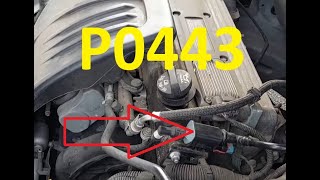
- Replacing the gas cap. While a bad gas cap can cause other EVAP codes (like P0455 or P0457 for leaks), it does not cause a P0443 circuit code. 🎬 See this breakdown of P0443 causes and fixes
- Replacing the charcoal canister. The canister is a passive storage component and does not have an electrical circuit that would trigger a P0443 code.
- Replacing the EVAP vent solenoid. This is a different part of the EVAP system, usually located near the fuel tank above the spare tire, and has its own specific trouble codes (like P1451).
Most Likely Causes
- Faulty EVAP Purge Valve Solenoid 🔴 High Probability → Shop Vapor Canister The solenoid is an electromechanical part that cycles thousands of times, leading to eventual failure of the internal coil or mechanical valve. It can fail internally (open or shorted coil) or become stuck open or closed. This is the most frequent failure point for this code on Rangers.
How to confirm: Locate the purge valve behind the battery. With the key on, check for 10.5+ volts at the power wire (typically Red) in the connector. You can also test the solenoid's internal resistance with a multimeter; a Ford service document specifies a range of 30-38 ohms for a good valve, though other sources suggest a range of 20-30 Ω is also common for this type of part. Applying 12V directly to its pins should produce an audible 'click'. A definitive test is to use a hand vacuum pump; the valve should hold vacuum when de-energized and release it when 12V is applied.
Typical fix: Replace the EVAP purge valve solenoid. The OEM part number is F87Z-9C915-AA, which was superseded by F87Z-9C915-B. Aftermarket equivalents include Standard Motor Products CP415 and Dorman 911-233.
Est. part cost: $30-$80 - Damaged Wiring or Connector 🟡 Medium Probability The wiring harness in the engine bay is exposed to heat, vibration, and battery acid fumes, which can cause wires to fray, break, or corrode over time. The failure point is often right at the connector to the solenoid.
How to confirm: Visually inspect the two wires going to the purge valve for any signs of cracking, melting, or breaks. Wiggle the connector while the engine is running to see if it affects the idle. Check the electrical connector for corrosion or loose pins. Test for continuity between the PCM connector (Pin 56 for the control wire on a 2000 model) and the purge valve connector.
Typical fix: Repair the broken wire or replace the connector pigtail.
Est. part cost: $5-$25 - Blown Fuse ⚪ Low Probability
How to confirm: The purge valve solenoid shares power with other emissions components. On a 1998-2000 Ranger, check fuse #13 (15A) in the passenger compartment fuse panel. This fuse also powers the oxygen sensors and EGR regulator. If this fuse is blown, you will likely have other codes besides P0443.
Typical fix: Replace the blown fuse. If it blows again, there is a short circuit in one of the components on that circuit that needs to be diagnosed.
Est. part cost: $1-$5
Rare But Worth Checking
- Faulty Powertrain Control Module (PCM): → Shop Engine Control Module (ECM) This is extremely rare. Before condemning the PCM, all other possibilities (valve, wiring, fuses) must be exhaustively ruled out. A PCM failure would typically be accompanied by other trouble codes as well. Some forum users have replaced the PCM only to have the code return, indicating the problem was elsewhere. A failure of the internal driver circuit can cause a permanent ground, holding the valve open and potentially setting rich condition codes alongside P0443.
Diagnosis Steps
- Scan for Codes: Confirm P0443 is the only code present. If other codes exist, address them first.
- Inspect Fuse: Check fuse #13 (15A) in the fuse panel on the driver's side of the dashboard. Replace if blown.
- Visual Inspection: Carefully inspect the wiring harness and electrical connector for the purge valve, located behind the battery. Look for any obvious damage, corrosion, or loose connections.
- Check for Power: Disconnect the purge valve. With the ignition on (engine off), use a multimeter to verify there are at least 10.5 volts at the Red wire in the connector.
- Test the Solenoid: If power is present, test the solenoid itself. Measure the resistance across its two pins. It should be between 20 and 38 ohms. Alternatively, apply 12V power and a ground directly to the pins; you should hear a distinct 'click' as it actuates.
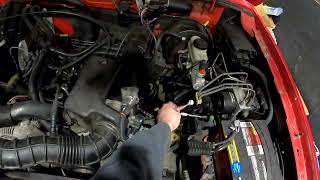
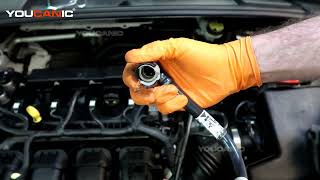
- Perform a Vacuum Test: For a definitive test, remove the valve. Attach a hand vacuum pump to the inlet port and apply vacuum. The valve should hold the vacuum. Then, apply 12V to the electrical pins; the vacuum should release immediately. If it fails either of these tests, it is faulty. 🎬 Watch: How to replace the purge control valve
- Check the Control Circuit: If the valve tests good, the problem is likely in the ground-side control wire (typically Green/White) running back to the PCM. Check this wire for continuity between the valve connector and the PCM connector (Pin 56).
- Replace the Faulty Component: Based on your findings, replace the faulty purge valve solenoid (OEM F87Z-9C915-B) or repair the damaged wiring.
Parts You'll Likely Need
- Vapor Canister Purge Valve / Solenoid
(OEM #F87Z-9C915-AA)— This is the most common failure point for a P0443 code on this vehicle. The internal coil fails or the valve mechanism gets stuck.
Trusted brands: Motorcraft (OEM), Dorman (911-233), Standard Motor Products (CP415), Wells (PV143)
OEM price range: $60-$90
Aftermarket price range: $30-$60
Platform-Specific Known Issues
- Real-World Repair Story: A user on Reddit with a 2000 2.5L Ranger reported a P0443 that persisted after replacing both the purge valve and vent solenoid. The community advised checking the wiring for power with the key on and then grounding the control wire at the PCM connector to confirm the wire's integrity, illustrating the importance of testing the circuit even with new parts.
- Confusion with Vent Solenoid: Multiple forum threads show owners mistakenly replacing the canister vent solenoid (near the gas tank) for the P0443 code, which relates to the purge valve/solenoid in the engine bay. This highlights a common point of confusion for DIY repairers.
- Manufacturer Service Procedures: Ford Bulletin #TSB 16-0163 highlights that P0443 can appear alongside a wide array of other circuit codes, requiring specific service procedure steps to correct the underlying electrical condition.
Mechanic-Grade Diagnostic Values
- EVAP Purge Valve Solenoid Resistance — expected: 30-38 ohms (per Ford service info) or 20-30 ohms (common for this part type). Readings outside 15-40 ohms generally indicate a faulty coil.. Failure: Infinite resistance (OL) indicates an open coil; near-zero resistance indicates a shorted coil.
- Scan Tool PID: EVAPCP (EVAP Canister Purge Duty Cycle) — expected: 0% with valve commanded closed (at rest). 100% with valve commanded fully open via bidirectional test.. Failure: PID value does not match the commanded state, indicating a circuit or PCM issue.
- Scan Tool PID: EVMV (EVAP Canister Purge Valve Current) — expected: 0 mA with valve commanded closed. Approx. 1,000 mA (1 Amp) with valve commanded fully open.. Failure: Current draw significantly higher than 1A suggests a short; 0 mA when commanded open suggests an open circuit or faulty solenoid.
- Purge Valve Control Wire Voltage (at PCM, back-probed) — expected: Approx. 5V when the PCM commands the valve to open during an EVAP purge test.. Failure: Absence of voltage when commanded suggests a faulty PCM driver.
Scan Tool Commands That Help
- Ford IDS (or equivalent professional scanner): Output Test Mode / EVAP System Test — This bidirectional control allows a technician to manually command the purge solenoid on and off. It is used to verify the entire circuit's integrity by observing voltage changes, current draw (EVMV PID), and duty cycle (EVAPCP PID) in real-time to confirm if the PCM, wiring, and solenoid are all responding correctly.
Wiring & Ground Locations
- PCM (Powertrain Control Module) — Located on the passenger side of the engine firewall.. The PCM is the source of the command signal for the purge valve. The control wire (Pin 56) runs from this module to the valve connector. Testing continuity to this location is the final step in diagnosing a wiring fault.
- G100 — On the LH (driver's side) front of the engine compartment, below the battery.. This is a primary chassis ground point. High resistance at this ground can cause various electrical issues in the engine bay, potentially affecting the power supply or reference for emissions components.
- G101 — On the LH (driver's side) of the upper radiator support.. This ground point is crucial for many engine sensors and actuators. The PCM's internal ground pins (e.g., Pin 91, Signal Return) are ultimately tied to the chassis through points like this. A poor connection here can cause erratic sensor readings and circuit faults.
OEM Part Supersession History
F87Z-9C915-AA→F87Z-9C915-B— Standard part revision by the manufacturer.
Model Year Variations Within This Range
- 1998-2000 vs. 2001: In 1998, Ford switched to a 'returnless' fuel system with one fuel line from the tank. For the 2001 model year, this was revised to a mechanical returnless system that used two fuel lines at the tank. While this doesn't directly alter the P0443 diagnosis, it's a significant underbody system change in the final year of the 2.5L engine that technicians should be aware of when working near the fuel tank or lines.
Diagnostic Flowchart
Other Known Issues on This Vehicle
Issues unrelated to this code that are worth knowing about as an owner of this generation:
- Recessed Exhaust Valve Seats 🔴 High — A well-documented issue on the 2.5L Lima engine, often appearing after 100k miles. Causes a rough idle, stalling after deceleration, and eventual misfires.
- Faulty Idle Air Control (IAC) Valve 🟠 Medium — Common failure item causing high or erratic idle, and sometimes stalling. Often requires replacement with an OEM Motorcraft part, as aftermarket units can cause issues.
- Camshaft Position Sensor Failure 🟠 Medium — The camshaft position sensor can fail, leading to code P0340, rough running, poor fuel economy, and no-start conditions.
- Frame Rust (Especially Leaf Spring Hangers) 🔴 High — Particularly prevalent in regions that use road salt. The rear of the frame, especially around the leaf spring shackles and fuel tank crossmember, is prone to severe rust-through. While later models had recalls, older ones should be inspected carefully. (Ref: While recalls existed for later models, none officially cover the 1998-2001 range for this specific issue.)
- Cracked/Brittle Vacuum Hoses 🟡 Low → Shop Vacuum Hose — Due to age and heat, the various rubber vacuum lines in the engine bay become brittle and crack, leading to vacuum leaks that cause lean codes (P0171) and rough idling.
Used vs. New Parts: Buying Guide for This Vehicle
When a used part is the smart pick: A used OEM (Motorcraft) purge valve from a junkyard is a reasonable choice for this repair, as it is a simple, external, and easily testable component. Given the low cost of new aftermarket parts, the savings may be minimal, but it's a viable option if on a tight budget.
Donor-vehicle mileage cap: roughly under 120000 miles for the part to have meaningful remaining life.
What to inspect on the donor part:
- Check the plastic housing for cracks or heat damage.
- Ensure the electrical connector pins are clean, straight, and free of corrosion.
- Bring a 9V or 12V battery with you. Apply power to the two pins; you should hear a sharp, immediate 'click'. If there is no click, the part is bad.
- If possible, try to blow through the valve. With no power applied, it should be closed and not allow air to pass. When power is applied, it should open and allow air to pass.
Aftermarket brands forum-validated for this vehicle:
- Dorman (911-233)
- Standard Motor Products (SMP CP415)
- Wells
Real Owner Stories
Aggregated from forums and TSBs cited above. Mileages and costs reflect what owners reported in those sources.
2000 Ford Ranger 2.5L
Symptoms: P0443 code persisted even after replacing both the purge valve and the vent solenoid.
What fixed it: The community advised checking the wiring for power and grounding the control wire at the PCM connector to confirm the wire's integrity, as the issue was likely in the wiring harness or PCM control circuit.
Source hint: Reddit (r/fordranger) - Thread: '2000 Ford Ranger P0443 Issue'
1998 Mazda B2500 2.5L
Symptoms: Evaporative emissions control system purge-control valve circuit malfunction (P0443).
What fixed it: After replacing the valve, the owner suspected the PCM, reinforcing that P0443 is a circuit code rather than a leak code.
Source hint: TheRangerStation.com - Thread: 'P0443 evaporative emissions control system purge-control valve circuit malfunction'
2000 Ford Ranger 2.5L
Symptoms: P0443 appeared after performing other work on the fuel system.
What fixed it: Diagnostic steps confirmed the need to check the wiring and the part itself, as recent repairs can sometimes introduce new circuit problems.
Source hint: Ranger-Forums.com - Thread: 'code PO443'
Documented NHTSA Reports
NHTSA ODI #11725076
Symptoms: An owner reported the check engine light coming on often due to the P0443 evap purge control valve "a" circuit malfunction, noting issues when getting fuel.
NHTSA ODI #11633558
Symptoms: A diagnostic test revealed multiple default codes including P0443 and P0456. Upon inspection at a dealership, the diagnosis confirmed an Evap system related issue on the line.
NHTSA ODI #11427851
Symptoms: This report describes an illuminated malfunction indicator lamp (MIL) with diagnostic trouble codes including P0443, P0420, and P1450.
Related OBD-II Codes
Frequently Asked Questions
Where is the EVAP purge valve located on my 2.5L Ranger?
What is the correct resistance for a new purge valve solenoid (F87Z-9C915-B)?
Which fuse should I check for a P0443 code on a 1998-2000 Ranger?
I replaced the solenoid near the gas tank but still have P0443. Did I change the wrong part?
Can I test the solenoid myself with a vacuum pump?
Are there any known recalls for frame rust on my 1998-2011 Ranger?
Helpful Videos
Used OEM Parts in Stock
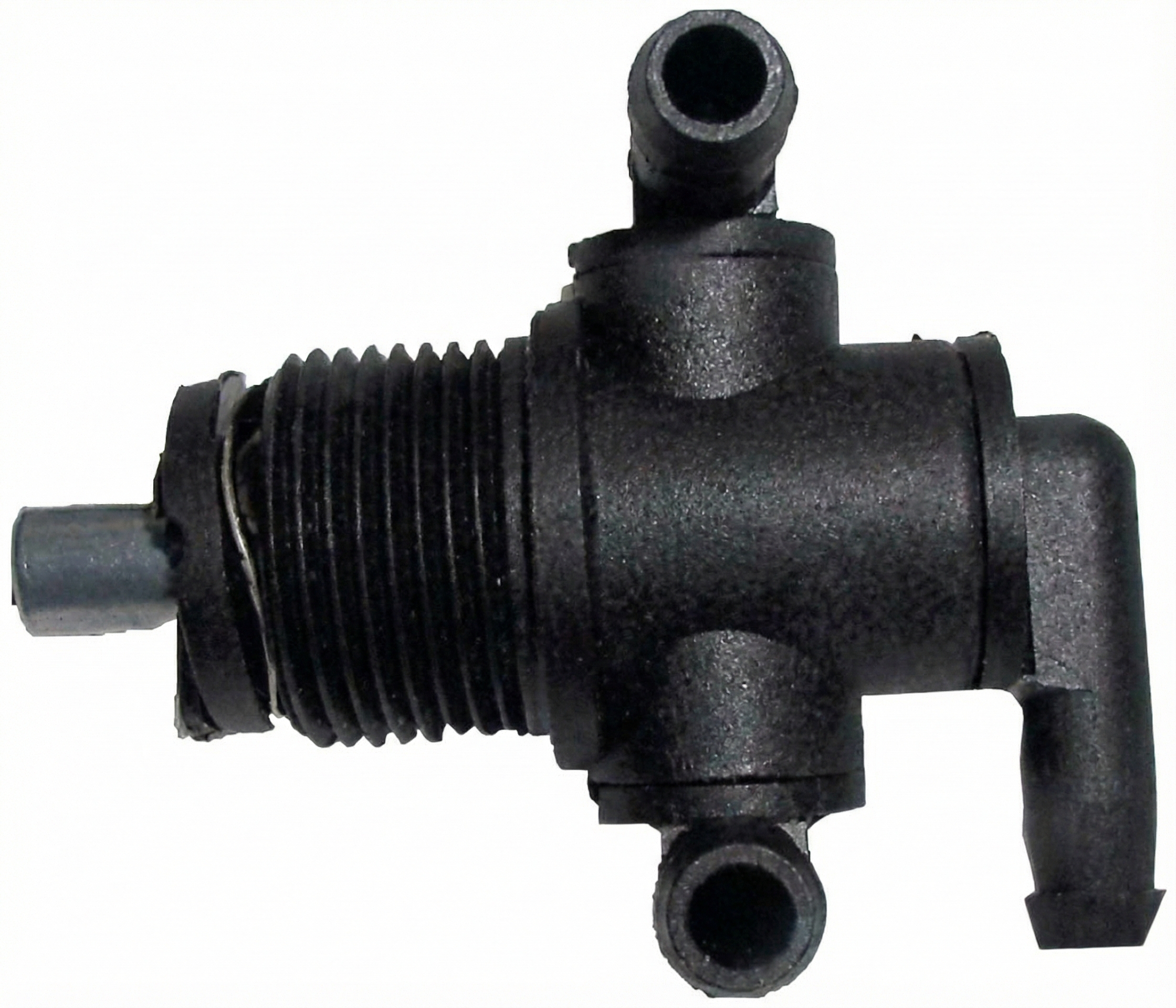
New Aftermarket Parts Available


The information in this article is provided for general reference and educational purposes only. Vehicle specifications, procedures, and part compatibility can vary by production date, trim level, and region. Always consult your vehicle's factory service manual and verify part numbers before purchasing or performing repairs. Safety-critical components such as airbags, seat belts, and braking systems should be installed by a qualified professional.
- Ford Ranger:
- 🧭 Diagnostic Flowchart
- 🎬 Helpful Videos
- 🛍️ Shop This Part
- What's Unique About the 1998-2011 Ford Ranger
- Symptoms You May Notice
- Most Likely Causes
- Rare But Worth Checking
- Diagnosis Steps
- Parts You'll Likely Need
- Platform-Specific Known Issues
- Mechanic-Grade Diagnostic Values
- Scan Tool Commands That Help
- Wiring & Ground Locations
- OEM Part Supersession History
- Model Year Variations Within This Range
- Other Known Issues on This Vehicle
- Used vs. New Parts: Buying Guide for This Vehicle
- Real Owner Stories
- 2000 Ford Ranger 2.5L
- 1998 Mazda B2500 2.5L
- 2000 Ford Ranger 2.5L
- Documented NHTSA Reports
- NHTSA ODI #11725076
- NHTSA ODI #11633558
- NHTSA ODI #11427851
- Related OBD-II Codes
- Frequently Asked Questions
- 🎟️ Get 5% Off