

P0443 on 2004-2012 GMC Canyon: EVAP Purge Solenoid Circuit Causes and Fixes
On a 2004-2012 GMC Canyon, code P0443 almost always means the EVAP Purge Solenoid Valve has failed. It's an inexpensive part ($25-$60) located in the engine bay, and replacing it is a common DIY fix that takes about an hour. Access is tight, so removing the battery and tray is the recommended method.
- P0443 on a 2004-2012 Canyon is an electrical circuit code, not a leak code. Do not replace the gas cap.
- The most likely cause is a failed EVAP Purge Solenoid Valve located in the engine bay.
- The part is relatively inexpensive and can be replaced by a DIYer with basic tools in about an hour.
- Accessing the solenoid on 4-cylinder and 5-cylinder models is easiest if you remove the battery and battery tray first.
- Before replacing the part, always check the wiring, connector, and the relevant fuse.
What's Unique About the 2004-2012 GMC Canyon
The first-generation GMC Canyon shares its platform (GMT355) and many parts with the Chevrolet Colorado and Hummer H3. Across all three models, the EVAP purge solenoid is a well-documented, common failure item. The location of the solenoid on the 4-cylinder (2.8L, 2.9L) and 5-cylinder (3.5L, 3.7L) engines is on the driver's side of the engine block, making access a bit tight. Owners and mechanics have found that the easiest way to reach it is by removing the battery and battery tray to get to it from the top. Some YouTube tutorials show it is possible to reach the 10mm retaining bolt with a very long (20-inch) extension and a swivel socket from the front, but battery removal is more common.
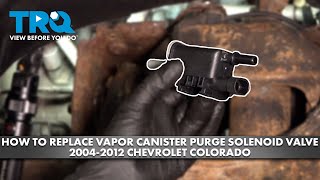
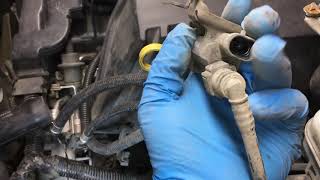
🎬 See how to remove the solenoid on a Canyon or Colorado.Symptoms You May Notice
- Check Engine Light is on
- Rough or erratic idle (if valve is stuck open)
- Difficulty starting the engine, especially right after refueling
- Slightly reduced fuel economy
- A faint fuel odor (less common)
- Inability to fill the gas tank without the pump repeatedly clicking off (less common, but reported by owners chasing EVAP issues).
- Replacing the gas cap. A gas cap issue will cause EVAP leak codes (like P0455 or P0456), not a circuit code like P0443.
- Replacing the EVAP Vent Solenoid. This is a different part located near the fuel tank and charcoal canister, which typically triggers a P0449 code. It is also a common failure on these trucks, but it is not the cause of P0443.
Most Likely Causes
- Failed EVAP Purge Solenoid Valve 🔴 High Probability → Shop Vapor Canister This part is a known common failure item on the GMT355 platform (Canyon/Colorado/H3) due to wear and tear of the internal electronic coil, which can short out or break, creating an open circuit. The internal valve can also get stuck open or closed. Manufacturer Bulletin #PIP5552 notes that engineering has investigated conditions where P0443 or P0459 sets, leading to a MIL (Malfunction Indicator Light).
How to confirm: With the engine off, try to blow through the solenoid; if air passes, it's stuck open and has failed. You can also test the coil's resistance with a multimeter; a good solenoid should have a resistance between 14 and 30 ohms. An open circuit (infinite resistance) or short (near zero resistance) indicates failure. Alternatively, apply 12V power and a ground to the two pins; a healthy solenoid will make an audible 'click'.
Typical fix: Replace the EVAP purge solenoid valve.
Est. part cost: $25-$60 - Damaged Wiring or Connector 🟡 Medium Probability Engine bay heat and vibrations can make wires and the plastic connector brittle over time, leading to cracks, corrosion, or loose pins. The wiring harness can chafe against engine components. As noted in a cross-manufacturer reference (Bulletin #PIT5336), technicians may find that damaged wires on the engine harness can lead to a P0443 code and an open Emission fuse.
How to confirm: Visually inspect the wiring harness leading to the purge solenoid for any signs of chafing, breaks, or melting. Check that the connector is fully seated and that the pins inside are clean and not corroded or bent. Use a multimeter to check for 12V power on the power wire (often pink or red/white) with the key on.
Typical fix: Repair the damaged section of wire or replace the connector pigtail. The pigtail connector is available as a separate part (e.g., ACDelco PT2183 or Dorman 645-211).
Est. part cost: $15-$30 - Blown Fuse ⚪ Low Probability
How to confirm: Check the fuse box in the engine bay for a blown fuse. On this platform, this circuit is often tied to the 'ECM/EVAP' fuse (Fuse #31 in some H3 models, check your Canyon's manual for the specific fuse). A short in the purge solenoid or its wiring can cause the fuse to blow.
Typical fix: Replace the blown fuse. If it blows again immediately, a short circuit exists that must be found and repaired.
Est. part cost: $1-$5
Rare But Worth Checking
- Faulty Powertrain Control Module (PCM): → Shop Engine Control Module (ECM) This is very rare. The PCM driver for the solenoid circuit can fail, but this should only be considered after all other possibilities (solenoid, wiring, fuses) have been thoroughly tested and ruled out.
Diagnosis Steps
- Scan the vehicle with an OBD-II scanner to confirm P0443 is the active code.
- Locate the EVAP purge solenoid in the engine bay. On I4 and I5 engines, it's on the driver's side of the engine block, below the intake manifold.
- Visually inspect the electrical connector and wiring harness for any obvious damage, corrosion, or loose connections.
- Check the underhood fuse panel for any blown fuses related to the emissions or ECM circuits. Consult the owner's manual for the specific fuse.
- Using a multimeter with the key on, engine off, check for 12V power at the solenoid's connector on the power supply wire (typically pink or red/white).
- Test the solenoid itself. Disconnect it and check the resistance across its two pins. A reading between 14-30 Ohms is typical for a good solenoid. An open circuit (OL) or short (0 Ohms) indicates a failed coil.
- If resistance is good, test for a stuck valve. With the solenoid disconnected, try blowing through it. No air should pass. If it does, the valve is stuck open and needs replacement.
- If the solenoid and wiring test good, use a capable scan tool to command the purge solenoid 'on' while monitoring the ground-side control wire. The PCM should apply a ground, and you should hear the solenoid click.
Parts You'll Likely Need
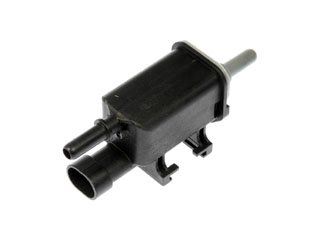
- Vapor Canister Purge Valve / Solenoid
(OEM #12597567)— This is the most common component to fail, triggering the P0443 circuit code on this platform. The original part number 12597567 has been superseded by other numbers, but the most common service replacement is ACDelco 214-1680.
Trusted brands: ACDelco (OEM), Standard Motor Products (CP471), Dorman (911-032)
OEM price range: $40-$75
Aftermarket price range: $25-$50 - Purge Solenoid Connector Pigtail
(OEM #ACDelco PT2183)— If the electrical connector is cracked, corroded, or has melted from heat, it must be replaced to ensure a solid connection to the new solenoid.
Trusted brands: ACDelco, Dorman (645-211)
OEM price range: $20-$35
Aftermarket price range: $15-$25
Related Codes That Often Appear With This One
- P0496 — This code indicates 'EVAP Flow During a Non-Purge Condition' and often appears if the purge valve has failed by getting stuck open, causing un-commanded vapor flow.
- P0444 — This code for 'EVAP Purge Control Valve Circuit Open' is a more specific version of P0443 and strongly points to a broken wire, unplugged connector, or a completely failed solenoid coil.
Technical Service Bulletins (TSBs) & Recalls
- No specific TSBs for P0443 on the 2004-2012 Canyon were found. However, TSBs exist for other EVAP system issues like the vent valve (P0449) and for related platform issues like cracked exhaust manifolds.
- Bulletin #PIP5552 addresses a MIL condition specifically for P0443 and P0459, indicating that manufacturer engineering has investigated this circuit fault.
- Bulletin #PIT5336, while referencing the Acadia, provides relevant diagnostic insight for GM vehicles, noting that a P0443 can be accompanied by an open Emission 1 fuse due to damaged wires on the engine harness.
Platform-Specific Known Issues
- A user on 355nation.net (a popular forum for this platform) created a detailed 'How-To' thread for replacing the P0443 purge solenoid, complete with photos showing the location and the process of removing the battery and tray for access. This is considered the standard DIY procedure by the community. 🎬 Watch: Full replacement walkthrough for the 3.7L engine.
- Another owner on a forum confirmed that after replacing the solenoid, their P0443 code was resolved, but they still had issues starting after refueling. This was traced to charcoal pellets from a disintegrating EVAP canister clogging the lines, a separate but related EVAP system problem that can occur on older vehicles.
Mechanic-Grade Diagnostic Values
- EVAP Purge Solenoid Coil Resistance — expected: 14-30 Ohms. Failure: Infinite resistance (OL) indicates an open coil; near-zero resistance indicates a shorted coil.
- Voltage at Solenoid Connector - Power Wire (Pink) — expected: Battery Voltage (~12V) with Key On, Engine Off.. Failure: 0V indicates a blown fuse or an open in the power supply wire from the fuse block.
- Voltage at Solenoid Connector - Control Wire (Dark Green/White) — expected: This is a PCM-controlled ground. With the valve commanded OFF, voltage should be near battery voltage. When commanded ON by a scan tool, voltage should drop to near 0V.. Failure: Voltage that does not change when commanded, or is stuck at an intermediate level (e.g., 3.15V as seen in one case), points to a wiring or PCM driver issue.
Scan Tool Commands That Help
- GM Tech2: EVAP Service Bay Test — This is a comprehensive, automated test that allows a technician to verify the entire EVAP system's integrity without a drive cycle. It commands the purge and vent solenoids and monitors the fuel tank pressure sensor to check for leaks and proper valve function. It's useful to confirm if the PCM can control the circuit after a repair or to diagnose an intermittent fault.
- GM Tech2 / Professional Scan Tool: EVAP Purge/Seal — This is a manual bidirectional control that allows the technician to command the purge solenoid ON and OFF directly. This is the primary method to test the control circuit; you can command the valve to open while listening for a click and checking for the voltage drop on the control wire.
Wiring & Ground Locations
- Purge Solenoid Power Wire — Pin A (Pink wire) on the purge solenoid connector.. This is the 12V power feed from the underhood fuse block. No power here is a primary cause of P0443, often due to a blown fuse.
- Purge Solenoid Control Wire — Pin B (Dark Green/White wire) on the purge solenoid connector, running to the PCM.. The PCM grounds this wire to activate the solenoid. A break or short in this wire will prevent the PCM from controlling the valve, directly causing a P0443 code.
- G101 / G102 / G103 — G101 is on the lower front of the engine block. G102 is at the left rear of the engine. G103 is on the cowl above the brake booster.. These are primary engine and body ground points. While not directly for the purge solenoid, a poor engine or PCM ground can cause erratic voltage readings and floating grounds across multiple sensors, potentially leading to a P0443 or other electrical codes. Cleaning these grounds is a good practice when chasing intermittent electrical faults.
Real Owner Repair Stories
- Reddit user on r/chevycolorado (2016 GMC Canyon SLT (newer but relevant platform)) — P0443 and P0458 codes
❌ Tried (didn't work) Cleaning the gas cap, Replacing the purge valve (worked temporarily)
✅ What actually fixed it The user found the replacement purge valve itself had failed with an open internal coil (infinite resistance). They were diagnosing a potential wiring issue due to strange voltage readings (15V on power, 3.15V on control) but confirmed the new part was defective before proceeding. This highlights that even new parts can be faulty.
"I Checked Everything" — The Actual Cause
- P0443 is an electrical circuit code, not a leak code. Performing a smoke test for P0443 is a misdiagnosis. The test will almost certainly pass (show no leaks) because the fault lies in the solenoid's coil, the wiring, the connector, or the PCM driver, not the physical sealing of the EVAP hoses. Technicians should focus on electrical tests (resistance, voltage, and ground) for this specific DTC.
OEM Part Supersession History
12597567→ACDelco 214-1680 (also 12606684)— Standard part lifecycle replacement and potential minor internal revisions for durability.
Heads up: These part numbers are directly interchangeable for the purge solenoid on this vehicle.10386359 (EVAP Vent Solenoid)→20907779 / ACDelco 214-2149— The original design was highly prone to failure from debris/moisture. The new part is a more robust design.
Heads up: CRITICAL: This note applies to the *vent* solenoid (P0449), not the purge solenoid (P0443), but is a common point of confusion. The updated vent solenoid requires a separate jumper harness adapter (ACDelco 19257603) because the electrical connector was changed. Many aftermarket kits include this adapter.
Diagnostic Flowchart
Other Known Issues on This Vehicle
Issues unrelated to this code that are worth knowing about as an owner of this generation:
- Passlock Anti-Theft System Failure 🔴 High — Very common across all 2004-2012 models. Can cause a no-start or crank-no-start condition, often intermittently, leaving the driver stranded. (Ref: No recall, but numerous TSBs and a well-known issue. The common fix is replacing the ignition lock cylinder/Passlock sensor or performing a permanent bypass.)
- Cracked Exhaust Manifold 🟠 Medium — Common on the 3.5L and 3.7L 5-cylinder engines. Thermal stress causes the manifold to crack, leading to an exhaust leak, ticking noise, and potentially lean codes (P0171). (Ref: TSB #PIP4409E addresses related symptoms like a rough running engine.)
- Blower Motor Resistor Failure 🟡 Low — Extremely common. Results in the HVAC fan only working on the highest setting (or not at all). Often the connector melts as well. (Ref: GM TSB PIT3688A addresses the poor connection that causes this failure.)
- Worn Intake Valve Seats 🔴 High — Primarily affects early 2004-2006 models with the 2.8L and 3.5L engines. Leads to low compression, misfires (P0300), and requires cylinder head repair. (Ref: No recall, but was a known manufacturing defect in the cylinder heads of early models.)
- Throttle Body Needs Frequent Cleaning 🟡 Low — Common across all engines. Carbon buildup causes a low or unstable idle and can set a P0506 code. Cleaning the throttle body is a regular maintenance item for many owners.
Used vs. New Parts: Buying Guide for This Vehicle
When a used part is the smart pick: A used part is generally not recommended for the solenoid itself due to its high failure rate and low cost for a new part. However, sourcing a used connector pigtail from a junkyard is a viable option if the original is damaged and you need a section of OEM wiring to splice in.
Donor-vehicle mileage cap: roughly under 80000 miles for the part to have meaningful remaining life.
What to inspect on the donor part:
- For a pigtail: Inspect for any cracks in the plastic, brittleness in the wires, or corrosion on the pins.
- For a solenoid (if you must): Ask for a resistance reading before purchase. It should be between 14-30 ohms. Avoid parts from vehicles with very high mileage or visible signs of engine bay damage.
OEM-only on this vehicle (don't cheap out):
- No parts for this specific P0443 repair are strictly 'OEM-only'. The solenoid is a simple and common part.
Aftermarket brands forum-validated for this vehicle:
- ACDelco (OEM supplier)
- Standard Motor Products (SMP)
- Dorman (often provides redesigned parts or kits)
Brands owners have reported issues with on this vehicle:
- Unbranded, no-name parts from online marketplaces can have poor quality control and may fail prematurely, as evidenced by forum posts where even new parts are dead on arrival.
Real Owner Stories
Aggregated from forums and TSBs cited above. Mileages and costs reflect what owners reported in those sources.
2004-2012 GMC Canyon
Symptoms: The check engine light was on. After replacing the solenoid and disconnecting the negative battery terminal to reset the light, the truck is running with no light so far.
What fixed it: Replaced the EVAP purge solenoid valve.
Source hint: youtube_comment source_name: TRQ
2004-2012 GMC Canyon
Symptoms: P0443 code was present. Even after replacing the solenoid, the vehicle still had difficulty starting specifically after refueling.
What fixed it: The issue was traced to charcoal pellets from a disintegrating EVAP canister clogging the lines.
Source hint: vehicle_specific_issues - forum owner report
2004-2012 GMC Canyon
Symptoms: P0443 code; needed a DIY guide to access the part which required removing the battery and tray for access.
What fixed it: Replacement of the purge solenoid following a community 'How-To' guide.
Source hint: 355nation.net - 'P0443 - EVAP Purge Solenoid - How To'
Related OBD-II Codes
Frequently Asked Questions
Where is the EVAP purge solenoid located on my GMC Canyon with the I4 or I5 engine?
Is there a specific TSB for the P0443 code on the 2004-2012 Canyon?
Can I test the purge solenoid myself with a multimeter?
What specific replacement connector pigtail should I use for the purge solenoid wiring?
Why does my Canyon struggle to start specifically after I fill up the gas tank?
Which fuse should I check for the EVAP system on the GMT355 platform?
Helpful Videos

Used OEM Parts in Stock
New Aftermarket Parts Available


The information in this article is provided for general reference and educational purposes only. Vehicle specifications, procedures, and part compatibility can vary by production date, trim level, and region. Always consult your vehicle's factory service manual and verify part numbers before purchasing or performing repairs. Safety-critical components such as airbags, seat belts, and braking systems should be installed by a qualified professional.
- GMC Canyon:
- 🧭 Diagnostic Flowchart
- 🎬 Helpful Videos
- 🛍️ Shop This Part
- What's Unique About the 2004-2012 GMC Canyon
- Symptoms You May Notice
- Most Likely Causes
- Rare But Worth Checking
- Diagnosis Steps
- Parts You'll Likely Need
- Related Codes That Often Appear With This One
- Technical Service Bulletins (TSBs) & Recalls
- Platform-Specific Known Issues
- Mechanic-Grade Diagnostic Values
- Scan Tool Commands That Help
- Wiring & Ground Locations
- Real Owner Repair Stories
- "I Checked Everything" — The Actual Cause
- OEM Part Supersession History
- Other Known Issues on This Vehicle
- Used vs. New Parts: Buying Guide for This Vehicle
- Real Owner Stories
- 2004-2012 GMC Canyon
- 2004-2012 GMC Canyon
- 2004-2012 GMC Canyon
- Related OBD-II Codes
- Frequently Asked Questions
- 🎟️ Get 5% Off