

P0443 on 2006-2010 Hummer H3: EVAP Purge Solenoid Circuit Fault Causes and Fixes
P0443 on a 2006-2010 Hummer H3 almost always points to a failed EVAP Purge Solenoid Valve located in the engine bay. It's a common failure item across its GM platform mates, but is inexpensive and relatively easy to replace for a DIYer, though access on 5-cylinder models can be tight.
- P0443 on an H3 points to an electrical fault in the EVAP Purge Solenoid circuit, not a system leak.
- The most likely cause is a failed purge solenoid valve (OEM Part #12597567), which is a common and inexpensive part to replace.
- Before buying parts, perform a quick visual inspection of the wiring and connector for obvious damage, and check fuse #31 in the underhood fuse block.
- Do not confuse the Purge Solenoid (in the engine bay) with the Vent Solenoid (at the rear of the truck, which causes code P0449).
- This repair is considered beginner-friendly on V8 models. On 5-cylinder models, access is more challenging and may require removing the wheel/fender liner or the battery tray.
What's Unique About the 2006-2010 Hummer H3
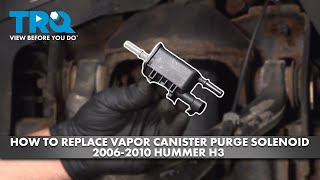
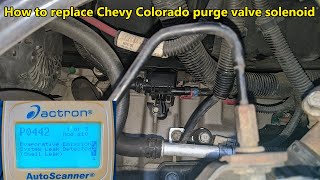
The Hummer H3 shares its GMT345 platform (and many parts) with the 2004-2012 Chevrolet Colorado and GMC Canyon trucks. As a result, the EVAP purge solenoid is a well-documented common failure point across all three models. 🎬 See how to swap the solenoid on this shared platform. Owners should be careful not to confuse the purge solenoid in the engine bay with the vent solenoid located at the rear of the vehicle near the charcoal canister, as they are different parts that can cause similar issues but different codes (like P0449 for the vent solenoid).
Symptoms You May Notice
- Check Engine Light is on.
- Slightly rough idle.
- Difficulty starting the engine, especially right after refueling (stumbling, stalling, or extended crank).
- Fuel pump nozzle clicks off repeatedly when trying to fill the gas tank.
- A noticeable fuel odor.
- Reduced fuel economy.
- Replacing the gas cap. While a loose or faulty gas cap can cause other EVAP codes (like P0455 for a large leak), it does not cause a P0443 circuit code.
- Replacing the EVAP Vent Solenoid. This is a different part located near the charcoal canister at the rear of the H3. A P0443 code specifically points to the purge solenoid circuit in the engine bay. The vent solenoid typically triggers a P0449 code.
Most Likely Causes
- Faulty EVAP Purge Solenoid Valve 🔴 High Probability → Shop Vapor Canister This component is a known common failure item on the H3 and its sister platforms (Chevy Colorado/GMC Canyon). The internal solenoid coil can fail electrically (open or short circuit), or the valve can become physically stuck open or closed.
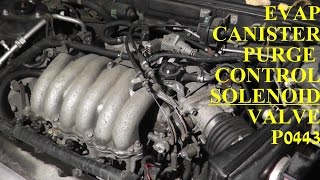
How to confirm: Use a scan tool to command the purge solenoid on and off; a healthy solenoid will make an audible clicking sound. You can also test the solenoid's internal resistance with a multimeter; a typical GM purge solenoid should have a resistance between 30 and 38 ohms. If you feel constant vacuum on the valve's port even when it's not commanded on, it is stuck open. 🎬 Watch: How to test and replace a faulty purge valve.
Typical fix: Replace the EVAP purge solenoid valve.
Est. part cost: $15-$50 - Damaged Wiring or Electrical Connector 🟡 Medium Probability The wiring harness in the engine bay is exposed to heat and vibration, which can lead to chafed or broken wires, especially near bends or where the harness is clipped to the engine. Corrosion can also form on the connector pins.
How to confirm: Visually inspect the wiring harness leading to the purge solenoid for any signs of damage, chafing, or breaks. Unplug the connector and check for corrosion. Use a multimeter to check for 12-volt power at the connector's power wire with the key on. Then, check for continuity on the ground/control wire back to the PCM.
Typical fix: Repair the damaged section of wire or clean/replace the connector.
Est. part cost: $5-$25 - Blown Fuse ⚪ Low Probability An electrical short in the circuit can cause the corresponding fuse to blow, cutting power to the purge solenoid. This is less common than the valve or wiring failing on its own.
How to confirm: Locate the fuse for the EVAP system in the underhood fuse block. On an H3, this is often fuse #31 (ECM/EVAP). Visually inspect the fuse or test it with a multimeter to see if it has blown.
Typical fix: Replace the blown fuse. If it blows again, there is an underlying short circuit that must be diagnosed and repaired.
Est. part cost: $1-$5
Rare But Worth Checking
- Faulty Powertrain Control Module (PCM): → Shop Engine Control Module (ECM) This is very rare. The PCM driver for the solenoid can fail, but this should only be considered after all other possibilities, including the valve, wiring, and fuses, have been thoroughly tested and ruled out.
Diagnosis Steps
- Verify the code with an OBD-II scanner.
- Locate the EVAP purge solenoid. On 5-cylinder models, it's on the driver's side of the engine, below the fuel rail. Access can be difficult, often requiring removal of the driver's side front wheel and inner fender liner, or the battery and battery tray for top-down access. On V8 models, it's more accessible on top of the intake manifold.
- Visually inspect the electrical connector and wiring harness for any obvious damage, corrosion, or loose connections. Pay close attention to where the harness bends or is secured.
- With the ignition on and engine off, use a scan tool to command the purge solenoid to cycle. Listen for an audible clicking sound from the valve. No click suggests a faulty valve or a lack of power/ground.
- If no click is heard, disconnect the electrical connector. Use a multimeter or test light to verify that one pin has battery voltage (around 12V) with the key on.
- If power is present, test the resistance of the solenoid itself across its two pins. Compare this reading to the manufacturer's specification (typically 30-38 ohms for GM). An open circuit (infinite resistance) or a short (near zero resistance) indicates a failed solenoid.
- If the solenoid and power supply are good, check the integrity of the control wire (the ground side switched by the PCM) from the solenoid connector back to the PCM. This checks for a break in the wire.
- Check the relevant fuse (e.g., #31 in the underhood fuse block) to ensure it is not blown.
- If all wiring and the solenoid test good, the fault may lie within the PCM, but this is extremely uncommon and should be the last resort.
Parts You'll Likely Need
- EVAP Vapor Canister Purge Solenoid Valve
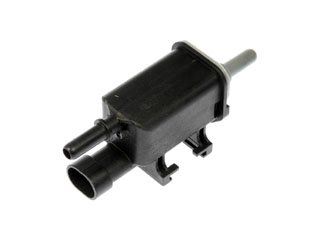
(OEM #12597567)— This is the most common component to fail, causing the P0443 circuit code. This part number is widely listed for all 2006-2010 H3 engines (3.5L, 3.7L, and 5.3L). It is also cross-referenced under ACDelco part number 214-1680.
Trusted brands: ACDelco, Standard Motor Products (SMP), Gates, Dorman
OEM price range: $30-$60
Aftermarket price range: $15-$40
Related Codes That Often Appear With This One
- P0496 — P0496 indicates 'EVAP Flow During a Non-Purge Condition.' This often occurs when the purge valve is physically stuck open, which can happen alongside the electrical circuit fault of P0443.
- P0442 — P0442 indicates a 'Small EVAP System Leak.' If the purge valve is not sealing correctly, it can be interpreted by the system as a small leak, sometimes appearing with the P0443 circuit code.
Technical Service Bulletins (TSBs) & Recalls
- While no TSB is specific to P0443 on the H3, GM has issued general bulletins like #20-NA-213 for newer vehicles that address wire harness chafing causing a wide variety of DTCs, including EVAP codes. This highlights the importance of checking the wiring harness for damage as a key diagnostic step.
Platform-Specific Known Issues
- Difficult Access on 5-Cylinder (I5) Models: On the 3.5L and 3.7L I5 engines, the purge solenoid is located on the driver's side of the engine block, tucked under other components. Owners report two main methods for access: either removing the driver's side front wheel and inner fender liner to approach from the side, or removing the battery and battery tray to reach down from the top. Neither is straightforward and requires more labor than on the V8.
- Easier Access on V8 Models: On the 5.3L V8 engine, the purge solenoid is typically located in a much more accessible position on top of the intake manifold, making replacement a very quick job requiring only basic tools. 🎬 Watch this step-by-step guide to replacing the H3 purge solenoid.
Mechanic-Grade Diagnostic Values
- EVAP Purge Solenoid Coil Resistance — expected: 15 - 35 Ohms. Failure: A reading of infinite resistance (open circuit) or near-zero resistance (short circuit) indicates a failed solenoid.
- Voltage at Purge Solenoid Connector (Power Feed) — expected: Battery Voltage (~12V) with ignition on.. Failure: No voltage indicates a blown fuse (e.g., #31) or an open in the power supply wire.
- Voltage at Purge Solenoid Connector (Control Wire) — expected: This is a ground-side switched circuit. With the solenoid commanded OFF, you should read battery voltage. When commanded ON by the PCM, the voltage should drop to near 0V.. Failure: Voltage that is always 0V suggests a short to ground in the control wire. Voltage that never drops from battery voltage when commanded ON suggests an open in the control wire or a failed PCM driver.
Scan Tool Commands That Help
- Tech2 / Professional Scan Tool: EVAP Purge/Seal or EVAP Purge Solenoid Valve Command — This bidirectional control is used to manually command the purge solenoid open and closed (or to a specific percentage) while the engine is running or off. This allows a technician to listen for the solenoid's audible click and to check for voltage changes on the control wire, confirming if the PCM driver and wiring are functioning correctly.
Wiring & Ground Locations
- Purge Solenoid Connector Pin A — The two-wire connector at the EVAP purge solenoid.. This is the voltage supply circuit terminal. With the ignition on, it should have battery voltage. A test lamp connected between this pin and a good ground should illuminate.
- Purge Solenoid Connector Pin B — The two-wire connector at the EVAP purge solenoid.. This is the control circuit that the PCM provides a ground to. Testing this pin with a scan tool commanding the solenoid on/off is the primary way to diagnose the control side of the circuit.
- G102 / G103 — On the lower left side of the engine block (G102) and on the cowl above the brake booster (G103).. These are primary engine and body control grounds. While not directly for the purge solenoid, a poor ground at these locations can cause a host of erratic electrical issues and codes, including problems with PCM operation. Checking that these grounds are clean and tight is a good practice when chasing any electrical fault.
- Underhood Fuse Block - Fuse #31 — The main fuse block in the engine compartment, located above the left front wheel well.. This fuse is often cited as protecting the ECM/EVAP circuit. If it is blown, the purge solenoid will not receive power, causing a P0443 code.
Real Owner Repair Stories
- Reddit user on r/chevycolorado (2016 GMC Canyon SLT (sister platform)) — P0443 and P0458 codes.
❌ Tried (didn't work) Cleaning the gas cap., Replacing the purge valve (this initially fixed a P0442 but the P0443 returned later).
✅ What actually fixed it The user was in the process of diagnosing a wiring issue. They measured 15V on the power wire and a constant 3.15V on the control wire, which is incorrect. The final fix was not posted, but their detailed diagnostic process correctly identified the fault was in the wiring or PCM, not the solenoid itself, which is a critical distinction for others to follow. - hummerforums.com user 'fitch' (Hummer H3 (I5 engine)) — P0455 code (large leak), high idle.
❌ Tried (didn't work) Replacing the gas cap ($53).
✅ What actually fixed it Replacing the EVAP purge solenoid valve (GM part, cost $44). The user provided a detailed guide on accessing it by removing the driver's side front wheel and inner fender liner. The fix resolved both the code and the high idle symptom.
OEM Part Supersession History
12597567→This part number is still widely active but is often sold under the ACDelco part number 214-1680. Some aftermarket replacements may cross-reference to Dorman 911-032.— Standard part branding and distribution.
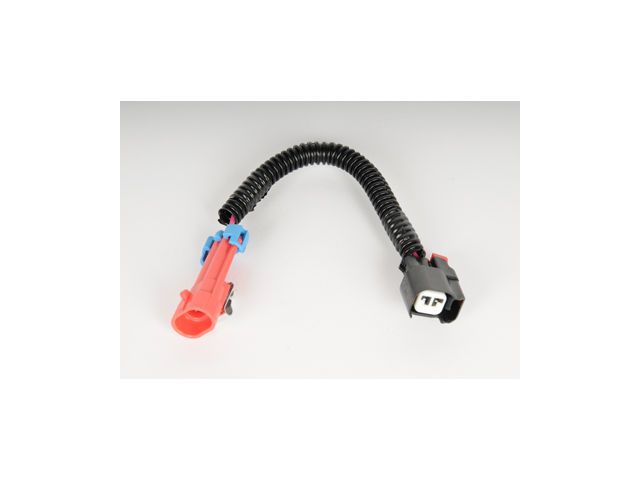
Heads up: Some replacement solenoids, particularly for the rear vent valve (P0449), come with an adapter harness because GM changed connector styles. Ensure the purge solenoid you purchase has the correct connector for your vehicle or includes the necessary pigtail adapter.
Diagnostic Flowchart
Used vs. New Parts: Buying Guide for This Vehicle
When a used part is the smart pick: For this specific repair, buying a used EVAP purge solenoid is not recommended. The part is a known common failure item and is relatively inexpensive to buy new from reputable aftermarket or OEM brands. The risk of getting a used part that has already failed or is near the end of its service life is high.
What to inspect on the donor part:
- Not applicable as a used part is not advised.
OEM-only on this vehicle (don't cheap out):
- No parts in this repair require strictly OEM. The ACDelco (GM's own brand) part is recommended, but quality aftermarket alternatives are widely available and used successfully.
Aftermarket brands forum-validated for this vehicle:
- ACDelco (GM Genuine)
- Standard Motor Products (SMP)
- Dorman
Brands owners have reported issues with on this vehicle:
- No specific brands are consistently reported as problematic in forums, but ultra-low-cost, unbranded parts from online marketplaces carry a higher risk of premature failure.
Real Owner Stories
Aggregated from forums and TSBs cited above. Mileages and costs reflect what owners reported in those sources.
Hummer H3
Symptoms: P0443 error code was present, and the battery would die every couple of days despite being new.
What fixed it: The issue was not resolved after a shop replaced the vent valve and fuel pump, suggesting a misdiagnosis where the purge valve or wiring was the likely culprit.
Source hint: Hummer Forums
Hummer H3 with 5-cylinder engine
Symptoms: Check Engine Light with code P0443.
What fixed it: The owner successfully replaced the purge solenoid by removing the driver's side wheel and fender liner to gain access.
Source hint: hummerforums.com - 'Step by step purge valve replacement'
Hummer H3 with I5 engine
Symptoms: An emissions code appeared after a gas cap warning.
What fixed it: The owner replaced the purge solenoid by removing the battery and battery case to access the part from the top of the engine bay.
Source hint: hummerforums.com - 'replaced evap solenoid'
2006 Hummer H3
Symptoms: The engine was stumbling and stalling immediately after refueling.
What fixed it: A dealership correctly diagnosed the issue and replaced the EVAP purge solenoid.
Source hint: hummerforums.com - '2006 H3 Stumbles after fueling'
Related OBD-II Codes
Frequently Asked Questions
Where is the EVAP purge solenoid located on my Hummer H3?
Is it difficult to replace the purge solenoid on the 5-cylinder H3?
My H3 stumbles and stalls right after I fill it with gas. Is this related to code P0443?
What fuse should I check for a P0443 code on my H3?
How can I test the purge solenoid myself to see if it's bad?
Are other GM trucks like the Chevy Colorado affected by this same P0443 issue?
Is there a specific Technical Service Bulletin (TSB) for P0443 on the 2006-2010 Hummer H3?
Helpful Videos
Used OEM Parts in Stock
New Aftermarket Parts Available


The information in this article is provided for general reference and educational purposes only. Vehicle specifications, procedures, and part compatibility can vary by production date, trim level, and region. Always consult your vehicle's factory service manual and verify part numbers before purchasing or performing repairs. Safety-critical components such as airbags, seat belts, and braking systems should be installed by a qualified professional.
- Hummer H3:
- 🧭 Diagnostic Flowchart
- 🎬 Helpful Videos
- 🛍️ Shop This Part
- What's Unique About the 2006-2010 Hummer H3
- Symptoms You May Notice
- Most Likely Causes
- Rare But Worth Checking
- Diagnosis Steps
- Parts You'll Likely Need
- Related Codes That Often Appear With This One
- Technical Service Bulletins (TSBs) & Recalls
- Platform-Specific Known Issues
- Mechanic-Grade Diagnostic Values
- Scan Tool Commands That Help
- Wiring & Ground Locations
- Real Owner Repair Stories
- OEM Part Supersession History
- Used vs. New Parts: Buying Guide for This Vehicle
- Real Owner Stories
- Hummer H3
- Hummer H3 with 5-cylinder engine
- Hummer H3 with I5 engine
- 2006 Hummer H3
- Related OBD-II Codes
- Frequently Asked Questions
- 🎟️ Get 5% Off