

P0443 on 2016-2020 Kia Optima: EVAP Purge Valve Circuit Causes and Fixes
On a 2016-2020 Kia Optima, code P0443 almost always means the canister purge valve has failed. This is a very common, inexpensive, and easy DIY fix, typically costing $25-$75 for the part and taking less than 30 minutes to replace. The issue is shared with its platform-mate, the Hyundai Sonata.
- P0443 on a 2016-2020 Optima is an electrical circuit code, not a gas cap or leak issue.
- The most likely culprit by a wide margin is a failed canister purge valve, a common issue for this platform and its Hyundai mates.
- This is a beginner-friendly DIY repair that can be completed in under 30 minutes with basic tools.
- Always check the fuse (often 'SENSOR 2', but sometimes 'SENSOR 1') and wiring before buying parts, as a wiring fault can mimic a failed valve.
- The correct OEM part number to look for is 28910-3C200.
What's Unique About the 2016-2020 Kia Optima
The 2016-2020 Kia Optima (JF generation) shares its platform, engines, and many components with the Hyundai Sonata. On these specific Hyundai/Kia platforms, the canister purge valve is a known high-failure item due to the internal solenoid coil burning out or failing electrically from engine heat cycles and vibration. The issue is consistent and very common across all available engines for this generation (1.6L Gamma, 2.0L Theta II Turbo, and 2.4L Theta II).
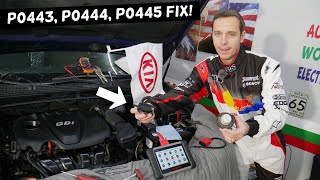
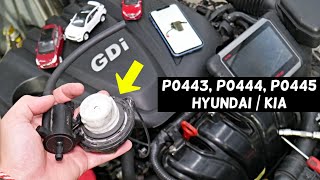
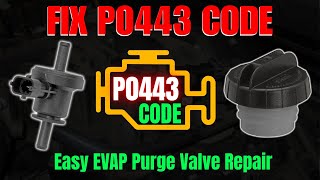
🎬 See how this common failure affects the 2.4L GDI engine.Symptoms You May Notice
- Check Engine Light is on
- Slightly rough idle
- Difficulty starting the engine, especially right after refueling.
- Reduced fuel economy
- A faint fuel odor near the engine (less common)
- Engine may stall at idle in some cases
- Replacing the gas cap. P0443 is a circuit code, not a leak code (like P0455 or P0456). A bad gas cap will not cause a P0443.
- Replacing other EVAP components like the canister or vent valve without first testing the purge valve circuit, which is the specific area indicated by the code.
Most Likely Causes
- Failed Canister Purge Valve (Solenoid) 🔴 High Probability → Shop Vapor Canister The internal electronic coil of the purge valve solenoid is a very common failure point on many Hyundai/Kia models of this era due to repeated heat cycles and engine vibration, causing an open or short in the coil.
How to confirm: Unplug the electrical connector from the valve and measure the resistance across the two pins with a multimeter. A healthy valve should read between 15 and 30 ohms (a common reading is ~26 ohms). A reading of infinity (open circuit) or near zero (short circuit) confirms the valve is bad. You can also apply 12V directly to the pins; a good valve will make an audible click.
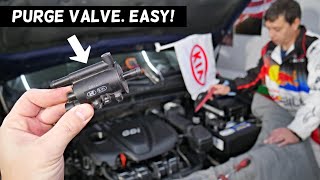
Typical fix: Replace the canister purge valve. It is located on top of the engine's intake manifold and is held in place by one or two small bolts and two hoses.
Est. part cost: $25-$75 - Damaged Wiring or Loose Connector 🟡 Medium Probability
How to confirm: Visually inspect the wiring harness leading to the purge valve for any signs of fraying, melting, rodent damage, or corrosion, especially near the connector. Ensure the connector is securely plugged into the valve and that the pins inside are clean and not bent.
Typical fix: Repair the damaged section of wire or clean/replace the electrical connector.
Est. part cost: $5-$25 - Blown Fuse ⚪ Low Probability
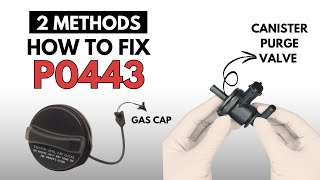
How to confirm: Check the fuse box in the engine compartment for a blown fuse. On many Kia models, the fuse for the purge valve is part of a multi-sensor circuit, often labeled 'SENSOR 2'. However, some model years may use the 'SENSOR 1' fuse. Visually inspect the fuse or test it with a multimeter 🎬 Watch: Two simple methods to diagnose and fix code P0443. for continuity.
Typical fix: Replace the blown fuse with a new one of the same amperage.
Est. part cost: $1-$5
Rare But Worth Checking
- Faulty Powertrain Control Module (PCM): → Shop Engine Control Module (ECM) This is extremely rare. Before condemning the PCM, all other possibilities (valve, wiring, fuses) must be exhaustively ruled out. A PCM failure would likely be accompanied by other trouble codes and more severe drivability issues.
Diagnosis Steps
- Scan the vehicle with an OBD-II scanner to confirm P0443 is the active code.
- Locate the canister purge valve on top of the engine, typically on the intake manifold. It will have two hoses and one electrical connector attached.
- Inspect the electrical connector for a secure fit and check the wiring harness for any visible damage, such as cracks, melting, or rodent damage.
- Check the fuse for the EVAP system, often labeled 'SENSOR 2' but sometimes 'SENSOR 1' in the engine bay fuse box. Replace if blown.
- If the wiring and fuse are okay, disconnect the electrical connector from the purge valve.
- Use a multimeter to test the resistance between the two pins on the valve itself. A reading between 15-30 ohms is expected. If it's outside this range (e.g., OL or 0), the valve is faulty and needs to be replaced.
- If the valve tests good, check for power at the connector with the ignition on. One wire should have battery voltage. The other wire is the ground-side control from the PCM.
- If all tests pass but the code returns immediately after clearing, there may be an intermittent wiring issue or a rare PCM fault. Note: Starting the engine with the purge valve connector unplugged during testing can set a P0443 code, which may need to be cleared.
Parts You'll Likely Need
- Canister Purge Valve
(OEM #28910-3C200)— This is the most common failure point for code P0443 on this vehicle. The internal solenoid fails electrically. This part is widely used across Hyundai and Kia models.
Trusted brands: Genuine Kia/Hyundai, Dorman (p/n 911-349), Standard Motor Products (p/n CP635), Beck/Arnley
OEM price range: $60-$105
Aftermarket price range: $25-$80
Related Codes That Often Appear With This One
- P0444 — This code indicates a purge valve circuit 'open' condition, which is a more specific version of P0443, often caused by a broken wire or a failed-open coil inside the valve.
- P0445 — This code indicates a purge valve circuit 'shorted' condition, another specific version of P0443, pointing to a short in the wiring or a shorted coil in the valve.
Platform-Specific Known Issues
- Forum Report: Code Persists After Valve Replacement: A user on Reddit reported that after replacing the purge valve for a P0443 code, the issue and code remained. This highlights the importance of checking the wiring and fuse before assuming the valve is the only possible cause. An open or short in the harness between the PCM and the valve will prevent a new part from working.
Mechanic-Grade Diagnostic Values
- Canister Purge Valve Solenoid Resistance — expected: 15 to 30 Ohms. Failure: A reading of infinity (OL) indicates an open coil; a reading near 0 Ohms indicates a shorted coil.
- Purge Valve Connector Power Pin Voltage — expected: ~12 Volts (Battery Voltage) with Key On, Engine Off. Failure: 0 Volts indicates a blown fuse or an open in the power supply wire.
- Purge Valve Connector Control Pin Voltage (during active test) — expected: Near 0 Volts when the PCM commands the valve ON (active ground).. Failure: Voltage does not drop to near 0V when commanded ON, indicating an open in the control wire or a faulty PCM driver.
Scan Tool Commands That Help
- Kia GDS or professional bidirectional scanner (e.g., Autel, XTOOL): EVAP Purge Valve Active Test / Bidirectional Control — Use this to command the purge valve solenoid on and off to verify circuit integrity and PCM control. While commanding the valve ON, you should hear it click and the control pin voltage should drop to near zero. This test definitively separates a wiring/PCM issue from a faulty valve.
- Kia GDS or professional bidirectional scanner: EVAP System Test (Purge & Seal) — This is used to test for a mechanically stuck-open purge valve. With the engine running, command the purge valve OFF and the vent valve ON (closed). Monitor the Fuel Tank Pressure (FTP) sensor data. If the pressure value begins to drop (indicating a vacuum is being pulled), the purge valve is leaking or stuck open mechanically, even if it passes electrical tests.
Wiring & Ground Locations
- Engine Bay Fuse Box — In the engine compartment, typically on the driver's side.. This box contains the fuse that provides 12V power to the purge control valve. A blown fuse will cause an immediate P0443 code.
- Fuse 'SENSOR 2' (10A) — Inside the engine bay fuse box.. On many Kia models of this era, this fuse powers the purge valve along with other sensors. This is the first fuse to check.
- Fuse 'SENSOR 1' (10A) — Inside the engine bay fuse box.. A wiring diagram for the 2017 Optima indicates the purge valve is on the 'SENSOR 1' fuse. This is a known variation, so both 'SENSOR 1' and 'SENSOR 2' should be checked.
- Main Engine Ground Strap — A braided metal strap typically connecting the engine block or cylinder head to the vehicle's chassis/frame rail.. While not a direct cause, a corroded or loose main engine ground can create unstable voltages and intermittent electrical faults for multiple components, including the purge valve circuit. Verifying it is clean and tight is good practice for any electrical diagnosis.
"I Checked Everything" — The Actual Cause
- Since P0443 is a circuit code, a smoke test is not the correct diagnostic procedure. The equivalent scenario is when basic electrical tests don't reveal the root cause. For example, a technician might find the purge valve's resistance is within spec and that the connector has power. However, the code returns. The actual cause could be an intermittent open/short in the wiring harness that only appears with engine vibration, or a failure of the driver circuit within the Powertrain Control Module (PCM), which is rare but possible.
OEM Part Supersession History
28910-3C200→N/A— This part number remains current and fits a wide range of Hyundai/Kia vehicles across many model years.
Heads up: No known supersession or incompatibility issues for the 2016-2020 Kia Optima.
Model Year Variations Within This Range
- 2016-2020: There is conflicting information regarding the specific fuse powering the purge valve. Most sources cite the 'SENSOR 2' 10A fuse in the engine bay fuse box. However, a diagram specific to the 2017 model year shows the purge valve on the 'SENSOR 1' 10A fuse. Technicians should check the diagram on the vehicle's fuse box cover and inspect both fuses.
Diagnostic Flowchart
Other Known Issues on This Vehicle
Issues unrelated to this code that are worth knowing about as an owner of this generation:
- Catastrophic Engine Failure (Theta II GDI) 🔴 High — Very common on 2.4L GDI and 2.0L Turbo GDI engines. Can occur at various mileages, often preceded by knocking noises and high oil consumption. (Ref: Subject of multiple recalls (e.g., SC147, SC200) and a major class-action settlement providing lifetime warranties and a Knock Sensor Detection System (KSDS) software update for affected vehicles.)
- Hydraulic Electronic Control Unit (HECU) Fire Risk 🔴 High — Affects 2013-2015 models, but the issue is notable for the platform. A short circuit in the HECU can cause a fire even when the vehicle is parked and off. (Ref: Recall SC197 was issued, advising owners to park outdoors away from structures until the repair (fuse replacement) is performed.)
- 7-Speed DCT Transmission Shudder 🟠 Medium — Common on models equipped with the 1.6L Turbo engine and 7-speed Dual-Clutch Transmission. Owners report hesitation and shuddering at low speeds. (Ref: Often addressed by a clutch and TCM software update from the dealer.)
- Excessive Oil Consumption 🟠 Medium — Frequently reported by owners of the 2.4L and 2.0T engines, often as a precursor to more serious engine problems. Requires frequent oil level checks.
- Cracked Trunk Latch Base 🟡 Low — The latch base may crack, preventing the internal emergency trunk release from functioning. (Ref: Recall SC278 was issued to replace the trunk latch base subassembly on 2016-2018 models.)
Used vs. New Parts: Buying Guide for This Vehicle
When a used part is the smart pick: For this repair, buying a used purge valve from a junkyard is not recommended. The part is a known high-failure item, and the cost of a new aftermarket part is very low (often $25-$40). The risk of the used part failing shortly after installation outweighs the minimal cost savings.
OEM-only on this vehicle (don't cheap out):
- No parts for this specific P0443 repair are considered 'OEM-only'. The purge valve is a simple solenoid available from multiple reputable aftermarket manufacturers.
Aftermarket brands forum-validated for this vehicle:
- Dorman
- Standard Motor Products (SMP)
- Beck/Arnley
Brands owners have reported issues with on this vehicle:
- Be cautious of unbranded, generic parts from online marketplaces with no warranty or brand reputation, as quality control can be inconsistent.
Real Owner Stories
Aggregated from forums and TSBs cited above. Mileages and costs reflect what owners reported in those sources.
2016 Kia Optima 2.4L
Symptoms: The check engine light is staying on all the time with an active code stored.
What fixed it: The source demonstrates the location and replacement of the purge valve to fix codes P0443, P0444, and P0445.
Source hint: YouTube - World Mechanics channel: Video titled 'KIA OPTIMA CODE P0443 P0444 P0445 ENGINE LIGHT ON FIX'
Kia Optima (Year not specified)
Symptoms: The owner replaced the purge valve for a P0443 code, but the issue and code remained.
What fixed it: The report emphasizes that the issue was not the valve itself but required checking the wiring and fuse, as an open or short in the harness prevents the valve from working.
Source hint: Reddit r/MechanicAdvice - Thread 'P0443 Issue?'
Kia Optima (Year not specified)
Symptoms: The P0443 DTC code appeared specifically after the owner was testing for a bad purge valve solenoid.
What fixed it: The code was inadvertently set by starting the car with the valve unplugged during diagnostic testing; it simply needed to be cleared.
Source hint: Reddit r/MechanicAdvice - Thread 'P0443 DTC Code after testing for a bad purge valve solenoid'
Related OBD-II Codes
Frequently Asked Questions
Where is the canister purge valve located on my 2016-2020 Kia Optima?
Which fuse should I check for a P0443 code on my Optima?
Why does my Optima have trouble starting specifically after I fill up the gas tank?
What is the correct resistance reading for a healthy purge valve on this vehicle?
I replaced the purge valve but the P0443 code is still there. What else could it be?
Is the P0443 code related to the Theta II engine recalls on my Optima?
Helpful Videos

Used OEM Parts in Stock
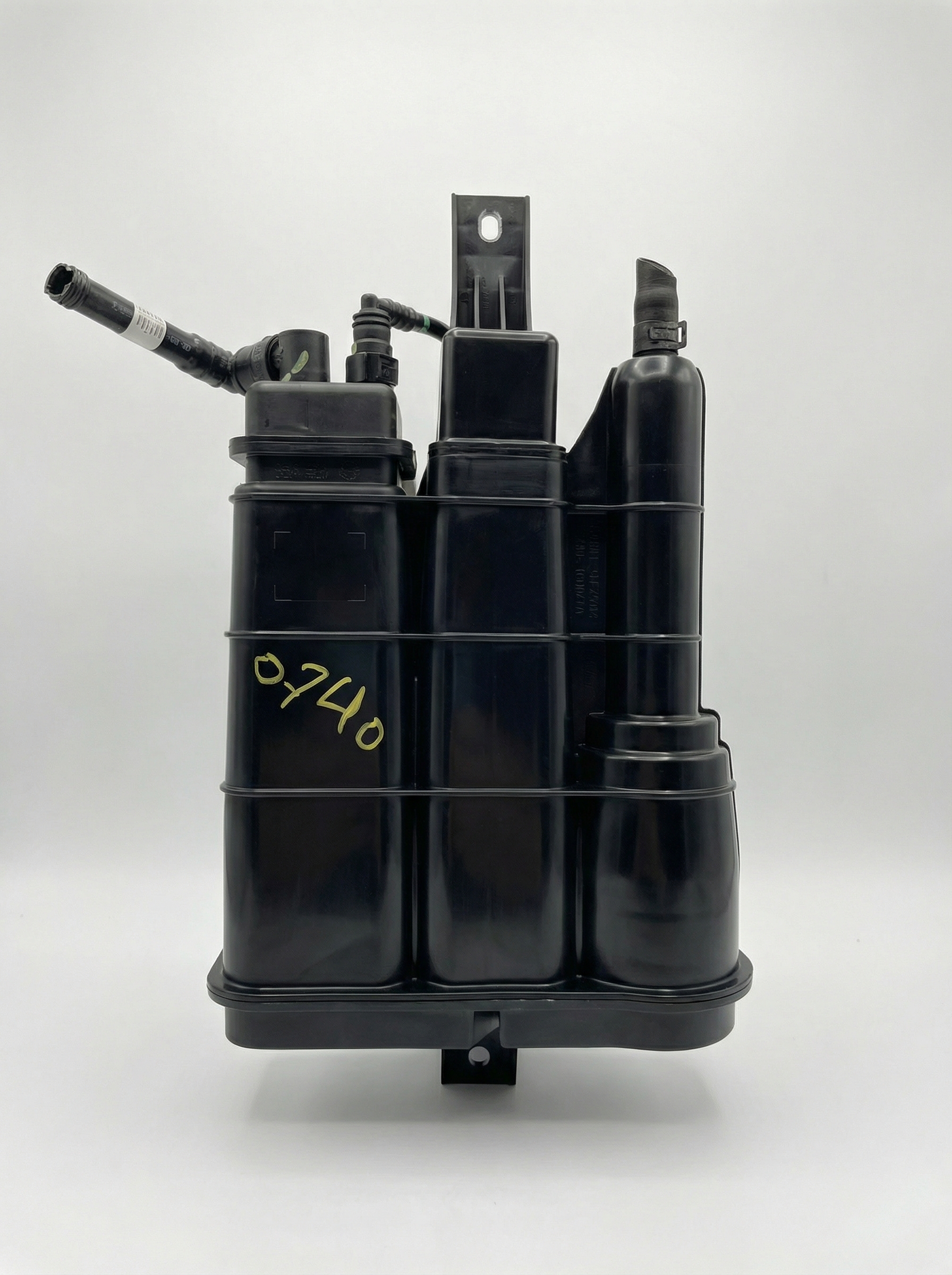
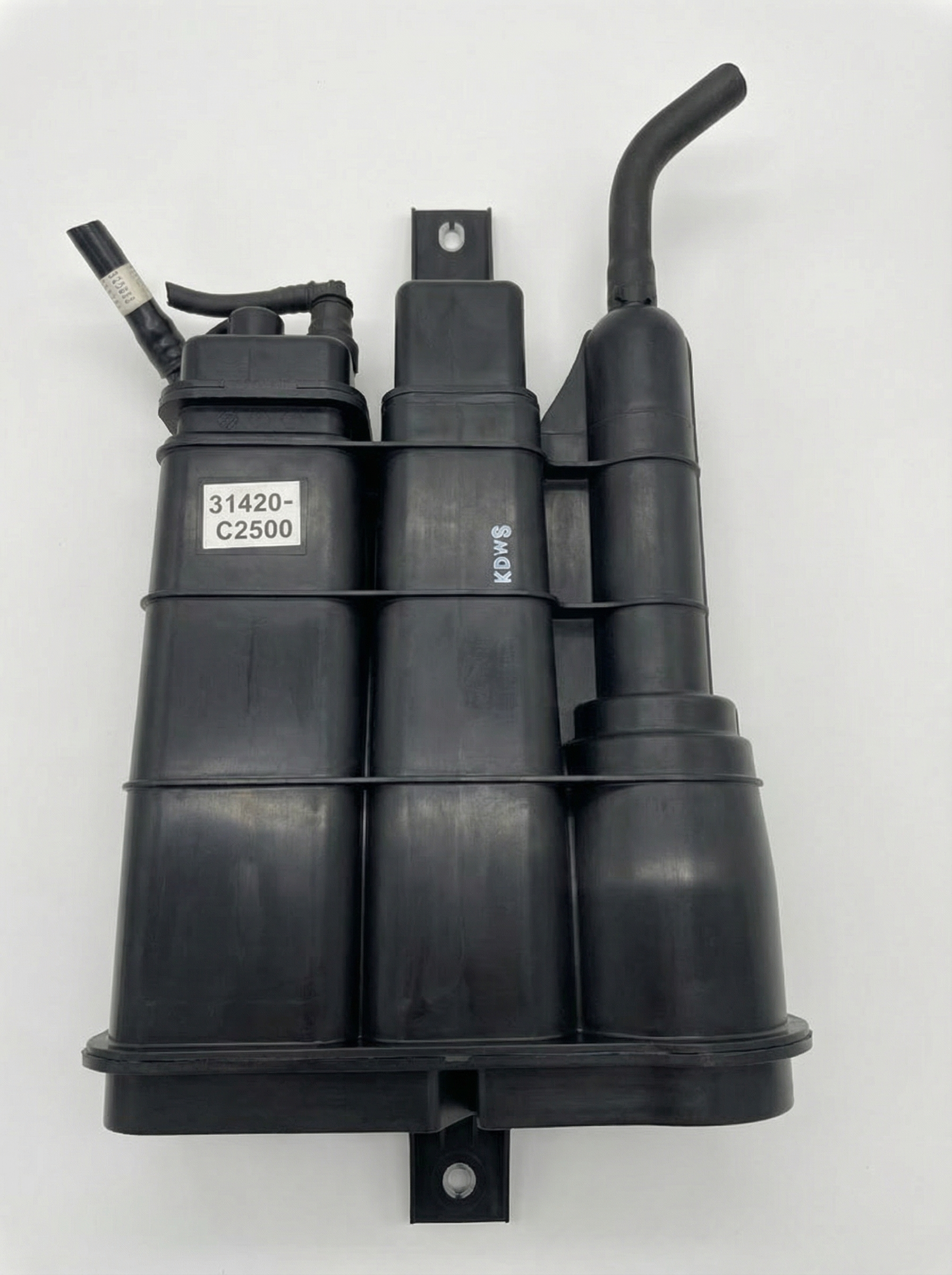
New Aftermarket Parts Available

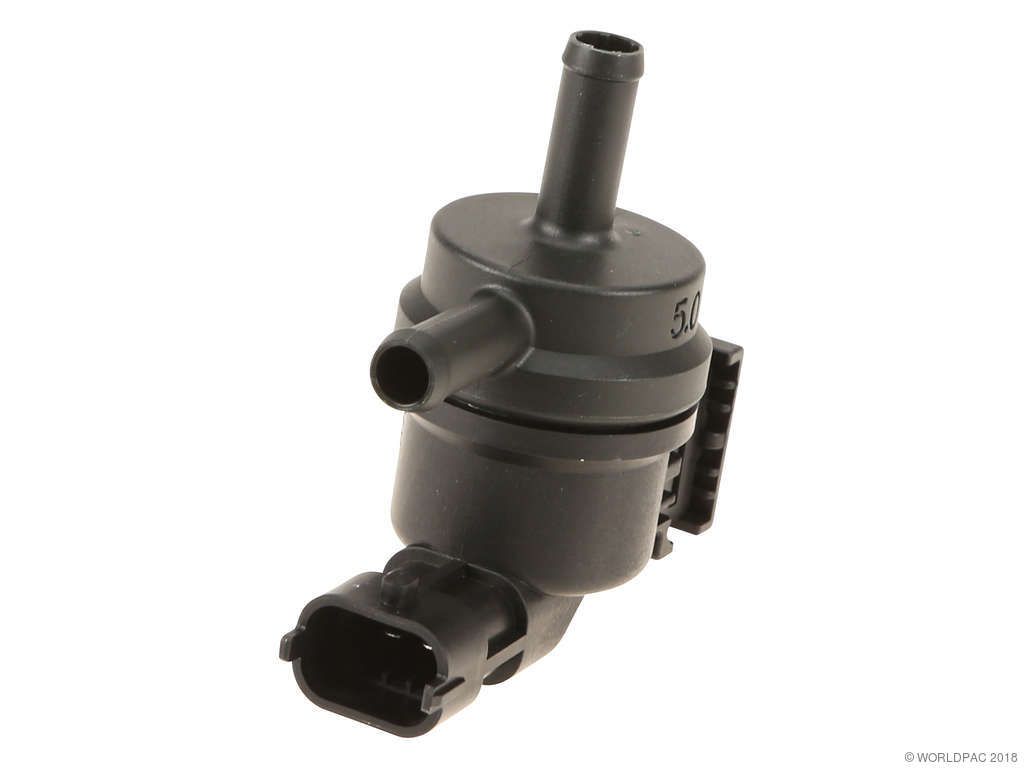
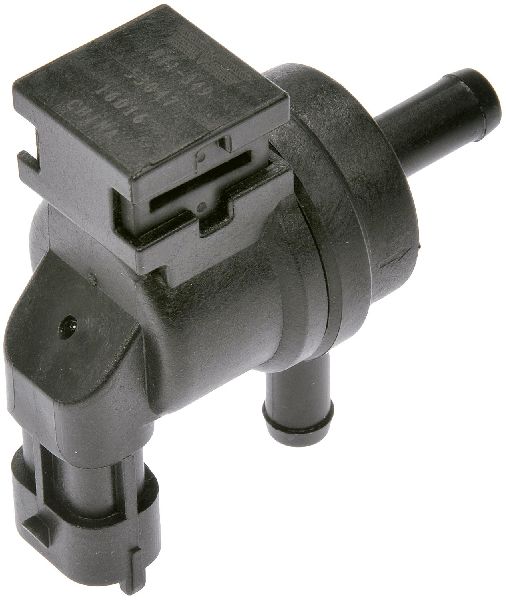

The information in this article is provided for general reference and educational purposes only. Vehicle specifications, procedures, and part compatibility can vary by production date, trim level, and region. Always consult your vehicle's factory service manual and verify part numbers before purchasing or performing repairs. Safety-critical components such as airbags, seat belts, and braking systems should be installed by a qualified professional.
- Kia Optima:
- 🧭 Diagnostic Flowchart
- 🎬 Helpful Videos
- 🛍️ Shop This Part
- What's Unique About the 2016-2020 Kia Optima
- Symptoms You May Notice
- Most Likely Causes
- Rare But Worth Checking
- Diagnosis Steps
- Parts You'll Likely Need
- Related Codes That Often Appear With This One
- Platform-Specific Known Issues
- Mechanic-Grade Diagnostic Values
- Scan Tool Commands That Help
- Wiring & Ground Locations
- "I Checked Everything" — The Actual Cause
- OEM Part Supersession History
- Model Year Variations Within This Range
- Other Known Issues on This Vehicle
- Used vs. New Parts: Buying Guide for This Vehicle
- Real Owner Stories
- 2016 Kia Optima 2.4L
- Kia Optima (Year not specified)
- Kia Optima (Year not specified)
- Related OBD-II Codes
- Frequently Asked Questions
- 🎟️ Get 5% Off