

P0443 on 2003-2008 Pontiac Vibe: EVAP Purge Valve Circuit Causes and Fixes
On a 2003-2008 Pontiac Vibe, code P0443 is almost always caused by a failed EVAP purge solenoid valve located in the engine bay. It's a simple, 15-minute DIY fix with a part costing between $30 and $90.
- P0443 is an electrical circuit code, not a leak code. Don't replace the gas cap or perform a smoke test.
- The most likely fix is replacing the EVAP purge solenoid valve in the engine bay, a very simple DIY job.
- This vehicle uses Toyota parts; the correct OEM part number is Toyota P/N 90910-12276.
- For 2005-2008 models, be aware of the historical recall for the Engine Control Module (GM #10282), which could be a rare cause if the valve and wiring are good.
What's Unique About the 2003-2008 Pontiac Vibe
The Pontiac Vibe is a unique joint-venture vehicle, essentially a rebadged Toyota Matrix with a Toyota-designed powertrain and emissions system. Therefore, for engine and emissions codes like P0443, it's crucial to follow Toyota's diagnostic procedures and use Toyota-compatible parts. The purge valve is often referred to by its Toyota name: a Vacuum Switching Valve (VSV). Additionally, 2005-2008 models with the 1.8L 1ZZ-FE engine were subject to a recall (GM #10282) for faulty Engine Control Modules (ECMs), which can be a rare cause of this code.
Symptoms You May Notice
- Check Engine Light is on
- Slightly rough idle in some cases
- Difficulty starting immediately after refueling (rare)
- Loud clicking or buzzing from the purge valve in the engine bay
- Noticeable fuel odor due to escaping vapors.
- Replacing the gas cap. A loose or faulty gas cap causes EVAP leak codes (like P0455 or P0457), not a circuit code like P0443.
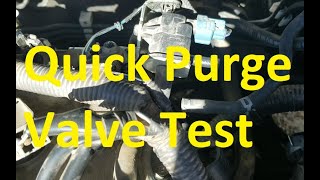
- Performing a smoke test. A smoke test is used to find physical leaks in the EVAP system hoses or canister. P0443 is an electrical circuit fault, so a 🎬 Watch: Understanding P0443 causes and fixes smoke test is not a useful diagnostic step for this specific code.
- Replacing the EVAP canister vent solenoid. This is a different valve located near the charcoal canister at the rear of the vehicle and is associated with different trouble codes (e.g., P0446).
Most Likely Causes
- Failed EVAP Purge Solenoid Valve (or VSV) 🔴 High Probability → Shop Vapor Canister This is a common failure point for many vehicles of this era. The internal coil windings can break, or the valve can become mechanically stuck open or closed.
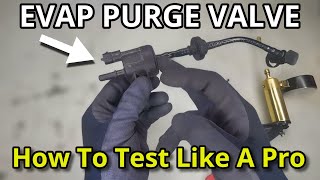
How to confirm: Locate the valve in the engine bay near the intake manifold. With the engine off, unplug the electrical connector and measure the resistance between the two pins on the valve with a multimeter. A good valve should have a resistance between 22-30 ohms. A reading of infinity (OL) indicates an open coil, while a reading near zero indicates a short. You can also apply 12V directly to the pins; a good valve will make an audible click. If you can blow through 🎬 Watch: How to test the purge valve without tools the valve when no power is applied, it is stuck open.
Typical fix: Replace the EVAP purge solenoid valve. This involves disconnecting the electrical connector, removing two spring clamps from the vacuum hoses, and sliding the old valve off its bracket. It is a very accessible part in the engine bay.
Est. part cost: $30-$90 - Damaged Wiring or Connector 🟡 Medium Probability Wiring in the engine bay is exposed to heat and vibration, which can cause wires to become brittle, chafe, or break over time. The connector pins can also corrode, causing a poor connection.
How to confirm: Visually inspect the wiring harness and electrical connector going to the purge solenoid for any signs of cracking, chafing, or corrosion. With the key on and engine off, use a multimeter or test light to check for battery voltage at one pin of the harness-side connector. The other wire is the ground control wire from the ECM.
Typical fix: Repair the broken or shorted section of wire. If the connector is damaged, replace it with a new pigtail connector.
Est. part cost: $5-$25
Rare But Worth Checking
- Faulty Engine Control Module (ECM): → Shop Engine Control Module (ECM) A recall (GM #10282, NHTSA #10V387000) was issued for improperly manufactured ECMs on 2005-2008 Pontiac Vibe models with the 1.8L 1ZZ-FE engine and two-wheel drive. A crack can develop on the ECM's circuit board, potentially causing various issues including harsh shifting, engine stalling, a no-start condition, or setting false trouble codes like P0443. This should be considered if the purge valve and wiring test good on these specific models.
- Blown Fuse: The EVAP system circuit is protected by a fuse. While not common, a blown fuse will cut power to the purge solenoid and trigger a P0443 code. Check the fuse box diagram for the appropriate fuse (often labeled 'EFI' or 'AM2' on Toyota-based systems) before condemning other parts.
Diagnosis Steps
- Verify the code with an OBD-II scanner.
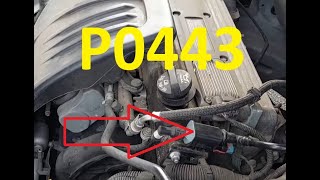
- Locate the EVAP purge solenoid on the driver's side of the engine bay, near the intake manifold. It's a small black plastic valve with two hoses and an electrical connector.
- Inspect the electrical connector and wiring harness for any visible damage, corrosion, or loose connections.
- Disconnect the electrical connector. Turn the ignition to the 'ON' position (engine off). Use a multimeter to check for battery voltage 🎬 See this step-by-step guide to testing the solenoid at one of the pins in the harness-side connector.
- If voltage is present, test the solenoid itself. Measure the resistance across the two pins on the solenoid. A good solenoid should have a resistance between 22-30 ohms. An open circuit (OL) or a short (near 0 ohms) means the solenoid is bad and needs replacement.
- If the solenoid's resistance is good, you can test its mechanical function. Use jumper wires to briefly apply 12V and ground to the solenoid's pins. You should hear an audible 'click'. If it doesn't click, it's mechanically stuck. Also, try to blow through it; if air passes when unpowered, it's stuck open.
- If the wiring has power and the solenoid tests good, the fault may lie in the ground control wire from the ECM or, rarely, the ECM itself, especially on 2005-2008 2WD models covered by the recall.
Parts You'll Likely Need
- EVAP Vapor Canister Purge Solenoid / Vacuum Switching Valve
(OEM #90910-12276)— This is the component that fails electrically over 90% of the time for a P0443 code. It is the primary cause.
Trusted brands: Denso (OEM Manufacturer), ACDelco, Standard Motor Products (SMP), Dorman
OEM price range: $60-$90
Aftermarket price range: $30-$55
Related Codes That Often Appear With This One
- P0444 — P0444 (Purge Control Valve Circuit Open) is a more specific version of P0443 and can be triggered by the same faults, such as a broken wire or failed solenoid coil.
- P0445 — P0445 (Purge Control Valve Circuit Shorted) is another specific version of P0443, indicating a short to ground or power in the circuit.
Technical Service Bulletins (TSBs) & Recalls
- GM Safety Recall No. 10282 / NHTSA Campaign ID 10V387000: Addresses potentially defective Engine Control Modules (ECM) on 2005-2008 Pontiac Vibe 2WD models with the 1.8L engine. A faulty ECM can cause a variety of symptoms, including setting false diagnostic codes.
Platform-Specific Known Issues
- A recall was issued for the Engine Control Module (ECM) on 2005-2008 Pontiac Vibe models with the 1.8L 1ZZ-FE engine (2WD models). A faulty ECM can, in rare cases, cause this code. If the purge valve and wiring are confirmed to be good, investigate if the vehicle was part of this recall (GM Safety Recall #10282).
Mechanic-Grade Diagnostic Values
- EVAP Purge VSV Coil Resistance — expected: 11-16 Ω at 20°C (68°F) per a 2003 Toyota service manual. Note: Other sources cite ranges from 22-38 ohms, so values may vary based on the specific part manufacturer.. Failure: A reading of infinity (OL) indicates an open circuit; a reading near zero indicates a shorted circuit. Either requires replacement.
- Voltage at Purge VSV Connector (harness side) — expected: 9-14 Volts (battery voltage) at the power supply pin with ignition ON, engine OFF.. Failure: No voltage suggests a blown fuse (e.g., 'EFI' fuse) or a break in the power wire.
- Purge VSV Ground Circuit (via Scan Tool) — expected: Using a bidirectional scan tool to command the purge valve ON should cause the ground-side circuit to complete, showing a fluctuating signal on a test light connected to battery positive.. Failure: If the test light does not illuminate or flash when the valve is commanded ON, it indicates a break in the ground wire to the ECM or a faulty ECM driver.
Scan Tool Commands That Help
- Toyota Techstream / Intelligent Tester / GTS: Active Test: 'Activate the VSV for Evap Control' — This is a definitive functional test. After confirming power and ground wiring, this command directly tells the ECM to operate the purge valve. A technician can feel for suction or listen for a click to confirm the valve is responding to the ECM's command, isolating the fault to the valve itself if it fails to operate.
Wiring & Ground Locations
- G104 — On the left side of the cylinder head.. This is a primary engine ground point. A loose or corroded G104 can cause a variety of intermittent electrical issues for engine-mounted sensors and actuators, including the EVAP purge solenoid, potentially triggering a P0443.
- ECM Pin 67 (PCSV) — At the main Engine Control Module connector.. This is the specific pin on the ECM that provides the ground-side control for the Purge Control Solenoid Valve (PCSV). Testing for continuity between this pin and the connector at the valve can confirm if the control wire is intact.
- EFI Fuse — In the under-hood fuse/relay box.. This fuse often provides the power supply to the EVAP purge valve. If it blows, the valve will have no power, immediately setting a P0443 circuit code.
Real Owner Repair Stories
- genvibe.com forum user 'adamh' (2005 Pontiac Vibe Base, manual FWD) — EVAP codes (P0453 in this case, but involves the same wiring harness)
❌ Tried (didn't work) Testing the purge valve in the engine bay (it clicked with a 9V battery)., Checking for voltage at the purge valve connector (it had 12V).
✅ What actually fixed it Found a damaged wiring harness located under the spare tire, near the left rear strut. The wires leading to the charcoal canister assembly (which includes the vent valve and pressure sensor) had been sliced. Repairing the wires with solder and heat shrink resolved the codes. - genvibe.com forum user 'robdog' (2003 Pontiac Vibe) — EVAP codes P0440, P0441, P0446
❌ Tried (didn't work) Replacing the gas cap.
✅ What actually fixed it The electrical connection at the charcoal canister itself was completely disconnected. Reconnecting it and clearing the codes solved the problem permanently.
OEM Part Supersession History
90910-12276→90910-TC001— Standard part number revision and update by Toyota.
Heads up: None. The new part number 90910-TC001 is a direct, fully compatible replacement for the original.
Model Year Variations Within This Range
- 2005-2008: These model years were subject to GM Safety Recall #10282 for potentially faulty Engine Control Modules (ECMs), which can be a rare cause of P0443. This recall does not apply to 2003-2004 models.
- 2003-2004 vs 2005-2008: The interior fuse panel layout differs slightly between these year groups, which is relevant when trying to locate fuses by their position in the panel.
Diagnostic Flowchart
Other Known Issues on This Vehicle
Issues unrelated to this code that are worth knowing about as an owner of this generation:
- Excessive Oil Consumption (1ZZ-FE Engine) 🔴 High — Common in pre-2005 models. Caused by piston rings getting clogged with carbon, leading to oil burning. Some owners report consuming a quart of oil every 400-600 miles. (Ref: No official recall, but Toyota did update the piston design in later engines to mitigate the issue.)
- Transmission Failure / Bearing Noise 🟠 Medium — Most prevalent in early (2003-2004) 5-speed manual transmissions due to bad bearings. Automatic transmission failures have also been reported, sometimes before 100,000 miles.
- Faulty Engine Control Module (ECM/PCM) 🟠 Medium → Shop Engine Control Module (ECM) — Affects 2005-2008 models with the 1.8L 1ZZ-FE engine and 2WD. Solder points on the circuit board can crack, leading to harsh shifting, stalling, no-start conditions, or false trouble codes. (Ref: GM Safety Recall No. 10282 / NHTSA Campaign ID 10V387000.)
- Leaking Intake Manifold Gasket 🟡 Low — A common cause for a P0171 (System Too Lean) code, which can cause a rough idle. The gasket can degrade over time, creating a vacuum leak.
- Window Regulator Bolt Failure 🟡 Low — Bolts holding the window glass to the regulator can loosen, causing the glass to become detached or shatter. (Ref: NHTSA recall for certain 2003-2004 models.)
Used vs. New Parts: Buying Guide for This Vehicle
When a used part is the smart pick: For this specific repair, a used part is not recommended. The failure mode is typically an electrical burnout of the internal solenoid coil. A used part from a junkyard has unknown remaining life and could fail quickly. Given that a new, reliable aftermarket part costs as little as $30, the savings from a used part are not worth the risk and potential repeat labor.
OEM-only on this vehicle (don't cheap out):
- Gas Cap - While not the cause of P0443, if you are servicing the EVAP system, it's widely recommended to use an OEM Toyota/GM gas cap to prevent future leak codes (like P0442/P0455), as many aftermarket caps have sealing issues.
Aftermarket brands forum-validated for this vehicle:
- Denso (this is the Original Equipment Manufacturer)
- Standard Motor Products (SMP)
- Dorman
Brands owners have reported issues with on this vehicle:
- Unbranded, 'white-box' parts from online marketplaces are frequently cited as having poor quality control and high premature failure rates.
Real Owner Stories
Aggregated from forums and TSBs cited above. Mileages and costs reflect what owners reported in those sources.
2004 Pontiac Vibe 1.8L
Symptoms: Check engine light on; owner demonstrated the location and simple replacement of the fuel vapor canister purge valve in the engine bay.
What fixed it: Replacement of the EVAP purge solenoid valve by disconnecting the electrical connector and removing two spring clamps from the vacuum hoses.
Source hint: YouTube - 'Fuel Vapor Canister Purge Valve pontiac vibe toyota matrix' by user 'jamie annett'
2005-2008 Pontiac Vibe 1.8L 1ZZ-FE 2WD
Symptoms: Harsh shifting, stalling, no-start conditions, or false diagnostic trouble codes being set.
What fixed it: Replacement of the Engine Control Module (ECM) under GM Safety Recall No. 10282 due to cracking solder points on the circuit board.
Source hint: GM Safety Recall No. 10282 / NHTSA Campaign ID 10V387000
2003-2004 Pontiac Vibe
Symptoms: Window glass becoming detached from the regulator or shattering.
What fixed it: Tightening or replacing the window regulator bolts.
Source hint: NHTSA recall for certain 2003-2004 models cited in known_issues
Related OBD-II Codes
Frequently Asked Questions
Is there a recall for my 2005-2008 Pontiac Vibe that could cause the P0443 code?
Where is the EVAP purge solenoid located on the 2003-2008 Vibe?
What resistance should I see when testing the purge valve with a multimeter?
Can I use a purge valve from a Toyota Matrix or Corolla to fix my Vibe?
Should I buy a used purge valve from a salvage yard to save money?
Why does my Vibe have a rough idle along with the P0443 code?
Helpful Videos
Used OEM Parts in Stock
New Aftermarket Parts Available


The information in this article is provided for general reference and educational purposes only. Vehicle specifications, procedures, and part compatibility can vary by production date, trim level, and region. Always consult your vehicle's factory service manual and verify part numbers before purchasing or performing repairs. Safety-critical components such as airbags, seat belts, and braking systems should be installed by a qualified professional.
- Pontiac Vibe:
- 🧭 Diagnostic Flowchart
- 🎬 Helpful Videos
- 🛍️ Shop This Part
- What's Unique About the 2003-2008 Pontiac Vibe
- Symptoms You May Notice
- Most Likely Causes
- Rare But Worth Checking
- Diagnosis Steps
- Parts You'll Likely Need
- Related Codes That Often Appear With This One
- Technical Service Bulletins (TSBs) & Recalls
- Platform-Specific Known Issues
- Mechanic-Grade Diagnostic Values
- Scan Tool Commands That Help
- Wiring & Ground Locations
- Real Owner Repair Stories
- OEM Part Supersession History
- Model Year Variations Within This Range
- Other Known Issues on This Vehicle
- Used vs. New Parts: Buying Guide for This Vehicle
- Real Owner Stories
- 2004 Pontiac Vibe 1.8L
- 2005-2008 Pontiac Vibe 1.8L 1ZZ-FE 2WD
- 2003-2004 Pontiac Vibe
- Related OBD-II Codes
- Frequently Asked Questions
- 🎟️ Get 5% Off