

P0443 on 2003-2007 Saturn Ion: EVAP Purge Valve Circuit Causes and Fixes
On a 2003-2007 Saturn Ion, code P0443 almost always points to a failed EVAP canister purge solenoid valve located on the engine. This is an electrical circuit code, not a system leak. Replacing the valve is a simple DIY job, with parts costing between $25 and $70.
- P0443 on a Saturn Ion is an electrical circuit code, not a leak code. Do not waste time with a smoke test or replacing the gas cap.
- The most likely cause by a wide margin is a failed EVAP purge solenoid valve.
- The valve is located on the driver's side of the engine and is very easy to access and replace with basic hand tools in under 30 minutes.
- Before replacing the valve, quickly check the 'EMISS' fuse and use a multimeter to confirm power at the connector and test the old valve's resistance.
- A bad purge valve can cause difficulty starting after getting gas and a rough idle.
What's Unique About the 2003-2007 Saturn Ion
For the Saturn Ion and its platform mates like the Chevy Cobalt, which use the Ecotec engine, the EVAP purge solenoid is a known high-failure part. The issue is almost always the valve itself rather than more complex wiring or PCM problems. Fortunately, GM placed this valve in a very accessible location on the driver's side of the engine, making it exceptionally easy to diagnose and replace compared to many other vehicles where it can be buried.
Symptoms You May Notice
- Check Engine Light is on
- Difficulty starting the engine, especially after filling the gas tank
- Rough idle or engine stalling
- Noticeable fuel smell
- Slightly reduced fuel economy
- Replacing the gas cap. P0443 is an electrical circuit code, not an EVAP leak code (like P0442 or P0455), so a bad gas cap is not the cause.
- Performing a smoke test. A smoke test is used to find physical leaks in the EVAP system and is not a valid diagnostic step for a circuit malfunction code like P0443.
Most Likely Causes
- Faulty EVAP Canister Purge Solenoid Valve 🔴 High Probability → Shop Vapor Canister This specific part has a high failure rate on GM Ecotec platforms of this era. The internal solenoid coil can fail (creating an open/short) or the valve can become mechanically stuck.
How to confirm: With the engine off, remove the valve. Try to blow through it; it should be closed and not allow air to pass. If air passes, it's stuck open. You can also test the coil's resistance with a multimeter; a good valve should read between 22 and 30 ohms. A reading of OL (open) or near zero (short) indicates a bad solenoid. Alternatively, apply 12V and a ground to the pins to see if it clicks open.
Typical fix: Replace the EVAP canister purge solenoid valve.
Est. part cost: $25-$70 - Damaged Wiring or Connector 🟡 Medium Probability Engine heat can make the connector brittle, and vibrations can cause wires to chafe or break over time.
How to confirm: Visually inspect the wiring harness and two-pin connector going to the purge solenoid. Look for any signs of chafing, breaks, corrosion, or loose pins. Use a multimeter to check for 12V power on the power wire (often pink) with the key on, engine off. The other wire is the ground control from the PCM.
Typical fix: Repair the damaged section of wire or clean/replace the connector pigtail.
Est. part cost: $5-$25 - Blown Fuse ⚪ Low Probability
How to confirm: Check the fuse box in the engine compartment for a blown fuse. On the Saturn Ion, this is often labeled as the 'EMISS' fuse. A wiring diagram for your specific year can confirm the correct fuse.
Typical fix: Replace the blown fuse. If it blows again, a short circuit is present that must be diagnosed.
Est. part cost: $1-$5
Rare But Worth Checking
- Faulty Powertrain Control Module (PCM): → Shop Engine Control Module (ECM) This is extremely rare. The PCM's internal driver for the purge solenoid circuit can fail. This should only be considered after all other possibilities (valve, wiring, fuses) have been exhaustively ruled out.
Diagnosis Steps
- Verify code P0443 is present using an OBD-II scanner.
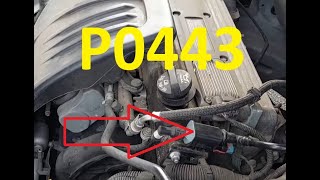
- Locate the EVAP purge solenoid valve. On the Saturn Ion, it is mounted on the driver's side of the engine, near the valve cover.
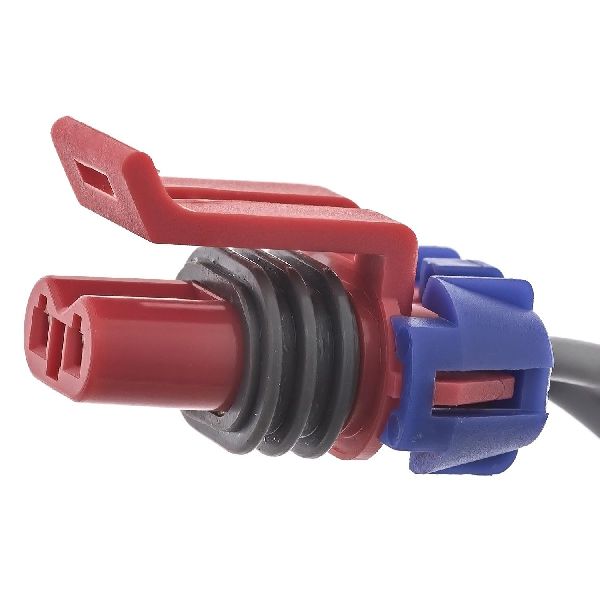
- Inspect the electrical connector and wiring going to the solenoid for any visible damage, corrosion, or looseness.
- With the ignition on and engine off, use a multimeter to confirm that one of the pins in the connector has battery voltage (approx. 12V). This is typically the pink wire.
- Check the 'EMISS' fuse in the under-hood fuse block if no power is present at the connector.
- Remove the solenoid from its bracket (typically slides off a bracket or is held by a single 10mm or 13mm nut).
- With the solenoid removed, attempt to blow air through it. It is normally closed, so no air should pass through. If air passes, the valve is stuck open and must be replaced.
- If the valve is not stuck open, test the internal coil. Use a multimeter set to Ohms to measure the resistance between the two pins on the solenoid. A good reading is typically between 22-30 Ohms. A reading of infinite resistance (OL) indicates an open circuit, while a reading near zero indicates a short. In either case, the solenoid is bad.
- If the wiring and solenoid test good, the final, though very unlikely, possibility is a fault in the Powertrain Control Module (PCM).
Parts You'll Likely Need
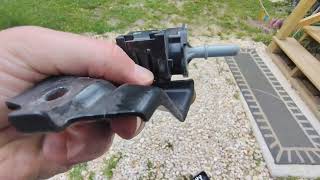
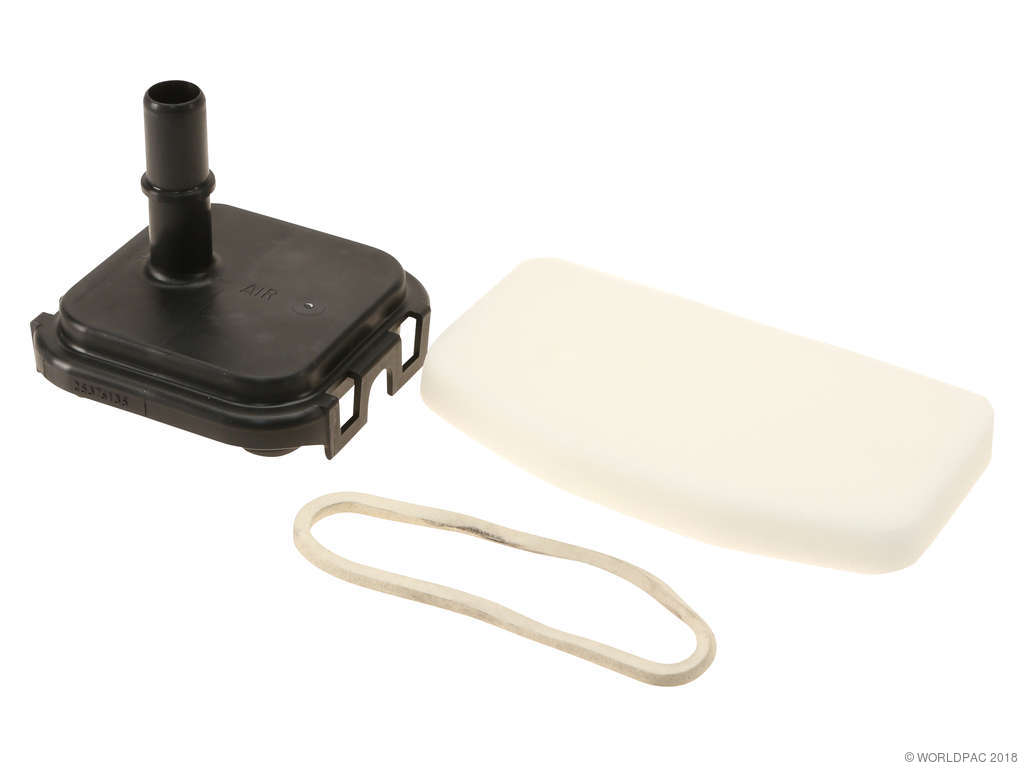
- EVAP Canister Purge Solenoid Valve
(OEM #12597567, 12575746)— This is the most common failure point for code P0443 on the Saturn Ion and related GM vehicles. The internal coil fails or the valve gets stuck.
Trusted brands: ACDelco (OEM Part: 214-1680), Dorman (911-030), Standard Motor Products (CP471)
OEM price range: $35-$60
Aftermarket price range: $25-$50
Related Codes That Often Appear With This One
- P0496 — P0496 indicates 'EVAP Flow During a Non-Purge Condition,' which is often caused by the same purge valve being mechanically stuck open. P0443 can appear if the valve is both electrically failing and mechanically stuck.
- P0441 — P0441 indicates 'Incorrect Purge Flow.' An electrical issue with the purge valve circuit (P0443) will prevent the valve from opening or closing correctly, leading to an incorrect flow condition.
Mechanic-Grade Diagnostic Values
- EVAP Canister Purge Solenoid Coil Resistance — expected: 22 - 26 Ω at room temperature. Failure: A reading of infinity (OL) indicates an open coil; a reading near 0 Ω indicates a shorted coil.
- Voltage at Purge Solenoid Connector (Power Wire) — expected: Approximately 12V (Battery Voltage) with Key On, Engine Off. Failure: 0V indicates a blown fuse (e.g., 'EMISS' fuse) or an open in the power supply wire.
Scan Tool Commands That Help
- Tech2 / Professional OBD-II Scanner: EVAP Purge Solenoid Active Test (or Bidirectional Control) — Use this after confirming 12V power at the solenoid connector. Command the solenoid ON and OFF (or to a specific duty cycle) while checking for a clicking sound from the valve and verifying the PCM is providing a ground signal on the control wire with a test light connected to battery positive. This confirms the wiring from the PCM and the PCM's driver circuit are functional.
Wiring & Ground Locations
- Purge Solenoid Connector Pin 1 (Power) — The 2-pin connector at the EVAP purge solenoid on the driver's side of the engine.. This pin, typically with a pink wire, should have 12V with the key on. No voltage here points to a fuse or wiring issue upstream of the solenoid.
- Purge Solenoid Connector Pin 2 (Control) — The 2-pin connector at the EVAP purge solenoid.. This wire is the ground-side control from the PCM. The PCM pulses the ground to operate the solenoid. A short to ground on this wire would cause the solenoid to stay on, while an open would prevent it from activating. This is the wire to test when using a bidirectional scan tool command.
- Engine Ground Strap — A braided ground wire often runs from the valve cover to the engine block on the exhaust side.. While not the direct ground for the solenoid (which is controlled by the PCM), a poor engine block or head ground can cause a variety of sensor and actuator electrical issues. Ensuring this ground is clean and tight is a good practice when diagnosing any engine electrical fault.
Real Owner Repair Stories
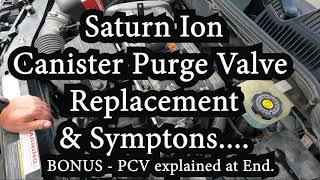
- Showtyme Mobile Auto Repair & Family (YouTube) (2007 Saturn Ion) — Hard to start after getting gas.
✅ What actually fixed it The EVAP canister purge valve was identified as the culprit. The video demonstrates its replacement, stating this is the classic cause for the hard-start symptom after refueling. - K&D_Enterprise (YouTube) (Saturn Ion (year not specified, but same body style)) — Hard to start after putting gas in the car (had to put pedal to the floor to get it to start), rough idling, and Check Engine Light.
✅ What actually fixed it Replaced the EVAP purge valve solenoid. The video shows the replacement process and confirms these are the main symptoms of its failure.
OEM Part Supersession History
12575746→12597567— Standard part evolution and consolidation by GM.
Heads up: The new part number (12597567) is a direct replacement and fully compatible with vehicles that used the original part.
Diagnostic Flowchart
Other Known Issues on This Vehicle
Issues unrelated to this code that are worth knowing about as an owner of this generation:
- Defective Ignition Switch 🔴 High — Extremely widespread across all model years. A heavy keychain or a bump from the driver's knee could move the key from 'Run' to 'Accessory' or 'Off', disabling the engine, power steering, and airbags while driving. (Ref: Major GM Recall (e.g., 14V047). All 2003-2007 Ions were included in this massive recall campaign.)
- Electric Power Steering (EPS) Failure 🔴 High — Very common, especially on 2004-2007 models. Can result in a sudden loss of power assist, making the vehicle very difficult to steer, particularly at low speeds. Often intermittent. (Ref: GM Special Coverage Adjustment 10187 extended the warranty for the power steering motor to 10 years/100,000 miles.)
- Timing Chain Wear and Failure (2.2L L61 Engine) 🔴 High — A well-documented weak point, particularly on earlier 2003-2004 models, but can affect all years. Caused by a poor oiler nozzle design, leading to chain stretch, guide failure, and rattling noises. Failure is catastrophic as it is an interference engine. (Ref: TSB #03-06-01-017 was issued to address an updated oiler nozzle design during repairs, but no recall was issued.)
- Cracked Fuel Pump Module 🟠 Medium — More common in vehicles from hot weather states (AZ, CA, FL, NV, TX). The plastic fuel pump outlet nipple can crack, causing a fuel leak and strong fuel odor. (Ref: Recall issued for certain 2007 models registered in specific hot-weather states.)
- Ignition Module/Coil Failure (2.2L L61 Engine) 🟡 Low — The integrated ignition control module and coil pack assembly, located on top of the valve cover, is prone to failure from heat, causing misfires (P0300) and a Check Engine Light.
Used vs. New Parts: Buying Guide for This Vehicle
When a used part is the smart pick: Buying a used EVAP purge solenoid is generally not recommended. The part is a known high-failure item, relatively inexpensive to buy new ($25-$50 for aftermarket), and crucial for passing emissions tests. The risk of getting a used part that has already failed or is near the end of its life outweighs the small cost savings.
Donor-vehicle mileage cap: roughly under 50000 miles for the part to have meaningful remaining life.
What to inspect on the donor part:
- Ensure the connector pins are clean, straight, and free of corrosion.
- Check for any cracks or damage to the plastic housing.
- If possible, test the resistance with a multimeter before purchase; it should be within the 22-30 ohm range.
OEM-only on this vehicle (don't cheap out):
- For this specific repair, an OEM ACDelco part is not strictly necessary, as reputable aftermarket brands like Dorman and Standard Motor Products offer reliable and widely-used alternatives.
Aftermarket brands forum-validated for this vehicle:
- ACDelco (OEM)
- Dorman
- Standard Motor Products (SMP)
Brands owners have reported issues with on this vehicle:
- No-name, unbranded parts from online marketplaces should be avoided, as their internal coil quality and valve sealing can be inconsistent, leading to a quick return of the P0443 code or other EVAP issues.
Real Owner Stories
Aggregated from forums and TSBs cited above. Mileages and costs reflect what owners reported in those sources.
2007 Saturn Ion
Symptoms: Go to the gas pump car doesn't really want to start you got to give it gas it takes a while to start after filling up.
What fixed it: Replacement of the vent valve solenoid (purge solenoid).
Source hint: youtube_comment from Showtyme Mobile Auto Repair & Family
2003-2007 Saturn Ion
Symptoms: User noted they were only getting 0.4 volts from the ECM to the purge valve while diagnosing P0443 and P0446.
What fixed it: Discussion focused on diagnostic steps for the PCM and circuit testing.
Source hint: SaturnFans.com Forum thread titled 'dang it - not again'
2005-2010 Chevrolet Cobalt (Platform Mate)
Symptoms: Car will not idle after code cleared; very rough idle and rich running condition.
What fixed it: Addressing an unplugged or failed EVAP purge solenoid.
Source hint: The Chevrolet Cobalt SS Forum thread 'p0443 car will not idle after code cleared'
Related OBD-II Codes
Frequently Asked Questions
Where is the EVAP purge solenoid located on my 2003-2007 Saturn Ion?
Which fuse should I check for a P0443 code on my Ion?
What are the resistance specifications for a healthy purge valve on the Ecotec engine?
Is there a recall for the fuel system on the 2007 Saturn Ion?
Can a P0443 code cause my Saturn Ion to struggle after refueling?
Are there other major recalls I should be aware of for the 2003-2007 Ion while fixing this code?
Helpful Videos

![How to Fix P0443 Engine Code in 3 Minutes [2 DIY Methods / Only $4.53]](https://img.youtube.com/vi/vuBVKjVg1JI/mqdefault.jpg)

Used OEM Parts in Stock
New Aftermarket Parts Available


The information in this article is provided for general reference and educational purposes only. Vehicle specifications, procedures, and part compatibility can vary by production date, trim level, and region. Always consult your vehicle's factory service manual and verify part numbers before purchasing or performing repairs. Safety-critical components such as airbags, seat belts, and braking systems should be installed by a qualified professional.
- Saturn Ion:
- 🧭 Diagnostic Flowchart
- 🎬 Helpful Videos
- 🛍️ Shop This Part
- What's Unique About the 2003-2007 Saturn Ion
- Symptoms You May Notice
- Most Likely Causes
- Rare But Worth Checking
- Diagnosis Steps
- Parts You'll Likely Need
- Related Codes That Often Appear With This One
- Mechanic-Grade Diagnostic Values
- Scan Tool Commands That Help
- Wiring & Ground Locations
- Real Owner Repair Stories
- OEM Part Supersession History
- Other Known Issues on This Vehicle
- Used vs. New Parts: Buying Guide for This Vehicle
- Real Owner Stories
- 2007 Saturn Ion
- 2003-2007 Saturn Ion
- 2005-2010 Chevrolet Cobalt (Platform Mate)
- Related OBD-II Codes
- Frequently Asked Questions
- 🎟️ Get 5% Off