

P0446 on 2016-2019 Ford Fiesta: EVAP Vent Circuit Causes and Fixes
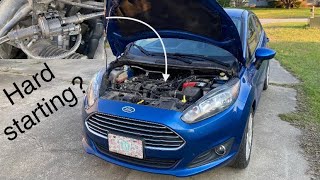
On a 2016-2019 Ford Fiesta, code P0446 is most often caused by a faulty canister purge valve located on the engine, not the vent valve at the rear. A hard start after refueling is a key symptom. Expect to pay $30-$50 for a new valve and splice it in yourself (DIY difficulty 2/5).
- For a P0446 code on a 2016-2019 Fiesta, investigate the canister purge valve on the engine first, especially if you have trouble starting the car after refueling.
- A recall (18S32) exists for this exact issue; check with a Ford dealer to see if your vehicle is covered.
- If your primary symptom is the gas pump clicking off, the vent valve at the rear of the car is the more likely culprit.
- Replacing just the purge valve by cutting the old one out and splicing in a new one is a common and cost-effective DIY repair.
What's Unique About the 2016-2019 Ford Fiesta
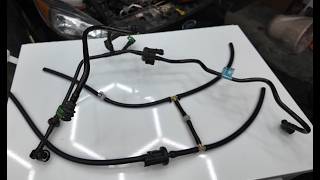
While the P0446 definition points to the vent valve (located near the fuel tank), the most common failure on the 2016-2019 Fiesta is actually the canister purge valve, located on top of the engine. This is a frequent point of confusion for owners and even some mechanics. A related Ford recall (18S32 / NHTSA 18V735) was issued for a stuck-open canister purge valve that could cause fuel tank deformation and stalling, highlighting the part's known issues on this platform. Owners of the performance 'ST' model sometimes even retrofit the more reliable purge valve system from the 2014-2015 models to solve recurring problems, a modification available from aftermarket suppliers. 🎬 See how to install the more reliable ST purge valve harness. The EVAP harness and connections were changed for the 2016 model year, which is the root of this common failure.
Symptoms You May Notice
- Check Engine Light is on
- Engine is difficult to start, stumbles, or stalls immediately after refueling
- Rough or unstable idle
- Slight fuel smell near the vehicle
- Difficulty filling the fuel tank (pump nozzle clicks off repeatedly)
- Inaccurate or erratic fuel gauge reading (related to recall 18S32)
- Replacing the gas cap. The Ford Fiesta has a capless fuel filler system, so there is no cap to replace. The issue would be with the seal on the filler neck itself, which is less common.
- Immediately replacing the vent valve without checking the purge valve. On this car, the purge valve is the more likely culprit despite the code's definition pointing to the vent circuit.
Most Likely Causes
- Faulty Canister Purge Valve 🔴 High Probability → Shop Vapor Canister This part is a known weak point on this generation of Fiesta, subject to a recall and frequent owner complaints. It is described by owners as a 'pile of crap that gets clogged immediately'. It often gets stuck open or closed. The design was changed for the 2016 model year, and this new design is known to be less reliable.
How to confirm: The strongest symptom is a rough idle or stalling right after getting gas. You can test the valve by applying 12V power to see if it clicks open and closed. A multimeter can be used to check for resistance across its terminals; a healthy unit should read between 20-30 ohms. When de-energized, you should not be able to blow air through it. If you can, it's stuck open.
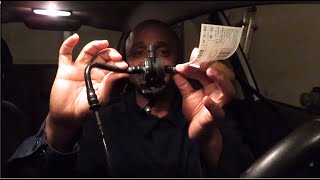
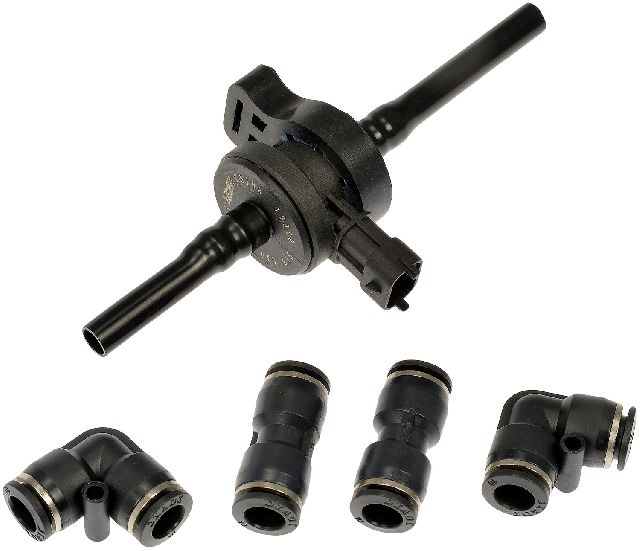
Typical fix: Replace the canister purge valve. The valve is located on top of the engine. 🎬 Watch this quick walkthrough on how to install the new valve. The original part is integrated into a hose assembly (Ford Part C1BZ-9C915-A), but it is common practice to carefully cut the old valve out and splice a new one in using hose clamps or heat-shrink clamps. Aftermarket valves like the Dorman 911-779 are designed for this splice-in repair.
Est. part cost: $30-$60 - Faulty EVAP Vent Valve / Solenoid 🟡 Medium Probability → Shop Vapor Canister Its location near the rear wheel exposes it to road debris and moisture, which can cause blockages or corrosion.
How to confirm: The key symptom is the fuel pump nozzle constantly clicking off when you try to refuel. The vent valve is located near the charcoal canister at the rear of the car, often behind the driver's side rear wheel. Inspect it for blockages from dirt, mud, or spider webs. Test its circuit for power and ground. With the valve removed, it should be normally open, meaning you can blow through it. Applying 12V power should cause it to click shut and block airflow. A healthy solenoid should have a resistance between 20 and 50 ohms.
Typical fix: Clean any blockages from the valve and its hoses. If the valve itself has failed electrically or is stuck, it must be replaced.
Est. part cost: $40-$80 - Damaged or Corroded Wiring ⚪ Low Probability
How to confirm: Visually inspect the wiring harnesses and connectors for both the purge valve (on the engine) and the vent valve (at the rear). Look for any breaks, chafing, or corrosion, especially on the exposed wiring for the rear vent valve. Use a multimeter to check for continuity and proper voltage at the connectors.
Typical fix: Repair or replace the damaged section of the wiring harness or the connector pigtail.
Est. part cost: $10-$30
Rare But Worth Checking
- Clogged or Failed Charcoal Canister: → Shop Vapor Canister This is usually a secondary failure caused by consistently over-topping the fuel tank, which floods the canister with raw fuel. The canister's activated charcoal can break down and send debris into the vent valve, clogging it. If you replace a clogged vent valve, it's wise to inspect the canister.
- Faulty Fuel Tank Pressure Sensor: → Shop Fuel Tank A bad sensor can send incorrect pressure readings to the computer, tricking it into setting the P0446 code. This is uncommon and would typically be diagnosed after other, more likely causes are ruled out.
Diagnosis Steps
- Scan for codes. Note if P1450 or other EVAP codes like P0441, P0455, or P0456 are present, as they strongly suggest a purge valve issue.
- Analyze symptoms. If the car runs poorly after refueling, suspect the purge valve first. If you can't fill the tank easily, suspect the vent valve first.
- Locate the canister purge valve on the right side of the engine. Visually inspect its wiring and hoses.
- With the engine off, disconnect the electrical connector and test the valve's resistance with a multimeter. A reading outside the 20-30 ohm range suggests failure.
- Test the purge valve for being stuck open by removing it and trying to blow through it. No air should pass when it is not powered. 🎬 Watch: A simple guide to diagnosing and fixing the P1450 code. If air passes, it has failed.
- If the purge valve seems okay, locate the EVAP vent valve near the charcoal canister at the rear of the car, typically behind the driver's side rear wheel.
- Inspect the vent valve and its hoses for any dirt, debris, or insect nests that could cause a blockage.
- Test the vent valve's electrical circuit for power and ground. Use a scan tool to command it closed and listen for a click, or apply 12V directly.
- If no issues are found with the valves or wiring, consider a smoke test to check the entire EVAP system for cracks or leaks in the hoses or charcoal canister.
Parts You'll Likely Need
- Vapor Canister Purge Valve
(OEM #C1BZ9C915A)— This is the most common failure point for code P0446 on the 2016-2019 Fiesta, often causing hard starts after refueling.
Trusted brands: Motorcraft, Dorman (P/N: 911-779), Standard Motor Products (P/N: CP903)
OEM price range: $100-$150 (for full assembly)
Aftermarket price range: $30-$60 (for valve only) - EVAP Canister Vent Valve / Solenoid — This is the part directly implicated by the code definition and is the likely cause if the main symptom is difficulty refueling.
Trusted brands: Motorcraft, Dorman
OEM price range: $60-$100
Aftermarket price range: $40-$80
Related Codes That Often Appear With This One
- P1450 — This is a Ford-specific code that means 'Unable to Bleed Up Fuel Tank Vacuum.' It's very commonly seen with a failing purge valve on Fiestas and other Ford models and is explicitly mentioned in the recall documentation.
- P0441 — Indicates 'Incorrect Purge Flow,' which directly points to a problem with the canister purge valve's function.
- P0455 — Indicates a 'Large EVAP Leak.' A vent valve stuck open or a purge valve that isn't sealing correctly can be interpreted by the system as a large leak.
- P0456 — Indicates a 'Small EVAP Leak.' This can also be triggered by a faulty purge valve and is listed as a related code in the official recall notice.
Technical Service Bulletins (TSBs) & Recalls
- 18S32 / NHTSA 18V735 - Fuel tank deformation due to stuck-open canister purge valve.
Platform-Specific Known Issues
- Recall 18S32 / NHTSA 18V735 was issued for a faulty canister purge valve (CPV) that could stick open, creating excessive vacuum, deforming the fuel tank, and potentially causing the engine to stall. The fix involves a PCM software update to better detect the fault, and if necessary, replacement of the CPV and potentially the fuel tank. Ford advised owners to keep the fuel tank at least half full until the recall was performed.
Mechanic-Grade Diagnostic Values
- Canister Purge Valve Solenoid Resistance — expected: 20 - 30 ohms. Failure: A reading of 0 ohms (short) or infinite ohms (open circuit).
- Canister Vent Valve Solenoid Resistance — expected: 20 - 50 ohms. Failure: A reading of 0 ohms (short) or infinite ohms (open circuit).
- Fuel Tank Pressure (FTP) Sensor Voltage (Key On, Engine Off, system at atmospheric pressure) — expected: ~2.6 - 2.65 Volts. Failure: A significantly different static voltage may indicate a sensor or wiring issue. A drop in voltage immediately upon starting the engine can indicate a purge valve stuck open.
Scan Tool Commands That Help
- Ford IDS (Integrated Diagnostic System): EVAP System Test — This is a guided test to check for large leaks and proper system function. It can be initiated from the 'Toolbox' -> 'Powertrain' -> 'Fuel' menu. It's the official first step in Ford's diagnostic procedure for this code.
- Ford IDS (Integrated Diagnostic System): Datalogger - Manual EVAP Test — Allows for manual, bidirectional control of the Canister Purge Valve and Canister Vent Valve to diagnose specific component failures. A technician can command the valves open or closed while monitoring the Fuel Tank Pressure sensor voltage to confirm mechanical operation. This is useful when the automated test fails or when the fuel level is outside the 15-85% range required for the automated test.
Wiring & Ground Locations
- Fuse F46 (Engine Compartment Fuse Box) — In the fuse box located in the engine bay.. This 10A fuse provides power to the Evaporative Emission Canister Purge Valve. A blown fuse will cause a circuit fault.
- G108 — Engine compartment, specific location varies slightly but is on the chassis frame rail.. This is a primary ground point in the engine bay. A corroded or loose connection at G108 can cause intermittent electrical issues for various engine components, including the EVAP system.
- G302 — Located in the rear of the vehicle, near the fuel tank and EVAP canister area.. This is the ground point for components at the rear of the car, including the EVAP Canister Vent Valve. Corrosion or damage to this ground is a potential cause for a P0446 circuit code.
Real Owner Repair Stories
- dheepthoughts.com blog post (2019 Ford Fiesta ST) — Stuttering/hesitation after a fill-up.
❌ Tried (didn't work) The owner considered splicing in just the valve but found it 'janky' and noted heating the old valve off the permanent tubing was unsuccessful.
✅ What actually fixed it Replacing the entire EVAP purge valve assembly (solenoid, tubing, check valve, and fittings) with Ford part number F2BZ-9C047-C. The owner noted that on the 2019 model, the replacement was 'super easy' and did not involve the difficult-to-access connection mentioned in videos for older models. - Reddit r/FiestaST user post (2017 Ford Fiesta ST) — Idle drop/stall at idle following a fill-up.
❌ Tried (didn't work) The user notes that simply replacing the purge valve with another OEM unit is a temporary fix as the part will 'inevitably fail again'.
✅ What actually fixed it The user provided a detailed guide to convert the 2016+ EVAP harness to the more reliable 2014 specification. This involves using the Standard Motor Products CP803 purge solenoid and adding a 3/8" one-way check valve to the harness, making future replacements much simpler and cheaper. - NHTSA ODI #11670709 — While reported on a different Ford model, a similar EVAP issue was documented where an owner retrieved DTC P0446 (Evaporative Emission Control System (EVAP) vent control circuit malfunction) after the engine warning light illuminated.
OEM Part Supersession History
C1BZ-9C915-A→F2BZ-9C047-C (Full Assembly for 2019+)— The original part number C1BZ-9C915-A refers to the purge valve assembly. For the 2019 model year, a repair story confirms the full assembly part number is F2BZ-9C047-C, which includes all hoses and fittings for an easier replacement.
Heads up: While the core valve may be the same, the hose assembly changed. The F2BZ-9C047-C assembly is reported to be an easier installation on 2019 models compared to earlier 2016-2018 versions.
Model Year Variations Within This Range
- 2016-2019: The EVAP harness, connections, and purge solenoid design were changed for the 2016 model year from the previous 2014-2015 design. This 2016+ design is known to be the primary source of the common purge valve failures that cause P0446 and P1450 codes on these vehicles.
Diagnostic Flowchart
Other Known Issues on This Vehicle
Issues unrelated to this code that are worth knowing about as an owner of this generation:
- DPS6 'PowerShift' Automatic Transmission Failure 🔴 High — Extremely common on 2011-2019 models with automatic transmissions, often appearing before 50,000 miles. Subject of multiple lawsuits and extended warranties. (Ref: Multiple TSBs and warranty extensions (e.g., 14M01, 14M02) were issued.)
- HVAC Blend Door Actuator Failure 🟡 Low — Very common; owners report a repetitive clicking or ticking sound from the dashboard upon startup or when changing climate settings.
- Coolant System Leaks / Overheating (EcoBoost Engines) 🔴 High — A known issue, particularly on 1.0L and 1.6L EcoBoost engines, where coolant hoses or the degas tank can fail, leading to rapid coolant loss and potential engine damage. (Ref: Recalls were issued for earlier models (pre-2016) for coolant hose failures.)
- Water Leaks into Cabin/Trunk 🟠 Medium — Common owner complaint where water enters the spare tire well or rear passenger footwells, often due to failing seals around the hatchback or tail lights.
- Starter Motor Failure 🟠 Medium — A frequently reported issue where the vehicle fails to start, accompanied by a clicking noise, even with a good battery.
Used vs. New Parts: Buying Guide for This Vehicle
When a used part is the smart pick: For this specific repair, buying a used purge valve or vent valve is generally not recommended. The failure rate of the purge valve assembly on 2016-2019 models is very high, so a used part from a donor vehicle is likely to have the same defect or a very short remaining life.
Donor-vehicle mileage cap: roughly under 20000 miles for the part to have meaningful remaining life.
What to inspect on the donor part:
- If buying used is unavoidable, source the part from the lowest mileage vehicle possible.
- Visually inspect plastic hoses for any signs of cracking or brittleness.
- Ensure all locking clips on connectors are intact and not broken.
OEM-only on this vehicle (don't cheap out):
- While not strictly 'OEM-only', using the complete Motorcraft hose and valve assembly (C1BZ-9C915-A or F2BZ-9C047-C) is the most straightforward, if expensive, repair.
Aftermarket brands forum-validated for this vehicle:
- Dorman (P/N: 911-779 or 911-775): Often cited as a direct replacement for the splice-in method. Reviews suggest the connector clips are an improvement over the difficult-to-remove OEM design.
- Standard Motor Products (P/N: CP803): Recommended by forum users as a reliable alternative, especially when performing the 2014-style harness conversion.
Brands owners have reported issues with on this vehicle:
- While no specific brands are consistently cited as 'bad' for this part, some general forum sentiment suggests avoiding no-name, unbranded parts from online marketplaces, as their quality and longevity can be highly questionable.
Real Owner Stories
Aggregated from forums and TSBs cited above. Mileages and costs reflect what owners reported in those sources.
2017 Ford Fiesta ST — 54680 miles
Symptoms: Check engine light for P0446. Occasional smell of gasoline. No problems starting or refueling yet. Replaced the vent valve and charcoal canister but the code remained.
What fixed it: The owner was directed to replace the canister purge valve (CPV) as the likely culprit despite having already replaced the rear vent components.
Source hint: Reddit r/FiestaST - Thread 'P0446 2017 ford fiesta st'
Related OBD-II Codes
Frequently Asked Questions
Is there a recall for the P0446 code on my 2016-2019 Ford Fiesta?
Why does my Fiesta stumble or struggle to start only after I fill up at the gas station?
I'm having trouble physically pumping gas into my Fiesta; the nozzle keeps clicking off. Is this related to P0446?
Can I replace just the purge valve, or do I need the whole hose assembly (Part C1BZ-9C915-A)?
What should the resistance be for a healthy purge valve on a 2016 Fiesta?
Does the Ford Focus share this same EVAP issue?
Helpful Videos

Used OEM Parts in Stock
New Aftermarket Parts Available


The information in this article is provided for general reference and educational purposes only. Vehicle specifications, procedures, and part compatibility can vary by production date, trim level, and region. Always consult your vehicle's factory service manual and verify part numbers before purchasing or performing repairs. Safety-critical components such as airbags, seat belts, and braking systems should be installed by a qualified professional.
- Ford Fiesta:
- 🧭 Diagnostic Flowchart
- 🎬 Helpful Videos
- 🛍️ Shop This Part
- What's Unique About the 2016-2019 Ford Fiesta
- Symptoms You May Notice
- Most Likely Causes
- Rare But Worth Checking
- Diagnosis Steps
- Parts You'll Likely Need
- Related Codes That Often Appear With This One
- Technical Service Bulletins (TSBs) & Recalls
- Platform-Specific Known Issues
- Mechanic-Grade Diagnostic Values
- Scan Tool Commands That Help
- Wiring & Ground Locations
- Real Owner Repair Stories
- OEM Part Supersession History
- Model Year Variations Within This Range
- Other Known Issues on This Vehicle
- Used vs. New Parts: Buying Guide for This Vehicle
- Real Owner Stories
- 2017 Ford Fiesta ST — 54680 miles
- Related OBD-II Codes
- Frequently Asked Questions
- 🎟️ Get 5% Off