

P0446 on 2002-2007 Saturn Vue: EVAP Vent System Causes and Fixes
On a 2002-2007 Saturn Vue, code P0446 is most often caused by a faulty EVAP vent solenoid or a clogged vent hose located under the vehicle near the charcoal canister. Spiders building nests in the vent lines are a surprisingly common cause. Expect to pay $30-$70 for a new vent solenoid, which is a common DIY repair. GM issued a TSB to relocate the vent's air filter to a less exposed location to prevent debris from clogging the system.
- P0446 on a 2002-2007 Vue almost always points to a problem with the EVAP vent system at the rear of the vehicle, not a loose gas cap.
- The most likely fix is replacing the EVAP vent solenoid, which is located on or near the charcoal canister under the car.
- Inspect the vent hoses for blockages from dirt or spider webs, as this is a known issue for this vehicle.
- If you find black plastic pellets in the EVAP lines, you must replace the charcoal canister in addition to the vent solenoid.
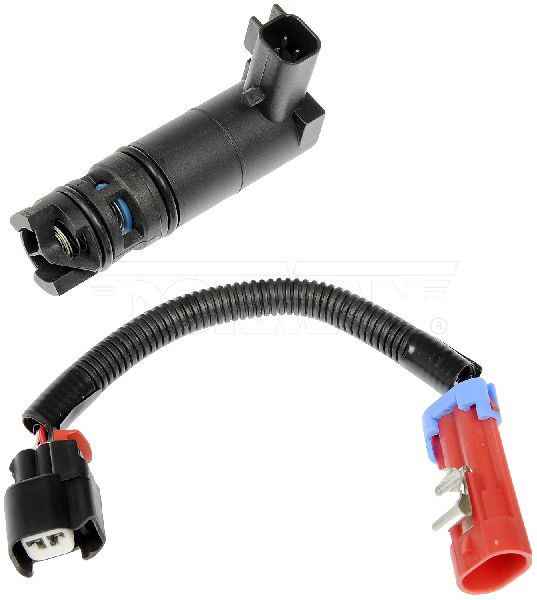
- When buying a new vent solenoid, ensure it comes with the updated wiring harness, as the original connector may not fit.
What's Unique About the 2002-2007 Saturn Vue
The first-generation Saturn Vue is highly susceptible to dust, debris, and even spider webs clogging the EVAP vent system, an issue common enough that General Motors released technical service bulletins (TSBs) to address it. The official fix involves installing an updated vent valve and a remote filter box, routing the vent hose to a cleaner, more protected area above the transmission to prevent dirt from entering the system. Because of this known design vulnerability, a clogged vent path is a very high-probability cause for P0446 on these vehicles.
Symptoms You May Notice
- Check Engine Light is on
- Difficulty refueling (gas pump clicks off repeatedly) 🎬 See why your gas tank might be slow to fill.
- Fuel smell around the rear of the vehicle (less common for this code, but possible if the canister is affected)
- A whooshing sound from the fuel tank area when removing the gas cap, indicating pressure or vacuum is not being properly vented.
- Replacing the gas cap. A bad gas cap typically causes a large leak code (like P0455) or a small leak code (P0442), not a vent restriction code like P0446. However, a faulty cap can sometimes be part of a larger system issue.
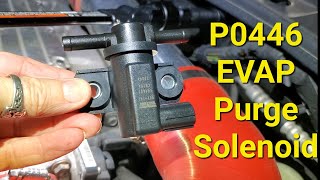
- Replacing the EVAP purge solenoid. The purge solenoid is located on the engine and controls vapor flow to the intake manifold. While a failure can cause other EVAP codes and symptoms like hard starting after refueling, P0446 specifically points to a problem on the vent side, which is near the fuel tank.
Most Likely Causes
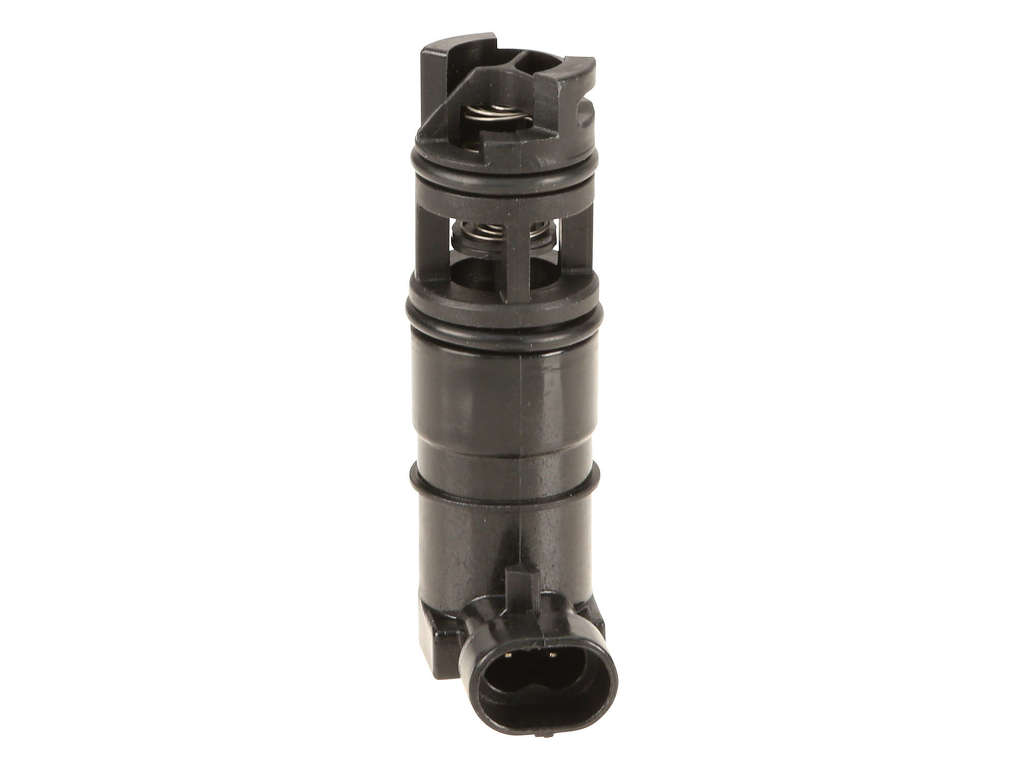
- Faulty or Clogged EVAP Vent Solenoid 🔴 High Probability → Shop Vapor Canister The vent solenoid is located under the vehicle on the charcoal canister, making it extremely vulnerable to dirt, moisture, and corrosion. It can fail electrically or, more commonly, get mechanically stuck closed by debris.
How to confirm: Locate the solenoid on the charcoal canister under the rear of the vehicle. With a bidirectional scan tool, command the valve to open and close; you should hear an audible click. You can also remove it and apply 12V to its terminals to test for operation. If it doesn't click, or if it's visibly clogged with dirt, it's faulty.
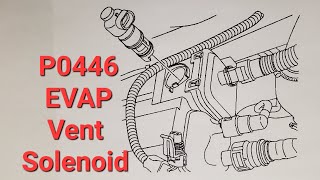
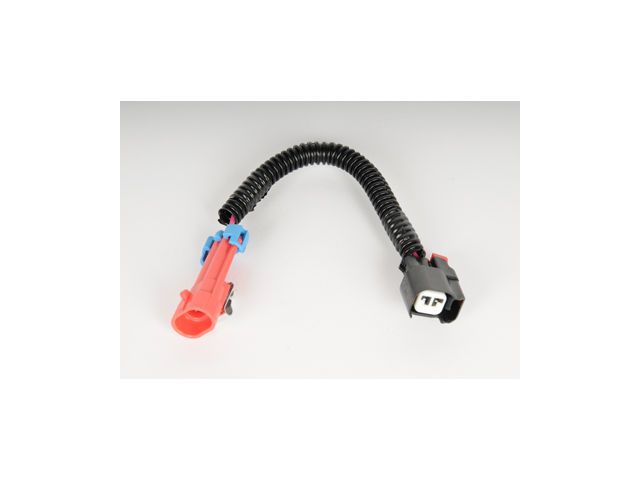
Typical fix: Replace the EVAP vent solenoid. The replacement part is often a Dorman 911-140 or ACDelco 214-2149. 🎬 Watch: How to replace and test the vent valve solenoid. The original connector may not fit the new part, so some kits include an updated wiring harness pigtail.
Est. part cost: $30-$70 - Restricted or Blocked EVAP Vent Hose 🔴 High Probability GM issued TSBs (#02-06-04-037H) for this exact issue, where dust and debris from the road get into the vent hose and cause a blockage. Spiders are also notoriously known to build webs and egg sacs inside these hoses, creating a complete obstruction.
How to confirm: Visually inspect the vent hoses connected to the charcoal canister and vent solenoid. Disconnect the hoses and attempt to blow compressed air through them to check for blockages. Pay close attention to the filter box at the end of the vent line if the TSB has been performed.
Typical fix: Clear the obstruction from the hose. If the hose is damaged or brittle, it should be replaced. If the vehicle is operated in a dusty environment, performing the TSB fix by adding the remote filter kit (if not already done) is the permanent solution.
Est. part cost: $10-$50 - Failed Charcoal Canister 🟡 Medium Probability → Shop Vapor Canister Overfilling the fuel tank (continuing to pump after the nozzle clicks off) can force liquid gasoline into the canister, saturating the charcoal and ruining it. The canister can also crack or break down internally with age, releasing charcoal pellets that clog the vent solenoid and lines.
How to confirm: Inspect the canister for physical cracks. Disconnect the hoses from the canister; if black charcoal pellets fall out, the canister has failed internally. A strong fuel odor or fuel wetness on the canister is also a sign of saturation.
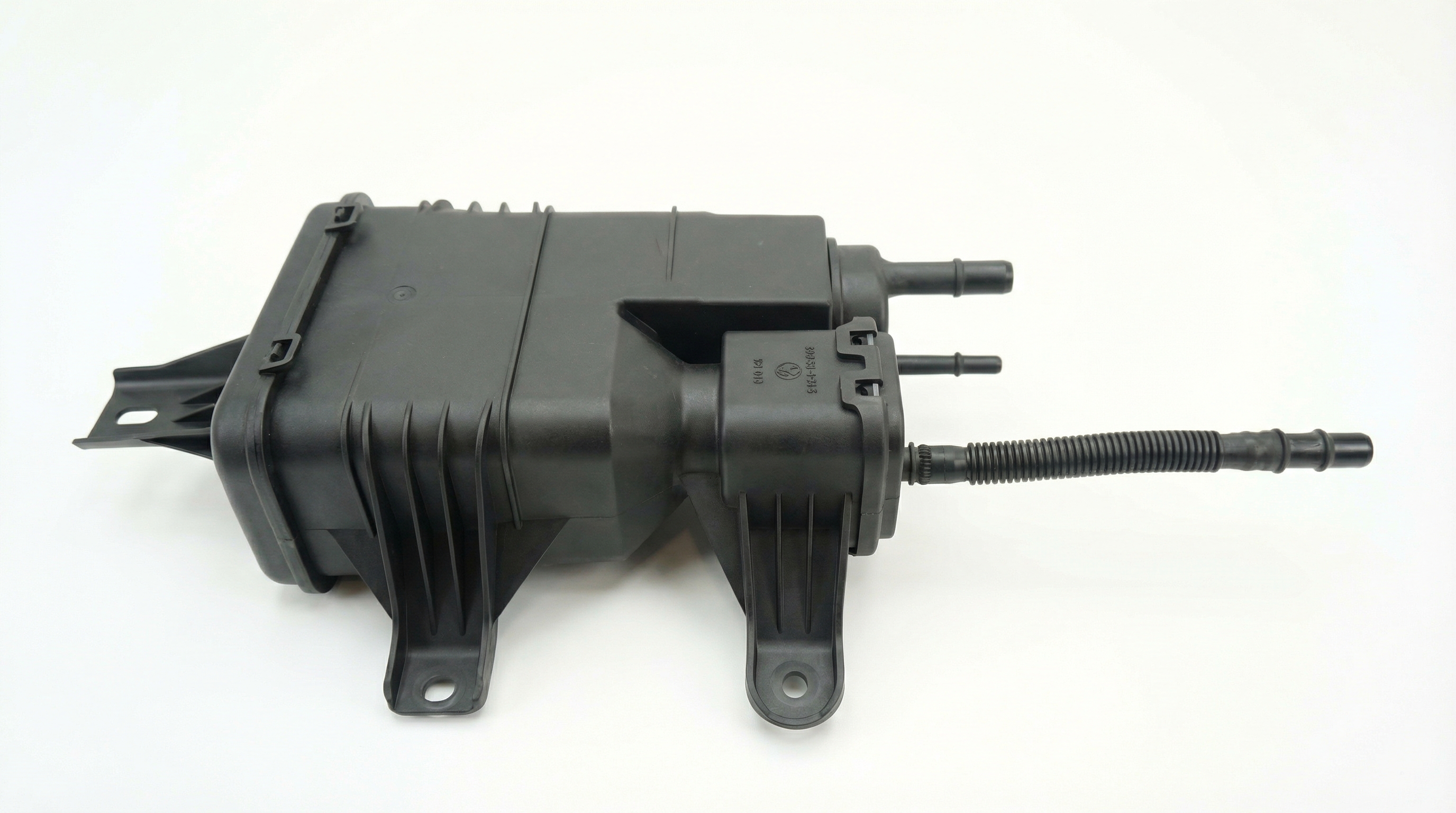
Typical fix: Replace the charcoal canister. Part numbers vary by year and engine; examples include GM 19259327 and Dorman 911-265. If the canister has failed and released charcoal pellets, you must also replace the vent solenoid and blow out all connected EVAP lines to prevent a repeat failure.
Est. part cost: $100-$220 - Damaged Vent Solenoid Wiring ⚪ Low Probability The wiring is routed underneath the vehicle and can be damaged by road debris or corrosion, especially in the rust belt.
How to confirm: Visually inspect the wiring harness leading to the vent solenoid for any breaks, chafing, or corrosion at the connector. Use a multimeter to check for 12V power on the supply wire with the key on.
Typical fix: Repair the damaged section of wire or replace the connector pigtail.
Est. part cost: $10-$25
Rare But Worth Checking
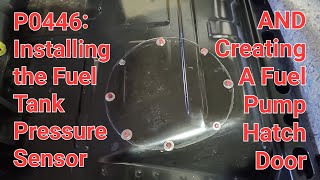
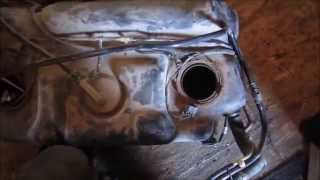
- Faulty Fuel Tank Pressure (FTP) Sensor: → Shop Fuel Tank While not a direct cause of a vent restriction, a faulty FTP sensor can provide incorrect data to the PCM, leading to a misdiagnosis of the vent system. This is typically a last resort after all other vent-side components have been checked. One owner on a forum replaced this sensor after other parts failed to resolve the code. Another owner confirmed this was the final fix after replacing both the vent and purge solenoids without success. 🎬 Watch this clever hack for installing the fuel pressure sensor.
Diagnosis Steps
- Read the code with an OBD-II scanner and confirm P0446 is present.
- Visually inspect the EVAP vent solenoid, charcoal canister, and all associated hoses under the rear of the vehicle (driver's side). Look for obvious cracks, disconnected hoses, or damage.
- Inspect the wiring going to the vent solenoid for corrosion or breaks.
- If you have a bidirectional scanner, command the vent solenoid to open and close. Listen for a distinct clicking sound. No click suggests a bad solenoid or a wiring issue.
- If the solenoid clicks, disconnect the vent hose from the canister and check it for blockages from dirt, debris, or spider webs. This is a very common point of failure.
- If the hose is clear, the vent solenoid itself is likely stuck or internally clogged. Remove it for a bench test (apply 12V) or replace it.
- While the hoses are disconnected, check for black charcoal pellets. If any are found, the charcoal canister has failed and must be replaced along with the vent solenoid.
- If all components seem to work correctly and are free of blockages, check for power (12V) at the vent solenoid connector with the key on to rule out a wiring fault.
- As a final check, consider the TSB fix. Trace the vent hose from the canister to its end point. If it's still located low on the chassis, it's prone to clogging. Relocating it to a higher point is the long-term solution.
Parts You'll Likely Need
- EVAP Canister Vent Solenoid / Valve
(OEM #ACDelco 214-2149 (Supersedes older numbers))— This is the most common failure point for code P0446. It can get stuck closed or fail electrically, causing a vent restriction.
Trusted brands: ACDelco, Dorman (911-140), Standard Motor Products (SMP)
OEM price range: $50-$90
Aftermarket price range: $30-$70 - EVAP Charcoal Canister
(OEM #19259327 (for 2004-2007 models), 19331039 (for 2002-2003 models))— Required if the old canister is cracked, fuel-saturated, or has broken down internally, releasing charcoal pellets that clog the system.
Trusted brands: ACDelco / GM Genuine Parts, Dorman (911-265 for 04-07 V6), Spectra Premium
OEM price range: $150-$250
Aftermarket price range: $100-$180
Related Codes That Often Appear With This One
- P0449 — This code also indicates an EVAP Vent Solenoid Control Circuit Malfunction and is very similar to P0446. They often point to the same set of failures and are sometimes used interchangeably by different manufacturers for the same fault.
- P0455 — While P0446 is a restriction code, a component failure (like a cracked canister or a valve stuck partially open) can sometimes cause both a restriction and a large leak, triggering both codes.
Technical Service Bulletins (TSBs) & Recalls
- 02-06-04-037H: 'DTC P0446 (Restricted/Blocked EVAP Vent Path) Set, Check Engine Light On'. Addresses dirt/dust intrusion and recommends replacing the vent valve with a sealed unit and adding a remote filter box routed to a cleaner location.
- 23-NA-073: A later bulletin also addressing dust intrusion causing P0446/P0449. Describes a customer-pay retro-fit kit with a new filter.
Platform-Specific Known Issues
- GM Technical Service Bulletin #02-06-04-037H specifically addresses P0446 on vehicles operated in dusty environments. It confirms that dirt and dust intrusion into the vent hose is the primary cause. The recommended fix is to replace the EVAP canister vent valve and relocate the air intake filter by running a new hose to a higher, more protected location above the transmission, securing it to the transmission vent hose.
Mechanic-Grade Diagnostic Values
- EVAP Vent Solenoid Connector Voltage — expected: Approximately 12V (battery voltage) on one wire with the key in the ON position.. Failure: No voltage suggests a blown fuse (check 'EMISS' fuse) or a break in the power wire.
- EVAP Vent Solenoid Coil Resistance — expected: Typically between 20 and 50 Ohms across the solenoid's two pins.. Failure: A reading of infinite resistance (OL) indicates an open coil, while a reading near zero suggests a short. Note: A good resistance reading does not rule out a mechanical (stuck) failure.
- EVAP Vent Solenoid Bench Test — expected: An audible 'click' when 12V is applied directly to the solenoid's terminals.. Failure: No click indicates the solenoid is seized or electrically failed and must be replaced.
Hidden / Shadow Codes Worth Checking
- EVAP Vent Solenoid Circuit Status: → Shop Vapor Canister While not a DTC, a professional scan tool can display the live status of the vent circuit as seen by the ECM. It may show 'Open', 'Short to Ground', or 'Incomplete', providing a more specific clue than the P-code alone. (see via GM Tech2 or equivalent professional bidirectional scan tool in the EVAP data display list.)
Scan Tool Commands That Help
- GM Tech2 / Professional Bidirectional Scanner: EVAP Purge/Seal Function Test or Vent Solenoid Output Control — This command allows the technician to manually cycle the vent solenoid on and off. It is used to confirm if the solenoid clicks when commanded, and to verify the integrity of the control circuit wiring from the ECM to the solenoid.
Wiring & Ground Locations
- Vent Solenoid Connector — Connected to the EVAP vent solenoid, which is mounted on the charcoal canister under the rear of the vehicle, typically on the driver's side.. The wires at the connector are a common failure point. They can break internally from vibration and exposure, even if the insulation looks intact. A wiggle test on the harness while checking for voltage can reveal an intermittent connection.
Real Owner Repair Stories
- YouTube user 'Skeeter's Garage' (2004 Saturn Vue 3.5L V6 (Honda J35 engine)) — P0446 Check Engine Light.
❌ Tried (didn't work) Replacing the EVAP vent solenoid., Replacing the EVAP purge solenoid.
✅ What actually fixed it Replacing the Fuel Tank Pressure (FTP) sensor located on top of the fuel tank. The owner had to cut an access panel in the floor under the rear seat to access the sensor, as dropping the fuel tank was not feasible. After replacement, the P0446 code was cleared and did not return, allowing the vehicle to pass an emissions test. - Reddit user 'twoslow' (2005 Saturn Vue V6 FWD) — P0446 Check Engine Light, needed to pass emissions.
❌ Tried (didn't work) Replacing the gas cap.
✅ What actually fixed it Replacing the EVAP vent solenoid fixed the code. - YouTube user 'Skeeter's Garage' (2004 Saturn Vue 3.5L V6) — P0446 and P0455 codes returned, plus a new symptom of the engine not starting after refueling.
❌ Tried (didn't work) The Dorman-branded EVAP purge solenoid that had been installed just a week prior.
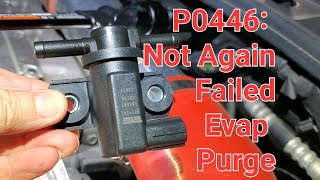
✅ What actually fixed it The aftermarket Dorman purge solenoid had failed prematurely, getting stuck open. Replacing it with a different aftermarket brand (SKP) resolved the no-start condition and the EVAP codes. This highlights potential quality issues with certain aftermarket parts.
"I Checked Everything" — The Actual Cause
- P0446 is a vent restriction/blockage code, not a leak code, so a smoke test will often come back clean. The PCM determines there's a restriction when it commands the vent valve to open but doesn't see the expected drop in vacuum via the Fuel Tank Pressure (FTP) sensor. If the vent valve, canister, and hoses are all clear, the root cause can be a faulty FTP sensor that is not correctly reporting the pressure change to the PCM. The system is venting properly, but the sensor's bad data makes the computer believe it's blocked.
OEM Part Supersession History
Various older GM vent solenoid part numbers→ACDelco 214-2149 / Dorman 911-140— Design update to improve durability and prevent debris intrusion.
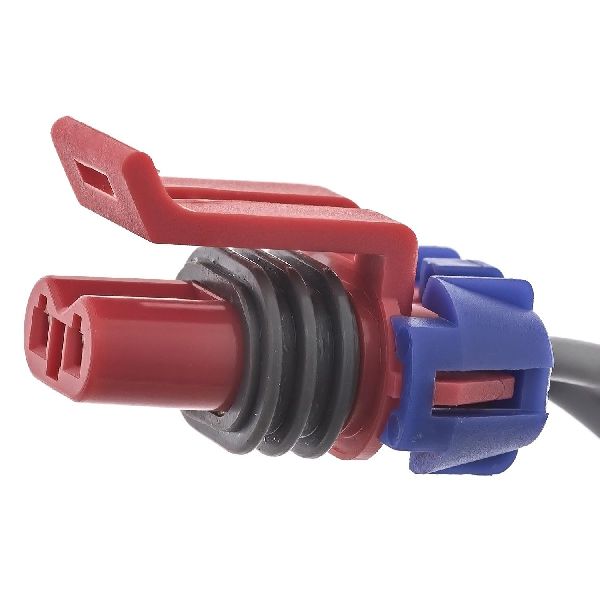
Heads up: The electrical connector on the updated solenoid (e.g., ACDelco 214-2149, Dorman 911-140) is often different from the original factory harness connector. Replacement kits frequently include a new wiring harness pigtail that must be spliced in.
Model Year Variations Within This Range
- 2002-2003 vs 2004-2007: The optional V6 engine changed. 2002-2003 models used a 3.0L GM L81 V6. 2004-2007 models used a 3.5L Honda J35A3 V6. While P0446 relates to the vent side near the tank, other EVAP components (like the purge valve) and their locations are engine-specific, which is critical information for comprehensive system diagnosis. The charcoal canister part number also differs between these year groups.
Diagnostic Flowchart
Other Known Issues on This Vehicle
Issues unrelated to this code that are worth knowing about as an owner of this generation:
- VTi CVT Transmission Failure 🔴 High — Very common on 2002-2005 4-cylinder models. The VTi (Variable Transmission with intelligence) was notoriously unreliable, with failures often occurring before 100,000 miles. GM discontinued its use after 2005 due to the high failure rate. (Ref: A class-action lawsuit was settled for these transmissions, and GM offered an extended warranty to 5 years/75,000 miles, but many failures occurred outside this window.)
- Honda V6 Automatic Transmission Problems 🟠 Medium — On 2004-2007 Vues equipped with the 3.5L Honda L66 V6, issues like shuddering, slipping, or harsh shifting can occur, often related to the torque converter or fluid condition.
- 2.2L Ecotec (L61) Timing Chain Failure 🔴 High — The plastic timing chain guides can become brittle and break, and the tensioner can fail, leading to a rattling noise on cold starts. If ignored, the chain can jump time or break, causing catastrophic engine damage. This is often exacerbated by low oil levels. (Ref: TSB #03-06-01-017 was issued for 2002-2003 models to install an updated oiler nozzle to improve chain lubrication at low RPMs.)
- Ignition Key Removable While Not in 'Off' 🟠 Medium — A widespread issue on 2002-2004 models where the key could be removed from the ignition when it was not in the 'Off' position, creating a rollaway risk. (Ref: GM Recall #14350 (NHTSA ID 14V490000) was issued to inspect and, if necessary, replace the ignition cylinder and key set.)
Used vs. New Parts: Buying Guide for This Vehicle
When a used part is the smart pick: A used charcoal canister from a low-mileage, non-rusted donor vehicle can be a cost-effective option if inspected carefully for cracks or fuel saturation. Used hoses or plastic lines are generally not recommended due to age and brittleness.
Donor-vehicle mileage cap: roughly under 80000 miles for the part to have meaningful remaining life.
What to inspect on the donor part:
- For a charcoal canister, ensure there are no visible cracks in the plastic housing.
- Shake the canister; there should be no rattling sound, which would indicate broken internal charcoal.
- Check the ports for any black charcoal pellets, a sign of internal failure.
- Avoid any parts from vehicles showing significant underbody rust or from regions in the rust belt.
OEM-only on this vehicle (don't cheap out):
- Fuel Tank Pressure (FTP) Sensor: Due to the extreme difficulty in accessing this part (requiring dropping the fuel tank or cutting the floor), using a new, high-quality OEM (ACDelco) or top-tier aftermarket part is strongly advised to prevent a repeat repair.
Aftermarket brands forum-validated for this vehicle:
- ACDelco (OEM supplier)
- Standard Motor Products (SMP)
- SKP (One user reported success with this brand for a purge solenoid after a Dorman part failed)
Brands owners have reported issues with on this vehicle:
- Dorman: While widely available, one detailed repair story documented an EVAP purge solenoid from Dorman failing within one week of installation, causing a no-start condition after refueling.
Real Owner Stories
Aggregated from forums and TSBs cited above. Mileages and costs reflect what owners reported in those sources.
2005 Saturn Vue V6 FWD
Symptoms: Check engine light with code P0446. The owner tried replacing the gas cap first, but it did not resolve the issue.
What fixed it: Replacing the vent solenoid fixed the issue.
Source hint: Reddit: '05 Vue v6 FWD- P0446 dtc'
2002-2007 Saturn Vue
Symptoms: DTC P0446 (Restricted/Blocked EVAP Vent Path) set and Check Engine Light on, specifically occurring in dusty environments.
What fixed it: Replacing the EVAP canister vent valve with a sealed unit and adding a remote filter box routed to a higher, cleaner location above the transmission.
Source hint: TSB 02-06-04-037H
Related OBD-II Codes
Frequently Asked Questions
My 2002-2007 Saturn Vue is hard to fuel and the gas pump clicks off constantly; is this related to P0446?
Does GM Technical Service Bulletin #02-06-04-037H apply to my Vue if I drive in dusty conditions?
Can I use a Dorman 911-140 to fix the P0446 code on my Saturn Vue?
I found black charcoal pellets in my vent lines while diagnosing P0446. What does this mean?
Is there a specific TSB for a retro-fit filter kit for the Saturn Vue EVAP system?
Where is the EVAP vent solenoid located on the 2002-2007 Saturn Vue?
Helpful Videos
Used OEM Parts in Stock
New Aftermarket Parts Available


The information in this article is provided for general reference and educational purposes only. Vehicle specifications, procedures, and part compatibility can vary by production date, trim level, and region. Always consult your vehicle's factory service manual and verify part numbers before purchasing or performing repairs. Safety-critical components such as airbags, seat belts, and braking systems should be installed by a qualified professional.
- Saturn Vue:
- 🧭 Diagnostic Flowchart
- 🎬 Helpful Videos
- 🛍️ Shop This Part
- What's Unique About the 2002-2007 Saturn Vue
- Symptoms You May Notice
- Most Likely Causes
- Rare But Worth Checking
- Diagnosis Steps
- Parts You'll Likely Need
- Related Codes That Often Appear With This One
- Technical Service Bulletins (TSBs) & Recalls
- Platform-Specific Known Issues
- Mechanic-Grade Diagnostic Values
- Hidden / Shadow Codes Worth Checking
- Scan Tool Commands That Help
- Wiring & Ground Locations
- Real Owner Repair Stories
- "I Checked Everything" — The Actual Cause
- OEM Part Supersession History
- Model Year Variations Within This Range
- Other Known Issues on This Vehicle
- Used vs. New Parts: Buying Guide for This Vehicle
- Real Owner Stories
- 2005 Saturn Vue V6 FWD
- 2002-2007 Saturn Vue
- Related OBD-II Codes
- Frequently Asked Questions
- 🎟️ Get 5% Off