

P0449 on 2012-2016 Hyundai Accent: EVAP Vent Valve Circuit Causes and Fixes
On a 2012-2016 Hyundai Accent, code P0449 is almost always caused by a faulty Canister Close Valve (CCV), also known as the EVAP vent solenoid. This is a common DIY repair, with the part costing between $25 and $75. The issue is so common that Hyundai issued a Technical Service Bulletin (TSB 18-FL-002) for this exact problem.
- P0449 on a 2012-2016 Accent specifically points to an electrical circuit issue with the Canister Close Valve (CCV), not a system leak.
- The most probable cause is a failed CCV itself, a part that costs under $50 and is accessible for DIY replacement at the rear of the car.
- Hyundai TSB 18-FL-002 is the definitive guide for this repair and recommends replacing both the CCV (if faulty) and the Air Drain Case (mandatory).
- Always inspect the wiring and connector for corrosion or breaks before replacing parts, as the under-car location makes them vulnerable.
What's Unique About the 2012-2016 Hyundai ACCENT
For the 2012-2016 Hyundai Accent (RB generation), the Canister Close Valve (CCV) is a known, widespread failure point. Hyundai issued a Technical Service Bulletin (TSB 18-FL-002) that directly addresses this code, along with P0455, P0456, and P0451. The TSB provides a specific inspection procedure for the CCV and mandates the replacement of the associated Air Drain Case (filter). The CCV itself was updated to a new part number (ending in FFF) to improve reliability.
Diagnostic Flowchart
Tap your situation to follow the diagnostic path that matches what you're seeing on this vehicle.
Symptoms You May Notice
- Check Engine Light is on.
- Difficulty filling the fuel tank (gas pump nozzle shuts off repeatedly before the tank is full).
- Possible faint fuel smell, especially after refueling (less common).
- Audible noise from the rear of the vehicle over bumps, which could be the loose or damaged canister assembly.
- Replacing the gas cap. A bad gas cap typically causes a leak-related code (like P0455 or P0456), not a circuit code like P0449.
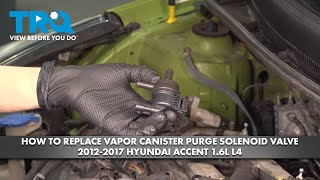
- Replacing the EVAP Purge Valve. The purge valve (or purge solenoid) is located in the engine bay, 🎬 See this walkthrough for replacing the engine bay purge solenoid valve. while P0449 refers to the vent valve (CCV) circuit, which is located at the rear of the car near the fuel tank.
Most Likely Causes
- Faulty Canister Close Valve (CCV) / Vent Solenoid 🔴 High Probability → Shop Vapor Canister This is a well-documented, high-failure item for this platform, as acknowledged by Hyundai TSB 18-FL-002. The valve is located at the rear of the vehicle near the charcoal canister and is susceptible to dirt, moisture, and internal electrical failure. The original part was superseded by an improved version.
How to confirm: Use a bidirectional scan tool to command the valve to open and close; a healthy valve will produce an audible click. If no click is heard, test for 12V power and ground at the valve's electrical connector. If power and ground are present when commanded, the valve itself has failed. A multimeter can also be used to check the resistance of the solenoid's coil; an open circuit (infinite ohms) or a value outside the expected range indicates a failed coil.
Typical fix: Replace the Canister Close Valve. It is located near the charcoal canister, above the rear axle on the driver's side. The bracket may need to be bent open with pliers to release the old valve.
Est. part cost: $25-$75 - Damaged or Corroded Wiring/Connector 🟡 Medium Probability The wiring to the CCV is located under the vehicle and is exposed to road debris, water, and salt, which can lead to corrosion or physical damage. Wires can break inside the insulation right at the connector, appearing visually intact but creating an open circuit.
How to confirm: Visually inspect the wiring harness and connector leading to the CCV for any breaks, chafing, or green/white corrosion on the pins. Gently tug on the wires at the back of the connector; a broken wire may pull out. Use a multimeter to check for continuity from the power source to the valve connector and from the control wire back to the PCM.
Typical fix: Repair the damaged section of wire or replace the connector pigtail. Liquid electrical tape can be used to seal the repair.
Est. part cost: $10-$30 - Clogged Air Drain Case / Vent Filter 🟡 Medium Probability TSB 18-FL-002 recommends replacing the air drain case as part of the repair procedure, indicating it can become clogged with dust, debris, or even spider webs, restricting airflow and contributing to the fault. A clogged filter can cause refueling issues even if the CCV is functional.
How to confirm: Remove the vent hose from the canister and inspect it and the filter for blockages. The TSB advises blowing compressed air through the old filter to check for flow, but recommends replacement regardless.
Typical fix: Replace the air drain case (filter) and blow out the connecting hoses with compressed air. This part is inexpensive and should be replaced when servicing the CCV.
Est. part cost: $20-$40
Rare But Worth Checking
- Faulty Powertrain Control Module (PCM): → Shop Engine Control Module (ECM) This is extremely rare and should only be considered after all other possibilities have been exhaustively ruled out. A shop would need to verify that the PCM driver circuit for the CCV is faulty after confirming the valve and wiring are good.
Diagnosis Steps
- Scan for any other trouble codes. TSB 18-FL-002 notes that P0449 can appear with P0455, P0456, and P0451.
- Locate the Canister Close Valve (CCV) and charcoal canister. They are at the rear of the vehicle, mounted on the left side of the rear suspension.
- Visually inspect the CCV's electrical connector and wiring for obvious signs of damage, corrosion, or disconnection. Gently pull on the wires to check for breaks inside the insulation.
- If you have a capable bidirectional scan tool, command the CCV to cycle on and off. Listen for a distinct clicking sound from the valve.
- If no click is heard, disconnect the connector. Use a multimeter or test light to check for 12V power on one pin and ground on the other when the valve is commanded on (or as specified by the wiring diagram).
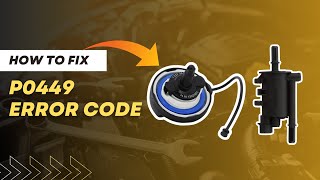
- If power and ground are present but the valve does not click, the CCV is faulty and needs to be replaced. 🎬 Watch: This step-by-step DIY guide shows you how to fix the P0449 code.
- If power or ground is missing, trace the wiring back towards the fuse box (check EVAP fuses) and PCM to find the break in the circuit.
- If the valve and wiring test good, inspect the vent hoses and the Air Drain Case (filter) for any blockages or restrictions. Per the TSB, the Air Drain Case should be replaced as part of the repair.
Parts You'll Likely Need
- Canister Close Valve (CCV)
(OEM #31453-3K600FFF)— This is the most common failure part for code P0449 on this vehicle, as identified in Hyundai's TSB 18-FL-002. The 'FFF' suffix indicates the updated, more reliable version of the part.
Trusted brands: Genuine Hyundai, Dorman, Standard Motor Products (SMP)
OEM price range: $25-$50
Aftermarket price range: $20-$40 - Air Drain Case
(OEM #31035-B2500FFF)— Hyundai's TSB 18-FL-002 mandates replacing this filter component along with the CCV inspection, as it can get clogged and restrict venting, causing refueling issues.
Trusted brands: Genuine Hyundai
OEM price range: $20-$40
Aftermarket price range: $15-$30
Related Codes That Often Appear With This One
- P0455 — EVAP System Large Leak Detected. A malfunctioning CCV stuck open or a related circuit issue can cause the system to fail a leak test, triggering this code. This code is explicitly mentioned in TSB 18-FL-002.
- P0456 — EVAP System Very Small Leak Detected. Similar to P0455, a faulty CCV can lead to this code. This code is also mentioned in TSB 18-FL-002.
- P0451 — EVAP System Pressure Sensor Range/Performance. The ECM may log this code if the pressure sensor readings are irrational due to the CCV not operating as commanded. This is the fourth code listed in TSB 18-FL-002.
Technical Service Bulletins (TSBs) & Recalls
- 18-FL-002 / 5NP-R8G4T-07: Addresses DTCs P0455, P0456, P0449, and P0451. It provides a procedure to inspect the Canister Close Valve (CCV), replace it if it has a black port, and mandates the replacement of the Air Drain Case with an updated part.
Platform-Specific Known Issues
- A Technical Service Bulletin (TSB 18-FL-002) was issued for 2012-2016 Accents for this code, recommending inspection and potential replacement of the Canister Close Valve (CCV) and mandatory replacement of the Air Drain Case.
- Owner forums frequently cite the CCV as the definitive fix for P0449, often after being frustrated by the 'pump clicking off' symptom.
Mechanic-Grade Diagnostic Values
- Canister Close Valve (CCV) Solenoid Coil Resistance — expected: Approximately 23-26 Ohms at 20°C (68°F) as a reference from other Hyundai models. General acceptable range is often cited as 20-50 Ohms.. Failure: An open circuit (infinite resistance) or a short (near zero resistance) indicates a failed coil.
- CCV Connector Voltage (Key On, Engine Off) — expected: One wire should have battery voltage (approx. 12V). The other is the control wire, which is ground-side switched by the ECM.. Failure: No voltage on the power feed wire indicates a problem with the fuse or wiring from the power source.
Scan Tool Commands That Help
- Hyundai GDS (Global Diagnostic System) or equivalent professional scan tool: Actuation Test for the Canister Close Valve (CCV). — This command is used to manually cycle the CCV solenoid on and off. A technician should listen for an audible click from the valve. The absence of a click, when power and ground are confirmed at the connector, proves the valve itself is mechanically or electrically failed internally.
- Professional Scan Tool: Reset Adaptive Values (under Vehicle S/W Management in GDS). — After replacing EVAP components, it can be beneficial to reset the ECM's learned fuel trim and EVAP test values to ensure the system re-learns based on the new, functional parts.
Wiring & Ground Locations
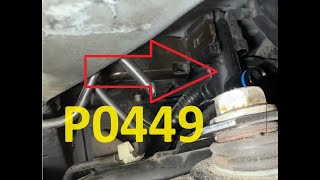
- Canister Close Valve (CCV) — Located at the rear of the vehicle on the left side of the rear suspension, attached to the charcoal canister assembly.. This is the precise location of the component and wiring harness that needs to be inspected for the P0449 code. Its underside location makes it vulnerable to road debris and corrosion.
- CCV Control Wire — Runs from a pin on the Engine Control Module (ECM) to the CCV connector. The specific pin can be found on a model-year specific wiring diagram under the name 'CCV CTRL/'.. If the valve and its power supply are good, a break or short in this specific control wire can cause the P0449 code. Testing continuity on this wire is a critical step before condemning the PCM.
Real Owner Repair Stories
- ScannerDanner YouTube Channel (Hyundai Sonata (similar EVAP system)) — Check Engine Light with code P0449, and the owner could not fill the fuel tank completely.
❌ Tried (didn't work) Initial diagnosis focused only on the code, which points to the vent solenoid.
✅ What actually fixed it The final repair required replacing two separate parts: the Canister Close Valve was mechanically stuck open (causing the P0449 code), and the separate EVAP system filter was completely clogged with debris (causing the refueling issue). This confirms the TSB's logic of replacing the filter assembly during the repair. - Reddit r/AskMechanics (2011 Hyundai Sonata) — Persistent P0449 code that would reappear immediately after clearing, difficulty fueling.
❌ Tried (didn't work) Replaced charcoal canister, Replaced purge valve, Replaced purge solenoid (vent valve)
✅ What actually fixed it After extensive testing confirmed all components and wiring were good, the issue was traced to a bad driver circuit within the Powertrain Control Module (PCM). Replacing the PCM with a used, matching-number unit resolved the code.
"I Checked Everything" — The Actual Cause
- Because P0449 is an electrical circuit malfunction code, it is common for the EVAP system to pass a smoke test. A smoke test is designed to find physical leaks (which set codes like P0455 or P0456), not electrical faults. A technician may perform a smoke test and find no leaks, leading them to believe the system is sealed. However, the actual fault lies with the Canister Close Valve's internal coil, its connector, the wiring circuit, or the PCM driver, none of which would be revealed by a smoke test.
OEM Part Supersession History
31453-3K600→31453-3K600-FFF— The original Canister Close Valve was a high-failure part. The 'FFF' version is an updated, more reliable design recommended by Hyundai in TSB 18-FL-002.
Model Year Variations Within This Range
- 2012-2014: Parts diagrams indicate the main vapor canister assembly (Part # 314201R500DS) was used for models built up to December 31, 2014, suggesting a potential change or update for the 2015 and 2016 model years. While the CCV itself may be the same, the surrounding canister and hoses could differ.
Helpful Videos

The information in this article is provided for general reference and educational purposes only. Vehicle specifications, procedures, and part compatibility can vary by production date, trim level, and region. Always consult your vehicle's factory service manual and verify part numbers before purchasing or performing repairs. Safety-critical components such as airbags, seat belts, and braking systems should be installed by a qualified professional.
- Hyundai ACCENT:
- 🧭 Diagnostic Flowchart
- 🎬 Helpful Videos
- What's Unique About the 2012-2016 Hyundai ACCENT
- Symptoms You May Notice
- Most Likely Causes
- Rare But Worth Checking
- Diagnosis Steps
- Parts You'll Likely Need
- Related Codes That Often Appear With This One
- Technical Service Bulletins (TSBs) & Recalls
- Platform-Specific Known Issues
- Mechanic-Grade Diagnostic Values
- Scan Tool Commands That Help
- Wiring & Ground Locations
- Real Owner Repair Stories
- "I Checked Everything" — The Actual Cause
- OEM Part Supersession History
- Model Year Variations Within This Range
- 🎟️ Get 5% Off