

P0449 on 2007-2009 Suzuki XL7: EVAP Vent Valve Circuit Causes and Fixes
On the 2007-2009 Suzuki XL7, code P0449 is almost always caused by a failed EVAP vent solenoid or, more commonly, a broken wire at its connector. The part is located under the vehicle near the charcoal canister. Before replacing the solenoid, thoroughly inspect the two wires leading to it for breaks or corrosion. Expect to pay $25-$50 for a new solenoid.
- P0449 on this Suzuki XL7 points to an electrical issue with the EVAP vent solenoid circuit, not a leak.
- Before buying any parts, inspect the wiring at the vent solenoid connector under the vehicle; a broken wire is a very common cause.
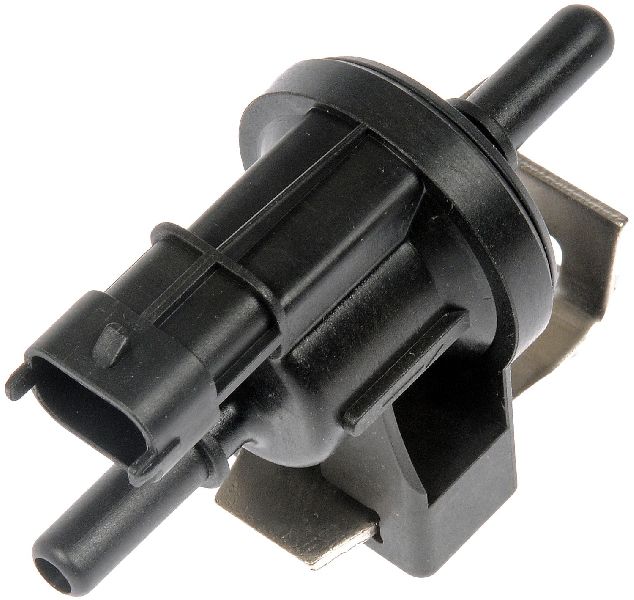
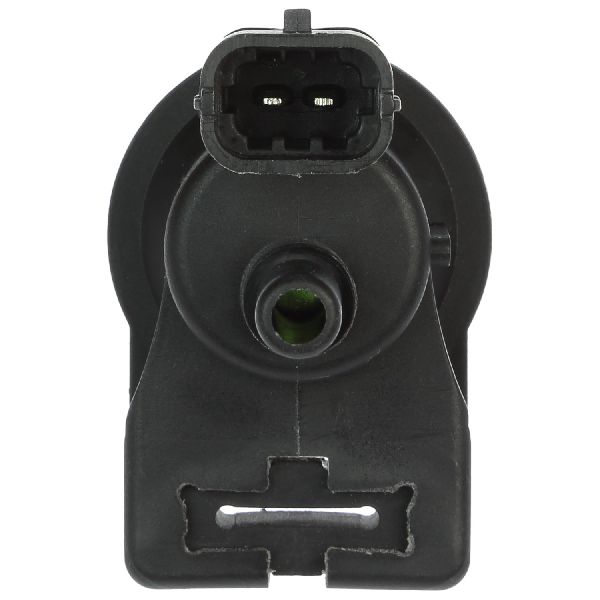
- The correct replacement solenoid is a common GM part (25932571), often sold under the ACDelco brand as part number 214-2149.
- Do not confuse the vent solenoid (under the car by the tank) with the purge solenoid (on the engine).
What's Unique About the 2007-2009 Suzuki XL7
This generation of the Suzuki XL7 is built on the General Motors (GM) Theta platform, sharing its 3.6L V6 engine (a variant of the GM LY7) and many components with vehicles like the Chevrolet Equinox, 🎬 See how to fix this code on a Chevy Equinox. Pontiac Torrent, and Saturn Vue. This is important because this P0449 code is a very common and well-documented issue on these GM models. The primary weakness is not always the vent solenoid itself, but the wiring leading to it, which is exposed under the vehicle and prone to corrosion and breaking right at the connector.
Symptoms You May Notice
- Check Engine Light is on
- Difficulty filling the gas tank (fuel pump nozzle clicks off repeatedly)
- Faint fuel odor near the rear of the vehicle
- In some GM vehicles, a message on the driver information center may appear
- Replacing the gas cap. A loose or faulty gas cap typically causes an EVAP leak code (like P0442 or P0455), not a circuit code like P0449.
- Replacing the EVAP Purge Solenoid/Valve. The purge solenoid is located on the engine, not under the car. It has its own trouble codes (like P0496) and is a separate component from the vent solenoid.
Most Likely Causes
- Broken Wire at Vent Solenoid Connector 🔴 High Probability The vent solenoid is located underneath the vehicle, exposing its wiring to moisture, road salt, and debris. Over time, the wires corrode and fatigue, often breaking right where they enter the plastic connector. This is the most cited failure on this platform.
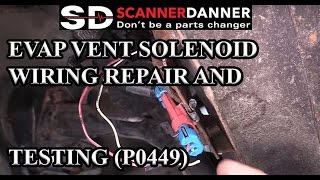
How to confirm: Visually inspect the two wires going into the vent solenoid connector, which is located near the EVAP charcoal canister under the vehicle. Gently tug on the wires to see if they are broken inside the insulation. A YouTube video for a 2008 XL7 shows this exact failure. 🎬 Watch: This 2008 XL7 video shows the exact wire failure.
Typical fix: Repair the broken wire(s). This can be done by splicing in a new section of wire or, for a more robust repair, replacing the connector with a new pigtail harness (e.g., Dorman 645-216).
Est. part cost: $15-$30 for a pigtail connector - Faulty EVAP Vent Solenoid 🔴 High Probability → Shop Vapor Canister The solenoid is an electromechanical part that cycles frequently and is exposed to the elements, leading to internal coil failure (an open circuit) or the valve mechanism getting stuck.
How to confirm: With the wiring confirmed to be good, use a scan tool to command the vent solenoid on and off; a working solenoid will make an audible click. You can also remove the solenoid and test its resistance with a multimeter (it should not be an open circuit) or by applying 12V power and ground to its terminals to see if it actuates.
Typical fix: Replace the EVAP vent solenoid. It is typically mounted to the charcoal canister or on a nearby bracket.
Est. part cost: $25-$50 - Blown Fuse ⚪ Low Probability
How to confirm: Check the vehicle's fuse box for a blown fuse related to the emissions or EVAP system. On many GM platforms, this may be a 10A fuse labeled 'EVAP'. Consult the owner's manual for the correct fuse location.
Typical fix: Replace the blown fuse. If the fuse blows again immediately, it indicates a short circuit in the wiring that must be found and repaired.
Est. part cost: $1-$5
Rare But Worth Checking
- Faulty Powertrain Control Module (PCM): → Shop Engine Control Module (ECM) This is very rare. Only consider this after you have definitively proven the vent solenoid, its wiring, and the fuse are all in perfect working order. The driver circuit inside the PCM can fail, but this is the least likely cause.
Diagnosis Steps
- Read the code with an OBD-II scanner to confirm P0449 is present.
- Safely raise and support the vehicle to access the components underneath.
- Locate the EVAP charcoal canister (a black plastic box) and the attached vent solenoid. It is typically located under the vehicle, near the fuel tank.
- Crucial Step for this vehicle: Thoroughly inspect the wiring and connector for the vent solenoid. Look for green corrosion, chafed insulation, or broken wires right at the back of the connector. Gently pull on each wire, as they often break internally.
- If the wiring is damaged, repair it first. Splicing in a new pigtail connector is the recommended fix. Clear the codes and drive the vehicle to see if the code returns. If it doesn't, the problem is solved.
- If the wiring appears intact, use a scan tool to command the vent solenoid to open and close. Listen for a distinct clicking sound from the solenoid.
- If no click is heard, disconnect the electrical connector. Use a multimeter to check for 12V power on one pin with the key in the 'ON' position.
- If power is present, the issue is likely a bad solenoid. You can confirm by checking the solenoid's resistance (it should not be infinite/open) or by applying power and ground directly to its terminals to see if it clicks.
- If power is NOT present at the connector, check the relevant fuse (e.g., 'EVAP' fuse). If the fuse is good, there is an open circuit in the power wire between the fuse box and the solenoid.
- If power is present but the solenoid never activates via the scan tool, the problem could be a break in the ground (control) wire running back to the PCM, or a faulty PCM (very rare).
Parts You'll Likely Need
- Vapor Canister Vent Solenoid
(OEM #25932571)— This is the component that fails most often, either mechanically or electrically, triggering the P0449 circuit code. The ACDelco service part number is 214-2149.
Trusted brands: ACDelco, Delphi, Dorman
OEM price range: $40-$60
Aftermarket price range: $25-$50 - Vapor Canister Vent Solenoid Harness Connector
(OEM #19257603)— Because of the high frequency of broken wires at the connector on this platform, replacing the connector pigtail is a common and durable repair.
Trusted brands: ACDelco, Dorman (p/n 645-216)
OEM price range: $20-$30
Aftermarket price range: $15-$25
Platform-Specific Known Issues
- Owner Experience on Saturn Vue (Platform Mate): A user on 2CarPros.com with a 2008 Saturn Vue (sharing the 3.6L V6 and platform) reported codes P0306 and P0449 simultaneously. This demonstrates the P0449 code's prevalence across the shared GM Theta platform, reinforcing that the issue is not unique to the Suzuki-branded vehicle.
Mechanic-Grade Diagnostic Values
- EVAP Vent Solenoid Coil Resistance — expected: 14 - 30 Ohms. Failure: A reading of infinite resistance (Open Loop / OL) indicates a broken coil winding. A reading of zero or near-zero ohms indicates a short circuit within the solenoid.
- Voltage at Vent Solenoid Connector (Pin A, Pink Wire) — expected: Battery Voltage (approx. 12.6V) with Key On, Engine Off.. Failure: 0V indicates a break in the power wire from the fuse block or a blown fuse. The fuse is typically a 15A fuse labeled 'EMIS' or 'EVAP' in the under-hood fuse block.
- Voltage at Vent Solenoid Connector (Pin B, White Wire) - Backprobed — expected: Should show battery voltage when the solenoid is commanded OFF (de-energized). Should drop to near 0V when a scan tool commands the solenoid ON (energized).. Failure: If voltage does not drop to 0V when commanded ON, it indicates a break in the white control wire going back to the PCM or a faulty PCM driver (rare).
Scan Tool Commands That Help
- GM Tech2 / GDS2 or equivalent professional scanner: EVAP Vent Solenoid ON/OFF Command — This is a primary diagnostic step after visual inspection. It is used to audibly check for solenoid operation (a click) and to verify the integrity of the control circuit. The scanner's data display will show the circuit status (e.g., 'OK', 'Open', 'Shorted'), which is invaluable for confirming an electrical fault detected by the PCM.
Wiring & Ground Locations
- Vent Solenoid Connector (C435) — On the EVAP vent solenoid, located near the charcoal canister under the rear of the vehicle.. This is the primary failure point. Pin A (Pink wire) is the 12V+ supply from the 'EMIS' fuse. Pin B (White wire) is the ground-side control from the PCM. Knowing this allows for precise voltage and continuity testing.
- Underhood Fuse Block — In the engine compartment, on the driver's side.. This block contains the fuse (typically 15A, labeled 'EMIS') that supplies power to the vent solenoid circuit. A blown fuse here will cause a P0449 and must be investigated for a short circuit.
- Harness Chafe Point — The wiring harness running along the frame rail from the solenoid towards the front of the vehicle.. In cases where the break is not at the connector, the harness can rub against the frame or other components, causing an open or short in the pink or white wire. This is a less common but known failure location.
Real Owner Repair Stories
- Chevrolet Equinox Forum (platform mate) (2008 Chevrolet Equinox 3.6L) — Check Engine Light with code P0449.
❌ Tried (didn't work) Replaced the EVAP vent solenoid with a new part.
✅ What actually fixed it The code returned after replacing the solenoid. Further diagnosis found the white control wire was broken inside its insulation about 12 inches away from the connector, where the harness was rubbing against a body seam. Repairing the broken wire resolved the code permanently.
OEM Part Supersession History
19152349→25932571— Standard part revision and consolidation by GM.
Heads up: None. 25932571 is a direct replacement for 19152349.N/A→ACDelco 214-2149— This is the service part number for GM 25932571.
Diagnostic Flowchart
Other Known Issues on This Vehicle
Issues unrelated to this code that are worth knowing about as an owner of this generation:
- Premature Timing Chain Stretch 🔴 High — Very common, often appearing between 70,000 and 120,000 miles. It is a well-documented flaw in the early GM 3.6L LY7 engine family. (Ref: GM Special Coverage 11340B and Suzuki TSB SI-0012R were issued to address this, extending warranty coverage and providing repair kits.)
- Power Steering System Failure 🔴 High — Commonly reported, with failures of the power steering pump, lines, or steering rack occurring as early as 45,000-75,000 miles. (Ref: No specific recall for the 2007-2009 models, but numerous owner complaints document sudden loss of power steering assist, making the vehicle very difficult to steer.)
- Water Pump Leaks 🟠 Medium — A frequent failure point on the 3.6L engine, often leading to coolant leaks and potential overheating if not addressed.
Used vs. New Parts: Buying Guide for This Vehicle
When a used part is the smart pick: Almost never for this repair. The primary failure parts (solenoid and connector) are inexpensive to buy new, and the failure is caused by age and exposure. A used part has already been subjected to the same conditions and has a limited remaining lifespan.
Donor-vehicle mileage cap: roughly under 15000 miles for the part to have meaningful remaining life.
What to inspect on the donor part:
- If forced to use a junkyard part, choose a donor from a dry, non-salt-belt region.
- Inspect the wiring pigtail on the donor part for any signs of brittleness, cracking, or previous repairs.
- Test the resistance of the used solenoid with a multimeter before purchase; it must be within the 14-30 Ohm spec.
OEM-only on this vehicle (don't cheap out):
- None for this specific repair. The solenoid and connector are simple components.
Aftermarket brands forum-validated for this vehicle:
- ACDelco (OEM supplier)
- Delphi
- Dorman (especially for the connector pigtail, p/n 645-216)
Brands owners have reported issues with on this vehicle:
- No-name, ultra-low-cost brands from online marketplaces may have poor coil windings or valve seals, leading to premature failure.
Real Owner Stories
Aggregated from forums and TSBs cited above. Mileages and costs reflect what owners reported in those sources.
2008 Suzuki XL7
Symptoms: Check Engine Light was on.
What fixed it: The owner tracked the P0449 code to the EVAP vent solenoid and found the white and red wires had broken off right at the electrical connector. Repairing the broken wires solved the issue.
Source hint: YouTube video titled '08 xl7. P0449 fix'
2008 Saturn Vue 3.6L V6
Symptoms: Vehicle had codes P0306 and P0449 simultaneously.
What fixed it: The forum post confirmed the presence of the code on this platform-mate vehicle, reinforcing that the issue is common across the GM Theta platform.
Source hint: 2CarPros.com (Saturn Vue)
Related OBD-II Codes
Frequently Asked Questions
Where is the EVAP vent solenoid that causes code P0449 located on my 2008 Suzuki XL7?
What is the most common failure that triggers a P0449 code on this specific vehicle?
Is there a recommended part to fix the common broken wire issue?
My gas pump nozzle keeps clicking off when I try to fill the tank. Is this related to the P0449 code?
I checked the wiring and it looks fine. What should I check next?
My 2009 Chevrolet Equinox has a P0449 code. Is the diagnosis the same as for the Suzuki XL7?
Helpful Videos
We Have This Part in Stock


The information in this article is provided for general reference and educational purposes only. Vehicle specifications, procedures, and part compatibility can vary by production date, trim level, and region. Always consult your vehicle's factory service manual and verify part numbers before purchasing or performing repairs. Safety-critical components such as airbags, seat belts, and braking systems should be installed by a qualified professional.
- Suzuki XL7:
- 🧭 Diagnostic Flowchart
- 🎬 Helpful Videos
- 🛍️ Shop This Part
- What's Unique About the 2007-2009 Suzuki XL7
- Symptoms You May Notice
- Most Likely Causes
- Rare But Worth Checking
- Diagnosis Steps
- Parts You'll Likely Need
- Platform-Specific Known Issues
- Mechanic-Grade Diagnostic Values
- Scan Tool Commands That Help
- Wiring & Ground Locations
- Real Owner Repair Stories
- OEM Part Supersession History
- Other Known Issues on This Vehicle
- Used vs. New Parts: Buying Guide for This Vehicle
- Real Owner Stories
- 2008 Suzuki XL7
- 2008 Saturn Vue 3.6L V6
- Related OBD-II Codes
- Frequently Asked Questions
- 🎟️ Get 5% Off