

P0451 on 2019-2024 Cadillac XT4: EVAP Pressure Sensor Causes and Fixes
On the 2019-2024 Cadillac XT4, code P0451 is most often caused by liquid fuel entering the EVAP vapor lines from overfilling the gas tank. GM issued TSB #22-NA-203 detailing that going beyond three 'clicks' of the fuel nozzle can cause this. The fix is often to clear the lines of fuel, which is a low-cost repair requiring no parts. A faulty Fuel Tank Pressure (FTP) sensor is the next most likely cause.
- Before buying any parts for a P0451 code on a 2019-2024 Cadillac XT4, check for liquid fuel in the EVAP lines.
- The most common cause is overfilling the fuel tank. Avoid going beyond three 'clicks' of the fuel nozzle to prevent this issue.
- If the EVAP lines are clear, try cleaning the capless fuel filler seal before suspecting a faulty Fuel Tank Pressure (FTP) sensor.
- This code does not indicate a serious drivability problem and is safe to drive with in the short term.
What's Unique About the 2019-2024 Cadillac XT4
The Cadillac XT4, particularly models with the 2.0L LSY engine, is subject to a specific issue that triggers the P0451 code. GM has issued Technical Service Bulletin (TSB) #22-NA-203 acknowledging that overfilling the fuel tank—specifically going beyond three clicks of the fuel pump nozzle—can force liquid gasoline into the EVAP vapor lines. This liquid fuel blocks the lines, causing abnormal pressure readings that the FTP sensor reports to the ECM, setting the code. This is so common that the primary diagnostic step for this vehicle, as outlined by GM, is to check for and clear fuel from these lines before replacing any parts.
Diagnostic Flowchart
Tap your situation to follow the diagnostic path that matches what you're seeing on this vehicle.
Symptoms You May Notice
- Check Engine Light is on
- Difficulty refueling (fuel pump nozzle clicks off prematurely).
- Slightly reduced fuel economy.
- Faint fuel smell.
- Replacing the Fuel Tank Pressure (FTP) sensor without first checking for liquid fuel in the EVAP lines. Per TSB #22-NA-203, clearing the lines is the first and most critical step for this specific vehicle and issue.
Most Likely Causes
- Liquid Fuel in EVAP Vapor Lines from Overfilling 🔴 High Probability As documented in GM TSB #22-NA-203, continuing to add fuel after the pump nozzle clicks off (specifically, going beyond three clicks) can force gasoline into the EVAP vapor recirculation line, contaminating the system and causing erratic pressure readings.
How to confirm: A technician can raise the vehicle and disconnect the three EVAP vapor lines near the fuel tank to check for the presence of liquid fuel.
Typical fix: The vapor lines must be disconnected and cleared of all liquid fuel. Per TSB #22-NA-203, the procedure involves disconnecting lines at the tank and at the EVAP canister (which requires removing the rear passenger-side wheel and liner) and then using low-pressure shop air to blow the lines clear. The code is then cleared and the customer is advised not to overfill the tank. No parts are required for this specific repair.
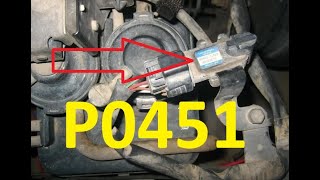
Est. part cost: $0 - Faulty Fuel Tank Pressure (FTP) Sensor 🟡 Medium Probability → Shop Fuel Tank The sensor itself can fail over time, providing incorrect voltage signals to the ECM. 🎬 Watch: Understanding P0451 causes and how the sensor functions. This is a common failure point for EVAP systems on many vehicles and the next logical part to replace if the lines are confirmed to be clear of fuel.
How to confirm: Test the sensor's voltage output with a multimeter to see if it corresponds to specified pressure/vacuum values. A scan tool can also monitor the sensor's live data to see if it's stuck or providing erratic readings.
Typical fix: Replace the Fuel Tank Pressure sensor. It is often located on top of the fuel tank or as part of the fuel pump module.
Est. part cost: $50-$100 - Dirty or Faulty Capless Fuel Filler Seal ⚪ Low Probability The XT4 has a capless fuel filler, and the internal sealing mechanism can be obstructed by dirt and debris, preventing a proper seal. A poor seal can cause pressure readings to be out of range, triggering an EVAP code.
How to confirm: Inspect the capless filler neck for visible debris or damage to the sealing flap.
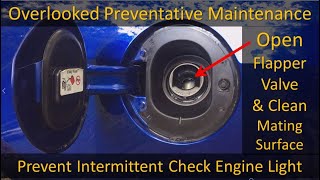
Typical fix: A common DIY fix involves cleaning the fuel filler neck sealing surface. Use a rag with a solvent like WD-40 or denatured alcohol to wipe the area. Then, insert the emergency fuel funnel (supplied with the vehicle) in and out several times while spraying a small amount of lubricant to work the mechanism and dislodge any trapped debris. 🎬 See how to properly clean a capless fuel filler seal. If the internal spring-loaded door is damaged, the entire filler neck assembly may need replacement.
Est. part cost: $0-$150
Rare But Worth Checking
- Clogged or Restricted EVAP Canister or Vent Lines: → Shop Vapor Canister A restriction in the EVAP system can prevent pressure from equalizing correctly, which can cause the FTP sensor to report out-of-range values. This can be caused by debris or a failure of the charcoal canister itself, sometimes as a result of repeated fuel overfilling.
- Damaged Wiring or Connectors: Corrosion or damage to the wiring or connector for the FTP sensor can cause an intermittent or lost signal, triggering the code. This should be checked before replacing the sensor.
Diagnosis Steps
- Read the code with an OBD-II scanner to confirm P0451 is present.
- Question the driver about refueling habits, specifically if they 'top off' the tank after the pump clicks off.
- As a preliminary step, inspect and clean the capless fuel filler neck. 🎬 Watch: Simple maintenance for capless filler necks to prevent codes. Use the emergency funnel and a suitable solvent/lubricant to work the sealing mechanism and clear any debris. Clear the code and see if it returns.
- If the code returns, follow the procedure in TSB #22-NA-203: Raise the vehicle and disconnect the three EVAP vapor lines near the fuel tank to check for liquid fuel.
- If fuel is present, drain the lines. Remove the rear passenger-side wheel and wheel liner to access the EVAP canister. Disconnect the two vapor lines with green quick connectors and clear all contaminated lines with low-pressure shop air. Reassemble, clear the DTC, and test drive.
- If no fuel is found, use a scan tool to monitor the FTP sensor's voltage. The voltage should change smoothly as pressure/vacuum is applied to the tank.
- If the sensor's readings are erratic or do not change, inspect the sensor's wiring and connector for damage or corrosion.
- If wiring is intact, the FTP sensor is likely faulty and should be replaced. The sensor is located on the fuel tank.
Parts You'll Likely Need
- Fuel Tank Pressure Sensor
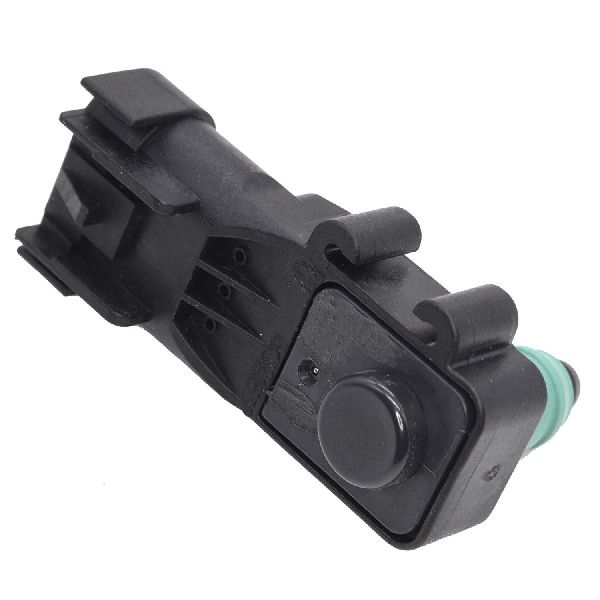
(OEM #13502903)— This sensor is the primary component that measures the pressure the code is based on. If it fails, it will send incorrect data to the ECM. This is the most common part to be replaced if the EVAP lines are clear of fuel. This part supersedes the older part number 13502510.
Trusted brands: ACDelco, GM Genuine Parts, NGK/NTK
OEM price range: $50-$100
Aftermarket price range: $45-$75
Technical Service Bulletins (TSBs) & Recalls
- 22-NA-203: Check Engine Lamp Illuminated on Driver Information Center (DIC) with DTC P0451 Set. Details the procedure for clearing liquid fuel from EVAP lines caused by overfilling ('beyond three clicks'). States that no parts are required for the repair. [⭐ MANUFACTURER TSB — highest authority]
- PIE0613B: An engineering information bulletin requesting technician feedback on a Check Engine Lamp, poor fuel fill, and DTC P0451, showing GM was actively investigating the root cause. [⭐ MANUFACTURER TSB — highest authority]
- PIE0537: An earlier engineering bulletin requesting technician feedback regarding a check engine lamp and DTC P0451, establishing a documented history of the issue. [⭐ MANUFACTURER TSB — highest authority]
Platform-Specific Known Issues
- GM has issued TSB #22-NA-203 which explicitly states that overfilling the fuel tank (going beyond three clicks) can cause liquid fuel to enter the vapor lines, leading to this code. The prescribed fix is to drain the lines, not replace parts, and carries a labor time of 0.6 hours under warranty.
- Prior to issuing a definitive fix, GM released engineering bulletins (PIE0537 and PIE0613B) to gather data from technicians on vehicles exhibiting P0451 and/or poor fuel fill issues, indicating a known history of this problem on the platform.
Mechanic-Grade Diagnostic Values
- FTP Sensor Voltage (Key On, Engine Off, Fuel Cap Removed) — expected: 1.3 - 1.7 Volts (typically 1.5V). Failure: A reading significantly outside this range indicates a sensor or wiring issue.
- FTP Sensor 5-Volt Reference Circuit — expected: 4.8 - 5.2 Volts (between reference circuit pin and ground). Failure: No voltage or low voltage indicates a problem with the ECM or the wiring from the ECM.
- FTP Sensor Low Reference Circuit — expected: < 5 Ohms (between low reference circuit pin and a known good ground). Failure: High resistance or an open circuit (OL) indicates a broken or corroded ground wire.
- DTC Setting Voltage Threshold — expected: Signal voltage should remain between 0.1V and 4.9V.. Failure: A voltage less than 0.1V or more than 4.9V for more than 5 seconds will set a DTC.
Scan Tool Commands That Help
- GDS2 / Tech 2: EVAP Service Bay Test — This is a comprehensive, automated test to verify the integrity of the entire EVAP system after a repair or during diagnosis. It commands the various solenoids and monitors the FTP sensor to confirm there are no leaks. Note: The test will only run if the fuel level is between 15-85% and engine coolant is below 158°F (70°C).
- GDS2 / Tech 2: Purge/Seal — This is a manual bidirectional control used to isolate parts of the EVAP system. A technician can command the vent valve to 'Seal' the system and then command the purge valve to open by a certain percentage to create a vacuum. By monitoring the FTP sensor voltage, the technician can determine if the system is holding the vacuum, which helps pinpoint leaks.
Wiring & Ground Locations
- EVAP Canister & Vent Solenoid — Located behind the rear passenger-side wheel and wheel liner.. This is a key service location. TSB #22-NA-203 requires accessing the canister to disconnect and blow out the contaminated vapor lines that cause P0451.
- GM Ground Naming Convention — Vehicle-wide. G1xx series grounds are in the engine bay, G2xx are in the front passenger cabin, G3xx are in the rear passenger area, and G4xx are in the cargo/rear chassis area.. If a faulty ground for the FTP sensor circuit is suspected, knowing this convention helps a technician narrow down the physical search area. The FTP sensor circuit ground would likely be a G3xx or G4xx point.
OEM Part Supersession History
13502510→13502903— Standard part revision or supplier change.
Heads up: None. The new part number 13502903 is the correct replacement for the original.
Helpful Videos
We Have This Part in Stock

The information in this article is provided for general reference and educational purposes only. Vehicle specifications, procedures, and part compatibility can vary by production date, trim level, and region. Always consult your vehicle's factory service manual and verify part numbers before purchasing or performing repairs. Safety-critical components such as airbags, seat belts, and braking systems should be installed by a qualified professional.
- Cadillac XT4:
- 🧭 Diagnostic Flowchart
- 🎬 Helpful Videos
- 🛍️ Shop This Part
- What's Unique About the 2019-2024 Cadillac XT4
- Symptoms You May Notice
- Most Likely Causes
- Rare But Worth Checking
- Diagnosis Steps
- Parts You'll Likely Need
- Technical Service Bulletins (TSBs) & Recalls
- Platform-Specific Known Issues
- Mechanic-Grade Diagnostic Values
- Scan Tool Commands That Help
- Wiring & Ground Locations
- OEM Part Supersession History
- 🎟️ Get 5% Off