

P0451 on 2017-2021 Ford Transit: EVAP Pressure Sensor Causes and Fixes
This code indicates a problem with the Fuel Tank Pressure (FTP) sensor's readings. On the 2017-2021 Ford Transit, this is often caused by a kinked EVAP vent line as noted in a Ford TSB. Before replacing the sensor, inspect all EVAP hoses for kinks or damage, particularly the fresh air line near the charcoal canister.
- P0451 on a 2017-2021 Ford Transit points to a problem with the Fuel Tank Pressure (FTP) sensor's signal.
- Before replacing any parts, perform a thorough visual inspection of all EVAP hoses for kinks, especially the fresh air vent line, as specified in Ford TSB 21-2106.
- Do not automatically replace the canister purge valve; a Ford TSB warns this is a common misdiagnosis.
- Confirming the failure of the FTP sensor with a scan tool's live data is a critical diagnostic step before replacement.
- The issue is not a severe driving concern but will cause an emissions test failure.
What's Unique About the 2017-2021 Ford TRANSIT
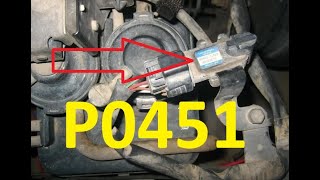
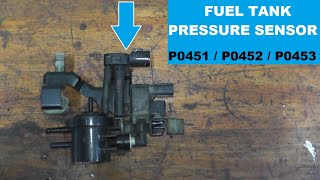
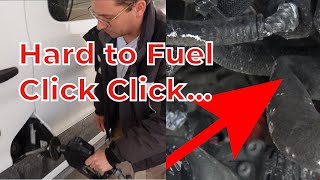
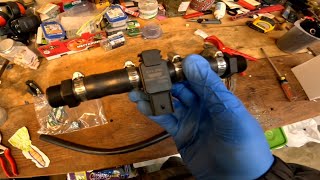
For the Ford Transit in this year range, the P0451 code is specifically called out in two Technical Service Bulletins (TSBs). One TSB points directly to a kinked EVAP fresh air vent line, which can cause this code and a slow fuel fill issue. 🎬 Watch: How to fix a Transit that's hard to fuel. Another bulletin warns that the canister purge valve is often replaced by mistake when it is not the root cause. This highlights the need to perform a thorough visual inspection of the EVAP lines 🎬 See this breakdown of P0451 causes and common fixes. before replacing parts. The FTP sensor itself is often part of a larger hose assembly on top of the fuel tank, making it difficult to source and replace individually, sometimes requiring the purchase of the entire line assembly.
Diagnostic Flowchart
Tap your situation to follow the diagnostic path that matches what you're seeing on this vehicle.
Symptoms You May Notice
- Check Engine Light is on
- Difficulty filling the fuel tank (slow fill or pump clicks off repeatedly)
- Slight smell of gasoline
- Hard starting after refueling (less common, but possible)
- Reduced fuel economy
- Replacing the EVAP canister purge valve. Ford TSB #SSM 50306 specifically notes that returned purge valves for this and related codes were tested and found to be fully functional, indicating this part is often replaced unnecessarily.
Most Likely Causes
- Kinked EVAP fresh air vent line 🔴 High Probability This is a documented issue in Ford's Technical Service Bulletin TSB 21-2106 for the 2017-2020 Transit. The routing of the line from the charcoal canister makes it susceptible to kinking, trapping pressure or vacuum.
How to confirm: Visually inspect the EVAP lines, particularly the fresh air vent line running from the canister to its filter, for any sharp bends, kinks, or collapses. This is often found near the fuel tank and rear axle.
Typical fix: Reroute or straighten the kinked line to restore proper airflow. If the line is damaged from the kink, the affected section may need to be replaced.
Est. part cost: $0-$50 - Faulty Fuel Tank Pressure (FTP) Sensor 🟡 Medium Probability → Shop Fuel Tank The FTP sensor is a sensitive electronic component that operates in a harsh environment and can fail over time, leading to incorrect voltage signals. On many Fords, including the Transit and F-150, the sensor is integrated into a hose assembly on top of the fuel tank, which can be difficult to access and sometimes requires dropping the tank.
How to confirm: Use a scan tool to monitor the FTP sensor's live data (PID). With the gas cap off (or capless filler adapter installed), the pressure should read at or near 0 inches of water (approx. 2.5-2.6 volts). If the reading is stuck high (e.g., over 3.5V) or low (e.g., under 1.0V), or doesn't change when vacuum is applied with a hand pump, the sensor is likely faulty.
Typical fix: Replace the Fuel Tank Pressure sensor. On many Ford models, this sensor is located on top of the fuel tank and may be integrated into a vapor line assembly that must be replaced as a unit. This may require lowering the fuel tank for access.
Est. part cost: $40-$250 - Damaged or blocked EVAP hoses 🟡 Medium Probability Hoses can become brittle, cracked, or blocked by debris or spider webs, which can alter the pressure readings within the system. This is especially true for lines exposed under the vehicle.
How to confirm: Perform a visual inspection of all accessible EVAP hoses for cracks or damage. A smoke test is the most effective way to find small, hard-to-see leaks or blockages.
Typical fix: Replace the damaged section of the hose.
Est. part cost: $10-$60 - Wiring or Connector Issue ⚪ Low Probability The wiring harness to the FTP sensor can be exposed to road debris and moisture, leading to corrosion or damage over time, especially at the connector on top of the fuel tank.
How to confirm: Inspect the connector and wiring at the FTP sensor for corrosion, damage, or loose pins. Use a multimeter to check for 5-volt reference, ground, and a proper signal back to the PCM.
Typical fix: Clean the connector with contact cleaner or repair the damaged section of the wiring harness.
Est. part cost: $5-$100
Rare But Worth Checking
- Faulty Powertrain Control Module (PCM): This is very rare. The PCM should only be considered after all other possibilities, including sensors, wiring, and hoses, have been exhaustively tested and ruled out.
- Saturated Charcoal Canister: → Shop Vapor Canister Repeatedly 'topping off' the fuel tank after the pump clicks off can force liquid fuel into the charcoal canister, ruining it. This can cause a variety of EVAP codes, including P0451, and symptoms like difficulty starting after refueling.
Diagnosis Steps
- Scan the vehicle for all stored trouble codes. Note any other codes that appear with P0451.
- Visually inspect the EVAP system, paying close attention to the fresh air vent line for any kinks or sharp bends, as specified in TSB 21-2106. The line runs from the charcoal canister, often near the rear axle.
- Inspect the capless fuel filler neck for debris that could prevent a proper seal. Use the supplied funnel to open the flap and check for dirt.
- Using a capable scan tool, observe the live data for the Fuel Tank Pressure (FTP) sensor. With the fuel filler open, the reading should be close to 0 inches of water or 2.5-2.6 volts.
- If the sensor reading is stuck or irrational, inspect the sensor's wiring and connector for damage or corrosion. This will require accessing the top of the fuel tank.
- If wiring is good, test the sensor itself. This can be done by applying a small amount of vacuum with a hand pump and watching for a corresponding change in voltage on the scan tool.
- If the sensor and wiring test good, perform a smoke test on the EVAP system to check for any hard-to-see leaks or blockages in the lines or canister.
- If no other cause is found, the issue may be with the PCM, but this is extremely rare and requires professional diagnosis.
Parts You'll Likely Need
- Fuel Tank Pressure Sensor
(OEM #BL3Z-9F972-B (Note: Often part of a larger hose assembly, verify with VIN))— This sensor is the primary component that reports the data that triggers the P0451 code. If its readings are out of range due to internal failure, it must be replaced. On many Fords, this sensor is integrated into a hose assembly on top of the tank.
Trusted brands: Motorcraft, Bosch, Dorman
OEM price range: $80-$150
Aftermarket price range: $40-$90 - EVAP Vapor Hose/Line
(OEM #Varies greatly, may include sensor (e.g., 9U5A-9C052 is a number found on an older F-150 assembly). Must verify with VIN.)— A kinked or cracked hose, especially the fresh air vent line mentioned in TSB 21-2106, can cause this code. The damaged section of the hose will need to be replaced. Sometimes the sensor is molded into this part.
Trusted brands: Motorcraft, Gates
OEM price range: $30-$250
Aftermarket price range: $10-$50
Related Codes That Often Appear With This One
- P1450 — Often appears with P0451, as noted in TSB 21-2106. P1450 indicates an inability to bleed up fuel tank vacuum, which can be caused by a kinked or blocked vent line.
- P0456 — This code for a 'very small leak' can appear alongside P0451 if the system has both a sensor performance issue and a small leak. TSB 21-2106 and SSM 50306 both list it as a related code.
- P0455 — This code for a 'gross leak' can also be seen with P0451. Both TSBs mention this code as a possible companion DTC.
- P0496 — Indicates 'EVAP Flow During a Non-Purge Condition'. This is another code mentioned in both TSBs that can be triggered by related system faults.
Technical Service Bulletins (TSBs) & Recalls
- TSB 21-2106: Addresses a slow fill condition and multiple EVAP DTCs, including P0451, caused by a kinked fresh air vent line.
- SSM 50306: Warns against unnecessarily replacing the EVAP canister purge valve for P0451 and other codes, as it is often not the cause.
Platform-Specific Known Issues
- TSB 21-2106 documents that some 2017-2020 Transits may have a kinked evaporator emissions fresh air vent line, leading to P0451 and other EVAP codes, as well as a slow fuel fill condition.
- TSB SSM 50306 warns technicians that the canister purge valve is often misdiagnosed as the cause for P0451 and other EVAP codes. Ford's testing showed these returned parts were functional.
- The Fuel Tank Pressure (FTP) sensor is often integrated into a larger vapor hose assembly on top of the fuel tank, making it a more complex part to source and replace than a simple standalone sensor.
Mechanic-Grade Diagnostic Values
- FTP Sensor Voltage (FTP_V PID) — expected: ~2.5V - 2.6V with key on, engine off (KOEO) and the fuel cap removed (system at atmospheric pressure).. Failure: A voltage that is significantly different, such as below 1.0V or above 3.5V, indicates a sensor or wiring fault.
- FTP Sensor Reference Voltage (VREF) — expected: 5.0V at the sensor connector.. Failure: No voltage or low voltage indicates a wiring or PCM issue.
Scan Tool Commands That Help
- Ford IDS (or equivalent bidirectional scanner): EVAP System Test / Manual EVAP Test — This function allows the technician to command the canister purge and vent valves to seal the system. While primarily used for leak detection (P0455/P0456), it can be used to apply vacuum and observe the FTP sensor's response to verify its functionality.
- Ford IDS / FORScan: Live Data PID: FTP_V (Fuel Tank Pressure Voltage) — This is the primary diagnostic data point for P0451. Monitoring this PID with the gas cap on and off is the fastest way to check for a sensor that is out of its normal operating range.
Wiring & Ground Locations
- Fuel Tank Pressure Sensor Circuit — A wiring diagram for the 2018 Ford Transit 250 with the 3.5L Turbo engine shows the Fuel Tank Pressure Sensor circuit on page 73.. This diagram is essential for tracing the signal, reference voltage, and ground wires from the sensor back to the PCM to check for opens, shorts, or high resistance.
OEM Part Supersession History
Varies - Must use VIN→Varies - Must use VIN— The Fuel Tank Pressure (FTP) sensor for this application is typically integrated into a vapor hose assembly. Part numbers for these assemblies are highly specific to the vehicle's configuration (wheelbase, etc.) and can change. For example, part numbers like JL3Z-9D333-D and JR3Z-9E325-A exist for other Ford vehicles with a similar design but are not correct for the Transit.
Heads up: Do not purchase a standalone sensor (like XS4Z-9C052-AA) unless you have visually confirmed it is serviced separately on your specific vehicle, as this is unlikely. Do not use the fuel rail pressure sensor (like CM-5247). Always verify the correct hose assembly part number with a Ford dealer using the vehicle's VIN.
Helpful Videos
We Have This Part in Stock

The information in this article is provided for general reference and educational purposes only. Vehicle specifications, procedures, and part compatibility can vary by production date, trim level, and region. Always consult your vehicle's factory service manual and verify part numbers before purchasing or performing repairs. Safety-critical components such as airbags, seat belts, and braking systems should be installed by a qualified professional.
- Ford TRANSIT:
- 🧭 Diagnostic Flowchart
- 🎬 Helpful Videos
- 🛍️ Shop This Part
- What's Unique About the 2017-2021 Ford TRANSIT
- Symptoms You May Notice
- Most Likely Causes
- Rare But Worth Checking
- Diagnosis Steps
- Parts You'll Likely Need
- Related Codes That Often Appear With This One
- Technical Service Bulletins (TSBs) & Recalls
- Platform-Specific Known Issues
- Mechanic-Grade Diagnostic Values
- Scan Tool Commands That Help
- Wiring & Ground Locations
- OEM Part Supersession History
- 🎟️ Get 5% Off