

P0455 on 2000-2005 Buick LeSabre: EVAP Large Leak Causes and Fixes
For a 2000-2005 Buick LeSabre, P0455 is almost always caused by a loose, worn, or incorrect gas cap. Before buying parts, ensure the cap is tight and the filler neck is clean. If the code returns, a new OEM-quality cap (ACDelco GT261) costs about $15-$30 and is a 1/5 difficulty DIY fix. If that doesn't solve it, the next most likely causes are the easily accessible EVAP purge solenoid on the engine or the vent solenoid near the fuel tank.
- P0455 indicates a large leak in the EVAP (emissions) system and is not a critical engine problem.
- Always check the gas cap first. A loose, damaged, or incorrect cap is the number one cause. Ensure it's tight and the seal is good.
- If the gas cap is not the issue, the most likely failed parts are the EVAP purge solenoid (on the engine) or the EVAP vent solenoid (near the gas tank).
- Driving with this code is safe, but you will not be able to pass an emissions inspection until the leak is repaired.
- A smoke test is the most reliable professional method to find a leak if it's not one of the common, easily replaceable components.
What's Unique About the 2000-2005 Buick LESABRE
The Buick LeSabre from this era, along with its GM H-body siblings like the Pontiac Bonneville and Buick Park Avenue, uses the reliable 3.8L V6 engine. A key characteristic of this platform is the location of some EVAP components. The EVAP purge solenoid is conveniently located on top of the engine, making it very easy to access and replace, often without tools. However, the vent solenoid and charcoal canister are typically located near the fuel tank, exposed to road debris, moisture, and salt, making them common failure points due to corrosion and getting stuck. The steel fuel filler neck is also a known weak point, prone to rusting through and causing a persistent P0455 code that a new gas cap won't fix.
Diagnostic Flowchart
Tap your situation to follow the diagnostic path that matches what you're seeing on this vehicle.
Symptoms You May Notice
- Check Engine Light is on
- A noticeable smell of gasoline, especially after refueling or around the car.
- Difficulty filling the fuel tank (the pump nozzle clicks off repeatedly) if the vent solenoid is stuck closed.
- A slight decrease in fuel economy.
- A "Check Gas Cap" or similar message on the driver information center.
- Rough idle or difficulty starting after filling the fuel tank, which can occur if the purge solenoid is stuck open.
- Replacing the Fuel Tank Pressure (FTP) Sensor. A faulty FTP sensor will typically set its own specific codes (like P0452 or P0453) and is not a common cause for a P0455 leak code.
- Repeatedly replacing the gas cap when the actual fault is a rusted-out fuel filler neck.
Most Likely Causes
- Loose, Damaged, or Incorrect Gas Cap 🔴 High Probability → Shop Fuel Tank Cap The gas cap is the most frequently handled part of the EVAP system. Its rubber seal can dry out, crack, or get dirty over time, preventing a proper seal. Using a cheap, non-OEM cap is a very common cause of this code. Owners often try multiple caps before realizing the issue is elsewhere.
How to confirm: Inspect the gas cap for any visible cracks or damage to the rubber O-ring. Ensure it is tightened until it clicks at least three times. Clean the sealing surface on the fuel filler neck of any rust or debris with a Scotch-Brite pad. Applying a thin layer of Vaseline to the seal can sometimes create a temporary fix and confirm the cap is the issue.
Typical fix: Tighten the cap and clear the code. If the code returns or the cap is damaged, replace it with a new OEM (ACDelco GT261) or high-quality aftermarket cap.
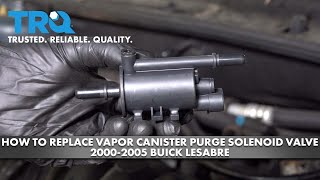
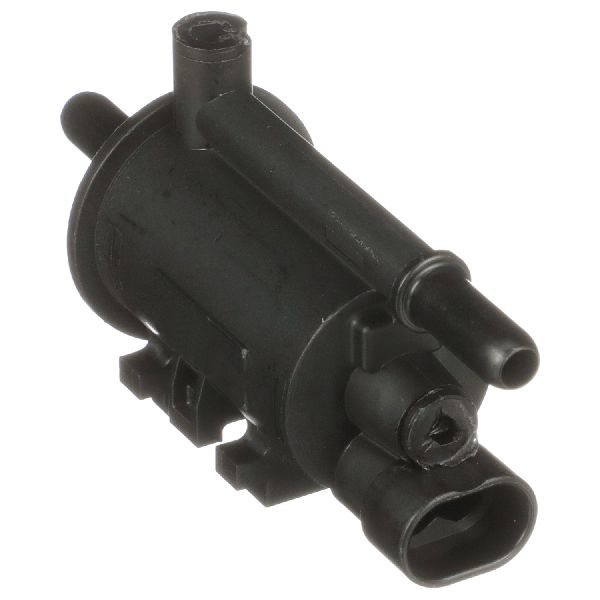
Est. part cost: $15-$30 - Failed EVAP Purge Solenoid/Valve 🟡 Medium Probability → Shop Vapor Canister This solenoid, located on the engine, can get stuck open or closed. If stuck open, it creates a constant vacuum leak that the ECM interprets as a large system leak. Its location on the 3.8L V6 makes it an extremely easy and common replacement, often taking only minutes. 🎬 Watch: A quick walkthrough on replacing the purge solenoid.
How to confirm: With the engine off, remove the purge solenoid. Try to blow through it; if air passes through, it is stuck open and has failed. It is a normally-closed valve. A stuck-closed valve can also cause P0455 because the system can't pull a vacuum during its test, which the ECM interprets as a large leak.
Typical fix: Replace the purge solenoid. It is mounted on the engine with a simple bracket and has two quick-disconnect hoses and an electrical connector.
Est. part cost: $25-$60 - Failed EVAP Vent Solenoid/Valve 🟡 Medium Probability → Shop Vapor Canister This solenoid is typically located near the charcoal canister by the fuel tank. Its exposure to road salt, dirt, and moisture can cause it to fail, often getting stuck open and creating a large leak. The internal spring and valve mechanism can corrode and freeze up.
How to confirm: The vent solenoid is a normally-open valve. A scan tool can command it closed to test its function. A smoke test is the most effective way to confirm if it is stuck open and leaking. When commanded closed during a smoke test, smoke should not escape from the valve's filter.
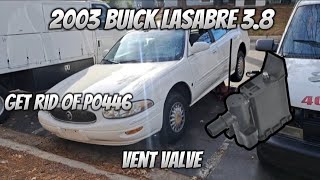
Typical fix: Replace the EVAP vent solenoid. This may require safely raising the vehicle for access. The part is often held by a single 10mm bolt and may require a new wiring harness adapter if replacing with an updated design. 🎬 See how to replace the vent valve solenoid yourself.
Est. part cost: $40-$85 - Cracked or Disconnected EVAP Hoses ⚪ Low Probability Over time, the rubber and plastic hoses in the EVAP system can become brittle and crack, especially the elbows and connectors. A common failure point is the short molded hose elbow coming off the purge solenoid on the engine.
How to confirm: Visually inspect all accessible EVAP lines from the engine bay to the fuel tank. A smoke test is the definitive method to pinpoint a leak in a hose or line that isn't obvious visually.
Typical fix: Replace the damaged section of hose or the entire line assembly. A cracked elbow can often be replaced with a generic piece of molded hose.
Est. part cost: $10-$50
Rare But Worth Checking
- Rusted/Cracked Fuel Filler Neck: → Shop Fuel Filler Neck A very common issue on these vehicles, especially in salt-belt states. Rust perforates the steel tube where the gas cap seals or along the vent line that runs parallel to it, causing a large leak that a new gas cap cannot fix. This is often found via a smoke test where smoke will be seen billowing from the filler neck area behind the wheel well liner. Replacement requires partially dropping the fuel tank to gain access.
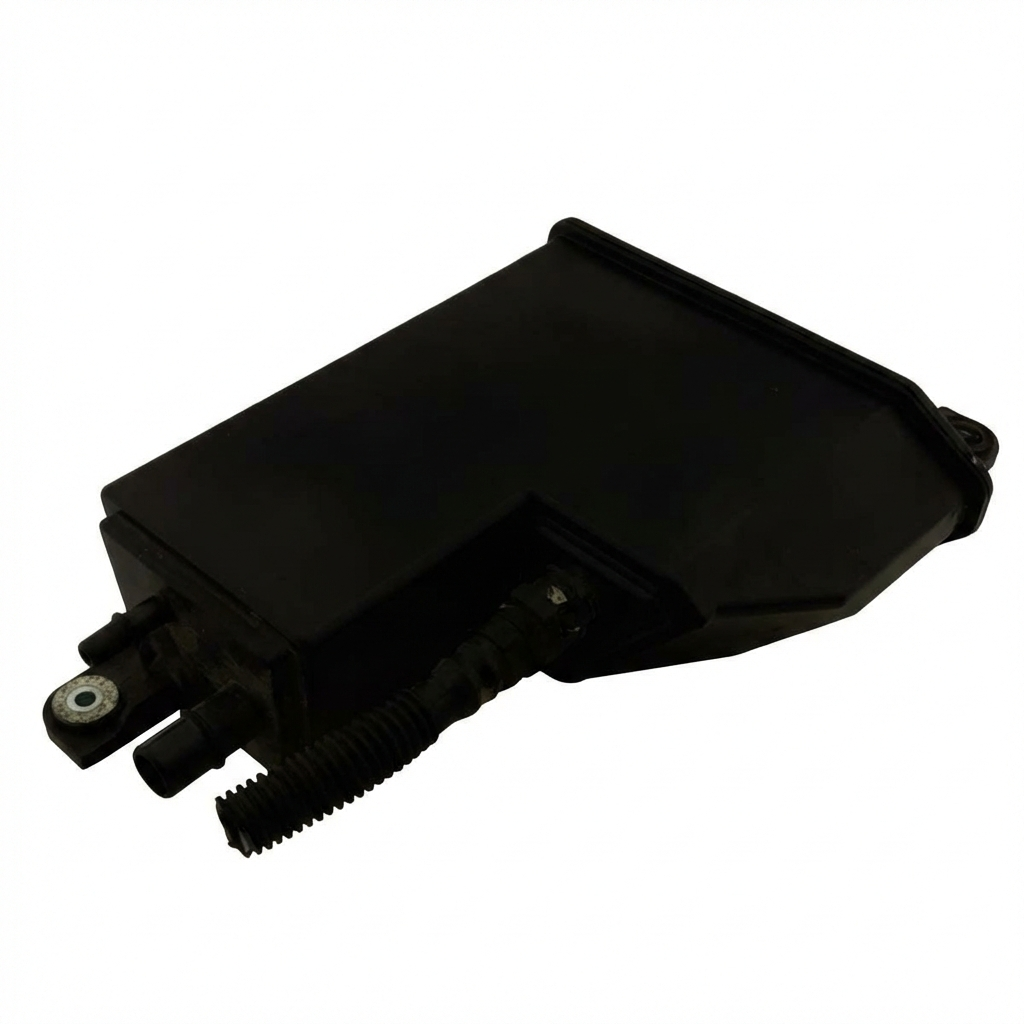
- Cracked Charcoal Canister: → Shop Vapor Canister The plastic housing of the charcoal canister can develop cracks from age or impact from road debris, creating a large leak. This is usually found during a smoke test.
- Leaking Fuel Tank or Fuel Pump Seal: → Shop Fuel Pump Rust and corrosion can perforate the top of the fuel tank, or the large O-ring for the fuel pump module can fail, causing a large leak. This is a serious issue that will almost always be accompanied by a strong fuel smell and is often found with a smoke test.
Diagnosis Steps
- Read the Code: Use an OBD-II scanner to confirm P0455 is the active code.
- Inspect the Gas Cap: This is the most common cause. Remove the cap. Check for cracks in the plastic and ensure the rubber seal is pliable and intact. Clean the filler neck sealing surface with a cloth or light abrasive pad to remove any rust or debris. Reinstall the cap, making sure it clicks several times.
- Clear the Code and Drive: After checking the cap, clear the code with the scanner and drive the vehicle for a few days to see if the code returns. The EVAP monitor needs specific conditions (like fuel level between 15-85% and a cold start) to run its test.
- Inspect the Purge Solenoid: If the code returns, locate the purge solenoid on the top of the engine. Disconnect it and try to blow through it. If air passes, it's stuck open and needs to be replaced. This is a quick, no-tools check.
- Visual Inspection: Carefully inspect all visible EVAP hoses and lines in the engine bay and under the car for obvious cracks, damage, or disconnections. Pay close attention to the rubber elbow on the purge solenoid.
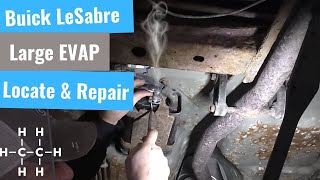
- Perform a Smoke Test: If the cause is still not found, a smoke test is the most effective next step. This involves injecting pressurized smoke into the EVAP system service port and looking for where the smoke escapes. 🎬 Watch a professional smoke test to find large EVAP leaks. This will definitively reveal leaks in hoses, the vent solenoid, the charcoal canister, or the fuel filler neck.
- Test the Vent Solenoid: During the smoke test, use a bi-directional scan tool to command the vent solenoid closed. If smoke continues to exit from the vent valve filter area (near the tank), the solenoid is faulty and not closing.
Parts You'll Likely Need
- Fuel Tank Cap
(OEM #GT261)— This is the most frequent failure point due to constant use and seal degradation. An improper or worn seal directly causes a large leak.
Trusted brands: ACDelco, Stant
OEM price range: $20-$35
Aftermarket price range: $15-$25 - Vapor Canister Purge Solenoid
(OEM #12569751)— This part often gets stuck open or closed, causing a large leak or a failed test. It's a very common failure on GM vehicles of this era and is extremely easy to access on the 3.8L engine.
Trusted brands: ACDelco, Dorman, Delphi
OEM price range: $40-$60
Aftermarket price range: $25-$45 - Vapor Canister Vent Solenoid — Located in the engine bay under the airbox on this specific platform, this valve is prone to failure. It is normally open and must close to seal the system for the EVAP test.
Trusted brands: ACDelco, Standard Motor Products, Dorman
OEM price range: $50-$90
Aftermarket price range: $30-$60
Related Codes That Often Appear With This One
- P0442 — P0442 indicates a small EVAP leak. It's common to see both codes if a leak is intermittent or on the borderline between small and large. The NHTSA TSB #21-NA-124 specifically mentions these two codes appearing together as a common diagnostic challenge.
- P0171 — If the EVAP purge solenoid is stuck open, it creates a vacuum leak that allows unmetered air into the intake manifold. This can make the engine run lean and trigger a P0171 (System Too Lean) code along with the P0455.
Technical Service Bulletins (TSBs) & Recalls
- 21-NA-124
Platform-Specific Known Issues
- GM issued Technical Service Bulletin #21-NA-124 which provides diagnostic advice for finding EVAP leaks that cause P0455 and P0442 codes. It advises a specific diagnostic order: 1. Check all line connections for proper seating. 2. Inspect lines for damage. 3. Test the vent valve. 4. Test the purge valve.
- A user on GM-Forum.com with a P0455 code found the solution to be a small, cracked molded hose elbow connected to the purge solenoid, which they repaired with a new piece of hose from an auto parts store.
- A user on the Scotty Kilmer community forum reported fixing their P0455 on a 2005 LeSabre by replacing the EVAP purge solenoid after a new OEM gas cap did not solve the issue.
- A detailed YouTube video by 'South Main Auto Repair' on a 2005 LeSabre with P0455 showed the leak being a loose hose clamp on the fuel tank, found only after a thorough smoke test.
Mechanic-Grade Diagnostic Values
- EVAP Canister Purge Solenoid Coil Resistance — expected: 30 - 38 Ohms. Failure: A reading of infinite resistance (open circuit) or zero resistance (short circuit) indicates a failed coil.
- EVAP Canister Vent Solenoid Coil Resistance — expected: 48 - 65 Ohms. Failure: A reading outside this range points to a faulty solenoid coil.
- Fuel Tank Pressure (FTP) Sensor Voltage (Key On, Engine Off, Gas Cap Off) — expected: ~1.5 Volts (Atmospheric Pressure). Failure: Voltage is stuck at 0V or 5V, or does not change when vacuum is applied. On GM systems, voltage should decrease as vacuum increases.
Scan Tool Commands That Help
- GM Tech2 or equivalent professional scanner: EVAP System Test (Service Bay Test) — This bidirectional command forces the EVAP system to run its self-test on demand. It commands the vent solenoid closed and the purge solenoid open to create a vacuum, allowing a technician to monitor the FTP sensor's response in real-time to diagnose component function without a full drive cycle.
- GM Tech2 or equivalent professional scanner: Vent Solenoid Command (On/Off) — Used during a smoke test to manually command the normally-open vent solenoid closed. If smoke continues to escape from the vent filter after the command is sent, the solenoid is confirmed to be stuck open and has failed.
Wiring & Ground Locations
- EVAP Canister & Vent Solenoid — In the front driver's side of the engine bay, located underneath the air filter housing/airbox.. This is a highly unusual location for these components, which are typically at the rear of the vehicle. Technicians unfamiliar with this specific GM H-body platform may waste significant time searching near the fuel tank.
- Powertrain Control Module (PCM) — Located inside the air cleaner (airbox) housing in the engine compartment.. The PCM controls all EVAP components. Its proximity to the canister and vent solenoid on this platform means wiring harnesses are short but also subject to disturbance during air filter changes.
- G105 — A splice pack ground located under the ignition control module on the engine.. This ground provides the ground path for the PCM. A poor connection here can cause erratic behavior of the entire engine management system, including the EVAP tests.
- G201 — Behind the passenger side kick panel.. This is the ground point for the Data Link Connector (DLC). A poor connection here could interfere with scanner communication during diagnosis.
Real Owner Repair Stories
- BuickForums.com user post (2001 Buick LeSabre, 77k miles) — Check Engine Light with codes P0440 and P0442, and an intermittent "gas cap loose - check cap" message.
❌ Tried (didn't work) Replacing the gas cap with a new genuine GM part.
✅ What actually fixed it The owner used a vacuum pump to find a leak at the metal flange on the fuel filler tube, which had become loose from the plastic neck. This confirmed the filler neck itself was the source of the leak, not the cap seal. - YouTube channel 'Weakest of Weeks' (2006 Buick LaCrosse 3.8L V6 (similar platform/engine)) — Check Engine Light with code P0455.
❌ Tried (didn't work) Visual inspection of the gas cap and filler neck.
✅ What actually fixed it Replaced the EVAP canister vent solenoid located near the fuel tank. The video outlines the common GM diagnostic order for P0455 as 1) Gas Cap, 2) Vent Solenoid, 3) Purge Solenoid.
"I Checked Everything" — The Actual Cause
- A P0455 code can be triggered even if the system passes a smoke test with no leaks found. This occurs when the EVAP purge solenoid is mechanically stuck in the closed position. During the diagnostic self-test, the ECM commands this valve to open to allow engine vacuum to draw down the fuel tank pressure. If the valve fails to open, no vacuum is created. The Fuel Tank Pressure (FTP) sensor reports no pressure change, which the ECM interprets as a massive leak equivalent to a missing gas cap, setting code P0455. Since the system is actually sealed, a smoke test will show no leaks, leading to a difficult diagnosis if this functional failure is not considered.
When the Usual Fixes Don't Work
- While the vast majority of P0455 codes are caused by a physical leak (gas cap, hose, etc.), a notable counter-narrative exists for when a smoke test finds no leaks. The cause in this scenario is often a mechanically failed component that tricks the ECM's diagnostic logic. The most common example is a purge solenoid that is electrically fine but mechanically stuck closed. The ECM's inability to draw a vacuum during its test is misinterpreted as a large leak, setting the P0455 code. In these cases, diagnosis must shift from finding a physical leak to testing the function of the individual solenoids with a scan tool's bidirectional controls.
OEM Part Supersession History
ACDelco 214-2246→ACDelco 214-641— Part consolidation and design update for the Vapor Canister Purge Valve.ACDelco 214-1363→ACDelco 214-2082— Part consolidation and design update for the Vapor Canister Vent Solenoid.
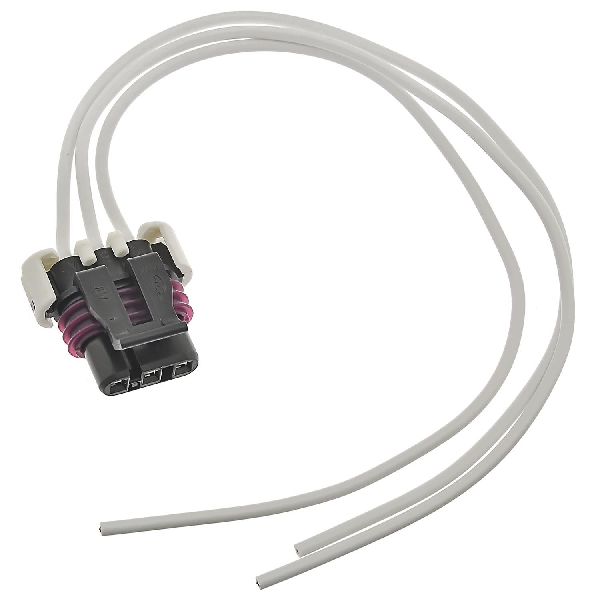
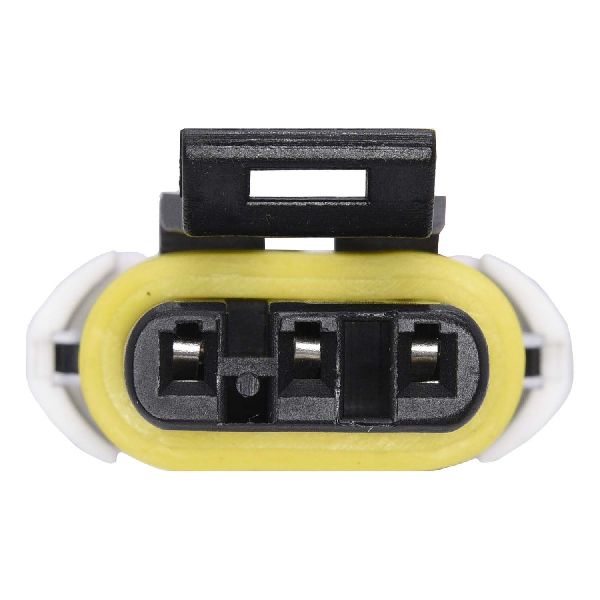
Heads up: Updated vent solenoid kits for GM vehicles sometimes have a different physical design or electrical connector than the original part. These kits often include a pigtail adapter harness to ensure compatibility.
Model Year Variations Within This Range
- 2000-2005: Unlike most vehicles where the EVAP canister and vent solenoid are located near the rear fuel tank, on the Buick LeSabre and its GM H-Body platform mates (e.g., Buick Park Avenue, Pontiac Bonneville), these components are located in the front driver's side of the engine bay, underneath the air filter housing. This significantly changes the diagnostic and repair procedure.
Helpful Videos
Used OEM Parts in Stock
New Aftermarket Parts Available


The information in this article is provided for general reference and educational purposes only. Vehicle specifications, procedures, and part compatibility can vary by production date, trim level, and region. Always consult your vehicle's factory service manual and verify part numbers before purchasing or performing repairs. Safety-critical components such as airbags, seat belts, and braking systems should be installed by a qualified professional.
- Buick LESABRE:
- 🧭 Diagnostic Flowchart
- 🎬 Helpful Videos
- 🛍️ Shop This Part
- What's Unique About the 2000-2005 Buick LESABRE
- Symptoms You May Notice
- Most Likely Causes
- Rare But Worth Checking
- Diagnosis Steps
- Parts You'll Likely Need
- Related Codes That Often Appear With This One
- Technical Service Bulletins (TSBs) & Recalls
- Platform-Specific Known Issues
- Mechanic-Grade Diagnostic Values
- Scan Tool Commands That Help
- Wiring & Ground Locations
- Real Owner Repair Stories
- "I Checked Everything" — The Actual Cause
- When the Usual Fixes Don't Work
- OEM Part Supersession History
- Model Year Variations Within This Range
- 🎟️ Get 5% Off