

P0455 on 2020-2023 Cadillac CT5: EVAP Large Leak Causes and Fixes
For a 2020-2023 Cadillac CT5, code P0455 indicates a large leak in the EVAP emissions system. Before replacing parts, inspect the capless fuel filler neck for debris preventing a seal. The most common faulty parts are the EVAP purge valve in the engine bay (approx. $20-$35) or the vent valve near the fuel tank, which is often integrated into the vapor canister assembly.
- P0455 signifies a large leak in the EVAP system, which is an emissions control issue but does not affect vehicle safety or performance.
- Always start by inspecting the capless fuel filler neck for debris or damage; this is the simplest and a very common cause.
- The most likely failed components are the EVAP purge valve (in the engine bay) or the vent valve (near the fuel tank).
- A smoke test is the most reliable method to find a leak if visual inspection of hoses and valves does not reveal the cause.
- Follow the diagnostic order from GM's TSB #21-NA-124: check lines/connections, then the vent valve, then the purge valve.
What's Unique About the 2020-2023 Cadillac CT5
The 2020-2023 Cadillac CT5 uses a capless fuel filler system, so unlike many vehicles, a 'loose gas cap' is not a possible cause. Instead, debris or damage to the fuel filler neck's sealing flap can cause the P0455 code. General Motors has issued a Technical Service Bulletin (TSB 21-NA-124) that provides a clear diagnostic order for this code, starting with checking hose connections before suspecting faulty valves, which is crucial for efficient diagnosis on this platform. Additionally, GM has a special warranty extension for the purge valve on 2020 models with the 2.0L engine.
Diagnostic Flowchart
Tap your situation to follow the diagnostic path that matches what you're seeing on this vehicle.
Symptoms You May Notice
- Check Engine Light is on.
- A faint smell of fuel, possibly near the rear of the car.
- Remote start feature may be disabled by the system when a check engine light is active.
- Replacing the fuel tank pressure sensor. While this sensor reports the pressure, it is rarely the cause of the leak itself.
- Immediately replacing the purge valve without testing. A stuck-closed purge valve can also cause a P0455, as the system fails to draw a vacuum during testing, which the ECM interprets as a massive leak.
Most Likely Causes
- Debris in Capless Fuel Filler Neck 🔴 High Probability → Shop Fuel Filler Neck The capless design can allow dirt, dust, or debris to get caught in the sealing flap, preventing the system from sealing correctly after refueling.
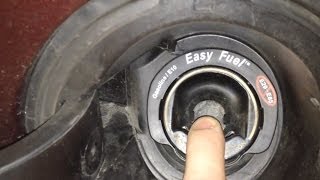
How to confirm: Visually inspect the fuel filler opening for any dirt, debris, or damage to the internal flap that would prevent a proper seal. The flap should move freely and create a tight seal when closed.
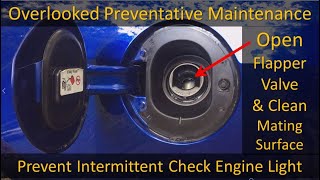
Typical fix: Clean the fuel filler neck area thoroughly with a clean rag. 🎬 Watch: How to clean and seal your capless filler neck If the sealing flap is damaged or the spring is weak, the filler neck assembly will need to be replaced.
Est. part cost: $0-$150 - Faulty EVAP Purge Valve Solenoid 🟡 Medium Probability → Shop Vapor Canister This is a common failure item on many modern GM vehicles. It can get stuck open, creating a permanent vacuum leak within the EVAP system. It can also fail by being stuck closed, which the ECM may interpret as a large leak because it cannot pull a vacuum during its test cycle. A special warranty extension exists for this part on 2020 2.0L models.
How to confirm: With the engine off, remove the purge valve (located in the engine bay) and try to blow through it. If air passes through, it is stuck open and faulty. A bi-directional scan tool can also command it closed to test function and listen for a click.
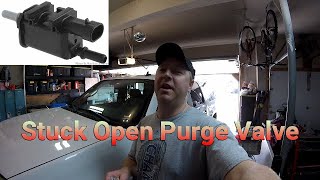
Typical fix: Replace the purge valve solenoid. This is typically an easy repair involving disconnecting one electrical connector and two hoses. 🎬 See this walkthrough on replacing a GM purge valve
Est. part cost: $20-$35 - Faulty EVAP Vent Valve Solenoid 🟡 Medium Probability → Shop Vapor Canister
How to confirm: The vent valve is normally open and closes when the ECM tests the system. It can get stuck open from road debris or age. A scan tool is required to command the valve closed. If it doesn't seal when commanded, it's faulty. A smoke test will show smoke exiting a faulty, stuck-open vent valve, which is often located near the charcoal canister.
Typical fix: Replace the vent valve solenoid. On the CT5, this valve is often integrated with the charcoal canister, requiring the replacement of the entire canister assembly.
Est. part cost: $25-$50 (if separate), $170-$260 (if part of canister assembly) - Cracked or Disconnected EVAP Hose ⚪ Low Probability
How to confirm: Visually inspect all accessible EVAP lines in the engine bay and under the car near the fuel tank. A definitive way to find a leak is with a smoke test, which forces smoke through the system to reveal the exit point. TSB 21-NA-124 specifically calls out checking for unseated or damaged tube connections as the first step.
Typical fix: Replace the cracked section of hose or securely reconnect a loose line. One owner of a related GM vehicle found a cracked molded hose elbow coming from the purge solenoid.
Est. part cost: $5-$30
Rare But Worth Checking
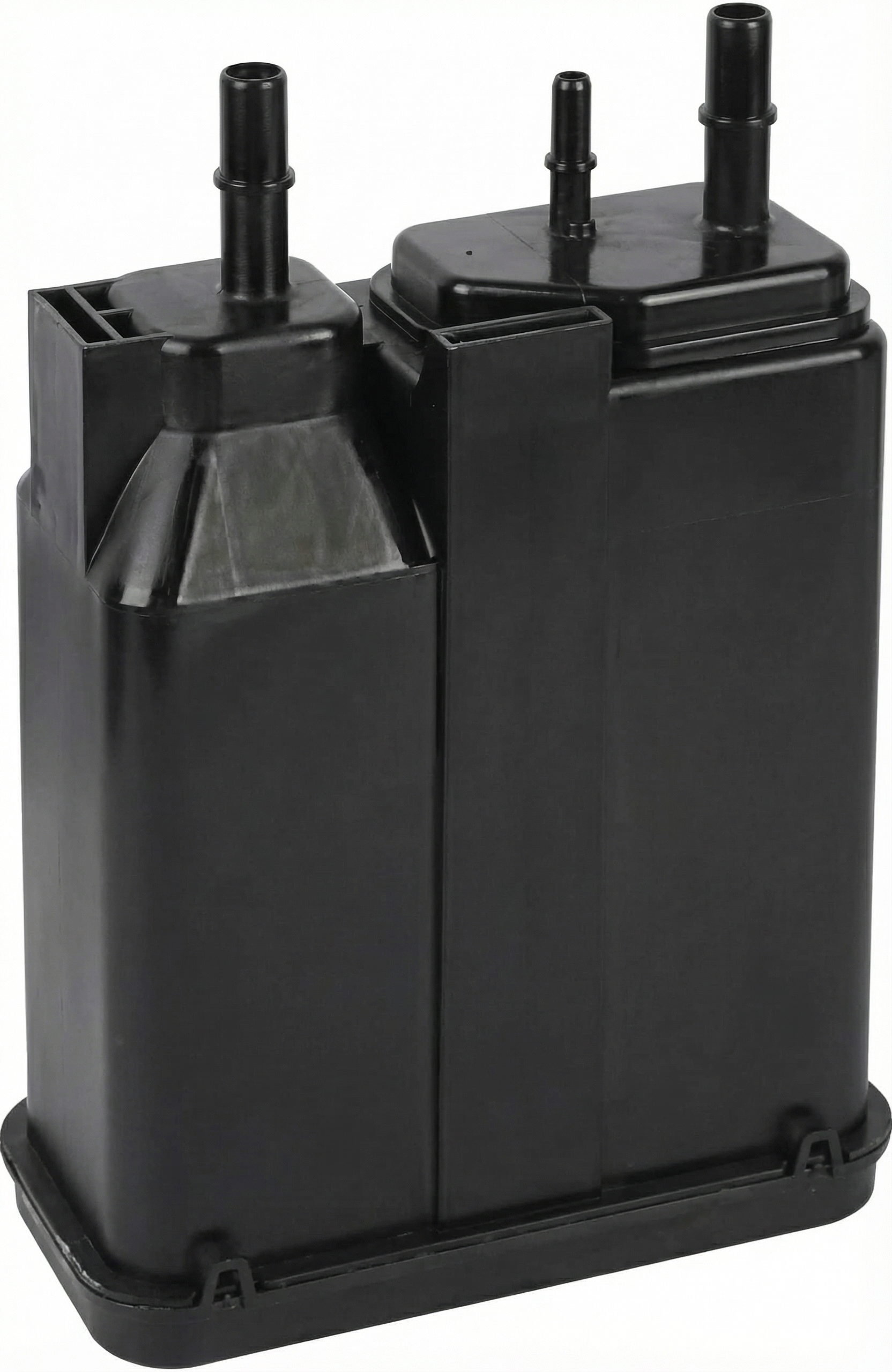
- Cracked EVAP Charcoal Canister: → Shop Vapor Canister While not as common as valve failures, the canister itself can be damaged by road debris or develop internal cracks, causing a large leak. The vent valve is often integrated into this part on the CT5, making it a more common replacement item.
- Engine Wire Harness Chafing: GM TSB 21-NA-149 addresses a potential issue on some GM vehicles where the engine wiring harness can chafe against engine or chassis components. While this TSB lists many potential DTCs, a short in the EVAP valve wiring could theoretically cause this code.
Diagnosis Steps
- Check the Check Engine Light: Confirm P0455 is the active code using an OBD-II scanner.
- Inspect Fuel Filler Neck: Carefully inspect the capless fuel filler opening for any debris, dirt, or damage that could prevent the flap from sealing. Clean it if necessary.
- Visually Inspect Hoses: Following the guidance from TSB 21-NA-124, perform a thorough visual inspection of all EVAP lines and connections in the engine bay and under the vehicle to ensure they are properly seated and not cracked or damaged. Pay close attention to the molded hoses near the purge valve.
- Test the Purge Valve: Locate the purge valve in the engine bay. Disconnect it and attempt to blow through it. It is a normally-closed valve, so if air passes through, it has failed and needs replacement.
- Test the Vent Valve: This requires a bi-directional scan tool to command the normally-open valve to close. If it fails to seal, it is faulty. This step may require professional assistance. The vent valve is often part of the vapor canister assembly on this vehicle.
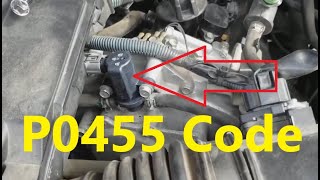
- Perform a Smoke Test: If the leak is not obvious, the most effective diagnostic step is to inject smoke into the EVAP system. The smoke will escape from the point of the leak, making it easy to identify a cracked hose, 🎬 Watch: A guide to common P0455 causes and fixes faulty canister, or bad seal.
Parts You'll Likely Need
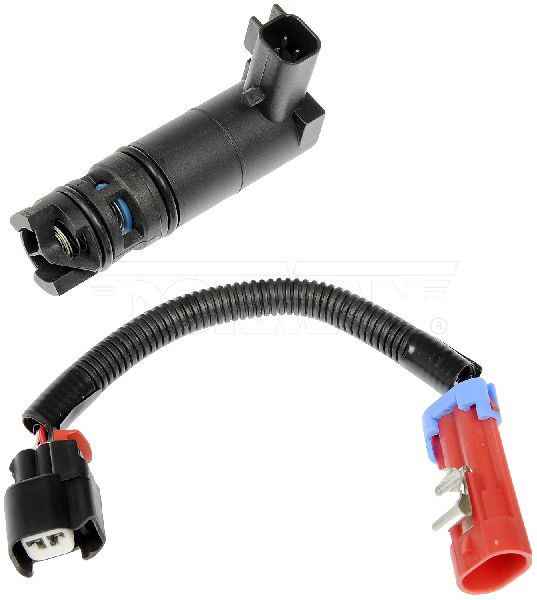
- Vapor Canister Purge Solenoid Valve
(OEM #12666845)— This is a very common failure point on modern GM vehicles that causes a large EVAP leak when it sticks open or closed. Part number 12666845 is listed for the CT4 (a platform mate) and other GM 2.0L and 2.7L engines.
Trusted brands: ACDelco, GM Genuine
OEM price range: $20-$35
Aftermarket price range: $15-$30 - Fuel Vapor Canister
(OEM #84524033)— The canister, which stores fuel vapors, can crack or the integrated vent valve can fail, leading to a P0455 code. This part number is cited as fitting both the CT4 and CT5 across all engine options from 2020-2025.
Trusted brands: ACDelco, GM Genuine
OEM price range: $170-$260
Aftermarket price range: $100-$180
Related Codes That Often Appear With This One
- P0442 — P0442 indicates a small EVAP leak. The same faulty component can sometimes be interpreted by the ECM as a small or large leak at different times. The official GM TSB 21-NA-124 groups these two codes together for diagnosis.
- P0496 — This code indicates incorrect purge flow, often pointing directly to a faulty EVAP purge valve that is stuck open. It's very common to see P0496 alongside P0455 when the purge valve is the root cause.
Technical Service Bulletins (TSBs) & Recalls
- 21-NA-124: Provides diagnostic tips for DTCs P0442 and/or P0455. It recommends a specific order of operations: 1. Investigate all EVAP lines for proper installation and damage. 2. Investigate potential vent valve malfunction (stuck open). 3. Investigate potential purge valve malfunction.
Mechanic-Grade Diagnostic Values
- Fuel Tank Pressure (FTP) Sensor Voltage — expected: ~1.5 Volts with key on, engine off, and fuel cap removed (system at atmospheric pressure).. Failure: A reading significantly different from 1.5V at rest indicates a skewed sensor that could falsely trigger a P0455 code.
- EVAP Purge or Vent Solenoid Coil Resistance — expected: 15 - 30 Ohms. Failure: A reading far outside this range, especially an open circuit (infinite resistance), indicates a failed solenoid coil.
Scan Tool Commands That Help
- GDS2 / Professional Bi-Directional Scanner: EVAP Service Bay Test (or 'EVAP Purge and Seal') — This is a powerful function to verify a leak without a smoke machine. It commands the vent valve closed and the purge valve open to pull a vacuum, then seals the system. By monitoring the Fuel Tank Pressure (FTP) sensor data, a technician can see if the system holds the vacuum. A rapid loss of vacuum confirms a leak. Note: Test will only run if fuel level is between 15-85% and ECT is below 158°F (70°C).
Wiring & Ground Locations
- G101 — Typically located at the front of the engine, lower block on GM vehicles.. This is a primary ground point for the Engine Control Module (ECM). A poor connection at G101 could cause erratic behavior from the ECM, including incorrect readings from the EVAP system sensors or improper operation of the purge and vent valve control circuits, potentially leading to a false P0455 code.
Real Owner Repair Stories
- Reddit user in r/Cadillac (2020 Cadillac CT5) — Owner received a letter from GM, not necessarily a Check Engine Light.
✅ What actually fixed it This is a pre-emptive notice from GM. The letter states that 'some 2020 Cadillac CT5 vehicles may have a condition that could cause the evaporative emissions purge pump to fail' and extends the warranty for this specific part to 15 years or 150,000 miles. It also warns that overfilling the fuel tank by more than three clicks may contribute to the failure. - Chevrolet Forum user (2004 Chevrolet Trailblazer (similar GM EVAP system logic)) — Persistent P0455 code.
❌ Tried (didn't work) A professional smoke test was performed and found no leaks., Replaced the gas cap., Replaced the EVAP vent valve., Replaced the EVAP purge valve.
✅ What actually fixed it The code returned after replacing all common components. The final unresolved suspicion was a faulty Fuel Tank Pressure Sensor (FTPS) giving the ECM incorrect readings, thus tricking the computer into thinking there was a large leak when none existed physically.
"I Checked Everything" — The Actual Cause
- In cases where a comprehensive smoke test reveals no leaks, but the P0455 code persists, the cause is often not a physical leak but an electrical fault. The most likely culprit is a faulty Fuel Tank Pressure (FTP) sensor. The sensor may be sending incorrect voltage signals to the ECM, making it believe a large leak is present when the system is perfectly sealed. A technician can verify this by observing the sensor's voltage at atmospheric pressure (e.g., with the fuel filler open), which should be around 1.5V on a GM vehicle.
Model Year Variations Within This Range
- 2020: For 2020 Cadillac CT5 models equipped with the 2.0L LSY engine, GM has issued a special warranty extension for the 'evaporative emissions purge pump' (also known as the purge valve, PN 12666845). The warranty is extended to 15 years or 150,000 miles. This was due to a known condition causing a higher-than-normal failure rate for this part on this specific model year and engine.
Helpful Videos
Used OEM Parts in Stock
New Aftermarket Parts Available


The information in this article is provided for general reference and educational purposes only. Vehicle specifications, procedures, and part compatibility can vary by production date, trim level, and region. Always consult your vehicle's factory service manual and verify part numbers before purchasing or performing repairs. Safety-critical components such as airbags, seat belts, and braking systems should be installed by a qualified professional.
- Cadillac CT5:
- 🧭 Diagnostic Flowchart
- 🎬 Helpful Videos
- 🛍️ Shop This Part
- What's Unique About the 2020-2023 Cadillac CT5
- Symptoms You May Notice
- Most Likely Causes
- Rare But Worth Checking
- Diagnosis Steps
- Parts You'll Likely Need
- Related Codes That Often Appear With This One
- Technical Service Bulletins (TSBs) & Recalls
- Mechanic-Grade Diagnostic Values
- Scan Tool Commands That Help
- Wiring & Ground Locations
- Real Owner Repair Stories
- "I Checked Everything" — The Actual Cause
- Model Year Variations Within This Range
- 🎟️ Get 5% Off