

P0455 on 2011-2018 GMC Savana 2500: EVAP Gross Leak Causes & Fixes
For a 2011-2018 GMC Savana, P0455 almost always points to a loose, faulty, or improperly installed gas cap. Check that it's tight and the tether isn't caught underneath. If the cap is good, the next most likely causes are a failed EVAP vent solenoid near the spare tire or a purge solenoid on the engine. A rusted fuel filler neck is also a common culprit in salt-belt regions.
- Always check the gas cap first for a P0455 code. Ensure it's tight, clicks several times, and the tether isn't caught under the seal. This is the most common fix.
- If the gas cap isn't the issue, the two most likely culprits are the EVAP vent solenoid (under the van by the spare tire) and the purge solenoid (on top of the engine).
- Driving with P0455 is not dangerous to the engine, but it will cause an automatic failure on an emissions test.
- If you live in an area with road salt, pay close attention to the fuel filler neck for rust, as this can prevent the gas cap from sealing.
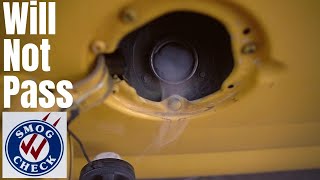
- If the leak isn't obvious, a smoke test is the most reliable and fastest way to find the exact source before buying parts.
What's Unique About the 2011-2018 Gmc SAVANA 2500
On this generation of GMC Savana and its Chevrolet Express twin, the P0455 code is frequently caused by simple, specific issues. A General Motors bulletin (PI0873) noted that the gas cap's tether can get caught under the cap's seal, preventing it from seating correctly and triggering the code. Additionally, the EVAP vent solenoid's location under the van near the spare tire makes it highly susceptible to failure from road debris, moisture, and rust, a very common failure point for these work vans. The fuel filler neck is also a known weak point for rust in northern climates, which compromises the gas cap seal.
Diagnostic Flowchart
Tap your situation to follow the diagnostic path that matches what you're seeing on this vehicle.
Generation note: The 2011-2018 year range falls within the long-running third generation of the GMC Savana (which began in 1996). While there have been powertrain and feature updates, the basic chassis and EVAP system architecture are consistent, making the causes and fixes for P0455 very similar across these model years and its platform mate, the Chevrolet Express.
Symptoms You May Notice
- Check Engine Light is on.
- A noticeable fuel smell, particularly around the rear of the van.
- Slight decrease in fuel economy.
- Difficulty starting the engine, especially after refueling (symptom of a stuck-open purge valve).
- Vehicle may fail an emissions test.
- Replacing the expensive charcoal canister when the actual fault is a much cheaper and more common failure of the vent or purge solenoid.
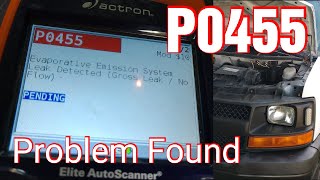
- Replacing other EVAP components before verifying the gas cap is tight and its seal is in good condition. 🎬 See a mechanic explain common P0455 causes on GM trucks.
- Assuming a P0455 code always means there is a physical leak, when it can also be caused by a stuck-closed purge valve or a faulty fuel tank pressure sensor that prevents the test from running correctly.
Most Likely Causes
- Loose, Damaged, or Incorrect Gas Cap 🔴 High Probability → Shop Fuel Tank Cap A GM service bulletin (PI0873) specifically notes the cap's tether can get caught under the seal, preventing it from seating properly. This is the most common and easiest fix. Age and wear can also cause the cap's rubber seal to crack and fail.
How to confirm: Ensure the cap is tightened until it clicks multiple times. Inspect the rubber seal on the cap for cracks or wear. Check that the tether is not interfering with the seal. An OEM-spec cap is recommended for a reliable seal.
Typical fix: Tighten or replace the gas cap.
Est. part cost: $15-$40 - Faulty EVAP Vent Valve/Solenoid 🟡 Medium Probability → Shop Vapor Canister Located under the vehicle near the spare tire, this valve is exposed to road debris, water, and salt, which causes it to corrode and get stuck open, preventing the system from sealing for its self-test. This is a very common failure on these vans.
How to confirm: A capable scan tool can command the valve closed to test it. Alternatively, it can be removed and tested by applying 12V power to see if the valve actuates (it should click). A smoke test will show smoke exiting the valve if it's stuck open. The valve is normally open when the vehicle is off.
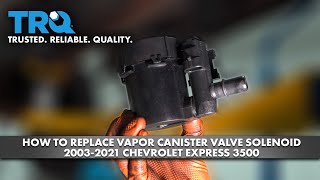
Typical fix: Replace the EVAP vent solenoid assembly. 🎬 Watch: How to replace the vent solenoid on your van.
Est. part cost: $30-$100 - Faulty EVAP Purge Valve/Solenoid 🟡 Medium Probability → Shop Vapor Canister This valve, located on top of the engine, can fail by sticking open, creating a constant vacuum leak from the EVAP system into the engine. This is a common failure on many GM vehicles and can also cause hard starting after refueling.
How to confirm: With the engine off, disconnect the hose from the purge valve that leads to the engine. If you can blow through the valve, it is stuck open and faulty. A stuck-open purge valve often causes code P0496 as well.
Typical fix: Replace the purge solenoid.
Est. part cost: $25-$75 - Rusted or Damaged Fuel Filler Neck ⚪ Low Probability → Shop Fuel Filler Neck In regions with road salt usage (the "rust belt"), the metal filler neck where the gas cap seals can rust and develop pits or holes, preventing a proper seal even with a new cap. Owners on forums frequently report this issue after other parts have been replaced.
How to confirm: Visually inspect the rim of the filler neck for rust, pitting, or damage. A smoke test is the definitive way to confirm a leak in this area.
Typical fix: Replace the fuel filler neck.
Est. part cost: $70-$200
Rare But Worth Checking
- Cracked EVAP Charcoal Canister: → Shop Vapor Canister The canister itself is durable, but can be cracked by road debris or a physical impact, creating a large leak. In some cases, the canister can break down internally, sending charcoal beads into the EVAP lines and causing other components like the purge valve to fail repeatedly. Inspect it for visible damage if other common causes are ruled out.
- Leaking EVAP Hoses: Over time, rubber hoses can become brittle, crack, or a connection can come loose. GM TSB #21-NA-124 specifically advises checking all EVAP line connections for proper seating before replacing parts. A thorough visual inspection or a smoke test is needed to find such a leak.
- Faulty Fuel Tank Pressure (FTP) Sensor: → Shop Fuel Tank Rarely, the sensor itself can fail and send incorrect data to the computer, making it believe there is a large leak when the system is actually sealed. One owner documented a case where the FTP sensor failed to register a pressure change during the EVAP test, triggering P0455 even though a smoke test showed no leaks. 🎬 Watch: What to check if the gas cap isn't the problem.
Diagnosis Steps
- Read the code with an OBD-II scanner and note any other codes present.
- Inspect the gas cap. Ensure it is tight (clicked several times) and that the tether is not caught under the seal. Check the cap's rubber O-ring for cracks or damage. Clear the code and drive to see if it returns. Consider replacing it with a quality OEM part as a cheap first step.
- If the code returns, perform a visual inspection of the fuel filler neck for any signs of rust or corrosion that could prevent a good seal.
- Visually inspect all accessible EVAP hoses and lines for obvious cracks, disconnections, or damage, particularly around the purge solenoid in the engine bay and the vent solenoid/canister area under the van.
- Locate the purge solenoid on top of the engine intake manifold (often has a green service cap). With the engine off, remove it and try to blow through it. If air passes through, it is stuck open and must be replaced.
- Locate the vent solenoid near the spare tire. Inspect it and its wiring for damage or corrosion. Testing requires a scan tool to command it closed or applying 12V power to check for actuation (listening for a click).
- If the cause of the leak is not apparent, the most effective diagnostic method is to have a professional perform a smoke test. This involves filling the EVAP system with a harmless, visible smoke and looking for where it escapes, pinpointing the exact location of the leak.
Parts You'll Likely Need
- Fuel Cap
(OEM #GT330)— This is the most common cause of P0455 due to a worn seal, improper tightening, or the tether getting caught. It is the cheapest and easiest part to replace first.
Trusted brands: ACDelco, Stant, Gates
OEM price range: $25-$40
Aftermarket price range: $15-$25 - EVAP Vent Valve Solenoid
(OEM #214-2149 (Supersedes 25932571))— This valve frequently fails on GM vans because its location under the vehicle exposes it to road debris and moisture, causing it to stick open. It is a normally-open valve that must close to seal the system for testing.
Trusted brands: ACDelco, Dorman (911-064), Delphi, Standard Motor Products
OEM price range: $60-$100
Aftermarket price range: $30-$70 - Vapor Canister Purge Valve Solenoid
(OEM #12690587)— Located on the engine, this valve can get stuck open, causing a large leak and sometimes difficulty starting after refueling. It's a common failure item on many GM vehicles.
Trusted brands: ACDelco, Bosch, Dorman
OEM price range: $40-$75
Aftermarket price range: $25-$50
Related Codes That Often Appear With This One
- P0442 — This code for a 'Small EVAP Leak' can sometimes accompany P0455, as noted in GM Technical Service Bulletin #21-NA-124, suggesting an intermittent or borderline leak.
- P0449 — This code indicates a fault in the EVAP vent solenoid control circuit. Seeing it with P0455 makes the vent solenoid the primary suspect, pointing to either an electrical or mechanical failure of the valve.
- P0496 — This code for 'EVAP Flow During a Non-Purge Condition' almost always means the purge solenoid on the engine is stuck open. If you have this code with P0455, the purge solenoid is the most likely cause.
Technical Service Bulletins (TSBs) & Recalls
- 21-NA-124: Diagnostic Tip for Malfunction Indicator Lamp (MIL) Illuminated - DTC P0442 and/or P0455 Set. This bulletin advises technicians to first inspect all EVAP line connections for proper seating and damage before suspecting component failure.
- PI0873: Preliminary information on a P0455 caused by the fuel filler cap tether being trapped between the cap and the filler neck, preventing a proper seal.
Platform-Specific Known Issues
- A known issue, referenced in GM Preliminary Information Bulletin PI0873, is the gas cap tether getting caught under the cap's seal, preventing it from seating correctly. This is a primary first check for any P0455 code on these vans.
- The under-chassis location of the EVAP Vent Solenoid makes it extremely vulnerable to corrosion and dirt ingress, leading to a high failure rate where it gets stuck in the open position.
- Fuel filler neck rust is a significant problem in the Rust Belt, often causing a P0455 that cannot be fixed with a new gas cap alone. A visual and tactile inspection of the neck's sealing surface is crucial.
Mechanic-Grade Diagnostic Values
- Fuel Tank Pressure (FTP) Sensor Voltage — expected: Approximately 1.5V with the gas cap off (at atmospheric pressure). The voltage should increase toward 4.9V as vacuum is applied.. Failure: A voltage that is stuck (e.g., near 0V or 5V) or does not change when the system is sealed and tested with a scan tool.
- EVAP System Test Preconditions — expected: Fuel level between 15-85%, Engine Coolant Temperature (ECT) below 158°F (70°C), and Intake Air Temperature (IAT) between 39-167°F (4-75°C).. Failure: The scan tool's automated 'EVAP Service Bay Test' will be denied and will not run if these conditions are not met.
- EVAP Vent Solenoid Connector Voltage — expected: 12V (Battery Voltage) on the power wire (often Red/White) with Key On, Engine Off.. Failure: No voltage indicates a blown fuse (e.g., CNSTR VENT SOL fuse 56, 10A) or an open wire.
Scan Tool Commands That Help
- GDS2 / Tech 2 or equivalent professional scan tool: EVAP Service Bay Test (or Purge/Seal function) — This is a guided test that commands the vent solenoid closed and the purge solenoid open to create a vacuum in the tank. It allows a technician to manually run the system's self-test to verify the function of the solenoids and check if the system can hold a vacuum, confirming a leak or a fix without waiting for a full drive cycle.
- GDS2 / Tech 2 or equivalent professional scan tool: EVAP Purge Solenoid Control — This command allows you to incrementally open the purge solenoid (e.g., from 0% to 50%) while monitoring the FTP sensor voltage. If the voltage doesn't change as the purge is commanded, it indicates the valve is stuck closed or there's a blockage.
- GDS2 / Tech 2 or equivalent professional scan tool: EVAP Vent Solenoid Control — This command allows you to manually close the normally-open vent solenoid. It's used during a smoke test to seal the system; if smoke still escapes from the vent valve when it's commanded closed, the valve is faulty.
Wiring & Ground Locations
- G400 — On the inner left rear frame rail.. This is a major chassis ground point near the fuel tank and EVAP canister. Corrosion or a loose connection here can affect the electrical circuits for the vent solenoid and fuel tank pressure sensor.
- CNSTR VENT SOL Fuse 56 (10A) — In the underhood fuse block.. This fuse provides power to the EVAP canister vent solenoid. If this fuse is blown, the solenoid cannot be commanded closed, which will prevent the EVAP test from running correctly and may set a P0449 in addition to P0455.
- Vent Solenoid Connector — At the EVAP vent solenoid, near the charcoal canister and spare tire.. This 2-pin connector is highly exposed to road spray and corrosion. A corroded connector or broken wire at the pigtail is a common failure point that can mimic a failed solenoid, often causing a P0449 circuit code.
Real Owner Repair Stories
- YouTube channel 'Homie Hektor' (2007 Chevrolet Express Van (similar system)) — P0455 code present, EVAP monitor would not complete for emissions testing.
❌ Tried (didn't work) A smoke test was performed and showed no leaks in the system., The EVAP vent valve was commanded closed with a scan tool and confirmed to be sealing properly.
✅ What actually fixed it The EVAP purge valve was stuck closed. During a bidirectional test, commanding the purge valve open resulted in no change in fuel tank pressure. A test light confirmed the ECM was sending the control signal, proving the valve itself was bad. Replacing the purge valve resolved the issue.
"I Checked Everything" — The Actual Cause
- In one documented case on a Chevrolet Express, the vehicle had a P0455 code but passed a smoke test, indicating no physical leaks. The technician then used a scan tool to run the 'EVAP Service Bay Test'. While commanding the purge valve to open, they observed no change in the Fuel Tank Pressure sensor reading. A test light confirmed the computer was sending the signal to the purge valve, but the valve was not opening. The root cause was a faulty, stuck-closed purge valve, which prevented the system from drawing a vacuum to even begin the test. Replacing the purge valve fixed the P0455 code.
OEM Part Supersession History
25932571→214-2149 (ACDelco)— Standard part evolution and consolidation by the manufacturer.
Helpful Videos
Used OEM Parts in Stock
New Aftermarket Parts Available


The information in this article is provided for general reference and educational purposes only. Vehicle specifications, procedures, and part compatibility can vary by production date, trim level, and region. Always consult your vehicle's factory service manual and verify part numbers before purchasing or performing repairs. Safety-critical components such as airbags, seat belts, and braking systems should be installed by a qualified professional.
- Gmc SAVANA 2500:
- 🧭 Diagnostic Flowchart
- 🎬 Helpful Videos
- 🛍️ Shop This Part
- What's Unique About the 2011-2018 Gmc SAVANA 2500
- Symptoms You May Notice
- Most Likely Causes
- Rare But Worth Checking
- Diagnosis Steps
- Parts You'll Likely Need
- Related Codes That Often Appear With This One
- Technical Service Bulletins (TSBs) & Recalls
- Platform-Specific Known Issues
- Mechanic-Grade Diagnostic Values
- Scan Tool Commands That Help
- Wiring & Ground Locations
- Real Owner Repair Stories
- "I Checked Everything" — The Actual Cause
- OEM Part Supersession History
- 🎟️ Get 5% Off