

P0455 on 2006-2011 Honda Civic: EVAP Large Leak Causes and Fixes
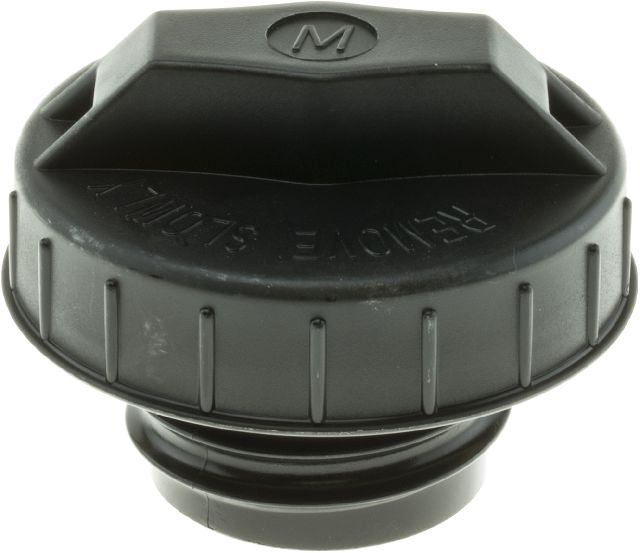
For a 2006-2011 Honda Civic, code P0455 most often means you have a loose or faulty gas cap. Before anything else, tighten your gas cap until it clicks multiple times. If that doesn't work, a new OEM gas cap (Part No. 17670-SNA-A02 or its successor 17670-T3W-A01) is the next most likely fix and is relatively inexpensive. Aftermarket caps are a frequent cause of repeat failures.
- P0455 on your 2006-2011 Civic is a large leak in the fuel vapor system.
- Start with the simplest and most common fix: inspect, tighten, and if necessary, replace the gas cap with a genuine Honda part.
- If a new OEM gas cap doesn't solve it, the EVAP purge valve is the next most likely culprit and is a straightforward DIY replacement.
- Do not use cheap aftermarket gas caps, as they are a known cause of this code.
- A smoke test is the best way to find less common leaks in hoses or the charcoal canister.
What's Unique About the 2006-2011 Honda Civic
The 8th generation Honda Civic is generally reliable, but like many vehicles, its EVAP system components can wear over time. For this specific platform, the two most frequent culprits for a P0455 code are remarkably simple: the gas cap and the canister purge valve. Owner and mechanic experiences overwhelmingly show that using a genuine OEM Honda gas cap is critical, as many aftermarket caps fail to provide the precise seal required, leading to recurring codes. The purge valve is also a known failure point at higher mileage, but it is conveniently located on the intake manifold in the engine bay for straightforward replacement.
Symptoms You May Notice
- Check Engine Light is on
- A faint smell of raw fuel, especially around the gas cap area or rear of the vehicle
- A "CHECK FUEL CAP" message may appear on the information display (if equipped)
- Difficulty refueling (gas pump nozzle clicks off before the tank is full), which can point to a stuck vent solenoid
- Replacing the purge valve or other components before checking the gas cap.
- Replacing the OEM gas cap with a cheap aftermarket one, which often fails to seal properly and does not fix the code.
Most Likely Causes
- Loose, Incorrect, or Faulty Gas Cap 🔴 High Probability → Shop Fuel Tank Cap The gas cap seal is a simple rubber gasket that degrades over time. Honda even issued a Technical Service Bulletin (TSB 14-006) for related models, noting that the original gasket material could create too much friction and prevent a proper seal. A manufacturer Service Bulletin dated 2014-02-18 further confirms that the MIL may come on with DTC P0455 and/or P0456 because the fuel fill cap may be loose or have a stickiness issue. Many owners report that aftermarket gas caps do not seal correctly on Hondas, making OEM replacement essential.
How to confirm: First, ensure your current cap is tightened until it clicks at least once. Inspect the cap's rubber seal for cracks, stiffness, or deformities. If the light returns after tightening, replacing the cap is the next logical step. A shop can test the cap with a pressure tester.
Typical fix: Replace the gas cap with a new, genuine OEM part from Honda (Part No. 17670-SNA-A02, which may be superseded by 17670-T3W-A01). Do not use a cheap aftermarket cap.
Est. part cost: $25-$50 - Faulty EVAP Canister Purge Valve 🟡 Medium Probability → Shop Vapor Canister This valve can get stuck open, creating a constant leak path from the EVAP system to the intake manifold. It's a common failure item on many vehicles, including this generation of Civic, as it cycles frequently during vehicle operation. NHTSA ODI #11442825 documents an instance where an EVAP leak was traced to the system being stuck open, resulting in codes P0455 and P0456.
How to confirm: The valve is normally closed. Locate the valve in the engine bay (on the intake manifold), disconnect it, and try to blow through it. If air passes through, the valve is stuck open and has failed. You can also test for a clicking sound when applying 12V power to its terminals.
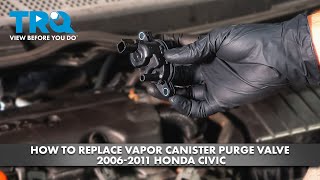
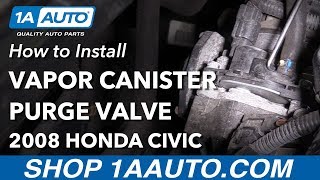
Typical fix: Replace the EVAP canister purge valve. The OEM part number is 36162-RNA-A01. It is typically located on or near the intake manifold and is accessible for DIY replacement. 🎬 See this step-by-step purge valve replacement walkthrough
Est. part cost: $30-$70 - Cracked or Disconnected EVAP Hoses ⚪ Low Probability The rubber hoses in the engine bay and underneath the car can become brittle and crack from age and heat cycles. A large leak is often a hose that has completely disconnected from a fitting.
How to confirm: Perform a thorough visual inspection of all accessible EVAP lines, especially at connection points. The definitive method is to have a smoke test performed, which will force low-pressure smoke through the system and reveal the exact location of any leaks.
Typical fix: Replace the cracked section of hose or re-secure the connection.
Est. part cost: $5-$30 - Faulty EVAP Vent Solenoid / Valve ⚪ Low Probability → Shop Vapor Canister This valve, located near the charcoal canister under the car, can get stuck open or fail electrically, preventing the system from sealing for its pressure test. It can also get clogged with dirt or debris, especially if driven in dusty conditions.
How to confirm: This component is harder to access. It is normally open and should close when 12V is applied. Testing often requires raising the vehicle. A smoke test will often reveal a leak at the vent solenoid if it is stuck open. A symptom of a stuck-closed vent valve can be difficulty filling the fuel tank.
Typical fix: Replace the EVAP vent solenoid.
Est. part cost: $40-$100
Rare But Worth Checking
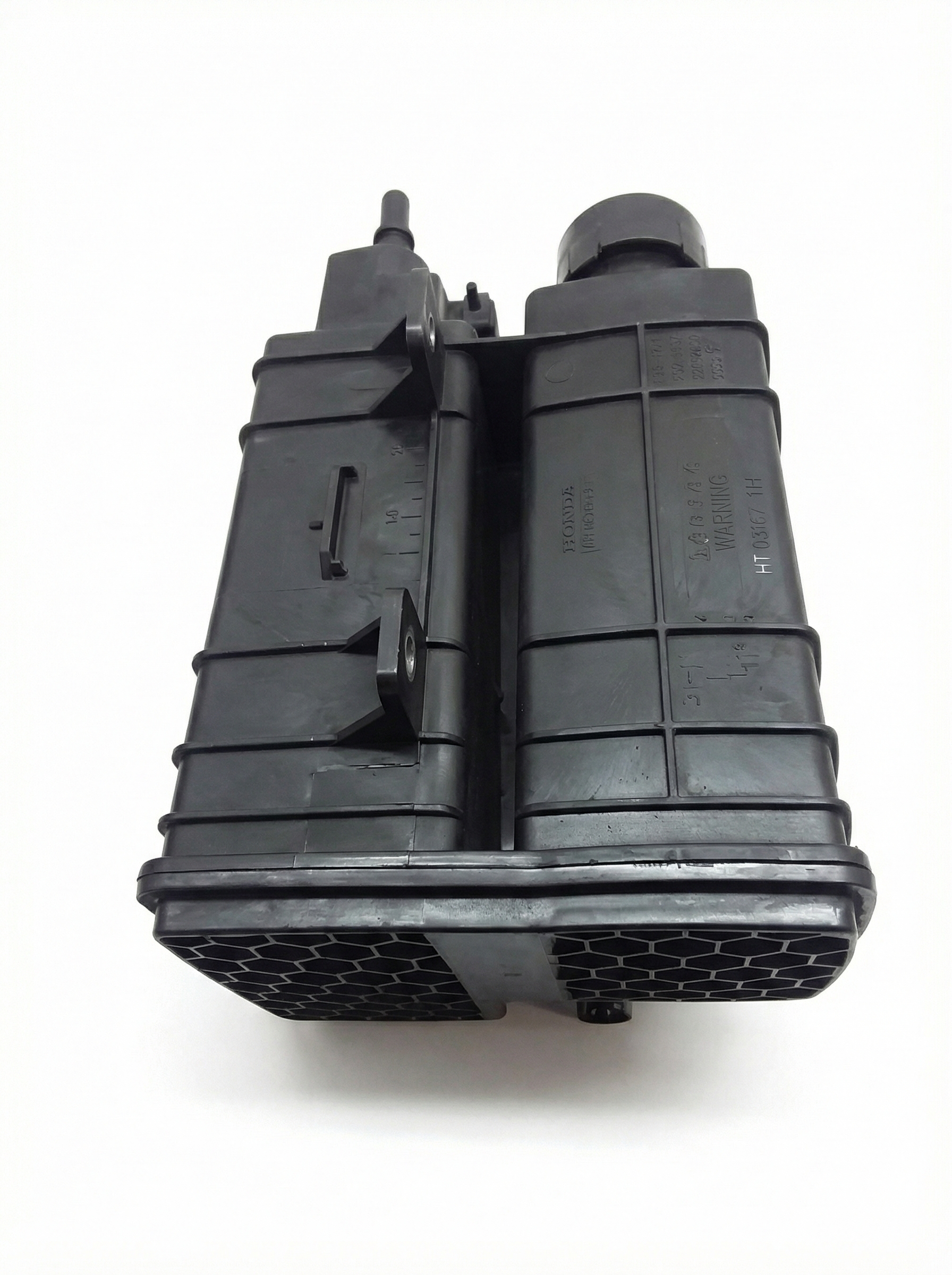
- Cracked EVAP Charcoal Canister: → Shop Vapor Canister The plastic body of the canister itself can develop cracks from age or impact from road debris. This is usually found during a smoke test when other components have been ruled out.
- Damaged Fuel Filler Neck: → Shop Fuel Filler Neck Rust or physical damage can cause the pipe leading from the gas cap to the tank to leak, preventing a proper seal. Manufacturer Bulletin #ATS170206 notes that if an EVAP leak is detected from the filler neck, technicians should investigate the specific cause before replacing the entire fuel fill pipe. This is more common in areas that use road salt and can be a source of a persistent P0455 code after other parts have been replaced.
Diagnosis Steps
- Read the code with an OBD-II scanner to confirm P0455 is present.
- Inspect the gas cap. Remove it, check the seal for damage, and reinstall it, ensuring it clicks several times.
- Clear the code with the scanner and drive for a few days to see if the light returns. This is called a drive cycle.
- If the light returns, replace the gas cap with a new OEM Honda part (17670-SNA-A02 or successor).
- If the code persists, visually inspect the EVAP hoses in the engine bay for obvious cracks or disconnections, particularly around the purge valve.
- Locate and test the EVAP purge valve on the intake manifold. Remove it and see if you can blow through it. If you can, it's bad and needs replacement.
- If the cause is still not found, the most effective next step is a professional smoke test to find the exact source of the leak. This can 🎬 Watch: A mechanic's guide to diagnosing the P0455 code identify cracks in hoses, the canister, or the fuel filler neck.
Parts You'll Likely Need
- Fuel Filler Cap (OEM)
(OEM #17670-SNA-A02 (superseded by 17670-T3W-A01))— This is the most common cause of P0455 on a Honda Civic. The seal wears out, and aftermarket caps are known to cause issues.
Trusted brands: Honda (Genuine)
OEM price range: $25-$50
Aftermarket price range: $10-$25 - EVAP Canister Purge Valve
(OEM #36162-RNA-A01)— The second most common failure point. It gets stuck open, creating a large leak.
Trusted brands: Honda (Genuine), Denso, Dorman (911-763), Standard Motor Products
OEM price range: $60-$90
Aftermarket price range: $30-$70
Related Codes That Often Appear With This One
- P0441 — P0441 (Incorrect Purge Flow) often points directly to a malfunctioning purge valve, which can also cause a P0455 if it's stuck open.
- P0456 — This code indicates a 'very small leak'. Sometimes a degrading component, like a gas cap seal, can cause intermittent large and small leak codes to appear as it fails.
- P0497 — This code for 'EVAP System Low Purge Flow' can also be associated with a faulty purge valve, which might be stuck open or closed, potentially leading to a P0455 as well.
Technical Service Bulletins (TSBs) & Recalls
- Acura TSB 14-006: Notes that on related models, the original fuel fill cap gasket (black) can create too much friction, preventing a proper seal. The fix is an updated cap with a brown gasket. While for Acura, the principle applies to Hondas of the same era experiencing gas cap issues.
- Bulletin #Service Bulletin (2014-02-18): Specifically addresses the MIL coming on for DTC P0455 and/or P0456, noting that the fuel fill cap may be loose or have a stickiness issue.
- Bulletin #ATS170206: A Tech line summary article advising that if an EVAP system leak is detected from the filler neck, technicians should evaluate the specific failure rather than immediately replacing the entire fuel fill pipe.
Platform-Specific Known Issues
- Component Locations for DIY Diagnosis: For the 2006-2011 Civic, the EVAP Purge Valve (solenoid) is easily accessible, located directly on the intake manifold in the engine bay. The EVAP Vent Solenoid (or vent valve) is located underneath the vehicle, attached to or very near the charcoal canister, which sits near the fuel tank.
Mechanic-Grade Diagnostic Values
- EVAP Canister Purge Valve (36162-RNA-A01) coil resistance — expected: 15 to 30 Ohms. Failure: A reading far outside this range, or an open/infinite reading, indicates a failed coil.
- EVAP Canister Vent Solenoid coil resistance — expected: 20 to 50 Ohms. Failure: A reading of 0 (short) or infinite (open) indicates the solenoid coil has failed.
- Fuel Tank Pressure (FTP) Sensor Voltage — expected: Approximately 2.5V at normal atmospheric pressure (gas cap off).. Failure: Voltage that does not change when vacuum or pressure is applied to the system, or a reading that is stuck high or low, points to a faulty sensor.
Scan Tool Commands That Help
- Honda Diagnostic System (HDS) or equivalent professional scanner: EVAP System Function Test — This is a bidirectional test used to command the EVAP system's solenoids (purge and vent) to open and close in a specific sequence. It allows a technician to verify that the valves are responding to ECU commands and helps determine if a valve is stuck, has an electrical fault, or if the system can hold pressure/vacuum when sealed.
Wiring & Ground Locations
- G101 — On the right rear of the engine block, often near the thermostat housing.. This is a primary engine and sensor ground. While a fault here would likely cause multiple other codes, a poor connection at G101 can lead to erratic sensor readings for various engine management systems, including potentially the FTP sensor.
- EVAP Purge Valve Connector — On the intake manifold.. One pin receives 12V power from the PGM-FI main relay when the ignition is on. The other pin is the control wire that goes to the Engine Control Module (ECM), typically pin B25 on the ECM connector for this generation. Testing for power at the connector and continuity to the ECM are key electrical diagnostic steps.
Real Owner Repair Stories
- Forum discussions (2006-2011 Honda Civic (various trims)) — Persistent P0455 code after replacing gas cap and purge valve.
❌ Tried (didn't work) Replacing gas cap (both aftermarket and OEM), Replacing EVAP purge valve
✅ What actually fixed it A smoke test revealed a leak from a rusted fuel filler neck, right below where the gas cap seals. Replacing the entire fuel filler neck assembly resolved the code. This is more common in regions with road salt usage. - Mechanic and forum reports (2007 Honda Civic) — P0455 code returns despite the EVAP system passing a smoke test.
❌ Tried (didn't work) Smoke test (showed no leaks), Replacing gas cap, Testing purge and vent valves (they functioned correctly)
✅ What actually fixed it The Fuel Tank Pressure (FTP) sensor was faulty. It was not accurately reporting the pressure changes to the ECU, causing the computer to believe there was a large leak when the system was actually sealed. Replacing the FTP sensor fixed the issue. - NHTSA ODI #11488601 — An owner reported that despite tightening the fuel tank cap per recommendations, the check engine light remained on with a P0455 EVAP Emission Control System Leak code.
"I Checked Everything" — The Actual Cause
- In some cases, the system will pass a smoke test, indicating no physical leaks are present. The persistent P0455 code was then traced to a faulty Fuel Tank Pressure (FTP) sensor. The sensor itself was not reading the system's pressure correctly, leading the ECU to misinterpret a sealed system as having a large leak.
OEM Part Supersession History
17670-SNA-A02→17670-T3W-A01— The original gas cap used a black gasket that could create excess friction and prevent a proper seal. The updated part uses a different gasket material (often brown) to ensure a better and more consistent seal, addressing the root cause of many P0455 issues.
Diagnostic Flowchart
Real Owner Stories
Aggregated from forums and TSBs cited above. Mileages and costs reflect what owners reported in those sources.
2009 Honda Civic
Symptoms: Check engine light was on, code P0455.
What fixed it: Owner was advised by the dealership that a new gas cap was needed, but the final repair is not stated in the post. They were considering an aftermarket replacement.
Cost: $15-$75
Source hint: 2009 Honda Civic code P0455 : r/MechanicAdvice
Honda Civic
Symptoms: Check engine light with code P0455.
What fixed it: The post does not state what ultimately fixed the issue, only that the initial attempt of replacing the gas cap failed.
Source hint: Honda civic code P0455 help!! - Reddit
2006-2015 Honda Civic
Symptoms: Check engine light with codes P0455 and P0456. Saw smoke leaking from the gas cap indicating it wasn't sealing properly.
What fixed it: Replaced the faulty gas cap with a new one after a smoke test and pressure test confirmed it was leaking.
Source hint: youtube_comment by serhiichernetskyi40
Honda Civic
Symptoms: P0455 code and 'Check Fuel Cap' message.
What fixed it: After replacing the gas cap with an OEM part did not solve the issue, they replaced the EVAP purge solenoid valve (part #36162-RNA-A01), which successfully resolved the code.
Source hint: 8thcivic.com thread titled 'P0455 code, check fuel cap message'
Related OBD-II Codes
Frequently Asked Questions
Why does my 2006-2011 Civic display a 'CHECK FUEL CAP' message along with the P0455 code?
I replaced my Civic's gas cap with an aftermarket one, but the P0455 code came back. What should I do?
Does Acura TSB 14-006 apply to my Honda Civic's gas cap issue?
Where is the EVAP purge valve located on the 8th generation Civic?
I'm having difficulty refueling my Civic and the gas pump keeps clicking off. Is this related to P0455?
How can I test the EVAP purge valve on my 2006-2011 Civic at home?
Helpful Videos

Used OEM Parts in Stock
New Aftermarket Parts Available


The information in this article is provided for general reference and educational purposes only. Vehicle specifications, procedures, and part compatibility can vary by production date, trim level, and region. Always consult your vehicle's factory service manual and verify part numbers before purchasing or performing repairs. Safety-critical components such as airbags, seat belts, and braking systems should be installed by a qualified professional.
- Honda Civic:
- 🧭 Diagnostic Flowchart
- 🎬 Helpful Videos
- 🛍️ Shop This Part
- What's Unique About the 2006-2011 Honda Civic
- Symptoms You May Notice
- Most Likely Causes
- Rare But Worth Checking
- Diagnosis Steps
- Parts You'll Likely Need
- Related Codes That Often Appear With This One
- Technical Service Bulletins (TSBs) & Recalls
- Platform-Specific Known Issues
- Mechanic-Grade Diagnostic Values
- Scan Tool Commands That Help
- Wiring & Ground Locations
- Real Owner Repair Stories
- "I Checked Everything" — The Actual Cause
- OEM Part Supersession History
- Real Owner Stories
- 2009 Honda Civic
- Honda Civic
- 2006-2015 Honda Civic
- Honda Civic
- Related OBD-II Codes
- Frequently Asked Questions
- 🎟️ Get 5% Off