

P0455 on 2006-2010 Hyundai Sonata: EVAP Large Leak Causes and Fixes
On a 2006-2010 Sonata, P0455 is most often caused by a loose gas cap or a faulty canister purge valve. Always check that the gas cap is tight and clicks. If the light returns, the purge valve is the next most likely part to fail and is a common, relatively inexpensive DIY fix. If those don't solve it, the canister close valve (CCV) near the rear charcoal canister is the next component to inspect.
- Do not panic; P0455 is an emissions-related code that does not affect vehicle safety or engine health.
- Always start with the simplest fix: check that your gas cap is tight. If the seal looks worn, replace it with an OEM part.
- The canister purge valve (PCSV) in the engine bay is the second most likely culprit and is a common failure item on these Sonatas.
- If the gas cap and purge valve are good, the canister close valve (CCV) by the rear wheel is the next part to inspect.
- A professional smoke test is the fastest way to find the leak if it's not one of the common components.
What's Unique About the 2006-2010 Hyundai Sonata
The 2006-2010 (NF generation) Sonata does not have unique, systemic design flaws related to the P0455 code. However, owner and technician experiences show that the canister purge valve (PCSV) is a particularly common failure point on this and other Hyundai/Kia models of the era. It can fail and trigger a large leak code without setting any other purge-flow-specific codes, which can sometimes mislead diagnosis. The Kia Optima (Magentis) from the same generation shares this platform and exhibits the same common failure points for P0455.
Symptoms You May Notice
- Check Engine Light is on
- A faint smell of fuel, especially around the rear of the car or gas cap area
- Slightly reduced fuel economy in some cases
- Difficulty starting the car immediately after refueling (if the purge valve is stuck open)
- Immediately replacing the charcoal canister. The canister itself is often just a plastic box with charcoal; it's the valves attached to it (Purge Valve, Close Valve) that typically fail. The canister should only be replaced if it is physically cracked.
- Replacing other EVAP components without performing a smoke test. A smoke test can save significant time and money by pinpointing the exact location of the leak, avoiding guesswork.
Most Likely Causes
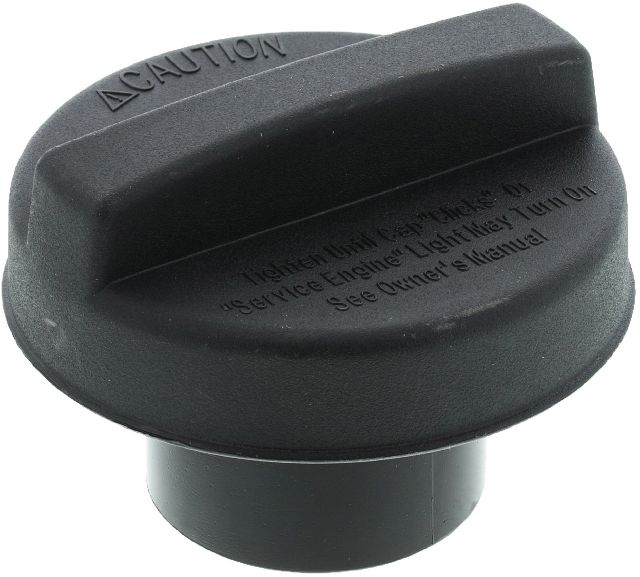
- Loose or Faulty Gas Cap 🔴 High Probability → Shop Fuel Tank Cap This is the most common cause on all vehicles, not specific to the Sonata. The rubber seal on the cap can wear out, crack, or harden over time, or the cap may simply not have been tightened until it clicked.
How to confirm: Remove the gas cap and inspect the rubber O-ring for cracks, stiffness, or damage. Reinstall the cap, ensuring you turn it until it clicks at least three times. Clear the code and see if it returns after a few drive cycles. You can also try cleaning the seal with a cloth.
Typical fix: Replace the gas cap if the seal is damaged or if tightening it doesn't resolve the issue. It is highly recommended to use an OEM cap for best results, as some aftermarket caps are known to cause the same P0455 code.
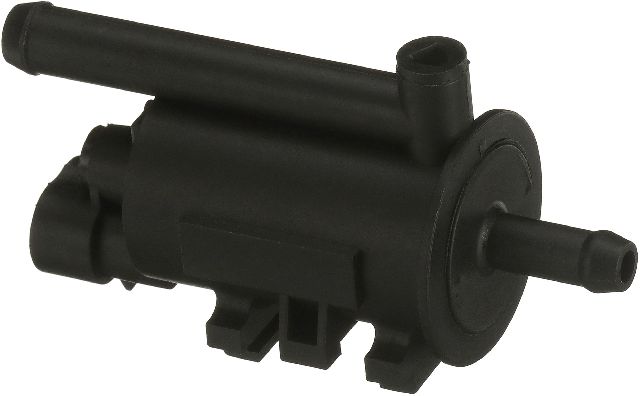
Est. part cost: $15-$30 - Faulty Canister Purge Valve (PCSV) 🔴 High Probability → Shop Vapor Canister This is a very common failure item on Hyundai vehicles of this era. It can become stuck open, creating a permanent vacuum leak from the EVAP system into the intake manifold. This can also lead to difficulty starting after filling the gas tank. In some instances, as noted in NHTSA ODI #11231676, a purge valve was found to be shortened internally, triggering the P0455 code.
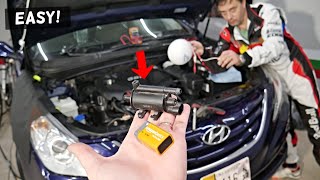
How to confirm: Locate the valve in the engine bay near the intake manifold. Disconnect the hoses and electrical connector. With the valve de-energized (off the car), try to blow through it. If air passes through, the valve is stuck open and is bad. It should be normally closed. 🎬 See how to test the purge valve yourself
Typical fix: Replace the canister purge valve. This is a straightforward DIY job 🎬 Watch: Step-by-step guide to replacing the purge valve for most owners, typically held by one or two bolts and connected by two hoses and an electrical clip.
Est. part cost: $30-$85 - Faulty Canister Close Valve (CCV) 🟡 Medium Probability → Shop Vapor Canister This valve, located near the charcoal canister at the rear of the vehicle, is exposed to road debris and moisture, and can fail or get stuck, preventing the EVAP system from sealing properly for its self-test.
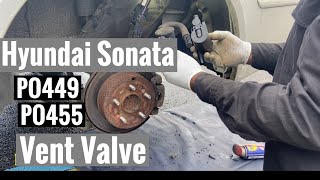
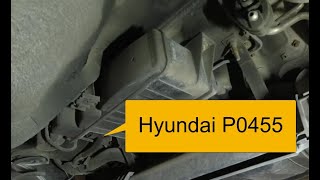
How to confirm: The valve is located near the charcoal canister, accessible by raising the vehicle and sometimes removing the driver's side rear wheel and plastic fender liner. A smoke test is the most effective way to confirm a leak at the CCV. A technician can also command the valve to close with a bi-directional scan tool to test its function.
Typical fix: Replace the canister close valve. This is more involved than the purge valve due to its location under the car but is still manageable for a DIYer 🎬 Watch: How to replace the canister close valve with proper tools and safety precautions.
Est. part cost: $40-$70 - Cracked or Disconnected EVAP Hoses ⚪ Low Probability Over time, rubber hoses can become brittle and crack, especially those exposed to engine heat or underbody elements. Connections can also become loose.
How to confirm: Visually inspect all accessible EVAP lines, from the engine bay (around the purge valve) to the rear of the car (around the charcoal canister and filler neck). A professional smoke test is the most reliable method to find a small crack or hidden leak.
Typical fix: Replace the cracked section of hose. Small cracks can sometimes be repaired, but replacement is recommended for a long-term solution.
Est. part cost: $5-$50
Rare But Worth Checking
- Cracked Charcoal Canister: → Shop Vapor Canister The canister itself can be damaged by road debris or age, leading to a large crack and a P0455 code. This is uncommon but should be considered if other components test good. A visual inspection or smoke test will reveal the damage. This is a known issue on the related Kia Optima platform.
- Leaking Fuel Filler Neck: → Shop Fuel Filler Neck Rust or corrosion on the metal fuel filler neck (where the gas cap screws on) can prevent the cap from sealing properly, causing a persistent leak. This is more common in 'salt belt' regions.
Diagnosis Steps
- Read the code with an OBD-II scanner to confirm P0455 is the only code present.
- Inspect the gas cap. Ensure it is tight and clicks when closed. Check the rubber seal for cracks or wear. If in doubt, replace it with an OEM cap, clear the code, and drive for a few days.
- If the code returns, perform a visual inspection of the EVAP hoses in the engine bay, particularly around the purge valve, for any obvious cracks or disconnections.
- Test the Canister Purge Valve (PCSV). Locate it in the engine bay, remove it, and try to blow air through it. If air passes, it has failed and needs to be replaced.
- If the purge valve is good, inspect the components at the rear of the vehicle. Raise and safely support the vehicle. Remove the driver's side rear wheel and inner fender liner to access the charcoal canister and Canister Close Valve (CCV).
- Visually inspect the canister, CCV, and surrounding hoses for any signs of damage or cracks. Check the fuel filler neck for excessive rust where the gas cap seals.
- If no visual faults are found, the most effective next step is a professional smoke test. A machine fills the EVAP system with a harmless, visible smoke, making it easy to pinpoint the exact location of the leak.
Parts You'll Likely Need
- Fuel Filler Cap
(OEM #31010-3L600)— This is the most frequent and simplest cause. The seal wears out over time, preventing the system from holding pressure.
Trusted brands: Hyundai (OEM)
OEM price range: $20-$30
Aftermarket price range: $15-$25 - Canister Purge Valve (PCSV)
(OEM #28910-25100 (for 2.4L I4) or 28910-3C100 (for 3.3L V6))— A very common failure point on this platform. It gets stuck open, causing a constant leak that the system detects during its self-test.
Trusted brands: Hyundai (OEM), Bosch, Dorman
OEM price range: $55-$85
Aftermarket price range: $30-$50 - Canister Close Valve (CCV)
(OEM #31453-3K500)— This valve at the rear of the car is the second most likely valve to fail, preventing the system from sealing for tests. It is exposed to the elements under the car.
Trusted brands: Hyundai (OEM), Dorman
OEM price range: $50-$70
Aftermarket price range: $35-$55
Technical Service Bulletins (TSBs) & Recalls
- NHTSA RECALL 13V113000 (Campaign 110): While not for P0455, this is a critical safety recall for 2006-2010 Sonatas in salt-belt states concerning severe rust-through of the rear subframe/crossmember, which can lead to loss of vehicle control. Owners in these regions should be aware of underbody corrosion which could also affect EVAP components like the filler neck or canister.
- Manufacturer Bulletin #21-FL-002H: While issued for the Sonata Hybrid, this bulletin notes that salt particulate deposits can form inside the Natural Vacuum Leak Detection (NVLD) sensor, potentially causing EVAP leakage codes including P0455.
- Manufacturer Bulletin #21-01-035H: This bulletin highlights that vehicles in coastal areas subject to marine layer clouds may experience check engine lights for P0455 Large Leak due to environmental factors affecting the EVAP system.
Mechanic-Grade Diagnostic Values
- Canister Purge Valve (PCSV) / Canister Close Valve (CCV) Solenoid Coil Resistance — expected: 10.1 ~ 11.1 Ω at 77°F (25°C). A general acceptable range is considered 8 Ω to 14 Ω.. Failure: A reading of 0 Ohms indicates a short circuit, while an infinite or OL (Over Limit) reading indicates an open circuit. Either requires replacement of the valve.
- Fuel Tank Pressure (FTP) Sensor Voltage/Pressure with Scan Tool — expected: With the engine off and gas cap removed (system at atmospheric pressure), the sensor should read approximately 2.5V or 0 inH2O. When the system pulls a vacuum during a test, this voltage should decrease.. Failure: A sensor that is stuck at a high or low voltage, or does not respond when a vacuum is applied during a smoke test, is likely faulty.
Scan Tool Commands That Help
- Hyundai GDS (Global Diagnostic System) or equivalent professional scanner: EVAP System Leakage Test / Actuation Test — This is a dealer-level function that forces the EVAP system into a test state. The technician can command the Canister Close Valve (CCV) to shut and the Purge Control Solenoid Valve (PCSV) to open, simulating the conditions under which the P0455 code is set. This allows for monitoring the Fuel Tank Pressure sensor to see if the system holds a vacuum, or to isolate which specific component (PCSV, CCV) is failing to actuate.
Wiring & Ground Locations
- GE01 / GE02 — Located on the left (driver's side) front of the engine compartment.. These are primary engine bay ground points. A corroded or loose ground here could cause intermittent or total failure of the engine-bay-mounted Canister Purge Valve (PCSV), leading to incorrect operation and potential codes.
- GE04 — Located on the right (passenger's side) of the engine compartment.. This is another key ground point that provides the ground path for various engine control systems. While less direct, a fault here could contribute to erratic ECU behavior affecting EVAP diagnostics.
- Rear Harness Ground — Typically located in the trunk area or near the rear lighting assembly, often under a trim panel.. The Canister Close Valve (CCV) is located at the rear of the vehicle. Its wiring harness relies on a clean ground in this area. Corrosion or damage to this ground point is a likely cause for CCV-related codes (like P0446, P0449) and could potentially be a factor in P0455 if the valve fails to seal due to a bad ground.
Real Owner Repair Stories
- YouTube channel '1A Auto' (2006-2014 Hyundai Sonata (demonstration vehicle)) — Check Engine Light with P0455.
❌ Tried (didn't work) The video focuses on direct replacement but implies that simple fixes are often overlooked.
✅ What actually fixed it During the replacement of the canister purge valve (PCSV), the technician discovered a small, split vacuum hose connected to the valve. The video notes that this tiny crack in the hose itself could have been the entire cause of the P0455 large leak code, rather than the valve. The final repair involved both replacing the valve and trimming the hose back to fresh material before reconnecting. - YouTube channel 'Joez Garage' (2007 Hyundai Sonata) — Multiple emissions codes preventing the vehicle from passing E-check (smog test).
❌ Tried (didn't work) The owner had taken the car to a dealership, who quoted $2,200 for the repair, implying a complex diagnosis.
✅ What actually fixed it The charcoal canister was replaced, which required dropping the fuel tank and exhaust for access. After reassembly with a new canister and fixing a broken fuel line clip, all emission codes were cleared and did not return, allowing the car to pass its emissions test. The video also notes a large mouse nest was found on top of the fuel tank, which can lead to chewed wires or hoses (though none were explicitly found to be damaged). - NHTSA ODI #11643345 — An owner reported that their vehicle lost power while going up a hill, generating codes P1326, P0455, and P0302.
- NHTSA ODI #11531219 — A report describes a vehicle that showed error code P0455 on a Fix Finder report; the vehicle later lost all power and required towing.
OEM Part Supersession History
Unknown→28910-25100— This is the current, widely available OEM part number for the Canister Purge Valve for the 2.4L engine in this Sonata generation.Unknown→31453-3K500— This is the current OEM part number for the Canister Close Valve (CCV) assembly for this Sonata generation.
Diagnostic Flowchart
Other Known Issues on This Vehicle
Issues unrelated to this code that are worth knowing about as an owner of this generation:
- Rear Subframe Corrosion 🔴 High — Common in 'salt belt' states, leading to a major safety recall. (Ref: NHTSA Recall 13V113000 / Hyundai Campaign 110)
- Theta II 2.4L Engine Failure 🔴 High — A well-documented issue involving connecting rod bearing failure due to manufacturing debris, leading to engine seizure. Can occur at various mileages. (Ref: Related to numerous recalls and lawsuits, primarily affecting later model years but the engine design has known flaws.)
- Malfunctioning Stop Lamp Switch 🟠 Medium — Common failure causing brake lights to not work or stay on, and can prevent deactivating cruise control. (Ref: NHTSA Recall 13V113000 (part of a larger campaign))
- Timing Chain Tensioner Rattle on Startup 🟠 Medium — The tensioner can fail to hold oil pressure when the engine is off, causing a brief rattle on startup. If ignored, it can lead to timing chain failure. (Ref: Mentioned as a common problem in repair videos.)
- Accelerator Pedal Position Sensor (APPS) Failure 🟠 Medium — Can cause the vehicle to enter 'limp mode' with reduced power, often accompanied by code P2122.
Used vs. New Parts: Buying Guide for This Vehicle
When a used part is the smart pick: Used parts are generally not recommended for the key failure components for P0455 (valves, gas cap) because they are wear items with a limited lifespan. However, a used charcoal canister from a junkyard can be a cost-effective choice IF the original is confirmed to be physically cracked and the donor part is intact with no rattling (indicating broken internal charcoal).
Donor-vehicle mileage cap: roughly under 80000 miles for the part to have meaningful remaining life.
What to inspect on the donor part:
- For a charcoal canister, inspect for any cracks or damage, especially around the hose ports.
- Shake the canister vigorously; if you hear rattling like a maraca, the internal charcoal is broken, and the part is useless.
- Inspect any included hoses for brittleness, swelling, or cracks.
OEM-only on this vehicle (don't cheap out):
- Fuel Filler Cap: Many forum and technician accounts confirm that aftermarket gas caps often fail to seal correctly, causing the P0455 code to return. Using a genuine Hyundai OEM cap is strongly advised.
Aftermarket brands forum-validated for this vehicle:
- Dorman
- Bosch
- Standard Motor Products (Intermotor)
Brands owners have reported issues with on this vehicle:
- No-name, unbranded parts from online marketplaces should be avoided, especially for electronic components like valves, as their quality control is highly inconsistent.
Real Owner Stories
Aggregated from forums and TSBs cited above. Mileages and costs reflect what owners reported in those sources.
2011 Hyundai Sonata
Symptoms: Check Engine Light (CEL) was on. Owner first replaced the gas cap, but the code returned after 3-4 days.
What fixed it: Replacing the purge valve (PCSV).
Cost: $30-$30
Source hint: YouTube - 2011 Hyundai Sonata P0455 CEL Fixed!
2009 Hyundai Sonata
Symptoms: P0455 large leak detected.
What fixed it: Replacement of the canister close valve (vent valve) located near the rear wheel.
Source hint: YouTube - Hyundai Sonata Evaporative Canister Vent Valve Solenoid Replacement
2012 Hyundai Sonata
Symptoms: P0455 code keeps appearing persistently.
What fixed it: The purge valve solenoid was found to be sticking intermittently.
Source hint: Reddit - r/sonata - 2012 Hyundai Sonata P0455 code keeps appearing
Related OBD-II Codes
Frequently Asked Questions
Is there a recall for my 2006-2010 Sonata that might be related to underbody EVAP leaks?
Why does my Sonata struggle to start only after I fill up the gas tank?
Can I use an aftermarket gas cap to fix the P0455 code on my Sonata?
Where is the Canister Close Valve (CCV) located on the 2006-2010 Sonata?
How can I tell if my Purge Control Solenoid Valve (PCSV) has failed?
Helpful Videos
We Have This Part in Stock


The information in this article is provided for general reference and educational purposes only. Vehicle specifications, procedures, and part compatibility can vary by production date, trim level, and region. Always consult your vehicle's factory service manual and verify part numbers before purchasing or performing repairs. Safety-critical components such as airbags, seat belts, and braking systems should be installed by a qualified professional.
- Hyundai Sonata:
- 🧭 Diagnostic Flowchart
- 🎬 Helpful Videos
- 🛍️ Shop This Part
- What's Unique About the 2006-2010 Hyundai Sonata
- Symptoms You May Notice
- Most Likely Causes
- Rare But Worth Checking
- Diagnosis Steps
- Parts You'll Likely Need
- Technical Service Bulletins (TSBs) & Recalls
- Mechanic-Grade Diagnostic Values
- Scan Tool Commands That Help
- Wiring & Ground Locations
- Real Owner Repair Stories
- OEM Part Supersession History
- Other Known Issues on This Vehicle
- Used vs. New Parts: Buying Guide for This Vehicle
- Real Owner Stories
- 2011 Hyundai Sonata
- 2009 Hyundai Sonata
- 2012 Hyundai Sonata
- Related OBD-II Codes
- Frequently Asked Questions
- 🎟️ Get 5% Off