

P0455 on 2016-2023 Mazda CX-9: EVAP Large Leak Causes and Fixes
For a 2016-2023 Mazda CX-9, a P0455 code is most often caused by a loose or faulty gas cap. Before buying parts, ensure the cap is tight and clicks. If the light returns, the next most common cause is a failed EVAP purge solenoid valve, an inexpensive and easy part to replace in the engine bay.
- Always check the gas cap first. Make sure it is tight and the seal is intact. This solves the problem a majority of the time.
- If the gas cap isn't the issue, the purge solenoid valve is the next most likely culprit and is a relatively easy and inexpensive DIY replacement located in the engine bay.
What's Unique About the 2016-2023 Mazda CX-9
The 2016-2023 Mazda CX-9 (TC generation) uses a capless fuel filler system on some model years and trims, which can be a specific point of failure for EVAP codes if the internal flap fails to seal or gets stuck. Unlike older Mazdas where cracked fuel pump lock rings were a known issue, the second-generation CX-9's P0455 is more typically related to standard EVAP components like the purge valve or gas cap (on models so equipped). There are no major TSBs or recalls specifically for P0455 on this platform, suggesting no widespread design flaw, though related TSBs for small leaks point to the gas cap as a primary culprit.
Symptoms You May Notice
- Check Engine Light is on
- A faint smell of gasoline, especially around the rear of the vehicle or near the gas cap.
- For models with a capless fuel filler, you may notice the flap is stuck or doesn't seal properly.
- On some older models, a dedicated "loose gas cap" warning light may illuminate on the dashboard.
- Replacing the charcoal canister when the actual fault is a much cheaper and simpler part like the purge valve or vent valve.
- Immediately assuming a complex leak exists before thoroughly checking that the gas cap is tight, correctly installed, and has a good seal.
Most Likely Causes
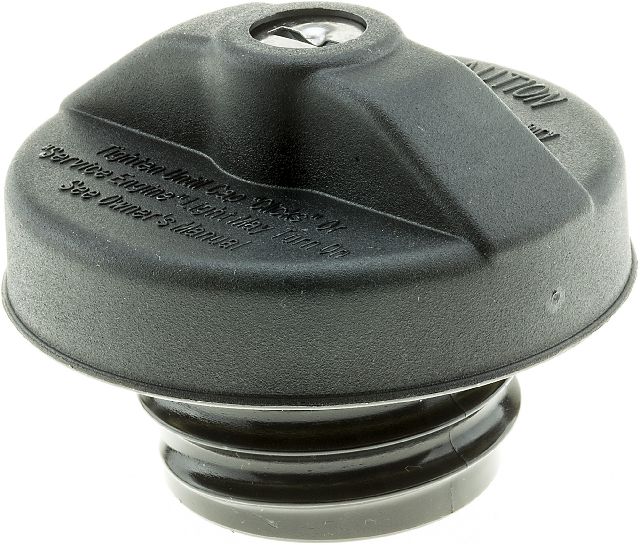
- Loose, Damaged, or Incorrect Gas Cap 🔴 High Probability → Shop Fuel Tank Cap This is the most common cause for P0455 on any vehicle, often due to user error (not tightening until it clicks) or a worn-out seal. Aftermarket caps are frequently reported to cause sealing issues.
How to confirm: Remove the gas cap, inspect the rubber seal for cracks or brittleness, and check the filler neck for rust or debris. Reinstall the cap, ensuring you hear it click at least once. Clear the code and drive for a few days. If the code returns, the cap is likely not the issue.
Typical fix: Replace the gas cap, preferably with a genuine OEM Mazda part, as aftermarket caps are often reported to not seal correctly.
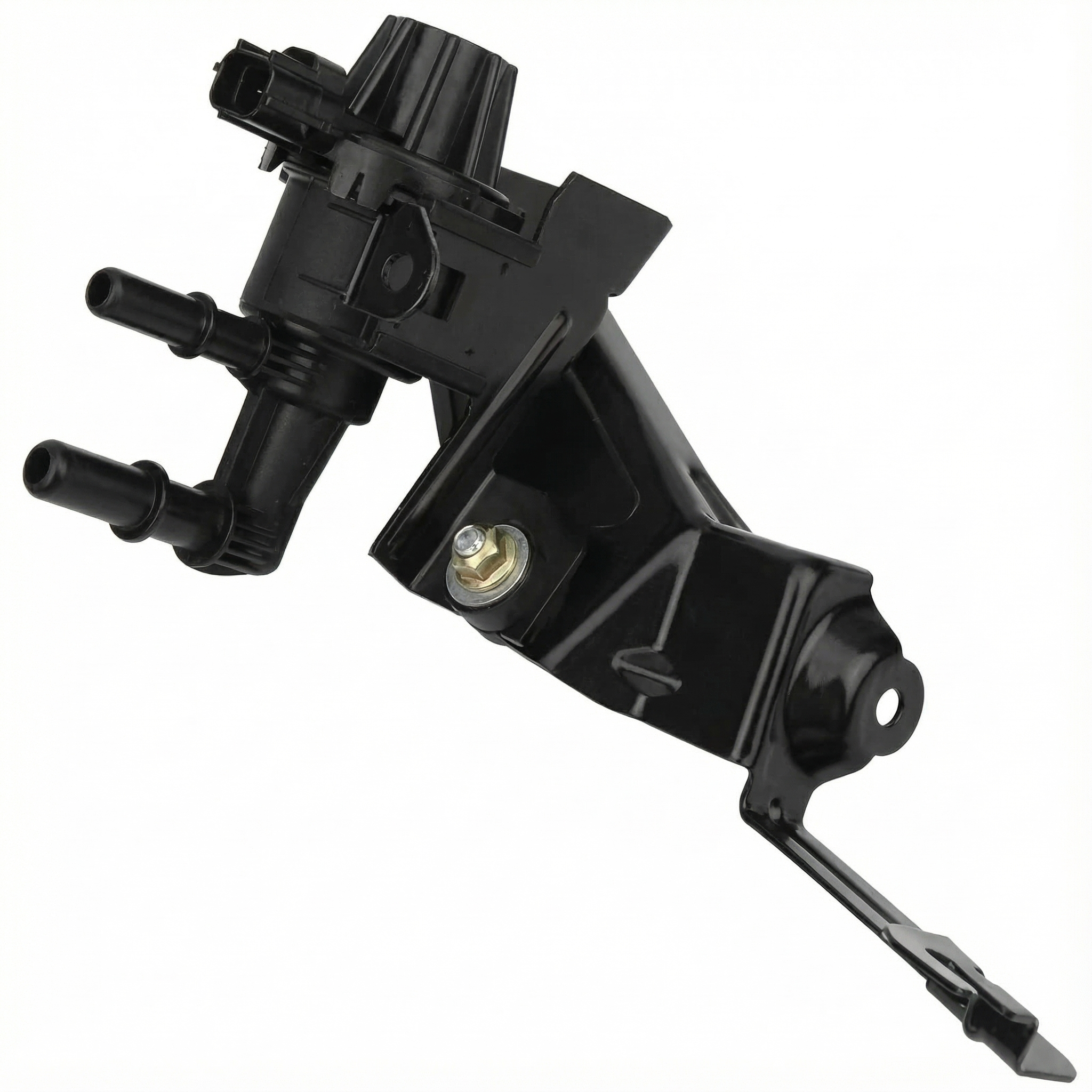
Est. part cost: $25-$40 - Failed EVAP Purge Solenoid Valve 🟡 Medium Probability → Shop Vapor Canister The purge valve is an electromechanical part that cycles frequently and is a common failure point on many modern vehicles. It can get stuck open, creating a large leak path from the EVAP system to the engine intake.
How to confirm: Locate the purge valve in the engine bay. With the engine off, disconnect the valve and try to blow through it. If air passes through, it is stuck open and needs to be replaced. It is a normally-closed valve.
Typical fix: Replace the purge solenoid valve. This is typically a straightforward DIY job located on top of the engine.
Est. part cost: $50-$100 - Cracked or Disconnected EVAP Hoses ⚪ Low Probability Rubber hoses can become brittle and crack over time due to heat and age. A connection could also be knocked loose during other service. This is less common than the cap or purge valve but is the next logical place to check.
How to confirm: Visually inspect all accessible EVAP lines in the engine bay and under the vehicle, running from the charcoal canister near the tank to the purge valve in the engine bay. A smoke test is the most effective way to find a leak in a hose.
Typical fix: Replace the cracked hose section or re-secure the connection.
Est. part cost: $10-$50
Rare But Worth Checking
- Failed Canister Vent Valve/Solenoid: → Shop Vapor Canister This valve is located near the charcoal canister by the fuel tank. It is normally open and closes to seal the system for testing. If it gets stuck open or fails to close, it will cause a large leak code. Dust and debris can cause it to stick.
- Cracked Charcoal Canister: → Shop Vapor Canister The plastic canister itself can be damaged by road debris, leading to a crack and a large leak. This is uncommon but possible, especially if the vehicle has been driven on rough roads. NHTSA ODI #10096503 describes a large leak P0455 where the owner noted the vehicle lacked a metal skid pad for protection.
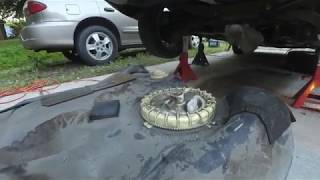
- Leaking Fuel Filler Neck: → Shop Fuel Filler Neck On vehicles operated in regions with heavy road salt use, the metal filler neck can rust 🎬 See this walkthrough on repairing a leaking Mazda fuel neck. and perforate, creating a leak that the gas cap cannot seal. NHTSA ODI #11331433 reports a "gross evap leak" specifically caused by the gas filler neck and canister purge valve.
- Fuel Pump Lock Ring: → Shop Fuel Pump While less common on the CX-9, NHTSA ODI #11439442 notes that a failed fuel pump lock ring on other Mazda models has caused P0455 and a strong smell of gasoline fumes around the rear of the car.
Diagnosis Steps
- Check the Gas Cap: This is the first and most common step. Remove, inspect, and securely retighten the gas cap until it clicks. If your CX-9 has a capless system, inspect the filler flap for debris or damage preventing a seal. Clear the code.
- Visual Inspection: If the code returns, visually inspect the EVAP purge valve and its connected hoses in the engine bay for any obvious cracks, damage, or loose connections.
- Test the Purge Valve: Remove the purge valve. It should be normally closed. Try to blow air through it. If air passes, the valve is faulty and must be replaced.
- Inspect Underbody Components: Safely raise the vehicle and inspect the charcoal canister (located near the fuel tank) and all connected hoses for cracks or damage. Check the vent valve solenoid, often attached to the canister.
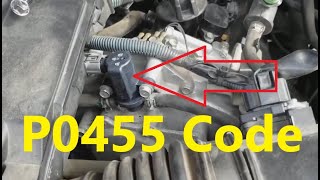
- Perform a Smoke Test: If the leak is not obvious, a smoke test is the definitive diagnostic method. 🎬 Watch: A helpful overview of P0455 causes and common fixes. A machine injects vaporized mineral oil smoke into the EVAP system under low pressure. The smoke will exit from the point of the leak, making it easy to spot. This is the fastest way for a professional to find the leak.
Parts You'll Likely Need
- Fuel Filler Cap
(OEM #L5C1-42-250)— This is the most frequent cause of a P0455 code due to a worn seal or improper tightening. Using an OEM cap is highly recommended as aftermarket versions can cause persistent issues.
Trusted brands: Mazda Genuine Parts
OEM price range: $25-$40
Aftermarket price range: $15-$25 - Vapor Canister Purge Solenoid Valve
(OEM #PY8W-18-740)— A common failure point that gets stuck open, causing a constant large leak. It's located in the engine bay and is relatively easy to replace.
Trusted brands: Mazda Genuine Parts, Bosch, Dorman
OEM price range: $70-$100
Aftermarket price range: $40-$70
Related Codes That Often Appear With This One
- P0456 — A P0456 (Very Small Leak) might appear first. If the leak worsens over time, it can eventually trigger the P0455 (Large Leak) code. TSB 01-005/19 addresses P0456 by first checking the gas cap.
- P0442 — Similar to P0456, this code for a 'Small Leak' can be a precursor to a P0455 if the source of the leak grows larger.
- P0457 — This code specifically means "EVAP System Leak Detected (Fuel Cap Loose/Off)" and often appears alongside P0455 if the cap is the root cause.
Technical Service Bulletins (TSBs) & Recalls
- TSB 01-005/19: While this TSB is for DTC P0456 (very small leak), it is highly relevant. It states the most likely cause is the fuel cap not being completely closed. This same user error is the number one cause for P0455 as well. It applies to 2007-2019 CX-9 models.
- Bulletin #01-002-18-3417: This manufacturer bulletin notes that some vehicles may have a MIL illumination with DTCs P0441, P0442, P0455, or P0456 stored in memory and provides a repair procedure to determine the location of the evaporative system leak.
Mechanic-Grade Diagnostic Values
- EVAP Purge Solenoid Valve Resistance — expected: 15-30 Ohms. Failure: A reading that is significantly higher (open circuit) or lower (short) than the specified range indicates a faulty solenoid coil.
- EVAP Canister Vent Valve Solenoid Resistance — expected: 20-50 Ohms. Failure: A reading outside this range, particularly an open circuit (infinite resistance), points to a failed solenoid winding.
- Fuel Tank Pressure (FTP) Sensor Voltage — expected: Approximately 1.5V with the system at atmospheric pressure (e.g., gas cap off). The normal operating signal range is typically between 0.5V and 4.5V.. Failure: A voltage stuck below 0.5V or above 4.5V can indicate a sensor or wiring fault, triggering various EVAP codes.
Scan Tool Commands That Help
- Mazda IDS (Integrated Diagnostic System) or equivalent professional scanner: EVAP System Test — This is a guided, automated test that commands the purge and vent valves to seal the system and monitors the fuel tank pressure sensor to check for leaks. It's the factory-prescribed method to verify a leak exists after an initial check.
- Professional Bidirectional Scan Tool: EVAP Canister Vent Valve On/Off — To manually test the vent valve. The valve is normally open, so commanding it 'On' (closed) should allow the system to build pressure/vacuum during a smoke test. You should hear a click from the valve when activated.
- Professional Bidirectional Scan Tool: EVAP Purge Solenoid Valve % Duty Cycle — To test the purge valve's function. By commanding the valve to open (e.g., 50% duty cycle) with the engine running, you can check for a corresponding change in short-term fuel trim and listen for the valve clicking, confirming its operation.
Wiring & Ground Locations
- EVAP System Ground Points — While specific ground point maps for the 2016-2023 CX-9 require paid access to Mazda's official service manuals, common locations for chassis grounds related to rear components (like the vent valve and fuel tank pressure sensor) are in the rear of the vehicle, often near the taillight assemblies or on the frame rail near the fuel tank.. A poor ground for the vent valve or fuel tank pressure sensor can cause erratic operation or incorrect readings, leading to a false P0455 code even if no physical leak exists.
- Purge Solenoid Valve Connector — On the purge solenoid valve itself, located in the engine bay, typically mounted on or near the intake manifold.. This two-pin connector provides power and ground (via PCM control) to the solenoid. Checking for 12V power with the key on and testing the control wire for continuity back to the PCM are critical steps if the valve itself tests good but does not operate.
Real Owner Repair Stories
- Reddit r/MechanicAdvice (2011 Mazda CX-9 (First Gen, but demonstrates common diagnostic path)) — Check engine light and fuel cap light on sporadically, codes P0455 and P0457.
❌ Tried (didn't work) Replacing the gas cap with a new OEM part., The purge valve had been replaced twice in the previous year and was not making its usual failure noise.
✅ What actually fixed it The owner reported that a smoke test was performed and came back with NO LEAK DETECTED. The thread ended without a final confirmed fix, highlighting how frustrating intermittent EVAP codes can be even after following standard procedures. This suggests a potential intermittent electrical issue or a failing vent valve that only sticks under certain conditions. - Reddit r/MazdaCX9 (Unknown year CX-9) — P0455 code
❌ Tried (didn't work) Initial internet search pointed to gas cap.
✅ What actually fixed it The owner replaced the gas cap with a Stant brand aftermarket cap, which resolved the P0455 code. This confirms that even if the OEM cap looks okay, its seal can degrade and a replacement is a valid first step. - NHTSA ODI #11128161 — An owner reported the check engine light coming on every few weeks with codes P0455, P2402, and P2407. Despite the dealer replacing the filler cap twice, the issue persisted, suggesting a more complex emission control system problem.
"I Checked Everything" — The Actual Cause
- In a case involving an older CX-9 with P0455 and P0457, the owner had a smoke test performed which showed no leaks. This is a classic 'mechanic's nightmare' scenario. The most likely causes when a smoke test is clean are: 1) An intermittent failure of the canister vent valve (it seals for the test but fails during the PCM's self-test). 2) A faulty Fuel Tank Pressure (FTP) sensor that is giving an incorrect reading, making the PCM believe there is a leak when there isn't. 3) An electrical issue in the wiring to one of the solenoids or sensors.
Model Year Variations Within This Range
- 2021-2023: For the 2021 model year, Mazda made a 10.25-inch center display standard and introduced the Carbon Edition trim. While not directly affecting the P0455 code, software logic in the PCM can have minor variations between model years, though no specific TSBs link these changes to EVAP diagnostics.
- 2016-2023: The capless fuel filler system was not standard on all trims across all years. The presence of a traditional gas cap vs. a capless system is the single biggest variation for diagnosing a P0455. If a cap is present, it is the number one suspect. If it is capless, attention should shift to the internal sealing flap and the purge valve.
Diagnostic Flowchart
Other Known Issues on This Vehicle
Issues unrelated to this code that are worth knowing about as an owner of this generation:
- Cracked Cylinder Head Coolant Leak 🔴 High — Affects 2016-2020 models most frequently. Can occur at various mileages, but often reported between 60,000 and 120,000 miles. Results in coolant leaking externally near the exhaust manifold or internally into the oil. (Ref: Mazda has an extended warranty program (CSP11) and TSBs (e.g., 01-013/21, 01-002-23a) to address this. Repair involves replacing the cylinder head with a redesigned part.)
- Defective Valve Stem Seals (Excessive Oil Consumption) 🟠 Medium — Primarily affects 2021 model year vehicles with the 2.5T engine. Owners report a 'Low Engine Oil' warning light appearing well before the scheduled oil change interval. (Ref: A class action settlement was reached, providing an extended powertrain warranty (to 7 years/84,000 miles) and replacement of the valve stem seals for affected vehicles.)
- Premature Brake Booster Failure 🟠 Medium — Reported on first-generation models but can also occur on the second generation. Results in a hard brake pedal and increased stopping distances, which worsens over time.
- Soul Red Crystal Paint Chipping/Flaking 🟡 Low — Common complaint across many Mazda models with this premium paint color, particularly from 2017-2019. The paint is reportedly very thin and susceptible to chipping easily from minor road debris.
Used vs. New Parts: Buying Guide for This Vehicle
When a used part is the smart pick: For this repair, used parts are generally not recommended. The primary failure components (gas cap, purge valve, vent valve) are relatively inexpensive new, and their failure is often due to age and wear (rubber seals, solenoid cycles). A used part from a junkyard will have unknown remaining life and may fail soon after installation.
Donor-vehicle mileage cap: roughly under 80000 miles for the part to have meaningful remaining life.
What to inspect on the donor part:
- If considering a used charcoal canister (as they are expensive new), inspect it for any physical cracks or damage from road debris.
- For any used electronic part like a solenoid, check for corrosion on the electrical pins.
OEM-only on this vehicle (don't cheap out):
- Fuel Filler Cap: Strongly recommended to use a genuine Mazda OEM cap. Forum and mechanic consensus is that aftermarket caps often have slightly different tolerances and fail to create a perfect seal, leading to the code returning.
Aftermarket brands forum-validated for this vehicle:
- Bosch (for Purge Solenoid Valve)
- Dorman (for Purge Solenoid Valve and Vent Valve)
Brands owners have reported issues with on this vehicle:
- Unnamed/white-box gas caps from online marketplaces are a frequent source of recurring P0455 codes.
Real Owner Stories
Aggregated from forums and TSBs cited above. Mileages and costs reflect what owners reported in those sources.
2011 Mazda CX-9
Symptoms: The owner experienced a P0455 large leak code along with a P0457 code.
What fixed it: The diagnostic path involved starting with a new OEM gas cap, then investigating the purge valve (which had a history of failure), and finally confirming the leak location with a professional smoke test.
Source hint: Reddit r/MechanicAdvice thread titled '2011 Mazda CX-9 EVAP Leak'
Mazda CX-9
Symptoms: Persistent EVAP codes that remained even after replacing the engine-bay purge valve multiple times with aftermarket parts.
What fixed it: The owner finally solved the code by ordering a canister-mounted vent valve from RockAuto.
Source hint: Reddit r/mazda
Related OBD-II Codes
Frequently Asked Questions
Does TSB 01-005/19 apply to my 2016-2023 Mazda CX-9 regarding EVAP leaks?
Should I use an aftermarket gas cap to fix the P0455 code on my CX-9?
How can I tell if my CX-9 purge valve is the reason for the large leak?
My CX-9 has a capless fuel filler; how does this affect P0455?
Is the P0455 code related to the cracked cylinder head issue on 2016-2020 CX-9s?
Could the P0455 code be caused by the charcoal canister?
Helpful Videos
Used OEM Parts in Stock
New Aftermarket Parts Available


The information in this article is provided for general reference and educational purposes only. Vehicle specifications, procedures, and part compatibility can vary by production date, trim level, and region. Always consult your vehicle's factory service manual and verify part numbers before purchasing or performing repairs. Safety-critical components such as airbags, seat belts, and braking systems should be installed by a qualified professional.
- Mazda CX-9:
- 🧭 Diagnostic Flowchart
- 🎬 Helpful Videos
- 🛍️ Shop This Part
- What's Unique About the 2016-2023 Mazda CX-9
- Symptoms You May Notice
- Most Likely Causes
- Rare But Worth Checking
- Diagnosis Steps
- Parts You'll Likely Need
- Related Codes That Often Appear With This One
- Technical Service Bulletins (TSBs) & Recalls
- Mechanic-Grade Diagnostic Values
- Scan Tool Commands That Help
- Wiring & Ground Locations
- Real Owner Repair Stories
- "I Checked Everything" — The Actual Cause
- Model Year Variations Within This Range
- Other Known Issues on This Vehicle
- Used vs. New Parts: Buying Guide for This Vehicle
- Real Owner Stories
- 2011 Mazda CX-9
- Mazda CX-9
- Related OBD-II Codes
- Frequently Asked Questions
- 🎟️ Get 5% Off