

P0455 on 2008-2017 Mitsubishi Lancer: EVAP Large Leak Causes and Fixes
For a 2008-2017 Mitsubishi Lancer, P0455 is most often caused by a loose or faulty gas cap. If a new cap (~$25) doesn't fix it, the next most likely culprits are a failed EVAP purge solenoid in the engine bay, a rusted fuel filler neck (especially in salt-belt regions), or cracked vacuum hoses. A smoke test is the most reliable way to find a leak that isn't obvious.
- Always start with the simplest fix: check that your gas cap is tight. If the seal looks old or cracked, replace it.
- If a new gas cap doesn't fix the code, a smoke test is the most efficient way to find the true source of the leak, which could be a cracked hose, a faulty solenoid, or a rusted fuel filler neck.
- This code does not indicate an urgent mechanical problem, but it will cause an automatic failure on an emissions test.
- Given the shared platform with Jeep/Dodge, a rusted fuel filler neck is a strong possibility in areas where road salt is used.
What's Unique About the 2008-2017 Mitsubishi Lancer
The 2008-2017 Lancer (generation 'CY2A/CZ4A') and its platform mates (Dodge Caliber, Jeep Compass/Patriot) share common EVAP system vulnerabilities. While the causes are typical for most cars, the fuel filler neck is particularly susceptible to rusting through in regions with road salt, creating a large leak that is often misdiagnosed. After the gas cap, owners frequently report that the next most common fixes are the purge solenoid valve located in the engine bay or tracking down a cracked hose, which often requires a smoke test to locate precisely.
Generation note: The 2008-2017 Mitsubishi Lancer is part of a single generation, often referred to as the Lancer 'X' or by its chassis codes (CY/CZ). Therefore, the causes and fixes for P0455 are generally consistent across this entire year range.
Symptoms You May Notice
- Check Engine Light is on
- A faint smell of gasoline, particularly around the rear of the vehicle or near the gas cap.
- Difficulty refueling (gas pump nozzle clicks off repeatedly), which can point to a blocked vent valve or canister.
- Replacing the oxygen sensor. This code is unrelated to the O2 sensors.
- Replacing the catalytic converter. P0455 is an EVAP system code, not an exhaust or catalyst efficiency code.
- Immediately replacing the fuel tank pressure sensor without a smoke test. While possible, a physical leak is far more common than a sensor failure for this specific code.
Most Likely Causes
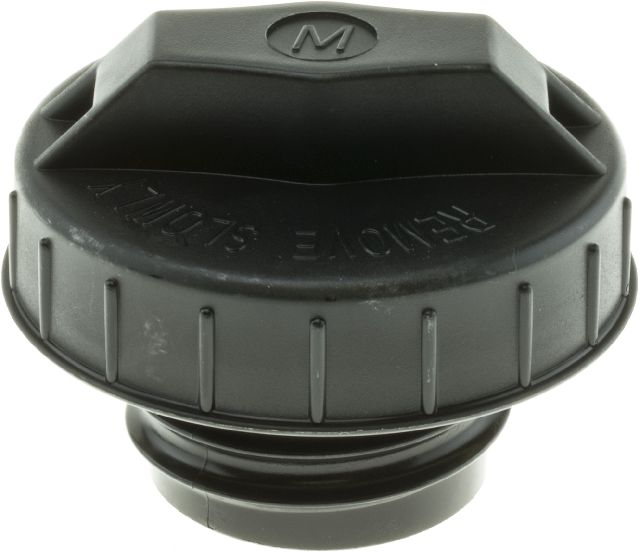
- Loose or Faulty Gas Cap 🔴 High Probability → Shop Fuel Tank Cap This is the most common cause for a P0455 code on virtually all vehicles, including the Lancer. The rubber seal on the cap can degrade over time or the cap may not have been tightened properly (until it clicks).
How to confirm: Inspect the gas cap for cracks or damage to the seal. Ensure it is tightened until it clicks at least once. If the seal is worn, a new cap is the best confirmation. Many forum users report this as the first attempted fix. Some users note that aftermarket caps may not seal as well as the OEM part.
Typical fix: Tighten or replace the gas cap.
Est. part cost: $15-$35 - Failed EVAP Canister Purge Solenoid/Valve 🟡 Medium Probability → Shop Vapor Canister This valve controls the flow of fuel vapors to the engine. It can get stuck open, creating a constant leak path that the system detects.
How to confirm: Locate the purge valve in the engine bay. Disconnect it and try to blow through it. A normally-closed valve should not allow air to pass when unpowered. If it does, it's faulty. Removal may require a T25 Torx bit. The coil resistance should be between 22-26 Ω at 20°C (68°F).
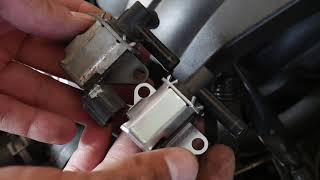
Typical fix: Replace the canister purge solenoid valve. 🎬 Watch: Step-by-step guide to replacing the Lancer purge valve.
Est. part cost: $40-$90 - Cracked or Disconnected EVAP Hose 🟡 Medium Probability Rubber hoses become brittle with age and exposure to heat in the engine bay or under the car. A crack or a hose that has popped off its fitting creates a large leak. Forum users often suggest checking the line from the charcoal canister to the intake manifold solenoid valve.
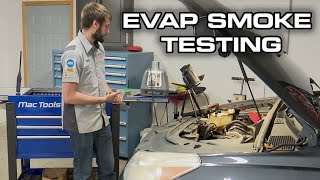
How to confirm: Visually inspect all accessible EVAP hoses in the engine bay and near the charcoal canister at the rear of the vehicle. The most reliable method is to have a professional perform a smoke test, which injects vapor into the system to reveal the exact location of the leak. 🎬 See how a professional smoke test finds hidden EVAP leaks.
Typical fix: Replace the damaged section of hose or re-secure the connection.
Est. part cost: $5-$30
Rare But Worth Checking
- Rusted or Damaged Fuel Filler Neck: → Shop Fuel Filler Neck In regions with heavy salt use, the metal tube leading from the gas cap to the fuel tank can rust through, creating a significant leak in the EVAP system. This is a very common failure on the Lancer's platform mates (Jeep Patriot/Compass) and should be a primary suspect if a new gas cap doesn't solve the code in a rust-belt state.
- Faulty EVAP Canister Vent Solenoid: → Shop Vapor Canister This valve, located near the charcoal canister, is responsible for sealing the 'exit' of the EVAP system during a test. It is normally open and closes when commanded. It can get stuck open due to dirt, debris (spiders are a known culprit for building webs in the vent tube), or internal failure, preventing the system from sealing. A generic resistance test would be to check for 20-50 ohms across the terminals.
- Cracked EVAP Charcoal Canister: → Shop Vapor Canister The canister itself, a black plastic box usually located near the fuel tank, can develop cracks from road debris or age, causing a large leak.
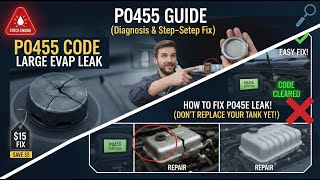
- Faulty Fuel Tank Pressure (FTP) Sensor: → Shop Fuel Tank In some cases, the sensor that measures pressure in the system can fail. It may send incorrect data to the ECM, making the computer believe there is a large leak 🎬 Watch: How to diagnose a P0455 large leak without overspending. when the system is actually sealed. This is less common than a physical leak. A scan tool should show a signal voltage between 1.5V and 3.5V.
Diagnosis Steps
- Read the code with an OBD-II scanner to confirm P0455 is present.
- Inspect the gas cap. Remove it, check the seal for cracks or debris, and clean the filler neck opening. Reinstall the cap and tighten it until it clicks several times.
- Clear the code using the scanner. Drive the vehicle for a few days to see if the light returns. The EVAP monitor can take over 100 miles of driving to run its self-test.
- If the light returns, perform a thorough visual inspection of all EVAP hoses in the engine bay, especially around the purge solenoid, and under the vehicle near the charcoal canister (located at the rear, driver's side). Look for obvious cracks, loose fittings, or disconnections.
- Test the purge solenoid in the engine bay. It is a normally-closed valve. Disconnect it and attempt to blow air through it. If air passes, the valve is stuck open. Test its coil resistance; it should be 22-26 Ω. If either test fails, replace it. A T25 Torx bit may be required for removal.
- Inspect the EVAP canister vent solenoid and its hoses, located near the charcoal canister under the rear of the car. Check for blockages from dirt or even spider webs in the vent tube.
- If no obvious issues are found, the most effective next step is a professional smoke test. This test will pressurize the system with a visible vapor, making even small leaks easy to spot on hoses, the canister, the purge valve, or especially a rusted fuel filler neck.
Parts You'll Likely Need
- Fuel Cap — This is the most frequent cause of a P0455 code due to a worn seal or improper tightening. It's the cheapest and easiest part to replace first. Some owners report aftermarket caps may not seal correctly.
Trusted brands: Stant, Duralast
OEM price range: $25-$40
Aftermarket price range: $15-$30 - Vapor Canister Purge Solenoid
(OEM #8657A049)— This valve is a common failure point that gets stuck open, creating a leak path directly to the engine intake.
Trusted brands: Dorman, Standard Motor Products
OEM price range: $70-$110
Aftermarket price range: $40-$90
Related Codes That Often Appear With This One
- P0456 (EVAP Small Leak Detected): Can appear if a leak is on the borderline between the computer's definitions for small and large.
- P0441 (EVAP Incorrect Purge Flow): Can be triggered by a stuck-open purge valve or a major hose break.
- P0457 (EVAP Leak Detected - Fuel Cap Loose/Missing): May appear if the computer specifically identifies the gas cap as the source of the large leak.
Mechanic-Grade Diagnostic Values
- EVAP Canister Purge Solenoid Coil Resistance — expected: 22 - 26 Ω at 20°C (68°F). Failure: A reading outside this range (e.g., open circuit/infinite resistance or a dead short) indicates a failed solenoid coil.
- Fuel Tank Pressure (FTP) Sensor Signal Voltage — expected: 1.5V - 3.5V (1,500 - 3,500 mV) with key on, engine off.. Failure: A voltage that is stuck high (near 5V) or low (near 0V) regardless of tank pressure indicates a faulty sensor or wiring issue.
- Fuel Tank Pressure (FTP) Sensor Supply Voltage — expected: 4.9V - 5.1V. Failure: No voltage or low voltage indicates a wiring problem or an issue with the ECM's 5V reference circuit.
- EVAP Canister Vent Solenoid Coil Resistance — expected: Approximately 20 - 50 Ω (General automotive specification). Failure: A reading significantly outside this range suggests a faulty solenoid coil.
Scan Tool Commands That Help
- Mitsubishi M.U.T.-III: System Test > Evap Leak Mon. — This is the factory-level command to force the ECM to run its complete, automated EVAP leak test procedure without having to perform a full drive cycle. It's the most definitive way to confirm if a leak is still present after a repair.
- Mitsubishi M.U.T.-III: Actuator Test > PURG VOL CONT/V — This allows a technician to manually command the purge solenoid to open by a certain percentage (e.g., 100%) while the engine is running to verify its mechanical operation and its effect on the system.
- Mitsubishi M.U.T.-III: Work support > EVAP SYSTEM CLOSE — This command forces the EVAP vent valve to close, sealing the system. It is used in conjunction with a hand pump to manually pressurize the system to check for clogs or leaks.
- Professional Bidirectional Scan Tool: Command EVAP Purge Valve OFF, Command EVAP Vent Valve ON (Closed) — With the engine running, command the purge valve off and the vent valve closed. Monitor the Fuel Tank Pressure (FTP) sensor PID. If vacuum builds (pressure drops), it confirms the purge valve is mechanically stuck open and leaking vacuum from the intake manifold into the EVAP system.
Wiring & Ground Locations
- B-115 — Engine bay, connector for the EVAP Purge Solenoid, located on the left side of the engine.. This is the electrical connector for the purge solenoid. Checking for power and ground here is a key step in diagnosing a non-responsive solenoid.
- D-17 — Top right side of the fuel tank.. This is the connector for the Fuel Tank Pressure (FTP) sensor. Probing this connector is necessary to test for the 5V reference voltage from the ECM and the return signal voltage.
- G4 — At the left rear of the engine compartment, on the shock tower.. This is a primary engine bay ground point. A loose or corroded G4 ground could potentially affect the operation of the engine-bay-mounted purge solenoid.
- B-109 — Behind the glove box, at the Engine Control Module (ECM).. This is one of the main ECM connectors. The wiring for the FTP sensor (pins 112, 113, 114 on some models) terminates here, making it the final point for continuity checks from the sensor.
Real Owner Repair Stories
- YouTube channel 'Tony's Mobile Auto Repair' (2013 Mitsubishi Lancer ES 2.0L) — Check Engine Light with code P0455.
❌ Tried (didn't work) Replacing the fuel cap.
✅ What actually fixed it The problem was resolved by replacing the EVAP canister purge solenoid/valve (OEM Part No. 8657A049) located in the engine bay. The repair required a T25 Torx bit. - YouTube channel 'That Krazy Kraut' (2002 Mitsubishi Lancer (from a rust-belt state)) — Leaking gasoline during refueling.
✅ What actually fixed it The fuel filler neck was completely rusted through, requiring replacement. While the video doesn't mention P0455, this physical failure is a documented cause for a large EVAP leak code on these vehicles in salt-heavy regions. - EvolutionM.net forum user 'Jehuty' (Mitsubishi Lancer (Evo)) — P0455 code returned after clearing.
❌ Tried (didn't work) Tightening the original fuel cap., Replacing the fuel cap with a new one.
✅ What actually fixed it The thread did not have a final confirmed fix from the original poster, but another user noted that aftermarket fuel caps can fail to seal properly and that an OEM cap is often required to solve the issue. The consensus recommendation was to perform a smoke test to find the true source of the leak.
"I Checked Everything" — The Actual Cause
- No specific repair stories were found for the Lancer where a smoke test passed but the code persisted. However, in such a scenario, the most likely culprit would be a non-physical leak, such as a faulty Fuel Tank Pressure (FTP) sensor sending incorrect data to the ECM, making it believe a leak exists when one does not.
OEM Part Supersession History
K5T46693→8657A049— Part number update/revision for the Vapor Canister Purge Solenoid.
Heads up: 8657A049 is the correct and most current OEM part number for the 2008-2017 Lancer (non-turbo). Aftermarket cross-references include Dorman 911-389, Standard Motor Products CP588, and Wells 2M1365.
Diagnostic Flowchart
Other Known Issues on This Vehicle
Issues unrelated to this code that are worth knowing about as an owner of this generation:
- CVT Transmission Failure/Hesitation 🔴 High — Widespread reports, often after 80,000 miles. Symptoms include slipping, jerking, whining, and overheating, sometimes triggering a 'slow down' warning. A class-action lawsuit was filed over this issue. (Ref: A recall was issued for some 2015-2016 models for a hesitation issue.)
- Clear Coat Paint Peeling 🟡 Low — Common complaint that the factory paint and clear coat are soft and prone to chipping and peeling.
- Engine Overheating Due to Cooling Fan Controller 🟠 Medium — The fan control module is a common failure point, preventing the cooling fans from activating and causing the engine to overheat in traffic.
- Crankshaft Position Sensor Failure 🟠 Medium — A known cause for a 'crank, no-start' condition or sudden stalling while driving.
- Timing Chain Stretch (4B11/4B12 Engines) 🔴 High — The timing chain can stretch, particularly on earlier models (pre-2009). Symptoms include a rattling noise on cold starts and a rough idle. If ignored, can lead to catastrophic engine failure.
Used vs. New Parts: Buying Guide for This Vehicle
When a used part is the smart pick: For purely mechanical, non-electronic parts from a rust-free donor vehicle. A used fuel filler neck, charcoal canister (if not cracked), or EVAP hoses from a southern or western climate car can be a cost-effective repair.
Donor-vehicle mileage cap: roughly under 100000 miles for the part to have meaningful remaining life.
What to inspect on the donor part:
- For fuel filler necks, inspect for any signs of rust, especially at welds and mounting brackets.
- For charcoal canisters, ensure the plastic housing has no cracks or damage and that all hose nipples are intact.
- For hoses, squeeze them to check for pliability; avoid any that are hard, brittle, or show surface cracking.
OEM-only on this vehicle (don't cheap out):
- Fuel Cap: Forum users report that some aftermarket gas caps do not seal correctly, causing the P0455 code to persist. An OEM cap is a safer investment to eliminate this common variable.
Aftermarket brands forum-validated for this vehicle:
- Dorman: Offers direct replacement purge valves (911-389), vent valves (911-815), and fuel filler necks, and is a widely available and generally trusted brand.
- Standard Motor Products (SMP): A well-regarded aftermarket manufacturer for electronic components like the purge solenoid (CP588).
Brands owners have reported issues with on this vehicle:
- No specific brands were consistently reported as problematic in owner forums, but caution is advised with unbranded, low-cost electronic parts from online marketplaces.
Real Owner Stories
Aggregated from forums and TSBs cited above. Mileages and costs reflect what owners reported in those sources.
2013 Mitsubishi Lancer ES 2.0L
Symptoms: Check engine light on, OBD-II code P0455 for an EVAP emission system large leak detected.
What fixed it: Replaced the canister purge valve. The owner also replaced the gas cap preventatively.
Cost: $15.99-$88.00
Source hint: YouTube comment from Repairs and Rides regarding P0455 fix on a 2013 Mitsubishi Lancer ES
2010 Mitsubishi Lancer
Symptoms: Check Engine Light P0455 EVAP Large Leak; owner replaced the gas cap but the light remained on.
What fixed it: A vacuum line issue between the canister and the intake manifold solenoid.
Source hint: EvolutionM - 'Check Engine Light P0455 EVAP Large Leak'
2009 Mitsubishi Lancer
Symptoms: P0455 code present; user was advised that the gas cap replacement did not resolve the issue.
What fixed it: Checking all EVAP lines and connections for leaks.
Source hint: EvolutionM - 'P0455 - need help!'
2012 Mitsubishi Lancer
Symptoms: P0455 code triggered.
What fixed it: Clearing a clogged vent tube that was obstructed by spider webs.
Source hint: EvolutionM - 'P0455 and E85'
Related OBD-II Codes
Frequently Asked Questions
Where is the purge valve located on my Lancer, and what tools do I need to remove it?
I replaced my gas cap but the P0455 code is still there. What should I check next on my Lancer?
Can I use an aftermarket gas cap to fix the P0455 large leak on my Mitsubishi?
Where is the charcoal canister located on the 2008-2017 Lancer?
How long do I need to drive my Lancer after a repair for the Check Engine Light to stay off?
Is there a specific TSB for the P0455 code on the 2015-2016 Lancer?
Helpful Videos

Used OEM Parts in Stock
New Aftermarket Parts Available


The information in this article is provided for general reference and educational purposes only. Vehicle specifications, procedures, and part compatibility can vary by production date, trim level, and region. Always consult your vehicle's factory service manual and verify part numbers before purchasing or performing repairs. Safety-critical components such as airbags, seat belts, and braking systems should be installed by a qualified professional.
- Mitsubishi Lancer:
- 🧭 Diagnostic Flowchart
- 🎬 Helpful Videos
- 🛍️ Shop This Part
- What's Unique About the 2008-2017 Mitsubishi Lancer
- Symptoms You May Notice
- Most Likely Causes
- Rare But Worth Checking
- Diagnosis Steps
- Parts You'll Likely Need
- Related Codes That Often Appear With This One
- Mechanic-Grade Diagnostic Values
- Scan Tool Commands That Help
- Wiring & Ground Locations
- Real Owner Repair Stories
- "I Checked Everything" — The Actual Cause
- OEM Part Supersession History
- Other Known Issues on This Vehicle
- Used vs. New Parts: Buying Guide for This Vehicle
- Real Owner Stories
- 2013 Mitsubishi Lancer ES 2.0L
- 2010 Mitsubishi Lancer
- 2009 Mitsubishi Lancer
- 2012 Mitsubishi Lancer
- Related OBD-II Codes
- Frequently Asked Questions
- 🎟️ Get 5% Off