

P0456 on 2000-2007 Ford Taurus: Causes and Fixes for Small EVAP Leaks
For a 2000-2007 Ford Taurus, the P0456 code is most often caused by a loose or faulty gas cap. Before buying parts, check that the cap is tight and the seal is intact. If that doesn't solve it, the next most likely culprits are a failing canister purge valve or a cracked EVAP hose, often found with a smoke test.
- P0456 is an emissions code for a very small leak and is not a safety concern.
- Always start with the gas cap; it's the most common and cheapest fix.
What's Unique About the 2000-2007 Ford Taurus
On the fourth-generation Ford Taurus (2000-2007), the EVAP system components are relatively straightforward. Unlike newer Fords with capless fuel fillers, this generation uses a traditional gas cap, which is a very frequent source of this code due to age and wear. The system's components, like the purge valve and canister, are also known to fail from simple age and exposure to the elements, making them common points of failure for owners of these older vehicles. The canister purge valve is particularly easy to access on the passenger side of the engine bay.
Symptoms You May Notice
- Check Engine Light is on.
- A faint smell of gasoline, particularly after refueling or when the car is parked.
- No noticeable impact on engine performance or fuel economy in most cases.
- Replacing the O2 sensors. O2 sensors are not part of the EVAP system and will not cause a P0456 code.
- Replacing the fuel injectors. This code is related to fuel vapors, not fuel delivery to the engine.
Most Likely Causes
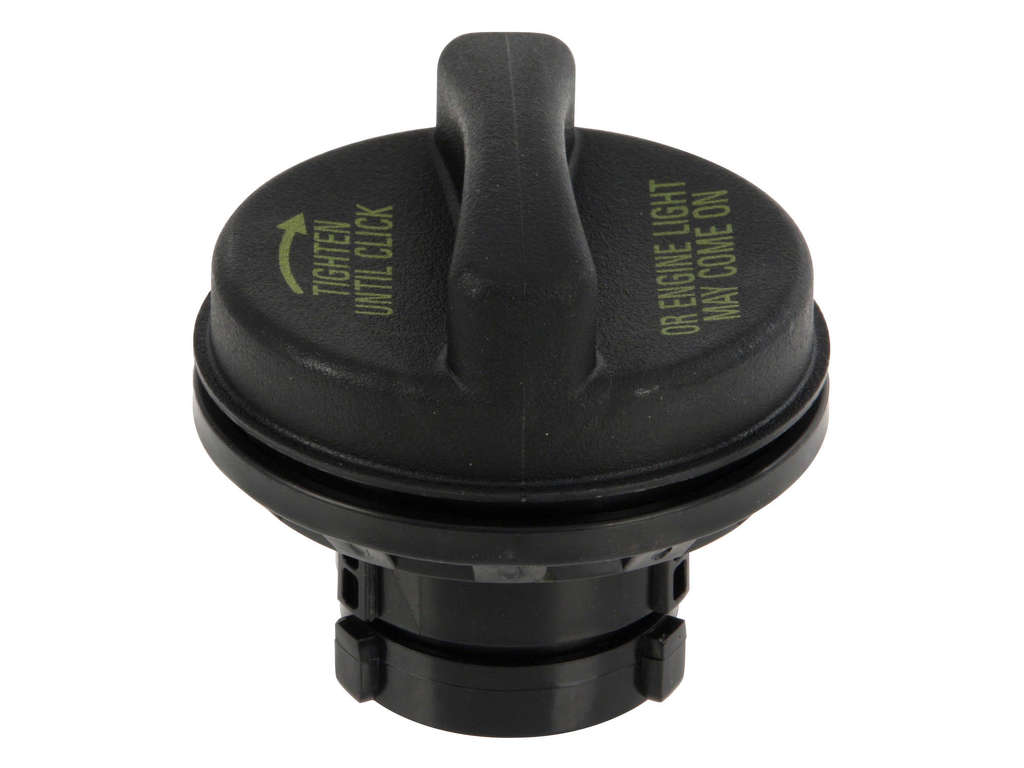
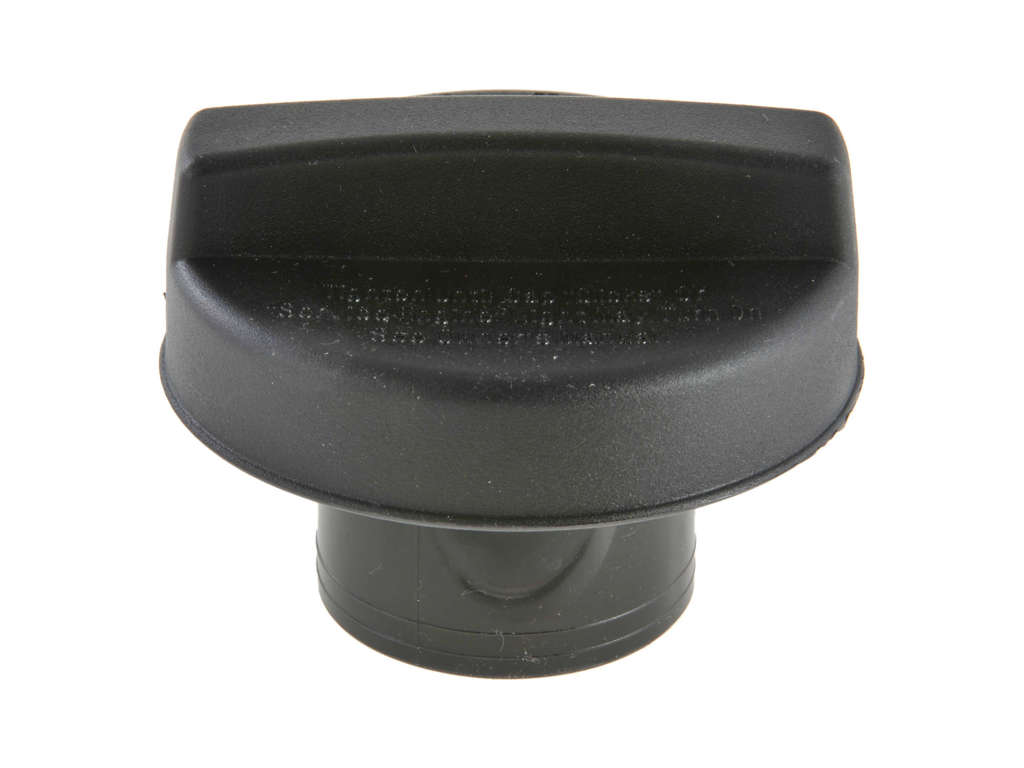
- Loose, Worn, or Incorrect Gas Cap 🔴 High Probability → Shop Fuel Tank Cap The gas cap seal is a rubber component that degrades over time, becoming hard and cracked, preventing a proper seal. This is the most common and cheapest cause for this code.
How to confirm: Inspect the gas cap for cracks or damage to the rubber O-ring. Ensure it is tightened until it clicks several times. A temporary test suggested by owners is to apply a thin layer of petroleum jelly 🎬 Watch: See how to use this $4 gas cap fix. to the seal to see if it helps the light go away after a few drive cycles.
Typical fix: Replace the gas cap. It is highly recommended to use an OEM (Motorcraft) or high-quality aftermarket cap, as cheaper alternatives are known to cause sealing issues.
Est. part cost: $10-$35 - Faulty Canister Purge Valve/Solenoid 🟡 Medium Probability → Shop Vapor Canister This valve is located in the engine bay and cycles frequently. Over time, it can get stuck slightly open, creating a small, constant vacuum leak within the EVAP system that the PCM detects during self-tests. As noted in NHTSA ODI #11618443 regarding similar Ford systems, a mechanic determined that a canister purge valve stuck open caused excessive vacuum in the fuel vapor.
How to confirm: The valve is located on the passenger side of the engine bay, near the firewall. Disconnect the electrical connector and hoses. When not energized, it should be completely closed. Try to blow through it; if any air passes, it has failed and is stuck open.
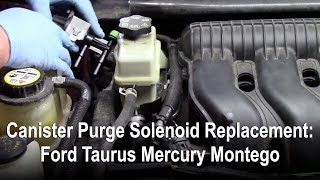
Typical fix: Replace the canister purge valve. This is an easy repair involving disconnecting two hoses and an electrical connector, then sliding the valve off its bracket. 🎬 Watch: A quick walkthrough of the purge valve replacement.
Est. part cost: $25-$60 - Cracked or Disconnected EVAP Hoses 🟡 Medium Probability The rubber and plastic hoses in the EVAP system become brittle with age and heat exposure, leading to small cracks, especially at connection points and elbows. Manufacturer Bulletin #TSB 25-2308 notes that for some Ford models, this code can be caused by a chaffing or rubbing condition between the fuel vapor canister line and the air vent hose.
How to confirm: Visually inspect all accessible EVAP hoses running from the engine bay to the charcoal canister at the rear of the vehicle. The most reliable method is to have a mechanic perform a smoke test, which forces low-pressure smoke into the EVAP system to reveal the exact location of any leaks.
Typical fix: Replace the cracked section of hose. Ensure connections are secure.
Est. part cost: $5-$50 - Faulty Canister Vent Solenoid ⚪ Low Probability → Shop Vapor Canister Located underneath the car near the charcoal canister, this valve is exposed to road debris and moisture, which can cause it to fail and not seal completely when commanded closed by the PCM during a system test.
How to confirm: The vent solenoid is normally open and closes only when the PCM tests the system. A failure causing a P0456 would likely be it not closing fully. Diagnosis often requires a bi-directional scan tool to command the valve closed and a smoke test to confirm it's leaking.
Typical fix: Replace the canister vent solenoid. It is located near the EVAP canister under the rear of the car.
Est. part cost: $30-$70
Rare But Worth Checking
- Cracked Charcoal Canister: → Shop Vapor Canister The plastic housing of the canister itself can develop hairline cracks from age or impact from road debris. This is usually found during a smoke test. NHTSA ODI #11537486 describes a case where a Ford owner was quoted for both a VMV and a charcoal canister to resolve the P0456 code.
- Leaking Fuel Tank or Fuel Pump Gasket: → Shop Fuel Pump Rust on the fuel tank or a degraded gasket for the fuel pump assembly can cause a small vapor leak. This is less common but possible on older vehicles in rust-prone climates.
- Cracked Fuel Filler Neck: → Shop Fuel Filler Neck The metal tube leading to the gas tank can rust and develop small pinholes, especially in areas where road salt is used. This is often discovered during a smoke test when smoke is seen exiting from around the filler neck area.
Diagnosis Steps
- Check the Gas Cap: Remove, inspect the seal for cracks or damage, and reinstall it, ensuring it clicks multiple times. A common DIY trick is to apply a thin coat of petroleum jelly to the seal as a temporary measure. Clear the code and see if it returns after a few days of driving.
- Visual Inspection: Carefully inspect all visible EVAP hoses in the engine bay and under the vehicle for obvious cracks, disconnections, or signs of rot. Pay close attention to the hoses connected to the purge valve.
- Test the Canister Purge Valve: Locate the purge valve on the passenger-side firewall. Disconnect it and attempt to blow air through it. If air passes, the valve is stuck open and must be replaced.
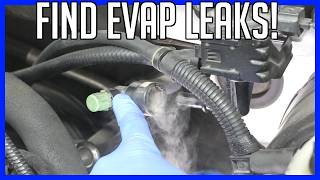
- Perform a Smoke Test: If the above steps do not reveal the issue, the most effective diagnostic method is a smoke test. A mechanic will inject pressurized smoke into the EVAP system's service port. Smoke will exit from the location of the leak, making it easy to spot, even if it's 🎬 Watch: How to find a leak when smoke isn't visible. a tiny crack in a hose or the charcoal canister. NHTSA ODI #11438585 notes a case where a smoke test was used to confirm a fuel vapor leak after a P0456 code appeared.
- Inspect Vent Solenoid and Canister: During the smoke test, pay close attention to the vent solenoid and the charcoal canister itself, located under the rear of the car near the spare tire well, as these are common leak points.
Parts You'll Likely Need
- Fuel Cap
(OEM #Motorcraft FC963)— This is the most frequent cause. The seal wears out over time, causing a small leak that triggers the code. Using an OEM part is highly recommended for a proper seal.
Trusted brands: Motorcraft, Stant
OEM price range: $20-$35
Aftermarket price range: $10-$20 - Canister Purge Valve / Solenoid
(OEM #Motorcraft CX1753)— A very common failure point. It gets stuck open, causing a constant small leak in the system. It's easily accessible in the engine bay.
Trusted brands: Motorcraft, Dorman, Standard Motor Products
OEM price range: $40-$70
Aftermarket price range: $25-$50 - EVAP System Hoses — Rubber hoses become brittle and crack with age, creating small leaks that are often found with a smoke test.
OEM price range: $20-$100
Aftermarket price range: $5-$30
Related Codes That Often Appear With This One
- P0455 — Indicates a large EVAP leak. If a component fails intermittently or the leak is on the borderline between small and large, both codes can appear.
- P0457 — Indicates an EVAP leak detected due to a loose or missing fuel cap. This is a more specific version of the leak codes and often points directly to the gas cap.
- P1450 — Indicates an inability to bleed up fuel tank vacuum. This is very common on Fords and is often caused by a stuck-open canister purge valve or a blockage in the EVAP system. NHTSA ODI #11564344 describes a scenario where P1450 and P0456 appeared together, indicating the purge valve was "sucking" and needed replacement.
Platform-Specific Known Issues
- Purge Valve Location: → Shop Vapor Canister On the 2000-2007 Taurus, the canister purge valve is conveniently located on the passenger side of the engine bay, mounted to the firewall near the coolant and power steering reservoirs, making it very easy to access for testing and replacement.
Mechanic-Grade Diagnostic Values
- EVAP Canister Purge Valve Solenoid Resistance — expected: 15 - 38 Ohms. Failure: A reading of 0 Ohms (short circuit) or infinite/OL (open circuit) indicates a failed solenoid.
- EVAP Canister Vent Solenoid Resistance — expected: 48 - 65 Ohms. Failure: A reading outside this range indicates a faulty solenoid winding.
- Voltage at Purge Valve Connector (Power Wire) — expected: ~12V (Battery Voltage) with Key On, Engine Off. Failure: 0V suggests a blown fuse or an open in the power wire (typically a red wire).
- Fuel Tank Pressure (FTP) Sensor Voltage at Atmospheric Pressure — expected: ~2.5 - 2.6 Volts with Key On, Engine Off. Failure: A significantly different static voltage may indicate a faulty FTP sensor.
Scan Tool Commands That Help
- Ford IDS (or equivalent professional scanner): EVAP System Leak Test — This is an automated test commanded by the scan tool to check the system for leaks. However, on this platform, it is primarily designed to detect large leaks (P0455), not the small leak of a P0456.
- Ford IDS (or equivalent professional scanner): Output State Control: Toggle Canister Vent (CV) Solenoid — Used to manually command the normally-open vent solenoid closed. This is the first step in sealing the system for a manual pressure/smoke test or for checking the function of the purge valve.
- Ford IDS (or equivalent professional scanner): Output State Control: Duty Cycle Purge Valve — Allows the technician to manually command the purge valve open by a certain percentage to check its operation while monitoring fuel tank pressure. A key test is to command it to 0% (closed) and see if vacuum still builds, which would indicate it's stuck open.
Wiring & Ground Locations
- G102 / G103 — Located on the right rear side of the engine compartment, near the firewall.. These are primary engine compartment grounds. While not exclusively for the EVAP system, poor grounding here can cause erratic behavior in various engine sensors and solenoids, including the easily accessible canister purge valve.
- G300 — Located in the luggage compartment, on the left side, behind the lining.. This ground is for circuits in the rear of the vehicle. An intermittent fault at this ground could potentially affect the canister vent solenoid or fuel pump module, which are located nearby.
- Main Engine Harness Ground — A main ground strap is located on the transmission case below the brake booster.. This is a critical ground for the Powertrain Control Module (PCM) and engine harness. A fault here could cause widespread, unpredictable issues, including incorrect readings from EVAP system sensors.
Real Owner Repair Stories
- YouTube channel 'Just a Dude with a Wrench' (Ford Taurus, year not specified but within the 2000-2007 generation) — P0456 code for a small EVAP leak.
❌ Tried (didn't work) A smoke test was performed but showed NO visible leaks from any hoses, the canister, or the filler neck.
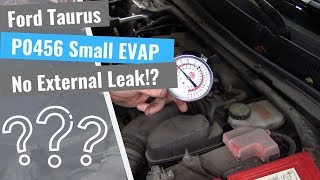
✅ What actually fixed it The canister purge valve was stuck slightly open. This was diagnosed using a scan tool to monitor Fuel Tank Pressure. With the vent valve commanded closed and the purge valve commanded to 0% (off), the fuel tank pressure sensor showed the system slowly pulling into a vacuum, proving the 'closed' purge valve was still leaking vacuum from the intake manifold. Replacing the purge valve solved the code. - YouTube channel 'Fix It Now' (Vehicle not specified, but demonstrating a common P0456 fix applicable to the Taurus.) — P0456 code.
❌ Tried (didn't work) Replaced gas cap., Replaced purge valve.
✅ What actually fixed it A smoke test revealed the leak was from a rusted and perforated fuel filler neck. This is a common issue in regions that use road salt.
"I Checked Everything" — The Actual Cause
- A common scenario for a P0456 on this Taurus is a canister purge valve that is mechanically stuck just slightly open. A smoke test, which uses very low pressure, may not be able to force enough smoke back through the tiny opening in the valve and into the intake manifold to be visible. However, when the engine is running, the high vacuum of the intake manifold is enough to pull on the system through that same tiny opening, causing the PCM to detect a leak. The definitive test is to use a scan tool to command the vent valve closed and the purge valve off, then watch the Fuel Tank Pressure (FTP) sensor. If the pressure (or voltage) begins to drop, it indicates the purge valve is leaking vacuum, even though it passed a smoke test.
Model Year Variations Within This Range
- 2000-2007: The primary difference in the EVAP system depends on the engine. Both the 3.0L OHV Vulcan V6 and the 3.0L DOHC Duratec V6 were available. While the core components are the same, their exact location and the routing of hoses can differ slightly. For example, on the Vulcan engine, the purge valve is typically mounted on the firewall, while on some Duratec applications it can be found closer to the throttle body. Always confirm component location for your specific engine.
- 2000-2007: The fourth-generation Taurus was a significant redesign from the third generation (1996-1999). While mechanically similar, body and interior components were changed. However, many core EVAP components like the purge valve and gas cap remained functionally identical or very similar across the 1996-2007 span, but part numbers should always be verified for the specific model year.
Diagnostic Flowchart
Other Known Issues on This Vehicle
Issues unrelated to this code that are worth knowing about as an owner of this generation:
- AX4N/4F50N Transmission Failure 🔴 High — Common across all model years. Can manifest as delayed or harsh shifting, slipping gears, or a sudden loss of engagement due to stripped torque converter splines. (Ref: A recall was issued for the torque converter, but failures are still common.)
- Front Coil Spring Fracture 🔴 High — Primarily affects 1999-2001 models in corrosion-prone areas. The spring can corrode, fracture, and puncture the front tire, potentially causing a loss of control. (Ref: Ford Recall 04S17 / NHTSA 04V332000 was issued to install protective shields and extend the warranty on the springs.)
- Camshaft Synchronizer Failure (3.0L Vulcan V6) 🟠 Medium — Common on the 3.0L 2V (Vulcan) engine. The synchronizer assembly, which replaced the distributor, wears out and produces a characteristic 'chirp' or 'squeak' at idle. If ignored, it can fail completely, causing misfires, stalling, and potential engine damage. (Ref: TSB 05-22-12 addresses a buck/jerk/miss condition related to this part.)
- Leaking Valve Cover and Oil Pan Gaskets 🟡 Low — Very common across all engine types with age. Oil leaks onto hot exhaust components, causing a burning smell and smoke from the engine bay.
- Failed Hydraulic Motor Mounts 🟡 Low — The fluid-filled lower motor mounts frequently leak and fail, causing a noticeable 'clunk' during acceleration from a stop as the engine shifts.
Used vs. New Parts: Buying Guide for This Vehicle
When a used part is the smart pick: For this repair, used parts are generally not recommended for the most common failure items. However, obtaining a used fuel filler neck from a donor vehicle from a dry, salt-free region can be a cost-effective solution if yours has rusted out. A used charcoal canister is also a possibility if it can be visually inspected for cracks and the donor vehicle has no EVAP codes.
Donor-vehicle mileage cap: roughly under 100000 miles for the part to have meaningful remaining life.
What to inspect on the donor part:
- For a fuel filler neck, look for zero rust, especially around the mounting flange and tube seams.
- For a charcoal canister, ensure the plastic housing has no cracks or signs of heat damage.
- For any part, check that plastic and rubber fittings are not brittle or cracked.
OEM-only on this vehicle (don't cheap out):
- Fuel Cap: This is the most critical part to buy from the OEM (Motorcraft). Aftermarket gas caps are notoriously inconsistent and are a very common cause of repeat P0456 codes even when new.
Aftermarket brands forum-validated for this vehicle:
- Standard Motor Products (SMP): Often considered a professional-grade brand, their solenoids and sensors are generally reliable.
- Dorman: A popular DIY brand that offers direct-fit replacements. While some forums have mixed reviews, they are a viable option for purge and vent valves if an OEM part is unavailable.
Brands owners have reported issues with on this vehicle:
- Unbranded/Cheapest Online Options: For electronic solenoids like the purge or vent valve, the cheapest options available on marketplaces are a significant gamble. Failure rates are high, and they can fail in ways that make diagnosis difficult. It is better to spend slightly more on a known brand.
Real Owner Stories
Aggregated from forums and TSBs cited above. Mileages and costs reflect what owners reported in those sources.
2004 Ford Taurus — 146000 miles
Symptoms: The emission systems light came on and remained steady, not flashing. The car was still running fine with no other noticeable issues.
What fixed it: The owner was advised to try the petroleum jelly trick on the gas cap seal before proceeding to a professional smoke test.
Source hint: Car Talk Community: 'What does the code P0456 mean on a 2004 Ford Taurus?'
Ford Owner Report — NHTSA ODI #11564344
Symptoms: The owner reported that the EVAP system was unable to bleed up the fuel tank vacuum, leading to codes P1450 and P0456. Additionally, the car would not start after getting gas.
What fixed it: It was determined that the purge valve needed replacement as it was "sucking" when it should not have been.
Related OBD-II Codes
Frequently Asked Questions
Where is the canister purge valve located on my 2000-2007 Ford Taurus?
Is there a specific gas cap I should buy for my Taurus to fix the P0456 code?
I heard about a petroleum jelly trick for the gas cap; how does that work?
Does TSB 05-22-12 relate to my EVAP system leak?
My 2004 Taurus has a P0456 but runs fine; is this normal?
Are there any recalls for the front coil springs on my 2000-2001 Taurus?
Helpful Videos
![How to Fix P0456 Engine Code in 3 Minutes [2 DIY Methods / Only $4.44]](https://img.youtube.com/vi/v_QDSjd1-Lw/mqdefault.jpg)
Used OEM Parts in Stock

New Aftermarket Parts Available


The information in this article is provided for general reference and educational purposes only. Vehicle specifications, procedures, and part compatibility can vary by production date, trim level, and region. Always consult your vehicle's factory service manual and verify part numbers before purchasing or performing repairs. Safety-critical components such as airbags, seat belts, and braking systems should be installed by a qualified professional.
- Ford Taurus:
- 🧭 Diagnostic Flowchart
- 🎬 Helpful Videos
- 🛍️ Shop This Part
- What's Unique About the 2000-2007 Ford Taurus
- Symptoms You May Notice
- Most Likely Causes
- Rare But Worth Checking
- Diagnosis Steps
- Parts You'll Likely Need
- Related Codes That Often Appear With This One
- Platform-Specific Known Issues
- Mechanic-Grade Diagnostic Values
- Scan Tool Commands That Help
- Wiring & Ground Locations
- Real Owner Repair Stories
- "I Checked Everything" — The Actual Cause
- Model Year Variations Within This Range
- Other Known Issues on This Vehicle
- Used vs. New Parts: Buying Guide for This Vehicle
- Real Owner Stories
- 2004 Ford Taurus — 146000 miles
- Ford Owner Report — NHTSA ODI #11564344
- Related OBD-II Codes
- Frequently Asked Questions
- 🎟️ Get 5% Off