

P0456 on 2011-2018 Kia Optima: Causes and Fixes for Small EVAP Leaks
For a 2011-2018 Kia Optima, code P0456 is most often caused by a loose or faulty gas cap. If that's not the issue, the next most likely culprits are the canister close valve (part of the NVLD assembly) or the purge control valve, with Kia issuing several technical service bulletins for these components. In some cases, particularly on older models, a rusted fuel filler neck can also be the source of the leak.
- Always check the gas cap first for code P0456; it's the easiest and most common fix.
- If the gas cap isn't the issue, be aware that Kia has issued multiple service bulletins (TSBs) for faulty leak detection valves (NVLD/FVLD) on this specific vehicle range.
- A professional smoke test is the most reliable way to find the leak's exact location, saving time and preventing the replacement of incorrect parts.
- When replacing parts like the gas cap, using an OEM part is highly recommended to ensure a proper seal.
- This code is not a critical safety issue, and you can continue to drive the car, but you will not pass an emissions inspection until it is resolved.
What's Unique About the 2011-2018 Kia OPTIMA

The 2011-2018 Kia Optima spans two different generations, and Kia has released specific Technical Service Bulletins (TSBs) for both. These bulletins directly address common failure points that cause the P0456 code, primarily focusing on the Natural Vacuum Leak Detector (NVLD) and related components. This makes diagnosis more targeted than on other vehicles, as there are known, documented issues to check first. Additionally, 🎬 Watch: A complete fixing guide for the Kia P0456 error. its platform-mate, the Hyundai Sonata, experiences identical issues, providing a broader knowledge base for diagnosis and repair.
Diagnostic Flowchart

Tap your situation to follow the diagnostic path that matches what you're seeing on this vehicle.
Generation note: The 2011-2018 range covers two Optima generations: - Third Generation (TF): 2011-2015. TSB FUE049 and Service Action SA447 specifically address P0456 on these models, often pointing to the Natural Vacuum Leak Detector (NVLD). Owners on forums have confirmed that replacing the NVLD and the associated fuel tank air filter, as suggested by the TSB, resolves the code. - Fourth Generation (JF): 2016-2018. TSB FUE046 and Service Action SA421 target P0456 on these models (specifically the HEV), also indicating issues with the Fuel Vapor Leak Detection (FVLD) unit, which is a similar component to the NVLD. Rust on the fuel filler neck, particularly under the mounting clamp, has also been identified as a specific failure point on these later models.
Symptoms You May Notice

- Check Engine Light is on
- A faint smell of fuel, particularly around the rear of the car.
- Slight decrease in fuel economy over time
- "Check Fuel Cap" message may appear on the dashboard display
- Difficulty starting the car right after refueling in some rare cases.
- Replacing the gas cap with a non-OEM (aftermarket) version that doesn't seal properly, leading to the code returning.
- Replacing the purge valve (PCSV) in the engine bay when the canister close valve (NVLD) at the rear of the vehicle is the actual point of failure.
- Assuming the charcoal canister is bad when a connected hose or the NVLD valve mounted to it is the real issue.
Most Likely Causes

- Loose or Faulty Gas Cap 🔴 High Probability → Shop Fuel Tank Cap This is the most common cause for a P0456 on any vehicle due to frequent use and wear of the cap's seal. Owners report the cap no longer 'clicking' when tight. A Reddit user with a 2018 Optima confirmed that after trying to clean the filler neck, replacing the gas cap with a new OEM one ultimately fixed the issue.
How to confirm: Ensure the gas cap is tightened until it clicks at least once. Inspect the cap's O-ring seal for cracks, dirt, or damage. If the seal is compromised or the cap is visibly damaged, it should be replaced. Many owners recommend using only an OEM cap, as aftermarket versions may not seal correctly.
Typical fix: Tighten or replace the gas cap. It is highly recommended to use an OEM (Original Equipment Manufacturer) cap for best results.
Est. part cost: $15-$40 - Faulty Canister Close Valve (CCV) / Natural Vacuum Leak Detector (NVLD) 🔴 High Probability → Shop Vapor Canister Kia has issued multiple Technical Service Bulletins (TSB_FUE049, TSB_FUE046, SA447) specifically identifying the NVLD assembly as a common failure point causing P0456 on both generations of the Optima. TSB SA447 for the 2011-2015 Optima Hybrid explicitly calls for replacing both the fuel tank air filter (31450-4R000QQK) and the NVLD (31480-4R100QQK) to resolve the code.
How to confirm: Diagnosis often requires a bi-directional scan tool to command the valve closed and a smoke machine to see if it leaks. A technician can also test the valve with a hand-held vacuum pump to see if it holds vacuum.
Typical fix: Replace the NVLD assembly, which often includes the Canister Close Valve. Per Kia TSBs, the fuel tank air filter is often replaced at the same time.
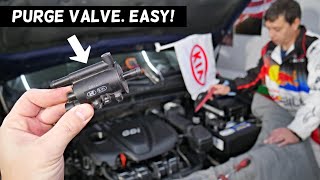
Est. part cost: $70-$150 - Faulty Purge Control Solenoid Valve (PCSV) 🟡 Medium Probability → Shop Vapor Canister Purge Solenoid The purge valve, typically located on or near the intake manifold, can get stuck open, creating a constant small leak path. This is a common failure item across many Kia/Hyundai models. Service Action SA142 was issued for some 2012 Optima Hybrids to inspect and replace specific PCSV units.
How to confirm: With the engine running, a technician can disconnect the EVAP line from the valve to feel for vacuum when it should be closed. It can also be removed and tested for leaks with a vacuum pump; it should be normally closed and hold vacuum. A YouTube video for a 2013 Optima shows its location and replacement process.
Typical fix: Replace the purge control solenoid valve.
Est. part cost: $40-$90 - Cracked or Leaking Charcoal Canister 🟡 Medium Probability → Shop Vapor Canister Kia issued a Pitstop bulletin (PS322) for the 2015 Optima specifically mentioning charcoal canister leaks in relation to code P0456. Canisters can crack from road debris or age. A voluntary service campaign (SC199) was also issued for some 2011-2015 Optimas to install an auxiliary canister to meet emissions standards, highlighting the focus on this component.
How to confirm: A visual inspection may reveal cracks. A smoke test is the most effective method, as smoke will be seen exiting from any cracks in the canister body.
Typical fix: Replace the charcoal canister assembly.
Est. part cost: $150-$300 - Cracked or Disconnected EVAP Hoses ⚪ Low Probability Rubber hoses can become brittle and crack over time due to heat and age. The connections at the purge valve, canister, and fuel tank are common places to check. Rusted hose clamps can also fail, causing a leak.
How to confirm: Visually inspect all accessible EVAP lines between the engine bay, charcoal canister, and fuel tank. A smoke test will quickly reveal leaks from cracked or disconnected hoses.
Typical fix: Replace the specific section of cracked hose or reconnect a loose line.
Est. part cost: $10-$50
Rare But Worth Checking
- Damaged Fuel Pump Seal: → Shop Fuel Pump A Kia Pitstop bulletin for 2017-2018 Optima Hybrids notes that if no other cause is found, a torn or split fuel pump seal can cause a P0456 and a fuel smell. A YouTube video on a 2012 Optima showed a P0456 was caused by a rotten fuel tank around the fuel pump opening, requiring tank replacement.
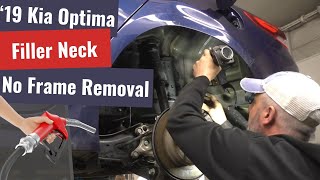
- Cracked Fuel Filler Neck: → Shop Fuel Filler Neck Rust or physical damage can cause small cracks in the metal tube leading to the gas tank, creating a leak. A detailed diagnostic video on a 2019 Optima with P0456 found the leak was a pinhole rusted through the filler neck directly under the mounting clamp, a spot that can be hard to see without a smoke test.
- Cracked Fuel Tank: → Shop Fuel Tank While rare, a small crack at the top of the fuel tank, especially around seams or the fuel pump mounting area, can cause this code. This was demonstrated in a YouTube video where a 2012 Optima's fuel tank was rotted and cracked, causing the P0456 code.
Diagnosis Steps
- Read the code with an OBD-II scanner to confirm P0456 is present.
- Inspect the gas cap. Ensure it is tight and the seal is not cracked or dirty. Tighten it until it clicks. Clear the code and drive for a few days. If it returns, consider replacing the cap with an OEM part as a cheap first step.
- Perform a visual inspection of all visible EVAP hoses and lines in the engine bay and under the vehicle for obvious cracks or disconnections. Pay special attention to the fuel filler neck area for signs of rust or damage.
- If no obvious issues are found, the most effective next step is to have a smoke test performed. A machine fills the EVAP system with a harmless, visible vapor under low pressure.
- While the smoke test is running, inspect the purge valve, canister close valve (NVLD), charcoal canister, and all connecting lines for smoke, which indicates the location of the leak.
- Pay close attention to the NVLD assembly and the fuel filler neck under its mounting clamp, as these are known failure points according to Kia TSBs and technician repair videos.
- If no leaks are found with the smoke test, a technician may need to use a bi-directional scan tool to command the purge and vent valves to operate while monitoring the fuel tank pressure sensor to isolate an intermittent or functional fault.
Parts You'll Likely Need
- Fuel Cap
(OEM #31010-3L600)— This is the most frequent and simplest fix for a P0456 code. The seal wears out over time. Forum users stress the importance of using an OEM cap to ensure a proper seal.
Trusted brands: Kia (OEM)
OEM price range: $25-$40
Aftermarket price range: $15-$25 - Canister Close Valve / Natural Vacuum Leak Detector (NVLD)
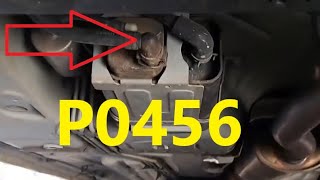
(OEM #31480-4R100QQK (for 2011-2015 Hybrid per TSB SA447))— This component is a known failure point identified in multiple Kia TSBs (FUE049, FUE046, SA447) for causing P0456. It is located near the charcoal canister at the rear of the vehicle.
Related Codes That Often Appear With This One
- P0442 — This code indicates a 'medium' leak. It can appear alongside P0456 if the leak size is on the borderline between the two thresholds or if there are multiple leaks.
- P0455 — This indicates a 'large' leak. If a component fails catastrophically (e.g., a large crack in the canister or a completely disconnected hose), it could be triggered along with the small leak code during different phases of the EVAP monitor test.
Technical Service Bulletins (TSBs) & Recalls

- TSB FUE049: Addresses P0456 on 2011-2016 models related to the NVLD.
- TSB FUE046: Addresses P0456 on 2016-2019 Optima HEV models related to the FVLD/NVLD.
- SA447: Service Action for 2011-2015 Optima Hybrid, replacing NVLD and fuel tank air filter for P0456.
- SA421: Service Action for 2016-2018 Optima HEV for P0456.
- PS322: Pitstop bulletin mentioning charcoal canister leaks for P0456 on the 2015 Optima.
- SC199: Voluntary Emissions Service Campaign for 2011-2015 Optima 2.4L to install an auxiliary evaporative canister.
Platform-Specific Known Issues
- TSB FUE049 / SA447: Affects 2011-2016 models. Points to a faulty Natural Vacuum Leak Detector (NVLD) as the cause for P0456. The fix involves replacing the NVLD and fuel tank air filter if the code is active.
- TSB FUE046 / SA421: Affects 2016-2019 Optima HEV models. Also identifies the leak detection unit (FVLD) and fuel tank air filter as the problem parts for a P0456 code.
- PS322: A 'Pitstop' bulletin for 2015 models that specifically calls out checking for charcoal canister leaks when diagnosing P0456.
- NHTSA ODI #11387482: An owner of a 2014 Optima reported a strong smell of fuel along with the P0456 code, confirming this as a primary symptom.
Mechanic-Grade Diagnostic Values
- Fuel Tank Pressure Sensor (FTPS) signal voltage, KOEO, gas cap OFF — expected: ~2.5V (indicating atmospheric pressure). Failure: Voltage significantly different from 2.5V, or no 5V reference power at the sensor connector.
- Fuel Tank Pressure Sensor (FTPS) signal voltage during manual PCSV test — expected: Should be greater than 1.5V. Failure: Voltage drops below 1.5V, indicating a restriction in the EVAP system (e.g., rollover valve, canister, CCV).
- Fuel Tank Pressure Sensor (FTPS) signal voltage during manual system pulldown — expected: Should rise to ~3.0V when vacuum is applied. Failure: Voltage does not rise, or falls below 1.5V after being sealed, indicating a leak.
Hidden / Shadow Codes Worth Checking
- P0456pd: This is a 'pending' code. It indicates that the fault was detected during the current or last driving cycle but has not yet met the criteria to illuminate the Check Engine Light. Its presence alongside a stored P0456 can help confirm an active fault. (see via Most standard OBD-II scanners will show pending codes separately from stored/active codes.)
Scan Tool Commands That Help
- Kia KDS/GDS (OEM Scan Tool): Evap. Leakage Test — This is the manufacturer-specified automated test to check the integrity of the entire EVAP system. It should be run after initial checks (gas cap) are complete. The command path is Home → S/W Management → Engine Control → Evap. Leakage Test.
- Professional Bi-Directional Scanner (e.g., Autel, Snap-on): Canister Close Valve (CCV) / Vent Valve Command — Used to manually close the vent valve to seal the system for a smoke test. This is a critical step to ensure the system is closed off from the atmosphere before injecting smoke.
- Professional Bi-Directional Scanner (e.g., Autel, Snap-on): Purge Control Solenoid Valve (PCSV) Command — Used to command the purge valve open and closed to test its function. A technician can feel for vacuum or listen for a click. It can also be used to check if the valve is stuck open by commanding it closed and seeing if fuel trims are affected.
- Kia KDS/GDS (OEM Scan Tool): Resetting Adaptive Values — After replacing a component like a PCSV or FTPS, resetting the engine control module's adaptive values can help the system relearn faster and confirm the fix without waiting for multiple drive cycles.
Wiring & Ground Locations
- FTPS Power and Ground — The Fuel Tank Pressure Sensor is located on top of the fuel tank, often integrated with the fuel pump assembly.. On a 2016 Optima, the FTPS gets its 5V power from the same ECM pin as the A/C pressure sensor, but has a separate ground pin at the ECM. If the FTPS shows no power with the key on, but the A/C sensor does, it points to a wiring issue between the ECM and the fuel tank rather than a faulty ECM.
- EVAP Component Pinouts — Connectors for the PCSV, CCV (NVLD), and FTPS.. Kia TSB PS469 advises technicians to tap into the control wires for manual testing and refers them to the official Kia Global Information System (KGIS) for specific vehicle pinouts, as they can vary.
- Ground Distribution — Various points on the chassis and engine block.. A poor ground for any of the EVAP solenoids or sensors can cause erratic operation and trigger false codes. Wiring diagrams for the specific model year are needed to locate the exact ground point (e.g., G###) for the component in question.
Real Owner Repair Stories
- Reddit user on r/kiacarnivals (2025 Kia Carnival (New model, but demonstrates a relevant failure mode)) — Persistent P0456 check engine light from ~1,500 miles.
❌ Tried (didn't work) Multiple dealer visits, Smoke testing the EVAP system (found no external leaks), Reseating the gas cap
✅ What actually fixed it After consultation with Kia corporate engineering, the technician diagnosed a malfunctioning internal one-way check valve within the Fuel Tank Pressure Sensor (FTPS) itself. The sensor was bleeding off pressure internally despite showing normal voltage. Replacing the FTPS (OEM part 31435-2J000) resolved the issue. - South Main Auto Repair YouTube Channel (2019 Kia Optima) — P0456 (Very Small EVAP Leak).
❌ Tried (didn't work) Owner polished the gas cap area., Initial smoke test where the flow meter ball dropped to the bottom, indicating no leak.
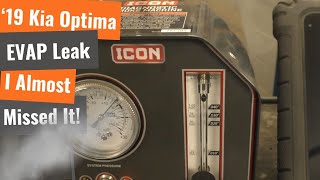
✅ What actually fixed it The technician let the smoke test run longer and noticed the flow meter ball would rhythmically bounce slightly off the bottom. This indicated a very tiny, intermittent leak. Using soapy water, he found a pinhole caused by rust on the fuel filler neck, directly hidden underneath the mounting clamp. Replacing the fuel filler neck was the correct repair. - CarGurus Forum User (2007 Kia Optima) — Recurring P0456 and P0456pd codes.
❌ Tried (didn't work) Dealer replaced Purge Control Valve., Dealer replaced gas cap with OEM part (aftermarket one was suspected)., Dealer performed smoke test and replaced Canister Close Valve (CCV).
✅ What actually fixed it After the code returned yet again, the owner personally inspected the engine bay and found a hose clamp on the (previously replaced) purge valve was not tight. He added a second clamp to secure the hose, which finally resolved the check engine light.
"I Checked Everything" — The Actual Cause
- A known failure mode for this platform is an internal malfunction of the Fuel Tank Pressure Sensor (FTPS). The EVAP system can pass a smoke test because there is no external leak, but an internal check valve in the sensor itself fails, allowing pressure to bleed off and tricking the ECU into setting a P0456 code. The fix is to replace the FTPS.
- A leak can be so small that it is missed during a standard smoke test. In one documented case on a 2019 Optima, a pinhole from rust on the fuel filler neck (hidden under a clamp) only became apparent after letting the smoke machine run for an extended period and noticing a very slight, rhythmic bounce on the flow gauge.
When the Usual Fixes Don't Work
- While common causes like the gas cap and NVLD are primary suspects, there are multiple documented cases where the P0456 code persisted after these parts were replaced. In one instance, the final fix was tightening a loose hose clamp on the purge valve that was missed during a professional repair. In another, more complex case, the root cause was an internal failure of the Fuel Tank Pressure Sensor that could not be detected by a standard smoke test, requiring replacement of the sensor itself. These cases show that if the common fixes don't work, a meticulous re-inspection of basic connections and consideration of non-leak functional failures is necessary.
OEM Part Supersession History
31480-4R000, 31480-4R100AQQK→31480-4R100— Part revision/update by manufacturer.
Heads up: These part numbers are associated with the NVLD/Pressure Sensor assembly for Optima Hybrids mentioned in TSBs. Using the latest superseded part number (31480-4R100) is recommended for repairs.
Model Year Variations Within This Range
- 2012 Hybrid only: Service Action SA142 was issued for a specific production range of 2012 Optima Hybrids. It requires a visual inspection of the Purge Control Solenoid Valve (PCSV). If the number '2' is embossed on the underside of the valve, it must be replaced. This indicates a known bad batch of parts affecting a narrow model range.
- 2011-2015 (TF) vs 2016-2018 (JF): Kia issued separate TSBs for the different generations. TSB FUE049 and SA447 apply to the earlier TF models, while TSB FUE046 and SA421 apply to the later JF models (specifically Hybrids), indicating different part numbers or common failure patterns for the NVLD/FVLD assemblies between generations.
Helpful Videos
![How to Fix KIA P0456 Engine Code in 3 Minutes [2 DIY Methods / Only $4.44]](https://img.youtube.com/vi/SbOPVLctNtg/mqdefault.jpg)

We Have This Part in Stock


The information in this article is provided for general reference and educational purposes only. Vehicle specifications, procedures, and part compatibility can vary by production date, trim level, and region. Always consult your vehicle's factory service manual and verify part numbers before purchasing or performing repairs. Safety-critical components such as airbags, seat belts, and braking systems should be installed by a qualified professional.
- Kia OPTIMA:
- 🧭 Diagnostic Flowchart
- 🎬 Helpful Videos
- 🛍️ Shop This Part
- What's Unique About the 2011-2018 Kia OPTIMA
- Symptoms You May Notice
- Most Likely Causes
- Rare But Worth Checking
- Diagnosis Steps
- Parts You'll Likely Need
- Related Codes That Often Appear With This One
- Technical Service Bulletins (TSBs) & Recalls
- Platform-Specific Known Issues
- Mechanic-Grade Diagnostic Values
- Hidden / Shadow Codes Worth Checking
- Scan Tool Commands That Help
- Wiring & Ground Locations
- Real Owner Repair Stories
- "I Checked Everything" — The Actual Cause
- When the Usual Fixes Don't Work
- OEM Part Supersession History
- Model Year Variations Within This Range
- 🎟️ Get 5% Off