

P0456 on 2009 Mercury Mariner Hybrid: EVAP Small Leak Causes and Fixes
For a 2009 Mercury Mariner Hybrid, code P0456 is most often caused by a faulty canister purge valve located on the engine. The second most likely cause is an issue with the 'Easy Fuel' capless filler neck. Replacing the purge valve is a common DIY fix costing around $30-$60.
- P0456 on your 2009 Mariner Hybrid indicates a very small leak in the fuel vapor system.
- The most likely cause is a faulty canister purge valve on the engine, a known issue for this vehicle.
- Before buying parts, inspect and clean the capless fuel filler neck, as a poor seal there is the second most common cause.
- This code will not affect how the vehicle drives but needs to be fixed to pass an emissions test.
- If you also have code P1450, it's almost certain the canister purge valve has failed.
What's Unique About the 2009-2009 Mercury Mariner Hybrid
The 2009 Mercury Mariner Hybrid is mechanically identical to the Ford Escape Hybrid and Mazda Tribute Hybrid. This model year uses the Ford 'Easy Fuel' capless system, which can be a source of leaks if the internal flap or seal is dirty or worn. However, the most frequent and well-documented cause of P0456 on this platform is a failing canister purge valve, a problem noted in Ford Technical Service Bulletin (TSB) 10-1-3 for this specific vehicle.
Symptoms You May Notice
- Check Engine Light is on
- A faint fuel smell may be noticeable, particularly after refueling or when parked.
- In rare cases, if the purge valve is stuck open, you might experience a rough idle or difficulty starting immediately after refueling.
- Replacing the gas cap. This vehicle does not have a traditional gas cap; the issue would be with the capless filler neck itself.
- Replacing other EVAP components before properly testing the canister purge valve, which is the most common failure by a wide margin.
Most Likely Causes
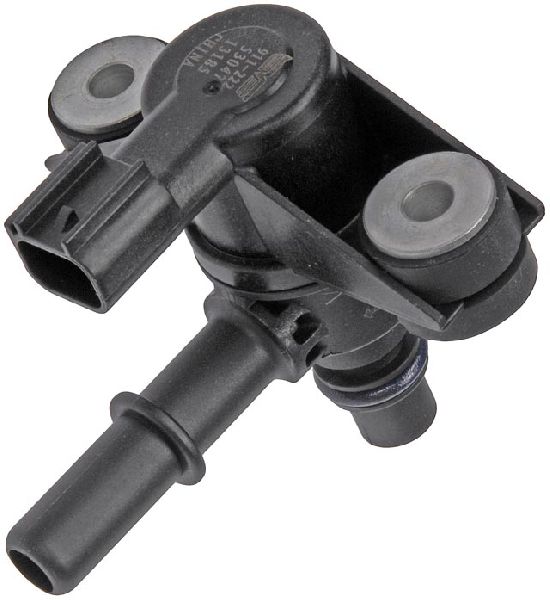
- Faulty Canister Purge Valve (Solenoid) 🔴 High Probability → Shop Vapor Canister This is a very common failure part on many Ford/Mercury models of this era. The valve can get stuck open or fail to seal properly, creating a small vacuum leak. TSB 10-1-3 was issued for this issue on the 2009 Mariner Hybrid.
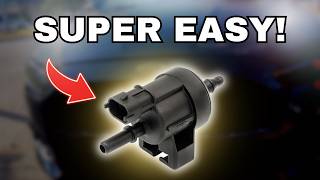
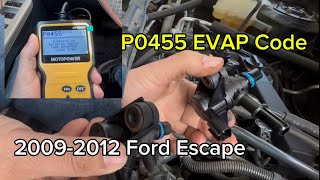
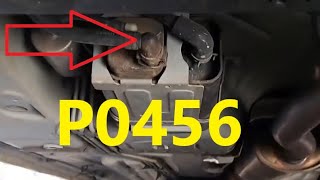
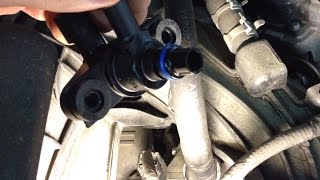
How to confirm: With the engine running and the electrical connector unplugged from the purge valve, disconnect the vapor line running from the valve towards the back of the vehicle. Place your finger over the port on the valve itself. If you feel any vacuum suction, the valve is stuck open and is faulty. This is the most definitive test. 🎬 Watch: How to test and replace the purge valve yourself. An older method is to try blowing through the valve with it removed from the car; no air should pass.
Typical fix: Replace the canister purge valve. It is located on the front of the engine and is typically held in place by two 8mm bolts.
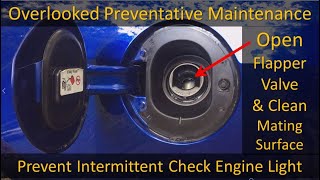
Est. part cost: $30-$60 - Leaking Capless Fuel Filler Neck 🟡 Medium Probability → Shop Fuel Filler Neck The 2009 Mariner uses Ford's 'Easy Fuel' capless system. Debris, dirt, or rust can get trapped in the spring-loaded flap, preventing a proper seal and causing a small leak.
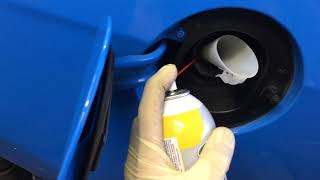
How to confirm: Visually inspect the fuel filler opening for any dirt, rust, or debris. Use the emergency fuel funnel (usually stored with the spare tire tools) to work the flap open and closed several times. Spray a small amount of WD-40 or silicone lubricant on the seal and work the funnel again to clean and lubricate the mechanism. Clean the sealing area with a rag and some rubbing alcohol.
Typical fix: Clean and lubricate the filler neck opening as described above. This simple procedure often resolves the code. If cleaning doesn't work and a smoke test confirms the leak is at the filler neck, the entire assembly may need to be replaced.
Est. part cost: $5-$15 for cleaning supplies, $150-$300 for a replacement filler neck. - Cracked or Disconnected EVAP Hoses ⚪ Low Probability Over time, rubber and plastic hoses can become brittle, crack, or come loose from their fittings, creating small leaks.
How to confirm: Visually inspect all accessible EVAP hoses between the engine, purge valve, and the charcoal canister (located near the fuel tank). A smoke test is the most effective way to pinpoint a small hose leak that isn't visually obvious.
Typical fix: Replace the cracked or damaged section of hose. Ensure all connections are secure.
Est. part cost: $10-$50
Rare But Worth Checking
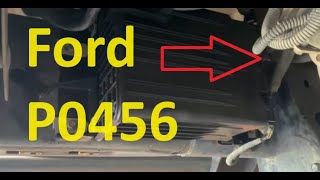
- Faulty EVAP Canister Vent Solenoid: → Shop Vapor Canister This valve, located near the charcoal canister under the vehicle, can fail to close during the EVAP system self-test, causing a leak code. It's less common than the purge valve failure but is a known possibility.
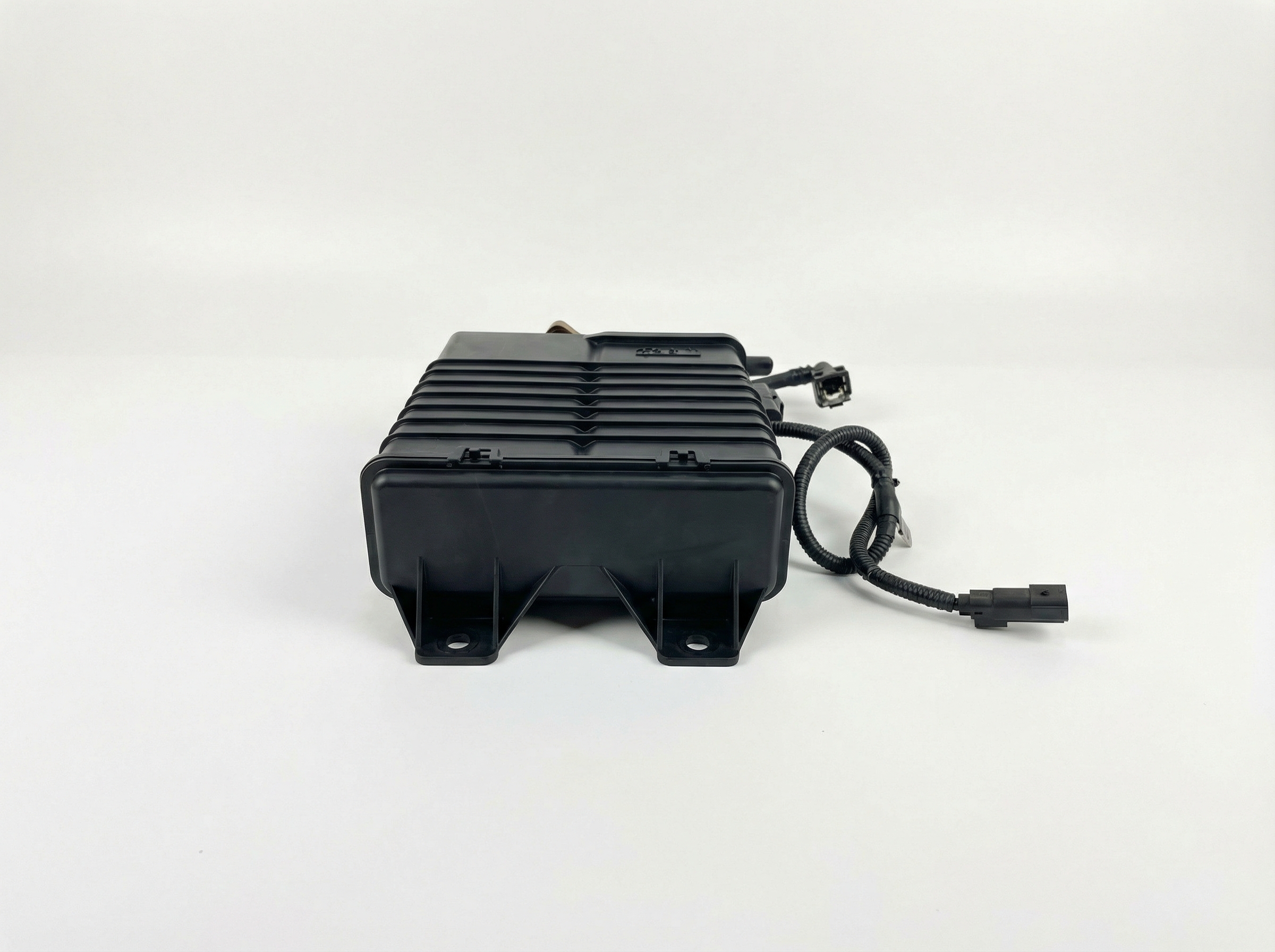
- Cracked EVAP (Charcoal) Canister: → Shop Vapor Canister Physical damage or age can cause the plastic housing of the charcoal canister to develop hairline cracks, leading to a small leak. This is usually found with a smoke test.
Diagnosis Steps
- Read the code: Use an OBD-II scanner to confirm P0456 is the active code and check for any other related codes like P1450.
- Inspect and clean the fuel filler neck: Check the capless filler neck for debris. Use the emergency funnel and a lubricant like WD-40 to operate the flap and clean the sealing surface.
- Clear codes and drive: After cleaning the filler neck, clear the codes with the scanner and drive the vehicle for a few days to see if the light returns. The EVAP monitor runs under specific conditions, so it may take time.
- Test the canister purge valve: If the light returns, the purge valve is the next most likely culprit. With the engine running, disconnect the valve's electrical plug and outlet hose, then feel for vacuum at the outlet port. Any suction indicates a failed, stuck-open valve.
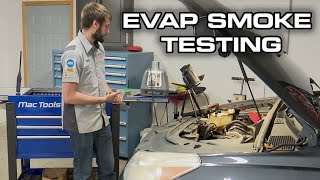
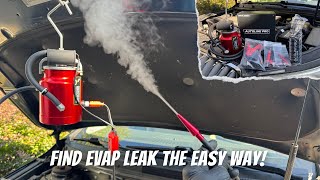
- Perform a smoke test: If the purge valve tests good, the most reliable way to find the small leak is to introduce smoke into the EVAP system using a smoke machine. The smoke will exit from the point of the leak (e.g., a cracked hose, canister, or vent solenoid).
Parts You'll Likely Need
- Canister Purge Valve / Solenoid
(OEM #9U5Z-9C915-H (Motorcraft CX2221))— This is the most common failure point for P0456 on this platform, as documented by owner experiences and a specific TSB.
Trusted brands: Motorcraft, Standard Motor Products (SMP), Dorman
OEM price range: $40-$70
Aftermarket price range: $25-$50
Related Codes That Often Appear With This One
- P1450 — This code for 'Unable to Bleed Up Fuel Tank Vacuum' is often caused by the exact same failure as P0456: a stuck-open canister purge valve. TSB 10-1-3 addresses both codes together for this vehicle.
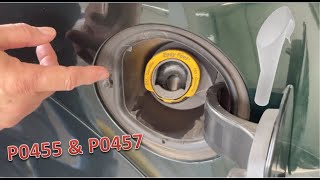
- P0455 — Indicates a 'Gross EVAP Leak'. Sometimes a component on the verge of failure, like a purge valve or filler neck seal, can cause either a small (P0456) or large (P0455) leak code to be set at different times.
- P0442 — Indicates a 'Medium EVAP Leak'. Similar to P0455, this code can appear for the same root causes as P0456, just with the leak being detected as a different size. TSB 10-1-3 also includes this code.
Technical Service Bulletins (TSBs) & Recalls
- TSB 10-1-3: Addresses DTCs P0442, P0456, or P1450 on 2009 Mariner Hybrid models, pointing to a known EVAP system issue, most commonly resolved by replacing the canister purge valve.
Platform-Specific Known Issues
- TSB 10-1-3 was issued for 2009 Mariner Hybrid vehicles (built on or before April 6, 2009) that may exhibit a Check Engine Light with codes P0442, P0456, or P1450. The bulletin points towards a potential issue with the EVAP system that often involves the canister purge valve.
- The Mazda Tribute Hybrid from 2009-2011 uses the same 2.5L powertrain and EVAP components, including the same purge valve, and is susceptible to the same P0456 failures.
Mechanic-Grade Diagnostic Values
- Canister Purge Valve Solenoid Resistance — expected: 30 to 38 ohms. Failure: A reading outside this range (e.g., open circuit or short) indicates a faulty solenoid coil.
- Canister Vent Solenoid Resistance — expected: 48 to 65 ohms. Failure: A reading of OL (open) or near zero (short) indicates the solenoid has failed.
Scan Tool Commands That Help
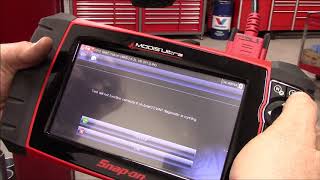
- Ford IDS (or equivalent professional scanner): EVAP System Test — This is an automated test the PCM runs to check for leaks. A technician can manually initiate this test to verify a repair without waiting for a full drive cycle.
- Ford IDS (or equivalent professional scanner): Output Test Mode: Close Canister Vent Solenoid — This command is critical when performing a smoke test. The normally-open vent solenoid must be commanded shut to seal the EVAP system, allowing it to be pressurized with smoke to find leaks. 🎬 Watch: How to perform a smoke test to find leaks.
Wiring & Ground Locations
- G104 — Located at the left front of the engine compartment.. This is a primary engine bay ground point. A corroded or loose G104 ground can cause intermittent electrical issues for various engine sensors and solenoids, including the canister purge valve, leading to incorrect operation and fault codes.
- Canister Purge Valve Connector — On the canister purge valve itself, located on the front of the engine near the throttle body.. This is a 2-wire connector that supplies power and control signals to the purge valve. The wires or connector pins can become damaged, causing an electrical fault. A replacement pigtail connector is available (e.g., Standard Motor Products S-1752), indicating it's a known repair item.
Real Owner Repair Stories
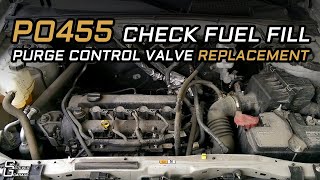
- YouTube channel SE's Garage (2010 Mercury Mariner (2nd Gen, same platform)) — Check Engine Light with code P0455 (Gross Leak) and a 'check fuel fill' message.
❌ Tried (didn't work) The user noted that while other things can cause the code, the purge valve is so common, cheap, and easy to replace that it's a good place to start.
✅ What actually fixed it Replacing the canister purge valve ($17 part from Amazon) resolved the Check Engine Light. The user confirmed this in the video's description. - NHTSA ODI #10524401 (Mercury Milan - Cross-model reference) — An owner reported that while investigating a potential throttle body issue, a diagnostic scan returned code P0456, indicating the need to replace a valve as signaled by the "Service Engine" light.
"I Checked Everything" — The Actual Cause
- On some Ford platforms, it is possible for the EVAP system to pass a smoke test (showing no physical leaks) but still set a P0456 code. This can be caused by a faulty Fuel Tank Pressure (FTP) sensor providing incorrect readings to the PCM, or a software glitch in the Powertrain Control Module (PCM) that misinterprets data and falsely flags a leak. In these cases, the fix may be a PCM reflash performed by a dealer, not a physical part replacement.
OEM Part Supersession History
9U5Z-9C915-H→9U5Z-9C915-J— Standard part revision and improvement by the manufacturer.
Heads up: The new part number (9U5Z-9C915-J) is the correct service replacement for the original. There are no known incompatibility issues.
Model Year Variations Within This Range
- 2009 (built on or before April 6, 2009): Vehicles built before this date are specifically called out in TSB 10-1-3 for exhibiting P0442, P0456, or P1450. This suggests an early production run may have had a higher incidence of the purge valve failure that the TSB addresses.
Diagnostic Flowchart
Other Known Issues on This Vehicle
Issues unrelated to this code that are worth knowing about as an owner of this generation:
- Electronic Throttle Body (ETB) Failure 🔴 High — Very common. Can occur at various mileages, leading to sudden power loss and 'limp home mode'. (Ref: Ford Customer Satisfaction Program 13N03 extended the warranty on the ETB to 10 years or 150,000 miles.)
- Power Steering Failure 🔴 High — Common enough to warrant a recall. The steering torque sensor can fail, resulting in a sudden loss of electric power steering assist. (Ref: NHTSA Recall 14V284000.)
- HVAC Blend Door Actuator Failure 🟠 Medium — A frequent complaint where the small plastic gears inside the actuator fail, causing clicking noises from the dash and an inability to control cabin temperature.
- Hybrid Coolant Pump Failure 🔴 High — A known failure point on hybrid models where the Motor Electronics Coolant Pump fails, which can lead to overheating of hybrid components and potential engine shutdown. (Ref: This was addressed by Ford Safety Recall 14S22 for some earlier models, but remains a known issue for this generation.)
Used vs. New Parts: Buying Guide for This Vehicle
When a used part is the smart pick: A used 'Easy Fuel' filler neck assembly can be a cost-effective option, as a new one is relatively expensive. It is a largely mechanical part, and its condition is easy to assess visually. A used charcoal canister or vent solenoid can also be viable.
Donor-vehicle mileage cap: roughly under 80000 miles for the part to have meaningful remaining life.
What to inspect on the donor part:
- For a filler neck, inspect the internal flap for smooth operation and ensure the sealing surface is free of rust, pitting, or damage.
- Source parts from vehicles in dry, non-salt-belt climates to avoid corrosion and brittle plastic issues.
- Verify the donor vehicle did not have any EVAP-related trouble codes stored.
Aftermarket brands forum-validated for this vehicle:
- Canister Purge Valve: Motorcraft (OEM), Standard Motor Products (SMP), Dorman.
- Due to the low cost and high failure rate of the purge valve, a new aftermarket part is strongly recommended over a used one.
Brands owners have reported issues with on this vehicle:
- No specific brands are consistently reported as problematic, but ultra-low-cost, unbranded parts from online marketplaces may have questionable quality control.
Real Owner Stories
Aggregated from forums and TSBs cited above. Mileages and costs reflect what owners reported in those sources.
2011 Ford Escape 2.5L
Symptoms: The owner was dealing with a P0456 Small EVAP Leak code that was difficult to 'see' or locate through standard visual inspection.
What fixed it: A professional diagnosis revealed an intermittently sticking purge valve that required a live vacuum test to identify, as it could pass a simple blow-through test while failing during operation.
Source hint: YouTube: P0456 Small EVAP Leak - What To Check When You Can't 'See' The Leak by South Main Auto Repair
2009 Ford Escape 3.0L V6
Symptoms: Check Engine Light on with code P0456.
What fixed it: Replacing the canister purge valve after confirming it was faulty by feeling for vacuum suction at the port while the electrical connector was unplugged.
Cost: $30-$60
Source hint: YouTube: How to test / replace Ford Escape P0456 Evap Purge Valve by Uncle Tinman
2009 Mercury Mariner Hybrid 2.5L
Symptoms: Recurring P0456 code on a capless fuel system.
What fixed it: Thoroughly cleaning and lubricating the capless fuel filler neck using a solvent and the emergency funnel to restore the seal.
Cost: $5-$15
Source hint: BobIsTheOilGuy Forum: Quick & Fix for Capless Fuel Systems
2009 Mercury Mariner Hybrid 2.5L
Symptoms: Check Engine Light active with P0456; replacing the purge valve and performing a smoke test did not immediately resolve the issue.
What fixed it: The owner highlighted that some leaks in this system can be very elusive, even after standard part replacement and smoke testing.
Source hint: Reddit /r/MechanicAdvice: Still getting P0456 code even after purge valve replacement (multiple times)
Mercury Milan (Cross-Model Reference)
Symptoms: An owner reported the traction light coming on along with a series of diagnostic codes including C1277, C1963, P1450, and P0456 at 117,000 miles (NHTSA ODI #11074537).
Related OBD-II Codes
Frequently Asked Questions
Does TSB 10-1-3 apply to my 2009 Mercury Mariner Hybrid?
I have a P0456 and a faint fuel smell after refueling my Mariner; what is the most likely cause?
Can I fix the P0456 code on my Mariner Hybrid without replacing parts?
Where is the canister purge valve located on the 2009 Mariner Hybrid?
Is there a specific tool I need to clean the capless fuel filler neck?
Does the 2009 Mazda Tribute Hybrid have the same P0456 issues as my Mariner?
Helpful Videos
Used OEM Parts in Stock

New Aftermarket Parts Available


The information in this article is provided for general reference and educational purposes only. Vehicle specifications, procedures, and part compatibility can vary by production date, trim level, and region. Always consult your vehicle's factory service manual and verify part numbers before purchasing or performing repairs. Safety-critical components such as airbags, seat belts, and braking systems should be installed by a qualified professional.
- Mercury Mariner Hybrid:
- 🧭 Diagnostic Flowchart
- 🎬 Helpful Videos
- 🛍️ Shop This Part
- What's Unique About the 2009-2009 Mercury Mariner Hybrid
- Symptoms You May Notice
- Most Likely Causes
- Rare But Worth Checking
- Diagnosis Steps
- Parts You'll Likely Need
- Related Codes That Often Appear With This One
- Technical Service Bulletins (TSBs) & Recalls
- Platform-Specific Known Issues
- Mechanic-Grade Diagnostic Values
- Scan Tool Commands That Help
- Wiring & Ground Locations
- Real Owner Repair Stories
- "I Checked Everything" — The Actual Cause
- OEM Part Supersession History
- Model Year Variations Within This Range
- Other Known Issues on This Vehicle
- Used vs. New Parts: Buying Guide for This Vehicle
- Real Owner Stories
- 2011 Ford Escape 2.5L
- 2009 Ford Escape 3.0L V6
- 2009 Mercury Mariner Hybrid 2.5L
- 2009 Mercury Mariner Hybrid 2.5L
- Mercury Milan (Cross-Model Reference)
- Related OBD-II Codes
- Frequently Asked Questions
- 🎟️ Get 5% Off