

P0456 on 2002-2007 Mitsubishi Lancer: Causes and Fixes for a Small EVAP Leak
The P0456 code on a 2002-2007 Lancer indicates a very small leak in the evaporative emissions (EVAP) system. The most common and cheapest fix is replacing a worn or loose gas cap. If that doesn't work, the next likely culprits are a rusted fuel filler neck, a cracked EVAP hose, or a faulty purge or vent solenoid.
- Code P0456 on a 2002-2007 Lancer means the computer has detected a very small leak in the fuel vapor (EVAP) system.
- Always start with the simplest and most likely fix: check that your gas cap is tight. If it's old, replace it. This solves the problem a majority of the time.
- If a new gas cap doesn't fix it, visually inspect the rubber EVAP hoses for cracks, especially in the engine bay and near the rear driver's side wheel where the charcoal canister is located.
- The next most likely parts to fail are the EVAP purge solenoid (in the engine bay) and the vent solenoid (on the charcoal canister).
- Finding a very small leak can be difficult without a smoke machine. If simple checks don't reveal the cause, a smoke test at a repair shop is the most efficient way to find the leak.
What's Unique About the 2002-2007 Mitsubishi Lancer
For the 2002-2007 Mitsubishi Lancer, the P0456 code is frequently caused by more than just a loose gas cap. A very common and platform-specific failure point is the fuel filler neck, which is prone to rusting through where it is obscured by a plastic shield in the wheel well. This area traps salt and moisture, leading to pinhole leaks that are a perfect match for a P0456 code. The EVAP system components, like the charcoal canister and vent solenoid, are located under the rear of the car near the driver's side, making them susceptible to road debris and corrosion. Owner experiences frequently point to the gas cap as the first check, followed by a close inspection of the filler neck, and then testing the purge solenoid in the engine bay.
Generation note: The 2002-2007 year range primarily covers the eighth generation of the Mitsubishi Lancer (chassis code CS). However, the ninth generation (chassis code CY) was introduced in 2007. While the fundamental causes of an EVAP leak are the same, part numbers and the exact location of components like the purge solenoid may differ between these two generations. This guide focuses on the more common 2002-2006 eighth-generation models.
Symptoms You May Notice
- Check Engine Light is on
- A faint smell of fuel, particularly around the rear of the car or after refueling
- Slightly rough idle or difficulty starting after refueling if the purge solenoid is stuck open
- Replacing the O2 sensors. O2 sensors are not related to the EVAP system and will not fix this code.
- Replacing the fuel pump. While the fuel pump module seal can leak, the pump itself is not a cause for a P0456 code.
Most Likely Causes
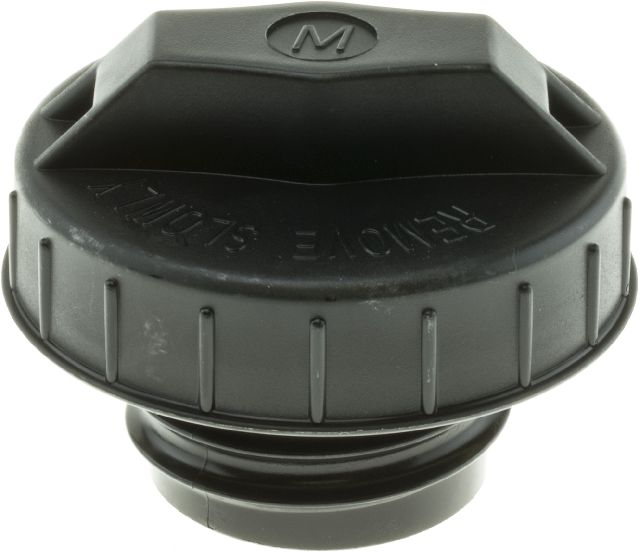
- Loose, worn, or incorrect gas cap 🔴 High Probability → Shop Fuel Tank Cap The gas cap seal is a rubber O-ring that degrades and hardens over time, preventing a proper seal. This is the most common failure point in any EVAP system. Many owners report that cheap, aftermarket caps fail to seal properly, so using an OEM or reputable brand like Stant is recommended.
How to confirm: First, ensure the cap is tightened until it clicks several times. Inspect the rubber seal on the cap for cracks, stiffness, or damage. If the seal looks worn, replacement is the best confirmation.
Typical fix: Replace the gas cap. It's a simple, inexpensive first step that often resolves the code.
Est. part cost: $10-$30 - Rusted or cracked fuel filler neck 🔴 High Probability → Shop Fuel Filler Neck This is a very common issue on Lancers of this generation, especially in areas with road salt. The metal filler neck runs through the rear wheel well, where a plastic shield traps moisture and debris, causing the neck to rust and develop pinhole leaks. Similar corrosion issues have been documented across the manufacturer's lineup; for instance, NHTSA ODI #10420972 describes a case where the fuel filler neck tube and all vent lines were found to be totally corroded.
How to confirm: A smoke test is the best method; smoke will be seen exiting from the rear wheel well area. Visual inspection requires removing the wheel and the plastic shield covering the filler neck. Look for bubbling rust or dampness on the pipe itself.
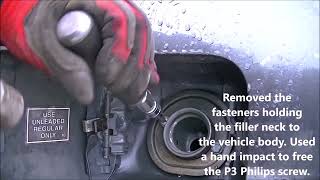
Typical fix: Replace the entire fuel filler neck assembly. 🎬 Watch this walkthrough on replacing a heavily rusted filler neck. This is a labor-intensive but common repair for this specific vehicle and code.
Est. part cost: $100-$200 - Cracked or disconnected EVAP hose 🟡 Medium Probability The rubber hoses in the EVAP system, especially those running from the charcoal canister to the fuel tank and purge valve, can become brittle and crack with age and exposure to the elements.
How to confirm: Visually inspect all accessible EVAP hoses in the engine bay and under the rear of the vehicle near the charcoal canister for cracks, splits, or loose connections. A smoke test is the most effective way to find a very small leak that isn't visually obvious.
Typical fix: Replace the damaged section of hose. Ensure clamps are secure.
Est. part cost: $5-$20 - Faulty EVAP Purge Solenoid/Valve 🟡 Medium Probability → Shop Vapor Canister This solenoid, typically located on the firewall or intake manifold in the engine bay, can get stuck open or closed, or develop a small leak in its diaphragm.
How to confirm: With the engine off, the valve should be closed. You can disconnect it and try to blow through it; if air passes, it's stuck open. It can also be tested by applying 12V to its terminals; a healthy solenoid will make an audible click. The resistance should be between 22-26 Ω or 30-38 Ω depending on the specific part installed.
Typical fix: Replace the purge solenoid. On many Lancers, it's mounted near the intake manifold.
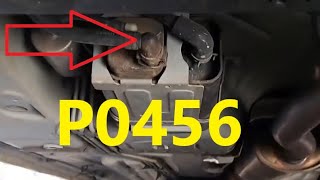
Est. part cost: $40-$80 - Faulty EVAP Vent Solenoid/Valve ⚪ Low Probability → Shop Vapor Canister Located near the charcoal canister at the rear of the car (driver's side), this valve can fail to close properly during the EVAP system's self-test, causing a leak. Its location makes it vulnerable to road salt and moisture.
How to confirm: This valve is normally open and closes only when commanded by the ECM during a test. Diagnosis usually involves a scan tool to command the valve closed and a smoke machine to check for leaks. Resistance should be between 48-65 ohms. A failing O-ring at the mounting point is also a possibility.
Typical fix: Replace the vent control valve assembly.
Est. part cost: $50-$100
Rare But Worth Checking
- Cracked charcoal canister: → Shop Vapor Canister The plastic housing of the canister itself can develop hairline cracks from age or impact, creating a very small leak. This is usually found with a smoke test after all other components have been checked.
- Small leak in the fuel tank or fuel pump gasket: → Shop Fuel Pump Rust or physical damage can create a small perforation in the fuel tank itself. Additionally, the gasket for the fuel pump access panel under the rear seat can fail, causing a leak and a strong fuel smell inside the cabin.
Diagnosis Steps
- Read the code from the OBD-II port using a scanner.
- Inspect the gas cap for damage and ensure it is tight. If in doubt, replace it with an OEM or quality aftermarket cap, clear the code, and drive for a few days to see if it returns.
- If the code comes back, perform a thorough visual inspection of all EVAP hoses and lines, from the engine bay to the charcoal canister at the rear of the vehicle. Look for any obvious cracks, disconnections, or rot.
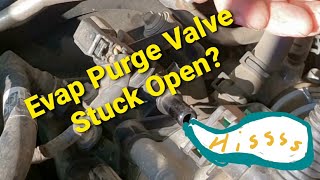
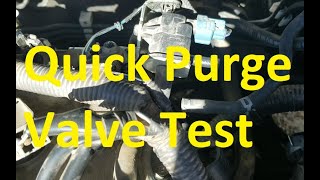
- Locate the EVAP purge solenoid in the engine bay. With the engine off, disconnect the hoses and check if it's properly sealed (no air should pass through). Apply 12V power to see if it clicks open. Check the resistance across the terminals, which should be within 22-38 ohms. 🎬 Watch: How to test your purge valve without any tools.
- If no visual faults are found, the most effective next step is to have a professional perform a smoke test. This involves injecting pressurized smoke into the EVAP system to pinpoint the exact location of the tiny leak. Pay close attention to the rear driver's side wheel well area, as the filler neck is a very common failure point.
- If the smoke test indicates a leak near the filler neck, remove the rear wheel and plastic splash guard to inspect the neck thoroughly for rust holes.
- Based on the smoke test results, replace the leaking component, which could be a hose, the filler neck, the vent valve, the purge valve, or the canister itself.
- After the repair, clear the DTC and perform a drive cycle to allow the ECM to re-test the EVAP system and confirm the fix.
Parts You'll Likely Need
- Fuel Tank Cap
(OEM #MN106232, 1711A015)— This is the most frequent first attempt at a fix due to the rubber seal wearing out over time.
Trusted brands: Mitsubishi Genuine, Stant, Gates
OEM price range: $30-$45
Aftermarket price range: $10-$25 - Fuel Filler Neck
(OEM #MN120043)— A very common failure point on this specific vehicle due to rust creating pinhole leaks.
Trusted brands: Mitsubishi Genuine, Spectra Premium, Dorman
OEM price range: $150-$220
Aftermarket price range: $100-$160 - EVAP Purge Solenoid
(OEM #MR507781)— This valve is a common failure point that can get stuck or develop a leak, causing a P0456 code.
Trusted brands: Standard Motor Products, Duralast, Genuine Mitsubishi
OEM price range: $60-$90
Aftermarket price range: $40-$70 - EVAP Vent Solenoid
(OEM #MR573877)— Though less common than the purge solenoid, this valve near the canister can fail to seal during system tests, causing a leak.
Trusted brands: Dorman (911-850), Standard Motor Products, Bosch
OEM price range: $70-$120
Aftermarket price range: $50-$90
Related Codes That Often Appear With This One
- P0442 — P0442 indicates a 'small leak detected,' which is slightly larger than the 'very small leak' of P0456. They can appear together if the size of the leak is on the borderline between the two thresholds. One owner reported getting a P0442 after replacing the gas cap for a P0456, indicating the new cap may not have sealed correctly.
- P0455 — P0455 indicates a 'gross leak'. A small rust hole in the filler neck can quickly grow, escalating a P0456 to a P0455.
Technical Service Bulletins (TSBs) & Recalls
- TSB-05-17-001: This technical service bulletin provides updated diagnostic procedures for various EVAP leak codes (including P0456) across multiple Mitsubishi models from the era. It emphasizes correct procedures for using the dealership's diagnostic tools (MUT-III) to test the system but does not pinpoint a single component failure.
Platform-Specific Known Issues
- source — A user on EvolutionM.net with an '03 Lancer traced a P0456 (which later became a P0455) to a rusted-through fuel filler neck. They noted the plastic cover in the wheel well trapped sand and salt, causing the corrosion. Replacing the filler neck assembly resolved the codes. They included a photo showing the rusted part and the pile of debris that caused it.
- source — Another user on EvolutionM.net replaced their rusted filler neck to try and solve a P0456 and strong fuel smell. While the neck was bad, the problem persisted. The issue was eventually traced to a faulty fuel pump gasket under the rear seat, which would only leak and smell when the tank was full.
Mechanic-Grade Diagnostic Values
- EVAP Canister Purge Valve Solenoid Resistance — expected: 22 - 26 Ω at 68°F (20°C) or 30 - 38 Ω depending on the specific part.. Failure: A reading significantly outside this range, or an open/infinite reading, indicates a faulty solenoid coil.
- EVAP Canister Vent Solenoid Resistance — expected: 48 - 65 ohms. Failure: A reading outside this range suggests the vent solenoid coil is bad.
- Fuel Tank Pressure (FTP) Sensor Voltage — expected: 1.0 - 4.0 volts during monitor execution.. Failure: Voltage stuck low (e.g., 0.3V) or high (5V) can indicate a sensor or wiring fault. The ECM will not run the EVAP monitor if the voltage is outside this range.
Scan Tool Commands That Help
- Mitsubishi M.U.T.-III: Actuator Test - Item 15: Evaporative Emission Ventilation Solenoid — This command energizes (closes) the normally open vent solenoid. While energized, a technician can use a hand vacuum pump to confirm the solenoid holds vacuum, verifying its mechanical function.
- Mitsubishi M.U.T.-III: Special Function - EVAP System Test — This initiates the ECM's self-test for the EVAP system on command. It closes the vent solenoid, opens the purge solenoid to create a vacuum, and then seals the system to monitor for pressure changes, simulating the conditions that would set a P0456 code.
Real Owner Repair Stories
- EvolutionM.net user 'Slobwalker' (Mitsubishi Lancer Evolution (similar EVAP system)) — P0456 code with a strong fuel smell in the cabin and outside the rear of the car when the fuel tank is full. The smell disappears when the tank is 3/4 full or less.
❌ Tried (didn't work) Replaced the fuel filler neck, which was severely rusted., Took the car to a Mitsubishi dealer for a smoke test, which it passed with no visible leaks. All solenoids were reported as working correctly.
✅ What actually fixed it The user did not post a final confirmed fix, but their investigation after the failed smoke test led them to suspect the fuel pump assembly gasket on the driver's side, as the smell was strongest there and inside the cabin. This suggests a leak at the top of the tank that only manifests with a full tank and may not be caught by a standard EVAP smoke test. - NHTSA ODI #10286733 — An owner reported that their vehicle was taken to a dealership where a P0456 code was found stored. Although the dealer cleared the code, the service light returned just a few days later, indicating a persistent very small leak.
- NHTSA ODI #10875370 — A report describes fuel tank filler tube corrosion causing a smell of fuel when filling the vehicle, which subsequently triggered the P0456 trouble code. The report also noted an additional leak of fuel from the tank itself.
"I Checked Everything" — The Actual Cause
- A Lancer Evolution owner reported a P0456 and strong fuel smell when the tank was full. A dealer smoke test found no leaks. The owner's own investigation pointed toward a leak at the fuel pump assembly gasket on the driver's side, which would explain the cabin smell and why it only occurred with a full tank. This type of leak at the top of the tank may not be detected by a standard low-pressure EVAP smoke test.
Model Year Variations Within This Range
- 2007: The 2007 model year was a transition year. While many 2007 Lancers are the 8th generation (CS chassis), the 9th generation (CY chassis) was also introduced. Component locations, wiring, and part numbers for the EVAP system can differ significantly between these two generations sold under the same model year.
Diagnostic Flowchart
Other Known Issues on This Vehicle
Issues unrelated to this code that are worth knowing about as an owner of this generation:
- Clear Coat / Paint Failure 🟠 Medium — Widespread across many model years, especially on horizontal surfaces like the roof and hood. Often starts after 5-7 years.
- Premature Suspension Bushing Wear 🟠 Medium — Control arm bushings and stabilizer links can wear out prematurely, often after 70,000 miles, causing clunking or squeaking noises from the suspension.
- Front Cross-member Corrosion 🔴 High — Significant rust on the front subframe/cross-member is a major issue, particularly in rust-belt regions. This led to a recall for some model years. (Ref: NHTSA Campaign 16V791000)
- Engine Stalling at Idle 🟡 Low — Some owners report intermittent stalling when slowing down or at a stop. This can be caused by a dirty throttle body, faulty Idle Air Control (IAC) valve, or vacuum leaks.
Used vs. New Parts: Buying Guide for This Vehicle
When a used part is the smart pick: For major structural parts like a fuel filler neck, a used part from a donor vehicle in a dry, salt-free climate can be a cost-effective option. Ensure the part is from a region known for low corrosion.
Donor-vehicle mileage cap: roughly under 100000 miles for the part to have meaningful remaining life.
What to inspect on the donor part:
- For a fuel filler neck, inspect the entire length for any signs of rust, especially around mounting brackets and the area that would be covered by the wheel well shield.
- For electronic components like solenoids, check for corrosion on the electrical pins and cracks in the plastic housing.
- For a charcoal canister, ensure there are no cracks in the plastic body and that the hose nipples are intact and not brittle.
OEM-only on this vehicle (don't cheap out):
- Fuel Cap: While many aftermarket caps exist, forums are filled with stories of them failing to seal properly and causing recurring EVAP codes. An OEM cap is strongly recommended to avoid repeat diagnostics.
Aftermarket brands forum-validated for this vehicle:
- Spectra Premium (for Fuel Filler Necks)
- Dorman (for Vent Solenoids, e.g., 911-850)
- Standard Motor Products (for Purge and Vent Solenoids)
Brands owners have reported issues with on this vehicle:
- Unbranded, low-cost gas caps from online marketplaces are a frequent cause of recurring P0456 codes.
Real Owner Stories
Aggregated from forums and TSBs cited above. Mileages and costs reflect what owners reported in those sources.
2003 Mitsubishi Lancer
Symptoms: Check engine light for P0456 which eventually progressed into a P0455 large leak code.
What fixed it: Replacement of the fuel filler neck assembly after discovering it had rusted through due to sand and salt trapped by the plastic wheel well cover.
Source hint: EvolutionM.net thread titled 'The reason for my EVAP code - Check this out!'
2002-2007 Mitsubishi Lancer
Symptoms: P0456 code and a strong fuel smell that persisted even after the fuel filler neck was replaced.
What fixed it: Replacing the fuel pump gasket located under the rear seat, which was leaking when the tank was full.
Source hint: EvolutionM.net - 'P0456 fuel smell passed smoke test help'
2004 Mitsubishi Lancer
Symptoms: P0456 code present; shop confirmed a leak via diagnostic testing.
What fixed it: Repairing a leak at the top of the gas tank caused by rust.
Source hint: Reddit r/Cartalk
Related OBD-II Codes
Frequently Asked Questions
Is there a specific technical service bulletin for EVAP leaks on my 2002-2007 Lancer?
Why does my Lancer smell like gas specifically after I fill up the tank?
I've heard the fuel filler neck is a common problem; why does it fail on this model?
What is the correct resistance for a replacement purge solenoid on a Lancer?
Where is the EVAP vent solenoid located on my car?
Can I use any gas cap to fix the P0456 code?
Helpful Videos

We Have This Part in Stock


The information in this article is provided for general reference and educational purposes only. Vehicle specifications, procedures, and part compatibility can vary by production date, trim level, and region. Always consult your vehicle's factory service manual and verify part numbers before purchasing or performing repairs. Safety-critical components such as airbags, seat belts, and braking systems should be installed by a qualified professional.
- Mitsubishi Lancer:
- 🧭 Diagnostic Flowchart
- 🎬 Helpful Videos
- 🛍️ Shop This Part
- What's Unique About the 2002-2007 Mitsubishi Lancer
- Symptoms You May Notice
- Most Likely Causes
- Rare But Worth Checking
- Diagnosis Steps
- Parts You'll Likely Need
- Related Codes That Often Appear With This One
- Technical Service Bulletins (TSBs) & Recalls
- Platform-Specific Known Issues
- Mechanic-Grade Diagnostic Values
- Scan Tool Commands That Help
- Real Owner Repair Stories
- "I Checked Everything" — The Actual Cause
- Model Year Variations Within This Range
- Other Known Issues on This Vehicle
- Used vs. New Parts: Buying Guide for This Vehicle
- Real Owner Stories
- 2003 Mitsubishi Lancer
- 2002-2007 Mitsubishi Lancer
- 2004 Mitsubishi Lancer
- Related OBD-II Codes
- Frequently Asked Questions
- 🎟️ Get 5% Off