

P0460 on 2004-2014 Audi A6: Fuel Level Sensor Circuit Malfunction Causes and Fixes
On a 2004-2014 Audi A6, code P0460 is almost always caused by a failed fuel level sender in the gas tank, often on Quattro models with dual senders. This results in an inaccurate or dead fuel gauge. The repair involves accessing the fuel tank, which is a fire hazard. Expect to pay $300-$650 for professional replacement of the faulty sender.
- P0460 on your Audi A6 means the fuel gauge is unreliable due to a faulty primary fuel level sensor (passenger side).
- The vehicle remains safe to drive, but you must keep track of fuel manually to avoid being stranded.
- The most common fix is replacing the fuel level sender inside the fuel tank, which requires a special tool.
- Due to the risk of fire when working with gasoline, this repair is recommended for professionals or highly experienced DIYers.
- Ensure you purchase the correct part for your specific A6 generation (C6 or C7) and confirm P0460 corresponds to the passenger-side sender before ordering parts.
What's Unique About the 2004-2014 Audi A6
The 2004-2014 Audi A6 spans two generations, the C6 (2004-2011) and C7 (2011-2014). Both generations, especially on Quattro all-wheel-drive models, use a 'saddle' style fuel tank to accommodate the driveshaft. This design requires two separate fuel level sensors to accurately measure the total fuel volume. The primary sender (Sensor 1 or 'G') is on the passenger side, often integrated with the fuel pump, while the secondary sender (Sensor 2 or 'G169') is on the driver's side. Code P0460 specifically refers to a circuit malfunction in sensor 'A' (the 'G' sensor), but a failure in this system highlights the complexity of the dual-sender setup. A fault in the secondary 'G169' sender can trigger a similar code, 00438.
Generation note: The specified year range covers the C6 (2004-2011) and the early C7 (2011-2014) generations of the Audi A6. The fuel level sensors and related components are different between these two platforms and are not interchangeable. Diagnosis and repair procedures are similar, but the specific parts and their locations will vary. For example, on the C6, both senders are accessed from under the rear seat, while on some C7 models, the secondary sender may be accessed through the trunk.
Symptoms You May Notice
- Check Engine Light is on
- Fuel gauge is inaccurate, erratic, or stuck (e.g., on empty, full, or half-tank)
- Low fuel warning light illuminates at incorrect times
- "Distance to Empty" calculation is unreliable or inaccurate
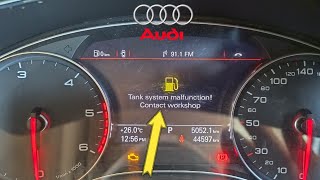
- On some models, a "Tank system malfunction" message appears on the instrument cluste 🎬 See how to fix the tank system malfunction warningr display.
- Replacing the entire fuel pump assembly when only the sender is bad (though sometimes they are sold as one unit).
- Replacing the instrument cluster without first thoroughly testing the sender and its wiring.
- Replacing the wrong fuel level sender. P0460 points to Sensor 'A'/'G' on the passenger side, not the 'G169' sender on the driver's side.
Most Likely Causes
- Faulty Fuel Level Sender (Sensor 'G') 🔴 High Probability The variable resistor strip on the sender unit wears out over time from the float arm's constant movement, creating dead spots or open circuits in the reading. This is a common wear-and-tear item on high-mileage vehicles.
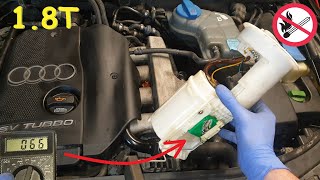
How to confirm: Using a VCDS or advanced scan tool, monitor the measuring blocks for 'Fuel Sender 1 (G)' and 'Fuel Sender 2 (G169)'. The resistance for Sender 1 (G) should be around 295-305 Ohms when empty and 56-68 Ohms when full. If the reading is erratic, stuck at a specific value, or shows an open circuit (infinite resistance) while manually moving the float arm, the sender is bad. 🎬 Watch: Audi A6 C6 fuel float and sender diagnostic steps
Typical fix: Replace the faulty fuel level sender. On most A6 models, this sender ('G') is attached to the fuel pump module on the passenger (right) side of the tank. Access is typically under the rear seat cushion. A special lock ring tool is required to safely remove the assembly.
Est. part cost: $100-$250 - Wiring Harness or Connector Issue 🟡 Medium Probability The main connector on top of the fuel tank access panel can be exposed to moisture and dirt kicked up from the road, leading to corrosion on the pins. Wires inside the tank that connect the two senders can also become brittle and break.
How to confirm: Visually inspect the wiring and connector pins on the fuel pump/sender assembly for green or white corrosion, bent pins, or loose connections. Perform a continuity test on the signal and ground wires between the sender and the instrument cluster to check for breaks (open circuit) or shorts to ground.
Typical fix: Clean the corroded connector terminals using a contact cleaner and a small brush. If the wiring is damaged, it must be repaired with gasoline-safe connectors or the harness section must be replaced.
Est. part cost: $10-$100
Rare But Worth Checking
- Faulty Instrument Cluster: → Shop Instrument Cluster In rare cases, the fault lies not with the sensor but with the instrument cluster's internal circuitry that processes and displays the fuel level information. This is unlikely and should only be considered after definitively ruling out both senders and all related wiring. A symptom could be multiple gauge failures at once.
- Faulty Powertrain Control Module (PCM): → Shop Engine Control Module (ECM) This is extremely rare. The PCM is a robust component, and a failure of the specific input circuit for the fuel level sensor is highly improbable. All other possibilities should be exhausted before considering PCM replacement.
Diagnosis Steps
- Connect an OBD-II scanner or VCDS and confirm the presence of the P0460 code. Check for any other related fuel system codes like P0461-P0463 or 00438.
- Use the scanner's live data function to monitor the fuel level sensor 'A' ('G') reading in Ohms or liters. Note if it is stuck, erratic, or shows an obviously incorrect value. Compare it with the reading from Sensor 2 ('G169').
- Gain access to the top of the fuel tank by removing the rear seat bottom cushion and the metal access cover(s) (typically held by three Phillips screws).
- Visually inspect the electrical connector on the fuel pump/sender assembly (passenger side for P0460) for any signs of corrosion, moisture, or damage.
- If the connector looks clean, disconnect it and use a multimeter to test the resistance of the sender unit through the pins on the flange. For a C6 A6, Sensor 1 (G) should read between ~56 Ohms (full) and ~305 Ohms (empty). An infinite reading indicates an open circuit.
- If the sender resistance seems plausible, perform a continuity and resistance check on the wiring harness between the tank and the instrument cluster to rule out an open or short circuit.
- If the sender is confirmed bad, use a specialized lock ring tool (e.g., Performance Tool W80668) to turn the plastic lock ring counter-clockwise and remove the sender/pump assembly. Do not use a hammer and screwdriver, as this can create sparks and damage the ring.
- After replacement, clear the codes and verify the fuel gauge reads correctly. 🎬 Watch: Step-by-step fuel gauge fix on an Audi A6
Parts You'll Likely Need
- Fuel Level Sender (Sensor G)
(OEM #C6: 4F0919673A, 4F0919673C. C7: 4G0919673B (check VIN))— This is the component that fails most often, containing the wear-prone resistor strip that measures the fuel level. P0460 specifically points to this primary sender.
Trusted brands: VDO, Bosch, Genuine Audi
OEM price range: $150-$250
Aftermarket price range: $80-$150 - Fuel Tank Sender Lock Ring
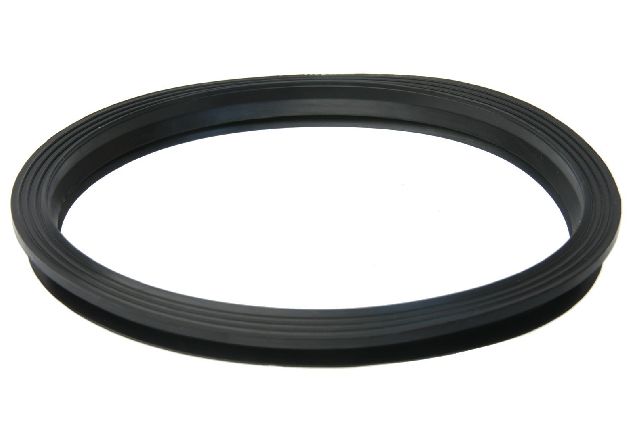
(OEM #e.g., 4F0201375)— The plastic lock ring can become brittle with age and may break during removal, even when using the correct tool. It's wise to have a replacement on hand.
Trusted brands: Genuine Audi
OEM price range: $20-$40
Aftermarket price range: $10-$25
Related Codes That Often Appear With This One
- P0461 — Indicates the sensor signal is erratic or out of its expected performance range, which is a common symptom of a failing sender's resistor strip.
- P0462 — Indicates the sensor circuit input is low (short to ground), which can be caused by a wiring issue or an internal failure of the sender.
- P0463 — Indicates the sensor circuit input is high (open circuit), which can be caused by a broken wire, bad connector, or an internal failure of the sender.
- 00438 — This is a VAG-specific code for 'Fuel Supply Sensor 2 (G169): Open or Short to Plus'. If you have issues with both senders, you may see this code alongside P0460, indicating a wider system problem.
Technical Service Bulletins (TSBs) & Recalls
- A TSB related to faulty G169 (Sensor 2) level senders for a specific VIN range of early C6 models was mentioned in a Ross-Tech forum, but the number was not provided. This indicates Audi is aware of potential sender issues on this platform.
Platform-Specific Known Issues
- Dual Sender System Complexity: On Quattro models, the saddle tank has two senders. P0460 refers to the passenger side sender (G), while a fault in the driver's side sender (G169) throws a different code (00438). Sometimes, a problem with the wiring that crosses over between the two senders inside the tank can cause confusing readings or faults for both.
- Slow Gauge Update After Refueling: Some owners report that after filling the tank, the gauge can take up to 15 minutes to update to 'Full'. This can be an early symptom of a failing sender, even if it doesn't set a code immediately.
Mechanic-Grade Diagnostic Values
- C6 A6 Fuel Level Sender 2 (G169) Resistance — expected: 50 to 86 ohms. Failure: A reading of 0 ohms indicates a short circuit, while an infinite reading indicates an open circuit. When removed, the sensor should read approx. 1004 ohms at the lower stop.
- C6 A6 Fuel Sender G and G169 Resistance (uninstalled) — expected: Minimum 50 ohms, Maximum 1004 ohms. Failure: Values outside this range, or no change when moving the float arm, indicate a faulty sender.
- Voltage to Fuel Pump Control Module (J538) at idle — expected: approx. 5.0 V. Failure: During a throttle burst, the voltage should rise slightly, then fall, then return to the idle value. If it does not behave this way, the J538 or its wiring may be faulty.
Scan Tool Commands That Help
- VCDS (VAG-COM): Measuring Blocks - Group 007 (C7) or similar — To view the live resistance readings from Fuel Sender 1 (G) and Fuel Sender 2 (G169) simultaneously. This allows a technician to compare the readings from both senders to identify an erratic or failed unit.
- VCDS (VAG-COM): Instrument Cluster (17) -> Output Tests (03) — To command a full sweep of the instrument cluster gauges, including the fuel gauge. If the gauge sweeps correctly during the test but reads incorrectly during normal operation, it confirms the instrument cluster itself is likely functional and the fault is in the sender or wiring.
- VCDS (VAG-COM): Instruments (17) -> Long Coding -> Byte 10 — To enable the 'Volume to Replenish' display in the instrument cluster. While not a diagnostic command, this can be a useful feature to enable, which shows how many liters/gallons are needed to fill the tank, providing a workaround if the gauge is unreliable.
Wiring & Ground Locations
- J538 — On C6 models, the Fuel Pump Control Module is located under the rear seat bench, near the right (passenger) side fuel pump access flange.. The J538 module processes the signals from the fuel level senders before they are sent to the instrument cluster. A fault in this module or its wiring can mimic a failed sender.
- Instrument Cluster Pin 6 — On the 32-pin connector at the rear of the C6 instrument cluster, Pin 6 is the input for Fuel Gauge Sender (G).. This is the final destination for the signal from the primary fuel sender. A continuity test from the sender connector in the tank to this pin can definitively rule out a wiring break.
- Instrument Cluster Pin 7 — On the 32-pin connector at the rear of the C6 instrument cluster, Pin 7 is the input for Fuel Gauge Sender 2 (G169).. This pin receives the signal from the secondary sender. Comparing signals at Pin 6 and Pin 7 can help diagnose issues in the dual-sender system.
- Earth Point 45 — Located in the center, behind the dash panel on the C6 A6.. This is a primary grounding point for the instrument panel. A loose or corroded ground here can cause erratic behavior in multiple gauges, including the fuel gauge.
- Earth Point behind Oil Filter Housing — A small gauge ground wire attached to one of the bolts on the oil filter housing on the 3.2L V6 engine.. While not directly for the fuel system, forum users report that this ground being loose or disconnected after engine work can cause various unexplained electrical issues. It's a known 'forgotten bolt' that can lead to chasing phantom electrical faults.
Real Owner Repair Stories
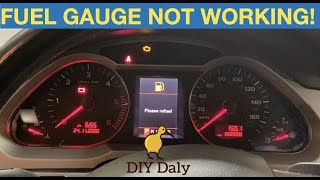
- YouTube user 'DIY Daly' (2007 Audi A6 3.0 V6) — Fuel gauge stuck on empty, low fuel light on, fault code 00771 (Fuel Level Sensor) stored.
❌ Tried (didn't work) Initial visual inspection of the connector showed no obvious corrosion.
✅ What actually fixed it The technician probed the small sender wires at the connector on top of the fuel tank. Wiggling the outermost wire caused the fuel gauge to start working again, indicating a bad connection or broken wire right at the pin. The final fix was to repair the individual wire/pin at the connector. - AudiWorld Forums user (2012 Audi A6 (C7)) — Intermittent "Fuel tank system malfunction! Contact dealer" message. Fuel gauge would go blank, then come back to life after a few minutes of driving, then fail again on restart.
❌ Tried (didn't work) Restarting the car., Tightening the fuel cap.
✅ What actually fixed it The issue was resolved under warranty by the dealer. The user was not given the exact cause but stated the fix was 'kinda costly', implying a component replacement (likely one of the fuel senders) was performed.
OEM Part Supersession History
4F0919673A→N/A, but has alternative part number 4F0 919 673 A— This is the primary part number for the left-side (passenger in UK, driver in US) fuel level sender for the C6 Quattro models.
Heads up: This part is VIN-specific. It is crucial to verify the part number with the vehicle's VIN before ordering, as there are variations even within the C6 generation. It is not compatible with C7 models.
Model Year Variations Within This Range
- 2004-2011 (C6) vs 2011-2014 (C7): The C6 Quattro has a larger 80-liter fuel tank compared to the C7's standard 65-liter tank. This affects the physical size and calibration of the senders. Furthermore, the instrument cluster and control modules (like J538) are different and not interchangeable between generations.
- FWD vs Quattro: Front-wheel-drive models typically have a smaller, single-lobe tank (around 70L on the C6) and may only use one fuel level sender. Quattro models have the larger, saddle-shaped tank (80L on the C6) which necessitates the dual-sender (G and G169) system to accurately measure fuel across both lobes of the tank.
Diagnostic Flowchart
Other Known Issues on This Vehicle
Issues unrelated to this code that are worth knowing about as an owner of this generation:
- Carbon Buildup on Intake Valves (FSI/TFSI Engines) 🔴 High — Common on all direct-injection engines (3.2 FSI, 2.0T, 3.0T) typically requiring cleaning every 60,000-100,000 miles. Causes rough idle, misfires, and power loss.
- Timing Chain Tensioner/Guide Failure (V6/V8 Engines) 🔴 High — A rattle on cold startup is the primary symptom, especially on C6 3.2L/4.2L and high-mileage C7 3.0T engines. Repair is extremely labor-intensive as the chains are at the rear of the engine.
- Excessive Oil Consumption (2.0T TFSI Engine) 🔴 High — Particularly prevalent in early C7 models (approx. 2012-2014) due to piston ring design. Can require adding oil every 500-1000 miles. Led to a class-action lawsuit and warranty extensions. (Ref: Warranty Extension (part of a class-action settlement))
- MMI Infotainment System Failure (C6) 🟠 Medium — Often presents as a black/dead screen. The cause is frequently a break in the fiber optic (MOST) ring, commonly due to a failed module (like the amplifier in the trunk) from water damage or other malfunction.
- Water Pump & Thermostat Failure (C7 3.0T) 🟠 Medium — The plastic housings for the water pump and thermostat are known to crack with age, causing coolant leaks. This is a very common maintenance item for the supercharged 3.0T engine.
- PCV Valve Failure (3.0T) 🟠 Medium — Failure of the Positive Crankcase Ventilation (PCV) valve is common and can cause a high-pitched whistle, vacuum leaks, rough idle, and increased oil consumption.
Used vs. New Parts: Buying Guide for This Vehicle
When a used part is the smart pick: A used part is generally NOT recommended for this repair. The fuel level sender is a wear item, and a used unit from a junkyard has an unknown amount of remaining life. The labor to access the tank is significant, so installing a used part that may fail soon is a poor value proposition. The only exception might be sourcing a complete fuel pump assembly from a very low-mileage, verified wreck if the cost is exceptionally low.
Donor-vehicle mileage cap: roughly under 30000 miles for the part to have meaningful remaining life.
What to inspect on the donor part:
- Verify the donor vehicle's mileage is low.
- Inspect the electrical connector pins for any signs of corrosion or overheating (discoloration).
- If possible, test the resistance of the used sender with a multimeter before purchase to ensure it's within spec and not an open circuit.
OEM-only on this vehicle (don't cheap out):
- Fuel Level Sender
- Fuel Tank Lock Ring Seal
Aftermarket brands forum-validated for this vehicle:
- VDO (often the OEM supplier)
- Bosch
Brands owners have reported issues with on this vehicle:
- Unbranded, no-name parts from online marketplaces should be avoided. Forum discussions and repair videos consistently show that the failure rate for these parts is high, often leading to doing the job twice.
Real Owner Stories
Aggregated from forums and TSBs cited above. Mileages and costs reflect what owners reported in those sources.
2006 Audi A6 C6
Symptoms: Incorrect fuel gauge reading and issues with the fuel float.
What fixed it: The owner diagnosed the fuel sending unit and discussed the replacement of both the driver and passenger side senders.
Source hint: AudiWorld Forum: C6 A6, C6 fuel float, fuel gauge, fuel sending unit diagnostic.
Related OBD-II Codes
Frequently Asked Questions
Where is the fuel level sender 'G' located on my Audi A6?
What are the correct resistance values for testing the fuel sender on a C6 A6?
Why does my fuel gauge take 15 minutes to show 'Full' after I gas up?
Can I use a hammer and screwdriver to remove the fuel pump lock ring?
Does my Quattro A6 have more than one fuel sender?
Is there a TSB for fuel sender issues on the Audi A6 C6?
Helpful Videos
We Have This Part in Stock

The information in this article is provided for general reference and educational purposes only. Vehicle specifications, procedures, and part compatibility can vary by production date, trim level, and region. Always consult your vehicle's factory service manual and verify part numbers before purchasing or performing repairs. Safety-critical components such as airbags, seat belts, and braking systems should be installed by a qualified professional.
- Audi A6:
- 🧭 Diagnostic Flowchart
- 🎬 Helpful Videos
- 🛍️ Shop This Part
- What's Unique About the 2004-2014 Audi A6
- Symptoms You May Notice
- Most Likely Causes
- Rare But Worth Checking
- Diagnosis Steps
- Parts You'll Likely Need
- Related Codes That Often Appear With This One
- Technical Service Bulletins (TSBs) & Recalls
- Platform-Specific Known Issues
- Mechanic-Grade Diagnostic Values
- Scan Tool Commands That Help
- Wiring & Ground Locations
- Real Owner Repair Stories
- OEM Part Supersession History
- Model Year Variations Within This Range
- Other Known Issues on This Vehicle
- Used vs. New Parts: Buying Guide for This Vehicle
- Real Owner Stories
- 2006 Audi A6 C6
- Related OBD-II Codes
- Frequently Asked Questions
- 🎟️ Get 5% Off