

P0460 on 2000-2007 Ford Taurus 3.0L Flex Fuel: Fuel Level Sensor Circuit Fixes
On a 2000-2007 Flex Fuel Taurus, code P0460 is most often caused by a failed Fuel Gauge Module located under the dash, not the fuel pump in the tank. Replacing this inexpensive module is the most likely fix and can save you from a costly and unnecessary fuel tank drop. This module is specific to the Flex Fuel models.
- For a 2000-2007 Ford Taurus with the 3.0L V6 Flex Fuel engine, ALWAYS diagnose the dash-mounted Flex Fuel Module first for a P0460 code.
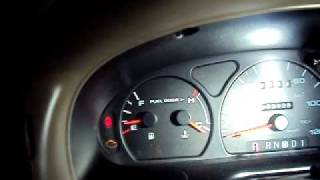
- A failed Flex Fuel Module will often cause the fuel gauge to be stuck past the 'Full' mark.
- Do not drop the fuel tank to replace the fuel pump assembly until you have definitively ruled out the much cheaper and easier-to-replace Flex Fuel Module.
- Driving with this code is possible, but you risk running out of fuel, which can cause the fuel pump to overheat and fail, leading to a significantly more expensive repair.
- This code will result in an automatic failure of an emissions test.
What's Unique About the 2000-2007 Ford Taurus
Unlike most vehicles where P0460 points directly to the in-tank fuel sending unit, the 3.0L V6 Flex Fuel (FFV) Taurus has a unique and critical intermediate component. These models use a special 'Flex Fuel Module' (also called a Fuel Gauge Module) located under the dashboard to process the signal from the in-tank sensor before it goes to the instrument cluster and PCM. This module is a very common failure point and is often the true cause of P0460, leading many to mistakenly replace the entire fuel pump assembly when the fix is a simple, inexpensive module swap inside the cabin. A failure of this module often results in the fuel gauge being pegged past full.
Symptoms You May Notice
- Check Engine Light is on
- Fuel gauge is inaccurate, erratic, or stuck (often pegged past 'Full')
- Low fuel warning light may come on randomly or not at all
- Inability to pass an emissions inspection
- Digital information center may display 'Fuel Level ERR'
- Inaccurate distance to empty (DTE) calculations
- Replacing the in-tank fuel pump/sending unit assembly before checking the Flex Fuel Module under the dashboard. This is the most common and costly mistake for this specific vehicle and powertrain.
Most Likely Causes
- Faulty Flex Fuel / Fuel Gauge Module 🔴 High Probability This specific module is a known, high-failure part on the 2000-2007 Flex Fuel Taurus and Sable models and is unique to this powertrain configuration.
How to confirm: The module is located behind the radio/center console area. A technician can back-probe the module's connectors to check for a proper input signal from the tank and a corresponding output signal to the gauge. If the input signal varies correctly but the output is missing or incorrect, the module is bad. A failed module often sends a signal that pegs the fuel gauge past 'F'.
Typical fix: Replace the module. It is a plug-and-play component held in by a single screw.
Est. part cost: $40-$80 - Defective In-Tank Fuel Level Sending Unit 🟡 Medium Probability → Shop Fuel Tank Sending Unit The resistor card on the sending unit can wear out over time or become contaminated by sulfur in the fuel, causing dead spots or open circuits. The float arm can also get stuck. Manufacturer service bulletin #SSM 50904 notes that an open circuit in the fuel level sender (FLS) can specifically cause the fuel gauge to read empty while triggering P0460.
How to confirm: If the Flex Fuel Module is ruled out, test the sending unit. Access the wiring at the fuel tank and measure the resistance (ohms) of the sender circuit. 🎬 See how to test a fuel level sensor without removing the pump For this Ford platform, the expected range is approximately 16 ohms at Full and 158-160 ohms at Empty. An open circuit (infinite resistance) or a stuck value indicates a bad sender. A temporary fix may sometimes be achieved by using a fuel system cleaner with Techron Plus, which is designed to clean sulfur deposits off the sender card.
Typical fix: The sending unit is part of the fuel pump module assembly. The entire module must be replaced, which requires dropping the fuel tank.
Est. part cost: $150-$300 - Wiring or Connector Issue ⚪ Low Probability
How to confirm: Visually inspect the wiring harness running from the fuel tank to the Flex Fuel Module and PCM. Check connectors under the driver's seat and at the top of the fuel pump for corrosion, moisture, or damage. Perform continuity tests on the signal and ground wires if a break is suspected. An improperly installed aftermarket remote start system can also cause this code by interrupting power to the instrument cluster during operation.
Typical fix: Repair the damaged section of wire or clean/replace the corroded connector.
Est. part cost: $5-$50
Rare But Worth Checking
- Faulty Instrument Cluster: → Shop Instrument Cluster While rare, the instrument cluster itself can fail, causing gauge issues. This is usually accompanied by other gauge or warning light problems and should be considered only after all other fuel system components are verified. Failures of this nature have been reported on other Ford vehicles of the era, sometimes triggering P0460 and P0463 codes.
- Faulty Powertrain Control Module (PCM): → Shop Engine Control Module (ECM) A PCM failure is extremely unlikely but possible. Internal degradation of the PCM's analog input channel can trigger P0460 even with a good sensor and wiring. This should be the absolute last consideration after every other component and wire in the circuit has been proven to be good.
Diagnosis Steps
- Verify the vehicle is a Flex Fuel model (the 8th digit of the VIN will be '2', not 'U').
- Scan the vehicle for trouble codes. Confirm P0460 is present. If P0462 or P0463 are also present, they can help pinpoint the electrical fault (short vs. open).
- Locate the Flex Fuel Module. It is typically found behind the center dashboard trim, often near the radio or climate controls.
- Test the module's function. Back-probe the connectors to check for a variable signal coming IN from the fuel tank sender and check for a proper signal going OUT to the instrument cluster. The output signal to the PCM and gauge is on the Orange/Green wire. 🎬 Watch: How to test the Flex Fuel Module on a Taurus If the input is good but the output is bad (or pegged high), replace the module.
- If the module is good or the input signal is bad, proceed to test the in-tank sending unit.
- Access the fuel pump electrical connector on top of the fuel tank. This may require lowering the tank slightly.
- With a multimeter set to Ohms, measure the resistance across the two sender wires. The reading should be between ~16 Ohms (Full) and ~160 Ohms (Empty). Rocking the vehicle to slosh fuel should cause the resistance to change smoothly. An infinite reading means an open circuit; a zero reading means a short.
- If the sender resistance is out of spec or doesn't change, the fuel pump/sending unit assembly needs to be replaced. This requires dropping the fuel tank. 🎬 Watch: Step-by-step fuel pump replacement walkthrough
- If both the module and sender test good, inspect the entire wiring harness between the components for shorts, opens, or corrosion. Pay special attention to grounds and any aftermarket wiring (e.g., remote starters).
- After repairs, clear the codes and perform a drive cycle to ensure the fix is complete and the Check Engine Light does not return.
Parts You'll Likely Need
- Flex Fuel / Fuel Gauge Module
(OEM #YF1Z-14A069-AA)— This is the most common failure point for P0460 on the 3.0L Flex Fuel Taurus. It processes the signal from the tank sender. This part number also supersedes F6DZ-14A069-AA.
Trusted brands: Motorcraft
OEM price range: $50-$90
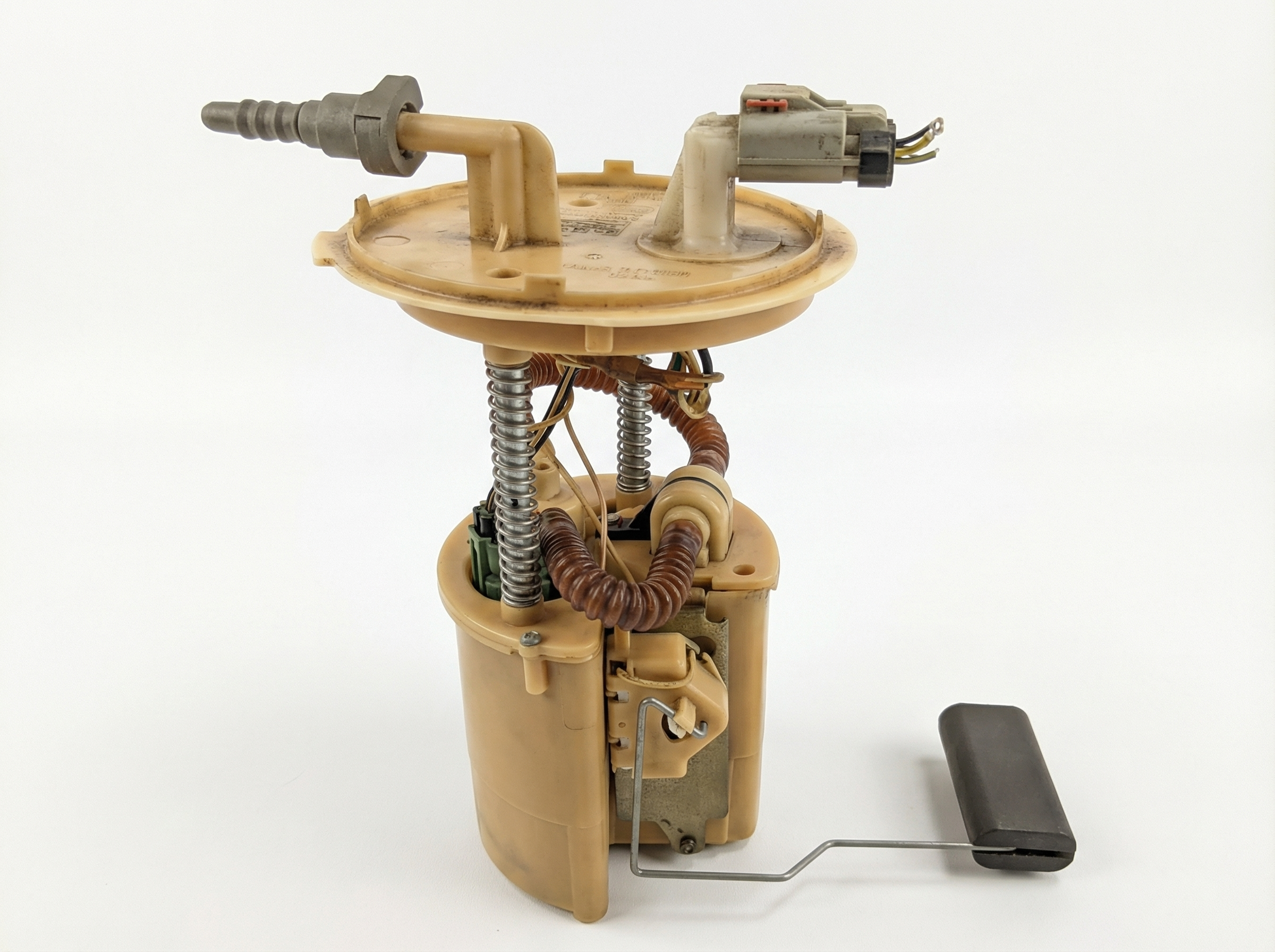
Aftermarket price range: $40-$70 - Fuel Pump and Sending Unit Assembly — If the Flex Fuel Module is not the cause, the in-tank sending unit has likely failed. It is sold as a complete assembly with the fuel pump.
Trusted brands: Motorcraft, Delphi, Bosch, Spectra Premium
OEM price range: $250-$400
Aftermarket price range: $150-$300
Related Codes That Often Appear With This One
- P0463 — Stands for 'Fuel Level Sensor 'A' Circuit High Input'. This code often appears with P0460 when the circuit has an open or the failed component (like the Flex Fuel Module) sends a signal that is stuck at the maximum value, causing the gauge to read past full.
- P0462 — Stands for 'Fuel Level Sensor 'A' Circuit Low Input'. This indicates the PCM is seeing a signal voltage that is lower than expected, which could be caused by a short to ground in the signal wire.
- P1450 / P0456 — These evaporative emission codes may sometimes appear alongside P0460 if there is a broader issue with the fuel tank or purge system, as noted in manufacturer bulletin #16-0062.
Technical Service Bulletins (TSBs) & Recalls
- While no TSB is specific to the Flex Fuel module failure, Ford TSB 99-2-6 for 1996-98 models provides the crucial sender resistance specifications (15 ohms empty, 160 ohms full) which are consistent with this generation.
- Ford Special Service Message 18465 notes that P0460 can be intermittently caused by improperly installed aftermarket remote start systems that fail to power all necessary instrument cluster circuits.
- Manufacturer Bulletin #SSM 50904 highlights that P0460, often accompanied by P0461 or P0463, can result from an open circuit in the fuel level sender, leading to a gauge that reads empty.
- Bulletin #16-0062 describes scenarios where P0460 appears with a cluster of other codes including P0420, P1450, and P0456, indicating the MIL may be illuminated for multiple concurrent fuel or emission system faults.
Platform-Specific Known Issues
- A user on the 2CarPros forum with a 2001 Flex Fuel Taurus and code P0460 reported that a dealer diagnosis confirmed the Flex Fuel Module was the cause, not the in-tank sender.
- A repair case for a 2000 Taurus with P0460 and a gauge stuck on full noted that after replacing the in-tank sender and the gauge itself with no success, the final fix was the Flex Fuel Sensor Module.
- NHTSA ODI #11443669 describes a situation where P0460 is accompanied by an inaccurate or erratic fuel gauge and inaccurate distance to empty (DTE) readings.
Mechanic-Grade Diagnostic Values
- Flex Fuel Module output signal to gauge/PCM (Orange/Green wire) — expected: A variable DC voltage signal corresponding to fuel level.. Failure: Signal is missing, stuck high, or stuck low despite a good input from the tank sender.
- Flex Fuel Module input signal from tank sender (oscilloscope) — expected: An alternating current (AC) signal of approximately 1.0 to 1.5 volts.. Failure: A flat line or incorrect voltage indicates a problem with the module's power or the sender circuit itself.
Wiring & Ground Locations
- Flex Fuel Module Output Wire — In the connector for the Flex Fuel Module behind the center dash.. The Orange/Green wire carries the final processed signal to the instrument cluster and PCM. This is the primary wire to test for a correct output voltage from the module.
- Fuel Pump Power/Ground (at FPDM) — At the Fuel Pump Driver Module (FPDM), if equipped, or at the pump connector.. On a 2005 model, the power wire to the pump is White/Red and the ground is Black/Pink. While not directly the sender circuit, confirming power and ground to the assembly is a preliminary step.
Real Owner Repair Stories
- Reddit user in r/MechanicAdvice (2005 Ford Taurus SEL 3.0 V6 FlexFuel) — Gas gauge dropped to empty intermittently, then set a Check Engine Light for 'Fuel Level Sensor Low Input' (likely P0462) and displayed 'Fuel Level ERR' on the dash.
❌ Tried (didn't work) Initial research was confusing due to multiple possible parts (sender, sensor, module).
✅ What actually fixed it Another user identified the common failure of the in-dash Flex Fuel Module (Part # YF1Z-14A069-AA). The original poster confirmed they ordered this specific part to perform the repair, which is the widely accepted fix for these exact symptoms. - YouTube channel MrGreasybob (2003 Ford Taurus 3.0L 12-valve Flex Fuel (VIN 2)) — Inoperative fuel gauge and trouble code P0460.
❌ Tried (didn't work) The video focuses directly on diagnosing the correct part.
✅ What actually fixed it The technician diagnosed a defective Flex Fuel Sensor Module located behind the radio. Using an oscilloscope, he showed the bad module produced no signal, while the new module produced a correct alternating signal to the sender and resulted in a working fuel gauge.
Documented NHTSA Reports
- An owner reported in NHTSA ODI #11419926 that after receiving a P0460 code, a physical inspection revealed the gas tank was "sunk in," which may relate to previous purge valve issues.
- NHTSA ODI #11427851 notes that P0460 can appear as part of a larger group of emissions-related codes, including P0420, P1450, and P0443, which may trigger the malfunction indicator lamp.
OEM Part Supersession History
F6DZ-14A069-AA→YF1Z-14A069-AA— Standard part revision and replacement.
Heads up: No known incompatibilities; YF1Z-14A069-AA is the correct service part.
Model Year Variations Within This Range
- 2000-2005: The common replacement Flex Fuel Module, YF1Z-14A069-AA, is explicitly listed by some vendors for the 2000-2005 model years. While it is believed to work for 2006-2007 models, owners of those years should double-check part compatibility before ordering.
- 2000-2007: The Flex Fuel Module is ONLY used on Flex Fuel models, identified by the 8th digit of the VIN being '2'. Non-Flex Fuel models (VIN 'U') do not have this module, and P0460 diagnosis would point directly to the in-tank sender or wiring.
Diagnostic Flowchart
Other Known Issues on This Vehicle
Issues unrelated to this code that are worth knowing about as an owner of this generation:
- Transmission Failure (AX4S/AX4N) 🔴 High — Very common, often occurring between 60,000 and 100,000 miles. Failures include stripped torque converter splines leading to a no-move condition, and internal component failures.
- Broken Front Coil Springs 🔴 High — Extremely common, especially in salt-belt states. The spring can fracture due to corrosion, potentially puncturing the front tire and causing a loss of control. (Ref: NHTSA Recall 04V332 (Ford 04S17) was issued for 1999-2001 models to install a protective shield, but the issue persists on later models without a recall.)
- Camshaft Synchronizer Failure (3.0L Vulcan) 🔴 High — A common wear item. The internal bushings fail, causing a distinct 'chirping' or 'squeaking' noise from the engine. If ignored, the unit can seize, destroying the gear that drives the oil pump, leading to catastrophic engine failure from oil starvation.
- Leaking Engine Gaskets (Oil Pan / Valve Covers) 🟡 Low — Common oil leaks from the valve cover gaskets (dripping onto the hot exhaust manifold) and the oil pan gasket are frequently reported.
- Failed Hydraulic Motor Mounts 🟠 Medium — The fluid-filled lower motor mounts often fail, causing the liquid to leak out. This results in a noticeable 'clunk' on acceleration and excessive engine vibration felt in the cabin.
Used vs. New Parts: Buying Guide for This Vehicle
When a used part is the smart pick: For the 'Flex Fuel / Fuel Gauge Module', a used part from a junkyard is a very reasonable and cost-effective choice. It is a simple, non-wear electronic component that either works or doesn't. Failure is common, but a used part is a low-risk gamble given the low cost and ease of replacement.
Donor-vehicle mileage cap: roughly under 150000 miles for the part to have meaningful remaining life.
What to inspect on the donor part:
- For a used Fuel Gauge Module, ensure the connector pins are clean, straight, and free of corrosion.
- For a used Fuel Pump Assembly (not recommended), check the electrical connector for any signs of melting or heat damage, which indicates a failing pump motor.
- Inspect the plastic housing of a used pump assembly for cracks, especially around the hose nipples.
OEM-only on this vehicle (don't cheap out):
- Flex Fuel / Fuel Gauge Module
Aftermarket brands forum-validated for this vehicle:
- Delphi
- Bosch
- Spectra Premium
- GMB
Brands owners have reported issues with on this vehicle:
- No specific brands are consistently reported as problematic, but be wary of unbranded, 'white box' fuel pump assemblies from online marketplaces due to the high labor cost of a repeat failure.
Real Owner Stories
Aggregated from forums and TSBs cited above. Mileages and costs reflect what owners reported in those sources.
2001 Ford Taurus 3.0L V6 Flex Fuel
Symptoms: The owner reported a P0460 code and sought to identify if the issue was the in-tank sender or the module.
What fixed it: A dealer diagnosis confirmed the Flex Fuel Module was the cause, rather than the in-tank sending unit.
Source hint: 2CarPros: 2001 Ford Taurus Fuel Level Sensor Circuit Malfunction
2000 Ford Taurus 3.0L V6 Flex Fuel
Symptoms: Fuel gauge was stuck on the high level (Full) and the vehicle threw a P0460 code.
What fixed it: After unsuccessfully replacing the in-tank sending unit and the instrument cluster gauge, the problem was finally resolved by replacing the flexible fuel sensor module.
Source hint: AutoCodes: 2000 Ford Taurus fuel gage stuck in high level with P0460 code
2003 Ford Taurus 3.0L V6 Flex Fuel
Symptoms: The vehicle had an inoperative fuel gauge and a stored P0460 code.
What fixed it: Replacement of the Flex Fuel Sensor Module after testing with an oscilloscope confirmed it was not outputting the correct signal to the gauge.
Source hint: YouTube: CHECKING A FLEX FUEL SENSOR MODULE ON AN 03 TAURUS WITH AN INOPERATIVE FUEL GAGE
Ford Owner Report (NHTSA ODI #11443669)
Symptoms: An owner reported an illuminated MIL with code P0460, accompanied by an inaccurate or erratic fuel gauge and inaccurate distance to empty (DTE) readings.
What fixed it: This report highlights the common symptoms associated with circuit failure in the fuel level system.
Related OBD-II Codes
Frequently Asked Questions
How can I tell if my 2000-2007 Ford Taurus is a Flex Fuel model affected by this specific module issue?
My fuel gauge is pegged past 'Full' even though I haven't filled up. Is this a common symptom of P0460 on this car?
Is there a TSB for the fuel sender resistance specifications for my Taurus?
Can an aftermarket remote start cause a P0460 code on my Ford Taurus?
I'm seeing 'Fuel Level ERR' on my dashboard. What does that mean?
Can I clean the fuel sender instead of replacing the whole pump assembly?
Helpful Videos

Used OEM Parts in Stock
New Aftermarket Parts Available


The information in this article is provided for general reference and educational purposes only. Vehicle specifications, procedures, and part compatibility can vary by production date, trim level, and region. Always consult your vehicle's factory service manual and verify part numbers before purchasing or performing repairs. Safety-critical components such as airbags, seat belts, and braking systems should be installed by a qualified professional.
- Ford Taurus:
- 🧭 Diagnostic Flowchart
- 🎬 Helpful Videos
- 🛍️ Shop This Part
- What's Unique About the 2000-2007 Ford Taurus
- Symptoms You May Notice
- Most Likely Causes
- Rare But Worth Checking
- Diagnosis Steps
- Parts You'll Likely Need
- Related Codes That Often Appear With This One
- Technical Service Bulletins (TSBs) & Recalls
- Platform-Specific Known Issues
- Mechanic-Grade Diagnostic Values
- Wiring & Ground Locations
- Real Owner Repair Stories
- Documented NHTSA Reports
- OEM Part Supersession History
- Model Year Variations Within This Range
- Other Known Issues on This Vehicle
- Used vs. New Parts: Buying Guide for This Vehicle
- Real Owner Stories
- 2001 Ford Taurus 3.0L V6 Flex Fuel
- 2000 Ford Taurus 3.0L V6 Flex Fuel
- 2003 Ford Taurus 3.0L V6 Flex Fuel
- Ford Owner Report (NHTSA ODI #11443669)
- Related OBD-II Codes
- Frequently Asked Questions
- 🎟️ Get 5% Off