

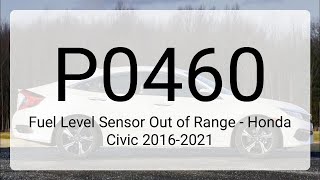
P0460 on 2016-2022 Honda Civic: Fuel Level Sensor Circuit Malfunction Causes and Fixes
On a 2016-2022 Honda Civic, code P0460 is most often caused by a failed fuel level sending unit, which is part of the in-tank fuel pump assembly. The repair involves replacing the entire fuel pump module, costing around $200-$300 for an OEM part and 1-2 hours of labor. Before starting repairs on a 2016-2021 model, check for eligibility under the massive fuel pump safety recall (NHTSA ID 24V101 / Honda TSB 24-008), as the free fix replaces the entire assembly.
- P0460 on a 2016-2022 Civic almost always points to a problem with the fuel level sending unit in the gas tank.
- Before buying parts for a 2016-2021 model, check if your vehicle is part of the fuel pump safety recall (24-008), as the free recall repair will fix this code.
- The fuel level sensor is part of the complete fuel pump module; you will need to replace the entire assembly and the tank seal.
- Driving with this code is possible but not recommended, as you risk running out of fuel and damaging the fuel pump.
What's Unique About the 2016-2022 Honda Civic
The 2016-2022 Honda Civic range covers two generations: the 10th (2016-2021) and the 11th (2022). For the 10th generation Civic, this code is particularly notable because of a widespread safety recall (NHTSA ID: 24V101, Honda TSB: 24-008) for defective fuel pump motors. The recall addresses a faulty impeller that can swell and cause the fuel pump to seize, leading to engine stalling. The repair involves replacing the entire fuel pump module, which includes the fuel level sending unit. Therefore, an owner experiencing P0460 on an eligible 2016-2021 Civic may have the root cause of their problem fixed for free as part of this recall.
Generation note: This range covers the 10th generation Honda Civic (2016-2021) and the 11th generation (2022). The primary cause, a faulty fuel sending unit, is common to both. However, a major fuel pump recall that replaces this component is specific to many 2016-2021 models (excluding Si and Type R, which have separate recalls).
Symptoms You May Notice
- Check Engine Light is on
- Fuel gauge reading is inaccurate (e.g., stuck on empty, full, or in the middle)
- Fuel gauge fluctuates erratically
- Low fuel warning light comes on unpredictably or stays on even with a full tank
- Engine may hesitate or stall if the underlying issue is a failing fuel pump from the recall.
- Replacing the instrument cluster before thoroughly testing the fuel sending unit and its wiring.
- Assuming the problem is complex wiring damage when it is simply a corroded connector at the fuel tank.
- Replacing the fuel pump for a P0460 code without first checking if the vehicle is eligible for the free recall repair.
Most Likely Causes
- Faulty Fuel Level Sending Unit 🔴 High Probability → Shop Fuel Tank Sending Unit The fuel level sensor is integrated into the fuel pump module, and these units are a common failure point. Wear on the sensor's variable resistor contacts can create dead spots, leading to irrational signals. Many 2016-2021 models were also subject to a recall for defective fuel pump assemblies, which includes this component.
How to confirm: After confirming wiring is intact, the most definitive test is to access the fuel pump module and measure the resistance of the sending unit's circuit while manually moving the float arm. The resistance should change smoothly. 🎬 See: How to diagnose and fix a P0460 code For many Honda models, the approximate range is 2-5 ohms at full and 105-110 ohms at empty. If the reading jumps, drops out, or is infinite (open circuit), the unit is bad.
Typical fix: Replace the entire fuel pump module assembly, which includes the fuel pump, filter, and the fuel level sending unit. It is also recommended to replace the fuel tank gasket/seal at the same time.
Est. part cost: $200-$350 - Damaged Wiring or Corroded Connector 🟡 Medium Probability The main electrical connector sits on top of the fuel tank, under an access panel (typically under the rear seat or center console). It can be exposed to moisture, spills, or physical stress during interior maintenance, leading to corrosion or damaged pins that disrupt the signal.
How to confirm: Visually inspect the wiring harness and the connector on top of the fuel pump assembly. Look for any green or white corrosion, bent pins, or frayed wires. Perform a continuity test on the signal and ground wires between the pump connector and the gauge control module to check for breaks.
Typical fix: Clean the connector terminals with an electrical contact cleaner or replace the connector pigtail if corrosion is severe. Repair any broken or shorted wires.
Est. part cost: $5-$30
Rare But Worth Checking
- Faulty Gauge Control Module / Instrument Cluster: → Shop Instrument Cluster While uncommon, the instrument cluster itself (or its control module) can fail to interpret a correct signal from the sending unit. This is usually suspected only after the sending unit and wiring have been confirmed to be good. Diagnosis involves using an advanced scan tool to monitor the raw data from the sender and compare it to the gauge's displayed value.
- Faulty Powertrain Control Module (PCM): → Shop Engine Control Module (ECM) This is extremely rare. The PCM is the last item to suspect. Before condemning the PCM, ensure all other possibilities, including TSBs for software updates, have been exhausted.
Diagnosis Steps
- Scan for Codes: Use an OBD-II scanner to confirm P0460 is the only code present. If other fuel system codes like P0461, P0462, or P0463 are present, they should be addressed first as they can be related.
- Check for Recalls/TSBs: For 2016-2021 models, immediately check if the vehicle's VIN is eligible for the fuel pump motor safety recall (NHTSA Campaign 24V101 / Honda TSB 24-008) using the NHTSA website. If eligible, schedule the free repair with a Honda dealer, which will likely solve the P0460 code.
- Inspect the Connector: Gain access to the top of the fuel pump module, usually under the rear seat cushion or center console. Disconnect the electrical connector and inspect it thoroughly for corrosion, moisture, or damaged pins.
- Test the Circuit: If the connector looks good, use a multimeter to check for proper voltage and ground at the connector with the key on. Check for continuity on the signal wire between the pump and the gauge control module to rule out a wire break.
- Test the Sending Unit: If the wiring is confirmed to be good, test the fuel level sensor itself. This involves measuring its resistance while moving the float arm. The resistance should change smoothly from approximately 2-5 ohms (Full) to 105-110 ohms (Empty). If the resistance values are out of specification or do not change smoothly, the sending unit has failed.
- Condemn the Part: If the sending unit fails the resistance test, the entire fuel pump module needs to be replaced.
Parts You'll Likely Need
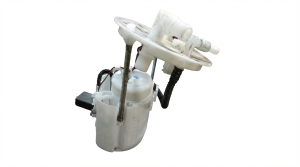
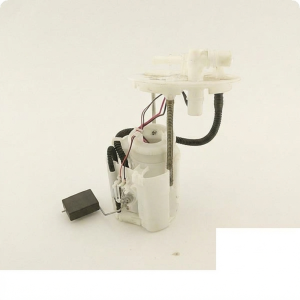
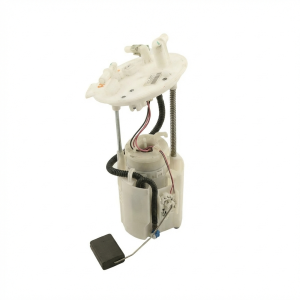
- Fuel Pump Module Assembly
(OEM #17045-TBA-A00 (and its supersessions like 17045-TBA-A01, A02, A03) for 10th Gen. 11th Gen uses different part numbers.)— This is the most common cause of P0460. The fuel level sending unit is integrated into this assembly and is not typically sold separately by Honda for these models. The part number has been superseded multiple times.
Trusted brands: Honda (OEM), Denso, Delphi
OEM price range: $250-$350
Aftermarket price range: $150-$250 - Fuel Tank Seal / Gasket — This rubber gasket seals the fuel pump module to the tank. It is highly recommended to replace it anytime the module is removed to prevent fuel leaks and vapor smells. It is often sold separately.
Trusted brands: Honda (OEM), Fel-Pro
OEM price range: $15-$30
Aftermarket price range: $10-$20
Technical Service Bulletins (TSBs) & Recalls
- 24-008: Safety Recall: 2016–21 Civic Fuel Pump Motor - This recall addresses a faulty fuel pump motor, and the repair procedure replaces the entire in-tank module, which includes the fuel level sensor.
- 23-103: This is an umbrella TSB that directs dealers to the specific fuel pump recall bulletin for each model, including 24-008 for the Civic.
Platform-Specific Known Issues
- Safety Recall 24-008 (NHTSA 24V101): Affects many 2016-2021 Civics for a defective fuel pump motor impeller that can cause the engine to stall. The fix is a replacement of the fuel pump module, which also contains the fuel level sensor, making it a highly relevant repair for a P0460 code.
- Access Panel Location: On 10th generation Civics, 🎬 Watch: 10th Gen Civic fuel level sensor diagnostic walkthrough the fuel pump access panel is located under the center console, requiring its removal, which is more labor-intensive than models with access under the rear seat.
Mechanic-Grade Diagnostic Values
- Fuel Level Sensor Resistance — expected: ~2-5 Ohms (Full) to ~105-110 Ohms (Empty). Failure: Readings are infinite (Open circuit), zero, or jump erratically when moving the float arm.
- Fuel Level Sensor Signal Voltage — expected: Varies by system, but typically ~0.5V (Empty) to ~4.5V (Full).. Failure: Voltage is stuck high (near 5V) or low (near 0V), or does not change smoothly as fuel level changes.
- Ground Circuit Voltage Drop — expected: < 0.1V. Failure: A voltage reading greater than 0.1V between the fuel pump connector ground pin and the chassis indicates high resistance in the ground circuit.
Scan Tool Commands That Help
- Honda Diagnostic System (HDS) or i-HDS: Clear DTCs — After a repair is completed, the HDS is used to clear the P0460 code and reset the system for verification.
- Honda Diagnostic System (HDS) or i-HDS: Data List — To monitor the live voltage or resistance value reported by the fuel level sensor. This allows a technician to see if the value is erratic or stuck without having to physically access the sensor.
- Honda Diagnostic System (HDS) or i-HDS: OBD Status — After clearing codes and performing a drive cycle, this function confirms if the onboard diagnostic test for the fuel level sensor circuit has run and passed, confirming a successful repair.
Wiring & Ground Locations
- Fuel Pump Connector — On top of the fuel pump module, under the access panel. For 10th Gen Civics (2016-2021), this panel is under the center console.. This is the primary connection point for the fuel level sensor. Corrosion or damage here is a common cause of P0460. The signal and ground wires for the sensor pass through this connector.
- G551 — This is a common chassis ground point for fuel system components on some Honda models. While specific location on a 2016+ Civic requires a factory manual, grounds are typically located on the chassis near the component, such as under a seat or trim panel.. A poor or corroded ground connection at G551 can cause a voltage drop in the fuel level sensor circuit, leading to incorrect readings and triggering a P0460 code.
- Gauge Control Module Connector A — Behind the instrument panel/dashboard.. This is the destination for the fuel level sensor signal. A diagnostic step involves checking for continuity between this connector and the fuel pump connector to rule out a break in the wiring.
OEM Part Supersession History
17045-TBA-A00→17045-TBA-A01, then 17045-TBA-A02, then 17045-TBA-A03— Honda frequently supersedes parts to implement design improvements, address reliability issues, or change suppliers. For the fuel pump module, these changes are often related to improving the reliability of the pump motor or sensor components, directly related to the widespread recall.
Heads up: All parts in this supersession chain (A00, A01, A02, A03) are interchangeable for the specified 2016-2021 1.5L and 2.0L Civic models. Always use the latest available part number (17045-TBA-A03) when purchasing new.
Model Year Variations Within This Range
- 2016-2021 (10th Generation): These models feature a wide, angled dashboard design and were subject to a major fuel pump recall. They also had known issues with the A/C system condenser and compressor seals, covered by a warranty extension. The fuel pump access is under the center console.
- 2022 (11th Generation): The 2022 model marked a new generation with a cleaner, more minimalist interior design, a longer wheelbase, and a standard 1.5L turbo engine across more trims. The infotainment and digital instrument cluster were significantly updated. While the fundamental fuel system design is similar, part numbers for the fuel pump module are different and it is not subject to the same recall as the 10th generation.
Diagnostic Flowchart
Other Known Issues on This Vehicle
Issues unrelated to this code that are worth knowing about as an owner of this generation:
- Engine Oil Dilution (1.5L Turbo) 🔴 High — Common on 2016-2019 models, especially in cold climates with frequent short trips. Can occur at low mileage. (Ref: Honda TSB A19-033, Product Update 18-137, and a warranty extension were issued to address the problem with software updates and, in some cases, new A/C control units.)
- A/C Condenser Failure 🟠 Medium — Widespread on 2016-2021 models. Can fail at any time, causing the A/C to stop blowing cold air. (Ref: Honda issued a warranty extension (TSB 19-091) covering the A/C condenser for 10 years/unlimited mileage due to a manufacturing defect causing leaks.)
- Sticky Power Steering 🟠 Medium — Reported on 10th generation Civics, where the electronic power steering (EPS) can feel notchy or sticky, particularly at highway speeds. (Ref: Multiple steering-related recalls exist, though not all address this specific symptom. Check VIN for eligibility.)
- Infotainment System Glitches 🟡 Low — Common complaints across the 10th generation include the head unit freezing, rebooting, or being unresponsive. Bluetooth connectivity can also be unreliable. (Ref: Software updates were released by dealers to address some of these stability issues.)
- Direct Fuel Injector Failure (1.5L Turbo) 🟠 Medium — A known failure point on the L15B7 engine, sometimes occurring after the oil dilution software fix. Can cause rich running conditions (P0172), misfires, and rough idle.
Used vs. New Parts: Buying Guide for This Vehicle
When a used part is the smart pick: For this specific repair, a used part is almost never a smart choice. The fuel pump module is a known failure point and the subject of a massive safety recall. A used part carries a high risk of either being the same defective design or having significant wear on the pump motor and sensor.
Donor-vehicle mileage cap: roughly under 15000 miles for the part to have meaningful remaining life.
What to inspect on the donor part:
- If forced to consider a used part, only select one from a very low-mileage, late-model year wreck.
- Verify the part number is the latest supersession (e.g., 17045-TBA-A03).
- Inspect the electrical connector for any signs of corrosion, melting, or bent pins.
- Ensure the float arm moves freely without binding.
OEM-only on this vehicle (don't cheap out):
- Fuel Pump Module Assembly
Aftermarket brands forum-validated for this vehicle:
- Denso (often the OEM supplier)
- Delphi
Brands owners have reported issues with on this vehicle:
- Unknown, no-name brands from online marketplaces should be avoided as fuel delivery is critical to engine operation and safety. A failed aftermarket pump can leave you stranded and may not have the same durability as OEM or reputable aftermarket brands.
Real Owner Stories
Aggregated from forums and TSBs cited above. Mileages and costs reflect what owners reported in those sources.
2016-2021 Honda Civic
Symptoms: Owners reported the fuel gauge was inaccurate or the gauge issue was present alongside potential engine stalling.
What fixed it: A dealer visit for the fuel pump recall (TSB 24-008) which replaced the fuel pump module.
Source hint: CivicX.com (10th Gen Civic Forum)
10th Generation Honda Civic
Symptoms: Fuel gauge reading is inaccurate, such as being stuck on empty, full, or in the middle, or fluctuating erratically.
What fixed it: Replacing the entire fuel pump module assembly and the fuel tank gasket/seal.
Source hint: Common Causes / Faulty Fuel Level Sending Unit
Related OBD-II Codes
Frequently Asked Questions
Is there a recall for the fuel pump on my 2016-2021 Honda Civic that might cause code P0460?
Where is the fuel pump access panel located on a 10th generation Civic?
What are the specific resistance values I should look for when testing the fuel sending unit on my Civic?
Can I just replace the fuel level sensor, or do I need the whole assembly?
Does TSB 23-103 apply to my P0460 issue?
Could my fuel gauge issues be related to the 1.5L Turbo oil dilution problem?
Helpful Videos

Used OEM Parts in Stock
New Aftermarket Parts Available


The information in this article is provided for general reference and educational purposes only. Vehicle specifications, procedures, and part compatibility can vary by production date, trim level, and region. Always consult your vehicle's factory service manual and verify part numbers before purchasing or performing repairs. Safety-critical components such as airbags, seat belts, and braking systems should be installed by a qualified professional.
- Honda Civic:
- 🧭 Diagnostic Flowchart
- 🎬 Helpful Videos
- 🛍️ Shop This Part
- What's Unique About the 2016-2022 Honda Civic
- Symptoms You May Notice
- Most Likely Causes
- Rare But Worth Checking
- Diagnosis Steps
- Parts You'll Likely Need
- Technical Service Bulletins (TSBs) & Recalls
- Platform-Specific Known Issues
- Mechanic-Grade Diagnostic Values
- Scan Tool Commands That Help
- Wiring & Ground Locations
- OEM Part Supersession History
- Model Year Variations Within This Range
- Other Known Issues on This Vehicle
- Used vs. New Parts: Buying Guide for This Vehicle
- Real Owner Stories
- 2016-2021 Honda Civic
- 10th Generation Honda Civic
- Related OBD-II Codes
- Frequently Asked Questions
- 🎟️ Get 5% Off