

P0460 on 2004-2015 Nissan Armada: Fuel Gauge Problems and Sensor Fixes
On a 2004-2015 Nissan Armada, code P0460 is almost always caused by a failed fuel level sensor (sending unit) inside the gas tank. This causes an erratic or incorrect fuel gauge. The sensor can be replaced separately from the fuel pump for about $80-$120 for an OEM part, and the repair is DIY-friendly with access under the rear seat. This is also a common problem on the Nissan Titan and Infiniti QX56.
- P0460 on your Armada almost certainly means the fuel level sensor has failed.
- Do not let a shop sell you a complete fuel pump assembly; the sensor can be replaced on its own for a fraction of the cost, a fact backed by Nissan TSBs.
- The repair is accessible for a DIYer with basic tools, as the fuel tank does not need to be dropped. Access is under the second-row seats.
- Always replace the large rubber o-ring (gasket) when performing this repair to prevent future fuel leaks or EVAP codes.
- This is a shared, well-documented problem across the Nissan Titan and Infiniti QX56 of the same era.
What's Unique About the 2004-2015 Nissan Armada
For the first-generation (2004-2015) Nissan Armada and its platform-mates, the Titan and Infiniti QX56, the P0460 code is an extremely common issue stemming from the eventual failure of the fuel level sending unit. Unlike some vehicles where the entire fuel pump assembly must be replaced, Nissan designed this platform with a serviceable fuel level sensor that can be purchased and replaced separately. This makes the repair significantly more affordable. The problem was so widespread on 2005-2009 models that Nissan issued a safety recall (Campaign ID: R1010, NHTSA #: 10V-074) and a corresponding Technical Service Bulletin (NTB10-037A) to replace the faulty sending unit.
Symptoms You May Notice
- Inaccurate or wildly fluctuating fuel gauge
- Fuel gauge stuck on empty, full, or somewhere in between (often gets stuck at 1/4 tank)
- Check Engine Light is on
- Low fuel warning light illuminates randomly, even with a full tank
- Inaccurate "Distance to Empty" (DTE) calculation on the trip computer
- Replacing the entire fuel pump assembly. This is the most common and costly mistake. The fuel pump itself is usually fine; only the sending unit has failed. Nissan TSBs NTB10-037A and NTB22-026 explicitly advise against this.
- Replacing the instrument cluster. This is an expensive and unlikely fix. Always diagnose the sensor and wiring first.
Most Likely Causes
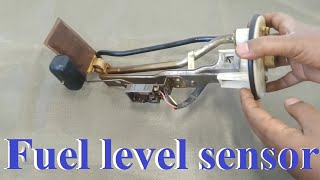
- Faulty Fuel Level Sensor (Sending Unit) 🔴 High Probability → Shop Fuel Tank Sending Unit The fuel level sensor is a mechanical part with a variable resistor that wears out over time. The constant movement of the float arm against the resistor eventually creates dead spots or causes erratic resistance readings, leading to a faulty signal. This failure is exceptionally common on the Armada/Titan/QX56 platform.
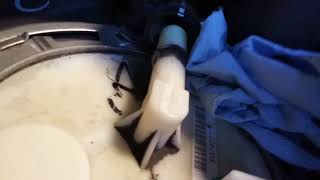
How to confirm: Access the fuel pump assembly under the rear seat. Disconnect the sensor and test its resistance with a multimeter while manually moving the float arm up and down. 🎬 See how to test the fuel level sensor The resistance should change smoothly from approximately 80-83 Ohms (empty) to 4-5 Ohms (full). If it jumps around, drops out (shows OL), or gives an out-of-spec reading, the sensor is bad.
Typical fix: Replace the fuel level sending unit. This part is located on the fuel pump assembly inside the fuel tank but can be replaced independently. Also replace the large o-ring gasket for the fuel pump access plate.
Est. part cost: $80-$120 - Damaged Wiring or Corroded Connector ⚪ Low Probability The connector for the fuel pump assembly is located under the rear seat/carpet and can be susceptible to moisture or physical damage over time, leading to corrosion on the pins for the fuel level sensor circuit.
How to confirm: Visually inspect the electrical connector on top of the fuel pump access plate. Look for any green or white corrosion, bent pins, or damaged wires. Test for continuity and proper voltage at the connector according to the factory service manual.
Typical fix: Clean the connector terminals with an electrical contact cleaner or replace the connector pigtail if damage is severe.
Est. part cost: $10-$30
Rare But Worth Checking
- Faulty Instrument Cluster (Combination Meter): → Shop Instrument Cluster This is very rare. Nissan clusters have a built-in self-diagnostic mode that can test the gauges. If the fuel gauge sweeps smoothly during the test, the cluster is likely not the problem. This should only be considered after the sensor and wiring have been proven to be good. A communication error with the cluster may also set a U0155 code. 🎬 Watch: Diagnosing Nissan instrument cluster and gauge failures
- Stuck or Damaged Float Arm: The mechanical arm that the float is attached to can become bent or get stuck, preventing it from accurately reading the fuel level. This is usually discovered during the visual inspection when replacing the sensor.
- Faulty Sub Fuel Level Sensor (4WD Models): → Shop Fuel Tank Sending Unit On 4WD models, the saddle-style fuel tank has two sending units: a primary unit on the main pump (Sensor 'A') and a sub-sensor on the driver's side (Sensor 'B'). While P0460 points to Sensor 'A', a failure in the sub-sensor can sometimes cause erratic overall readings. Diagnosis may require checking both sensors.
Diagnosis Steps
- Verify the P0460 code is present using an OBD-II scanner.
- Use the trip odometer to track fuel usage to avoid running out of gas.
- Perform the instrument cluster self-test to check if the gauge itself is functional. On many Nissans, this involves holding the trip reset button while turning the key to the 'ON' position.
- Gain access to the fuel pump assembly by removing the rear seat bottom cushion (or center console, depending on seating configuration) and the metal access plate.
- Disconnect the electrical connector and inspect it for corrosion or damage.
- If the connector looks good, use a multimeter set to Ohms to test the resistance between the pins for the primary fuel level sensor circuit on the pump assembly side.
- A good sensor should read approximately 4-5 Ohms when the float is at the 'full' position and 80-83 Ohms at the 'empty' position. The reading should change smoothly as you move the float arm.
- If the reading is erratic, jumps to infinity (OL), or is out of spec, the sending unit is faulty and must be replaced.
- For 4WD models, if the primary sensor tests good, you may need to access and test the sub-level sensor on the opposite side of the tank.
- If the sensor(s) test good, you must then check the wiring from the connector back to the ECM for continuity and shorts.
Parts You'll Likely Need
- Fuel Level Sensor (Fuel Sending Unit)
(OEM #25060-ZQ60A (supersedes 25060-7S00A, 25060-7S00B). Note: Multiple part numbers exist based on year/model/flex-fuel options, always verify with VIN.)— This is the component that fails over 95% of the time for this code. It is a wearable item that sends the fuel level signal to the computer.
Trusted brands: Nissan (Genuine), Bosch, Delphi, Dorman
OEM price range: $80-$120
Aftermarket price range: $40-$90 - Fuel Pump O-Ring / Gasket
(OEM #17342-7S000 or 17342-EA000)— This large rubber seal for the fuel pump access plate is a single-use item. It must be replaced to prevent fuel leaks and evaporative emissions (EVAP) codes after the repair.
Trusted brands: Nissan (Genuine)
OEM price range: $20-$40
Aftermarket price range: $15-$25
Related Codes That Often Appear With This One
- P0461 - Fuel Level Sensor Circuit Range/Performance
- P0462 - Fuel Level Sensor Circuit Low Input
- P0463 - Fuel Level Sensor Circuit High Input
Technical Service Bulletins (TSBs) & Recalls
- NTB10-037A - Part of Safety Recall R1010 for 2005-2009 models. Details the issue of fuel gauge inaccuracy and provides part numbers for the replacement sending unit.
- NTB22-026 - A newer TSB that applies to many Nissan models. It explicitly states to replace only the fuel level sensor for P0460-P0463 codes, not the entire fuel pump assembly. Manufacturer Bulletin #NTB22-026 notes that the fuel level sensor can be replaced separately rather than replacing the entire fuel pump assembly for P0460 (Fuel Lev Sen Slosh).
Platform-Specific Known Issues
- Nissan Safety Recall R1010 (TSB NTB10-037A) was issued for 2005-2009 Armada and Titan models due to the fuel gauge showing approximately 1/4 tank when it was actually empty, creating a stall risk. Some owners of 2004 models reported the same issue but were not covered by the recall.
- 4WD models have a saddle-shaped fuel tank with TWO fuel level sensors. The primary sensor ('A') is part of the main fuel pump assembly on the passenger side. A secondary 'sub-level' sensor is on the driver's side. P0460 specifically refers to the primary sensor, but a comprehensive diagnosis may involve checking both.
- TSB NTB22-026, while for newer models, reinforces Nissan's official procedure: if codes P0460, P0461, P0462, or P0463 are present, only the sensor should be replaced, not the entire fuel pump assembly.
Mechanic-Grade Diagnostic Values
- Primary Fuel Level Sensor Resistance — expected: Approx. 4-5 Ω at Full, Approx. 80-83 Ω at Empty. Failure: Readings are erratic, jump to OL (Open Loop), or are outside the specified range when moving the float arm.
- Sub-Level Sensor Resistance (4WD Models) — expected: Approx. 4-5 Ω at Full, Approx. 42-44 Ω at Empty. Failure: Readings are erratic, jump to OL, or are outside the specified range. Note the different 'Empty' resistance compared to the primary sensor.
- Voltage at Combination Meter — expected: Signal from the ECM to the combination meter should vary smoothly based on fuel level.. Failure: If sensor resistance is good, but the gauge is still wrong, check the signal wire between the ECM and the combination meter for shorts or opens.
Scan Tool Commands That Help
- Instrument Cluster: → Shop Instrument Cluster Combination Meter Self-Diagnostic Mode — To verify the functionality of the physical fuel gauge needle and its stepper motor. If the gauge sweeps correctly during this test, the instrument cluster is likely not the cause of the problem. The procedure typically involves pressing the trip reset button in a specific sequence while turning the ignition key.
Wiring & Ground Locations
- Fuel Pump Assembly Connector — On top of the fuel pump access plate, under the rear passenger-side seat carpet.. This is the primary connection point for the fuel level sensor. Corrosion or damage here is a common, though less frequent, cause of P0460. The sensor signal and ground wires pass through this connector.
- Harness Connector C5 — A chassis harness connector mentioned in the 2008 Armada service manual.. This connector is part of the circuit for the 'Fuel level sensor unit and fuel pump'. A problem at this junction in the main harness could interrupt the signal to the ECM.
- Fuel Pump Relay — Located in the engine compartment fuse and relay box, often integrated into the IPDM (Intelligent Power Distribution Module) and may not be individually serviceable.. While not a direct cause of P0460 (which is a sensor circuit code, not a pump power code), issues with the IPDM can cause a wide range of bizarre electrical problems, and it supplies power that may be related to the overall fuel system's electronics.
Real Owner Repair Stories
- YouTube video by user 'Fix it Angel' (2004-2015 TA60 model Armada) — Vehicle suddenly died while driving at 60mph because the fuel gauge was inaccurate, showing fuel when the tank was empty.
✅ What actually fixed it The user replaced the entire fuel pump assembly with an aftermarket unit for $80. During diagnosis, he tested the old sending unit with a multimeter and showed how the resistance readings were varying wildly and jumping all over the place, confirming the sensor had failed.
OEM Part Supersession History
25060-7S00A, 25060-7S00B→25060-ZQ60A— The original sending units were prone to premature wear of the resistor card, leading to the widespread recall. The updated part number features revised materials to improve longevity.
Heads up: There are different part numbers for Flex Fuel (FFV) models versus standard gasoline models. Using the wrong one can result in incorrect gauge readings. Always verify with VIN. For example, 25060-ZQ60A is often listed for non-flex fuel models up to 2009.
Model Year Variations Within This Range
- 2004: The 2004 model year was notably excluded from the official safety recall (R1010) for the fuel sending unit, despite many owners reporting identical failure symptoms (gauge stuck at 1/4 tank). Owners of 2004 models must pay for the repair out-of-pocket.
- 2008-2015: A facelift in 2008 introduced an updated interior and electronics, but the fundamental fuel sending unit design and failure mode remained the same as the earlier models.
Diagnostic Flowchart
Other Known Issues on This Vehicle
Issues unrelated to this code that are worth knowing about as an owner of this generation:
- Cracked Exhaust Manifolds 🔴 High — Very common, typically occurs between 80,000 and 120,000 miles. The thin-walled original manifolds are prone to cracking, causing a ticking noise, especially when cold.
- IPDM (Intelligent Power Distribution Module) Failure 🔴 High — Common failure item. The internal relay for the ECM can fail, leading to a no-start or crank-no-start condition. Symptoms can be intermittent at first.
- Rear Axle Seal Leaks 🟠 Medium — A frequent issue where the rear axle seals fail, causing differential fluid to leak onto the rear brake components. This can saturate the brake shoes/pads, requiring replacement of both the seals and brake hardware.
- Brake Booster / Delta Stroke Sensor Failure 🔴 High — Primarily affects earlier models (approx. 2004-2008). A faulty delta stroke sensor within the brake booster assembly can lead to an illuminated ABS light, grinding noises, and a hard brake pedal or loss of braking assist. (Ref: There were numerous complaints and service campaigns related to this issue.)
- Catalytic Converter Failure 🟠 Medium — The catalytic converters can fail prematurely, sometimes as a secondary effect of other issues like leaking exhaust manifolds altering the air-fuel ratio.
Used vs. New Parts: Buying Guide for This Vehicle
When a used part is the smart pick: A used part is almost never a smart choice for the fuel level sensor itself, as it is a known wear item and a used one may have little life left. However, if you need to replace the entire fuel pump *assembly* for other reasons (e.g., a failed pump motor), a low-mileage assembly from a reputable salvage yard could be a cost-effective option, as you would get the pump, housing, and sensor together.
Donor-vehicle mileage cap: roughly under 70000 miles for the part to have meaningful remaining life.
What to inspect on the donor part:
- Verify the donor vehicle's mileage if possible.
- Inspect the electrical connector on the used assembly for any signs of corrosion, melting, or bent pins.
- Check the plastic housing for cracks or damage from removal.
- If possible, test the resistance of the sending unit on the used assembly before purchase to ensure it reads smoothly.
OEM-only on this vehicle (don't cheap out):
- Fuel Pump O-Ring / Gasket. This is a critical seal that is single-use. Always buy this new, preferably from the OEM, to prevent dangerous fuel leaks.
Aftermarket brands forum-validated for this vehicle:
- Bosch
- Delphi
Brands owners have reported issues with on this vehicle:
- While Dorman offers an 'OE Fix' and is a popular choice, some professional mechanics and forum users report mixed results regarding the long-term durability of their sending units compared to OEM, Bosch, or Delphi. Unbranded, extremely low-cost units from online marketplaces should be avoided due to high failure rates.
Real Owner Stories
Aggregated from forums and TSBs cited above. Mileages and costs reflect what owners reported in those sources.
2005-2009 Nissan Armada
Symptoms: The instrument panel fuel gauge may inaccurately display that the vehicle still has some fuel, typically about one quarter tank, when the fuel tank is empty. This could cause the vehicle to run out of gas and stall.
What fixed it: Nissan recall R1010 / TSB NTB10-037A involving the replacement of the fuel level sending unit.
Source hint: NHTSA
2004-2015 Nissan Armada
Symptoms: Classic P0460 symptoms where the fuel gauge is inaccurate; owners confirmed the fix is replacing the sending unit and not the whole pump.
What fixed it: Replacing the fuel level sending unit (part numbers shared in thread).
Source hint: ClubArmada.com thread titled 'Fuel gauge problem'
2004-2015 Nissan Armada
Symptoms: P0463 and P0460 codes present; fuel level sensor failure.
What fixed it: Installation of a new sending unit.
Source hint: TitanTalk.com thread 'P0463 and P0460 Fuel Level Sensor'
Related OBD-II Codes
Frequently Asked Questions
Is there a recall for the fuel gauge issue on my 2005-2009 Nissan Armada?
My 2004 Armada has the same 1/4 tank inaccuracy; is it covered under the R1010 recall?
Do I need to replace the entire fuel pump assembly to fix code P0460?
How can I test if the fuel level sensor is actually bad on my Armada?
Does my 4WD Armada have more than one fuel sensor?
What is the estimated part cost for fixing the P0460 code?
Are there other common mechanical issues I should watch for on this platform?
Helpful Videos


We Have This Part in Stock

The information in this article is provided for general reference and educational purposes only. Vehicle specifications, procedures, and part compatibility can vary by production date, trim level, and region. Always consult your vehicle's factory service manual and verify part numbers before purchasing or performing repairs. Safety-critical components such as airbags, seat belts, and braking systems should be installed by a qualified professional.
- Nissan Armada:
- 🧭 Diagnostic Flowchart
- 🎬 Helpful Videos
- 🛍️ Shop This Part
- What's Unique About the 2004-2015 Nissan Armada
- Symptoms You May Notice
- Most Likely Causes
- Rare But Worth Checking
- Diagnosis Steps
- Parts You'll Likely Need
- Related Codes That Often Appear With This One
- Technical Service Bulletins (TSBs) & Recalls
- Platform-Specific Known Issues
- Mechanic-Grade Diagnostic Values
- Scan Tool Commands That Help
- Wiring & Ground Locations
- Real Owner Repair Stories
- OEM Part Supersession History
- Model Year Variations Within This Range
- Other Known Issues on This Vehicle
- Used vs. New Parts: Buying Guide for This Vehicle
- Real Owner Stories
- 2005-2009 Nissan Armada
- 2004-2015 Nissan Armada
- 2004-2015 Nissan Armada
- Related OBD-II Codes
- Frequently Asked Questions
- 🎟️ Get 5% Off