

P0460 on 2016-2022 Nissan Sentra: Fuel Level Sensor Circuit Fixes
P0460 on a 2016-2022 Sentra almost always indicates a failed fuel level sensor inside the gas tank. This causes an erratic or incorrect fuel gauge. Nissan issued a TSB (NTB22-026) confirming the sensor can be replaced separately from the entire fuel pump assembly, saving on parts cost. This is a known issue across two Sentra generations and also affects the Nissan Kicks and Versa.
- P0460 on a 2016-2022 Sentra points directly to a faulty fuel level sensor.
- An official Nissan TSB (NTB22-026) confirms this is a known issue.
- You can and should replace only the sensor, not the entire fuel pump assembly, which is much more expensive.
- Driving is possible, but you must manually track your mileage to avoid running out of fuel.
- The part number for the sensor is different for the 2016-2019 (B17) and 2020-2022 (B18) generations; verify with your VIN.
- This same problem affects other Nissans from this era, including the Kicks and Versa.
What's Unique About the 2016-2022 Nissan SENTRA
The key issue for the Sentra is that this is a well-documented problem. Nissan released Technical Service Bulletin NTB22-026 which covers this exact code for the 2016-2022 model years, as well as for platform mates like the Kicks and Versa. The bulletin's main point is to instruct technicians to replace only the faulty fuel level sensor, not the entire, more expensive fuel pump assembly. This is a critical cost-saving detail for this specific repair on this platform, as some repair estimates for the full assembly can exceed $1,500.
Diagnostic Flowchart
Tap your situation to follow the diagnostic path that matches what you're seeing on this vehicle.
Generation note: This range covers two Sentra generations: the B17 (2016-2019) and the B18 (2020-2022). The provided TSB NTB22-026 explicitly covers all years from 2016-2022, indicating the fuel level sensor issue and the separate serviceability of the sensor apply to both generations. However, they use different part numbers for the sensor itself.
Symptoms You May Notice
- Check Engine Light is on
- Fuel gauge reading is erratic, fluctuating, or stuck (e.g., stuck on empty or full)
- Fuel gauge shows a different level after restarting the car
- Distance-to-empty (DTE) display is inaccurate or shows '---'
- Low fuel warning light illuminates randomly, even with a full tank
- Replacing the entire fuel pump assembly. The TSB specifically warns against this, as only the sensor is typically needed, and doing so is a major unnecessary expense.
- Replacing the instrument cluster before diagnosing the sensor and wiring.
Most Likely Causes
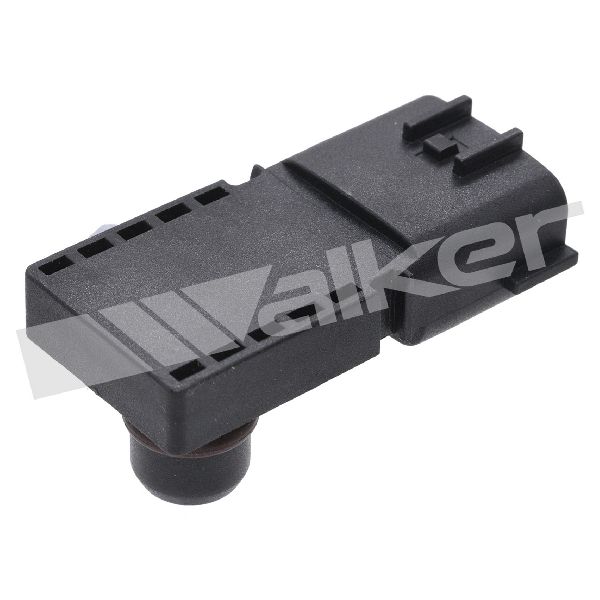
- Faulty Fuel Level Sensor (Sending Unit) 🔴 High Probability → Shop Fuel Tank Sending Unit This is a known issue acknowledged by Nissan via TSB NTB22-026. The sensor's internal variable resistor wears out or becomes contaminated, causing erratic electrical signals. The float arm may also become stuck.
How to confirm: Use a scan tool to monitor the fuel level sensor voltage/percentage. If the reading is erratic and doesn't correspond to the actual fuel level, the sensor is the likely culprit. A practical test is to gently tap the bottom of the fuel tank with a rubber mallet while observing the live data; if the reading jumps wildly, it confirms a faulty sensor. The definitive test is to remove the unit and measure the sensor's resistance with a multimeter while moving the float arm; 🎬 Watch: How to test and replace the fuel level sensor. the resistance should change smoothly, not jump or drop out. For Nissan vehicles, the expected resistance is approximately 31 ± 2 Ohms when the tank is full and 247 ± 3 Ohms when empty.
Typical fix: Replace the fuel level sensor. Per the TSB, this part can be replaced separately from the fuel pump assembly.
Est. part cost: $80-$200 - Damaged Wiring or Connectors ⚪ Low Probability
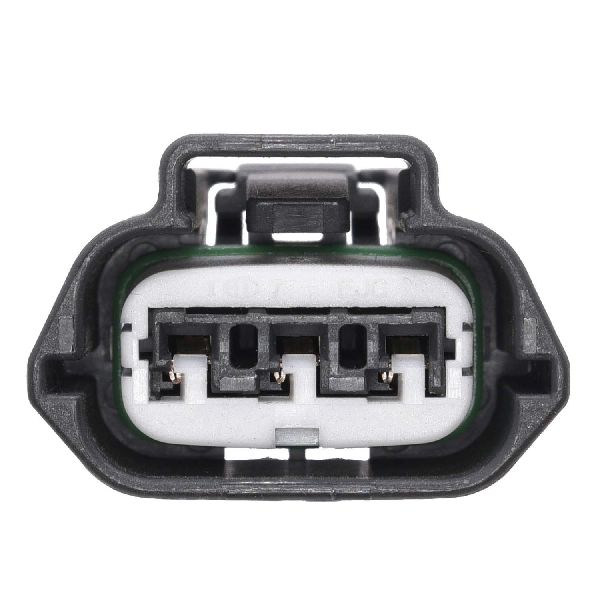
How to confirm: Visually inspect the wiring harness and connector on top of the fuel tank for any signs of corrosion, chafing, or loose pins. This requires accessing the top of the fuel tank, usually by removing the rear seat bottom cushion. A voltage drop test between the sensor connector and the PCM should show less than 0.5V; a reading greater than 0.5V indicates a wiring or corrosion issue.
Typical fix: Repair the damaged section of the wiring harness or clean/replace the corroded connector.
Est. part cost: $10-$50
Rare But Worth Checking
- Faulty Instrument Cluster: → Shop Instrument Cluster This is very uncommon. The gauge itself could be failing, but this should only be considered after the sensor and wiring have been thoroughly tested and confirmed to be good. If the Check Engine Light is on with P0460, the issue is almost certainly not the cluster.
- Faulty Powertrain Control Module (PCM): → Shop Engine Control Module (ECM) This is extremely rare. The PCM is the last component to suspect, as it's highly unlikely to be the source of this specific code.
Diagnosis Steps
- Read the trouble codes with an OBD-II scanner and confirm P0460 is present. Note any other related codes like P0461, P0462, or P0463.
- Use the scanner's live data function to observe the 'Fuel Level' or 'Fuel Tank Level Sensor' parameter. Watch for erratic jumps in the reading that don't reflect actual fuel movement.
- Turn the ignition off, then on again, and see if the reading changes drastically. This points to a sensor issue.
- Gain access to the top of the fuel tank. On a Sentra, this typically involves removing the rear seat bottom cushion to expose an access panel.
- Disconnect the electrical connector and inspect it and the wiring for any visible damage, corrosion, or loose connections.
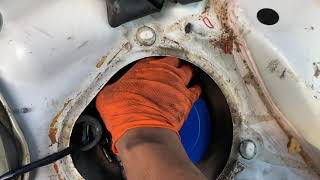
- If wiring appears okay, the fuel level sensor is the primary suspect. The next step is to remove the fuel pump assembly lock ring and lift the assembly out of the tank. A special tool is highly recommended for the lock ring to avoid damage. The job is safer 🎬 Watch: How to safely remove the fuel pump assembly. and cleaner with a near-empty fuel tank.
- Once removed, the fuel level sensor can be unclipped from the fuel pump assembly and replaced with a new one.
- Always replace the large O-ring/gasket for the fuel pump assembly to prevent dangerous fuel leaks or vapor smells.
- Reinstall the assembly, reconnect all lines and electrical connectors, and clear the trouble codes. Verify the fuel gauge reads correctly.
Parts You'll Likely Need
- Fuel Level Sensor (2020-2022, B18 Gen)
(OEM #25060-6LB0A)— This is the component that fails and causes the P0460 code for the B18 generation Sentra. 🎬 See this walkthrough for replacing the sensor on newer models. It is the direct fix recommended by Nissan's TSB.
Trusted brands: Nissan (OEM)
OEM price range: $130-$190
Aftermarket price range: $80-$150 - Fuel Level Sensor (2016-2019, B17 Gen)
(OEM #25060-3YU0A)— This is the corresponding sensor for the B17 generation Sentra. Part number can vary by trim (e.g., 1.6L Turbo models may use 25060-1KM0A). Always verify with VIN.
Trusted brands: Nissan (OEM), Delphi, Spectra Premium
OEM price range: $110-$170
Aftermarket price range: $70-$130 - Fuel Tank Seal / O-Ring — It is critical to replace this seal anytime the fuel pump assembly is removed from the tank to prevent fuel leaks and vapor smells. It is a cheap part that ensures safety.
Trusted brands: Nissan (OEM), Fel-Pro, Mahle
OEM price range: $15-$30
Aftermarket price range: $10-$20
Related Codes That Often Appear With This One
- P0461 — This code indicates 'Fuel Level Sensor Circuit Range/Performance'. It often appears with P0460 as both relate to implausible signals from the same sensor. The TSB NTB22-026 lists them together.
- P0462 — This code means 'Fuel Level Sensor 'A' Circuit Low Input'. It can be triggered if the failing sensor shorts to ground. The TSB NTB22-026 lists it as a related code.
- P0463 — This code means 'Fuel Level Sensor 'A' Circuit High Input'. It can be triggered if the failing sensor circuit has an open. The TSB NTB22-026 lists it as a related code.
Technical Service Bulletins (TSBs) & Recalls
- NTB22-026: 'SERVICE INFORMATION FOR FUEL GAUGE INACCURATE WITH DTCS STORED IN ECM' - Confirms P0460 is a known issue and advises replacing only the fuel level sensor. It also warns that warranty claims for replacing the entire pump assembly for this issue will be charged back.
Platform-Specific Known Issues
- Nissan has issued Technical Service Bulletin NTB22-026 for 2016-2022 Sentra models (among others) for inaccurate fuel gauge readings with DTCs P0460, P0461, P0462, or P0463. The bulletin explicitly states to replace only the fuel level sensor, not the entire fuel pump assembly, to correct the issue.
- Owners report that dealers not aware of the TSB may quote a very high price (over $1000) to replace the entire fuel pump assembly. Citing TSB NTB22-026 is key to getting the correct, cheaper repair.
Mechanic-Grade Diagnostic Values
- Fuel Level Sensor Resistance — expected: Approximately 31 ± 2 Ohms at FULL and 247 ± 3 Ohms at EMPTY.. Failure: Readings are outside this range, do not change smoothly as the float is moved, or show an open circuit (infinite resistance).
- Fuel Level Sensor Circuit Voltage Drop — expected: ≤ 0.5V. Failure: A voltage drop greater than 0.5V between the sensor connector and the PCM indicates excessive resistance from corrosion or a damaged wire.
- Instrument Cluster Gauge Test — expected: Gauge should respond when a test resistor is used.. Failure: If a 100 Ohm resistor is placed across the signal and ground wires at the sender connector and the gauge still reads incorrectly (e.g., stays on empty), the issue may be in the wiring to the cluster or the cluster itself.
Scan Tool Commands That Help
- Nissan CONSULT-III Plus: Active Test — The Nissan dealer tool has an 'Active Test' mode that allows for testing various vehicle systems. However, for the fuel level sensor specifically, there is no 'reset' or 'recalibration' function; if the sensor tests bad, it must be replaced.
Wiring & Ground Locations
- Fuel Pump Assembly Access Panel — Under the rear seat cushion, typically on the passenger side for the Sentra.. This is the primary access point needed to reach the fuel pump assembly connector for electrical testing and to remove the assembly to replace the fuel level sensor.
- Fuel Pump / FPCU Ground — On some Nissan models, the Fuel Pump Control Unit (FPCU) grounds through its metal case to the chassis.. A poor ground connection at the control unit mounting point can cause a variety of fuel system issues, including symptoms that mimic a failed pump or sensor. Ensuring the mounting surface is clean and the unit is secure is a critical, often overlooked, diagnostic step.
Real Owner Repair Stories
- Nissan Forum user 'elwesso' (Nissan Q45 (principles apply to other Nissans with a Fuel Pump Control Unit)) — Car died while driving, fuel pump was not running.
❌ Tried (didn't work) Replacing the fuel pump with a new OEM unit., Replacing the Fuel Pump Control Unit (FPCU).
✅ What actually fixed it The issue was a bad ground for the FPCU. Manually grounding the control unit's ground wire made the fuel pump operate correctly, proving the components were good and the ground path was the fault. - YouTube channel 'Gus's Garage' (2017 Nissan Sentra) — Check Engine Light on, inaccurate fuel gauge reading. Codes P0181 and P0183 were also present.
✅ What actually fixed it The entire fuel pump assembly was replaced, which resolved the issue. The video serves as a tutorial for accessing and replacing the unit.
OEM Part Supersession History
N/A→N/A— N/A
Heads up: A common point of confusion is that many OEM parts catalogs list the fuel level sensor (e.g., 25060-6LB0A) with the note 'Included with fuel pump'. This can mislead technicians or DIYers into ordering the entire expensive assembly. TSB NTB22-026 confirms the sensor is available and should be replaced separately.
Model Year Variations Within This Range
- 2016-2025: The diagnostic software required by Nissan dealers changes. The 2016-2022 Sentra is serviced using CONSULT-III Plus software. Starting with the 2026 model year, the Sentra will require the newer CONSULT 4 software for diagnostics.
Helpful Videos


We Have This Part in Stock

The information in this article is provided for general reference and educational purposes only. Vehicle specifications, procedures, and part compatibility can vary by production date, trim level, and region. Always consult your vehicle's factory service manual and verify part numbers before purchasing or performing repairs. Safety-critical components such as airbags, seat belts, and braking systems should be installed by a qualified professional.
- Nissan SENTRA:
- 🧭 Diagnostic Flowchart
- 🎬 Helpful Videos
- 🛍️ Shop This Part
- What's Unique About the 2016-2022 Nissan SENTRA
- Symptoms You May Notice
- Most Likely Causes
- Rare But Worth Checking
- Diagnosis Steps
- Parts You'll Likely Need
- Related Codes That Often Appear With This One
- Technical Service Bulletins (TSBs) & Recalls
- Platform-Specific Known Issues
- Mechanic-Grade Diagnostic Values
- Scan Tool Commands That Help
- Wiring & Ground Locations
- Real Owner Repair Stories
- OEM Part Supersession History
- Model Year Variations Within This Range
- 🎟️ Get 5% Off