

P0460 on 2010-2018 Subaru Forester: Fuel Level Sensor Circuit Causes and Fixes
On a 2010-2018 Forester, P0460 almost always means one of the two fuel level sensors has failed. Diagnosis is required to see if it's the main or sub sensor. Expect to pay $250-$550 for a shop to replace the faulty sensor; the part itself costs ~$90-$150 OEM.
- P0460 on your Forester means there's a problem with the fuel gauge reading, most likely a failed sensor.
- Your vehicle has TWO fuel level sensors (main and sub); the code does not tell you which one is bad.
- Diagnosis with a scan tool that can read live data from both sensors is the most efficient way to identify the faulty part before starting repairs.
- You can continue to drive, but must track mileage manually to avoid running out of fuel.
- The repair is manageable for a DIYer with moderate experience, but involves working with the fuel system, which requires caution.
What's Unique About the 2010-2018 Subaru Forester
The all-wheel-drive system in the 2010-2018 Forester requires a saddle-shaped fuel tank to accommodate the driveshaft. This design necessitates two fuel level sensors: a 'main' sensor, typically on the fuel pump module (right side), and a 'sub' sensor on its own (left side). The P0460 code doesn't specify which of the two has failed, making proper diagnosis essential before buying parts. 🎬 Watch: A quick overview of fixing the P0460 engine code. Failure of either sensor is a very common issue on this platform as they age, due to wear on the variable resistor contacts or float failure.
Generation note: This guide covers two Forester generations: the 3rd Gen (SH; 2010-2013) and the 4th Gen (SJ; 2014-2018). While the dual-sensor design is similar, the specific part numbers for the sending units differ between generations. Both are accessed via service panels under the rear seat cushion.
Symptoms You May Notice
- Check Engine Light is on
- Fuel gauge is inaccurate, erratic, or stuck (often on empty or full).
- Low fuel warning light illuminates at the wrong time, or not at all.
- Fuel gauge reading fluctuates wildly while driving.
- Inaccurate 'distance to empty' calculation on the trip computer.
- Replacing the fuel pump when only the sending unit has failed. On many models, the main sending unit is part of the pump assembly, but it's crucial to confirm the pump itself is faulty before replacing the entire expensive unit.
- Replacing the wrong sending unit. Without proper diagnosis to see which sensor (main or sub) has failed, you have a 50/50 chance of replacing the wrong part, wasting time and money.
- Replacing a sensor when the issue is a corroded connector on top of the tank assembly.
Most Likely Causes
- Faulty Fuel Level Sensor (Main or Sub Sending Unit) 🔴 High Probability → Shop Fuel Tank Sending Unit The variable resistor contacts on the sending units wear out or become contaminated over time from sulfur and other additives in gasoline, leading to incorrect resistance readings. The float arm can also get stuck, or the float itself can crack, fill with fuel, and sink. Given the dual-sensor setup, there is double the chance of a single sensor failure compared to other vehicles.
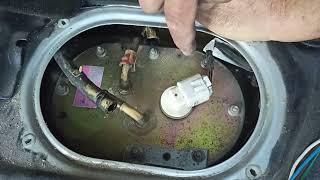
How to confirm: Use a scan tool to view live data for both the 'Main Fuel Level Sensor' and 'Sub Fuel Level Sensor' resistance or voltage. As you drive or add/remove fuel, the values should change smoothly. A sensor that is stuck at one value, reads 'open' (very high resistance), or jumps erratically is faulty. Alternatively, access the sensors under the rear seat, disconnect them, and test their resistance sweep with a multimeter. 🎬 See this walkthrough on removing the fuel pump and sender unit. A typical Subaru sensor might read around 2-5 ohms when full and 45-55 ohms when empty, though exact specs should be verified. Any sudden jumps or open readings during the sweep indicate failure.
Typical fix: Replace the identified faulty sending unit (either main or sub). Both are accessed via panels under the rear seat. It is recommended to have less than a half tank of fuel before starting the repair.
Est. part cost: $90-$150 - Damaged or Corroded Wiring/Connectors 🟡 Medium Probability The wiring harnesses and connectors on top of the fuel tank access panels are under the rear seat, but can still be exposed to moisture tracked into the cabin. Spills or tracked-in snow can lead to corrosion on the connector pins.
How to confirm: Visually inspect the wiring and connectors at both fuel tank access panels under the rear seat. Check for any green/white corrosion, broken wires, or loose pins. Perform a continuity test on the wires from the sensor connector to the combination meter if a wiring diagram is available. A 'wiggle test' on the harness while watching live data can also reveal intermittent connections.
Typical fix: Clean the corroded connector terminals with a contact cleaner or replace the connector pigtail. Repair any broken sections of wire.
Est. part cost: $5-$50
Rare But Worth Checking
- Faulty Instrument Cluster (Combination Meter): → Shop Instrument Cluster The instrument cluster processes the signals from the sensors to display the fuel level and sends the data to the PCM. While rare, an internal failure can cause incorrect readings even with good sensors. This is usually suspected only after sensors and wiring are confirmed to be good. A diagnostic check for codes specific to the instrument cluster may be necessary.
- Faulty Powertrain Control Module (PCM): → Shop Engine Control Module (ECM) This is extremely rare. The PCM is the last component to suspect as it only receives the final fuel level data from the instrument cluster. All other possibilities, including sensors, wiring, and the instrument cluster, should be exhaustively tested before considering PCM replacement.
Diagnosis Steps
- Connect an OBD-II scanner. Confirm P0460 is present. Check for related codes like P0462 or P0463, which point more directly to a short or open circuit. If these are present, troubleshoot them first.
- Use a capable scan tool to access live data. Monitor the resistance (ohms) or voltage for both the 'Main Fuel Level Sensor' and 'Sub Fuel Level Sensor'.
- Note the current readings. A healthy sensor will show a reasonable resistance value that corresponds to the approximate fuel level (e.g., ~2-55 ohms). An open circuit (infinity/high kOhms) or short circuit (0 ohms) points to a likely failure.
- If possible, drive the vehicle or add/remove fuel and watch the values. Both sensor readings should change smoothly. The faulty sensor will likely be stuck, erratic, or not change at all.
- If a scan tool is not available or for final confirmation, depressurize the fuel system by pulling the fuel pump fuse and running the engine until it stalls. Disconnect the battery.
- Remove the rear seat bottom cushion to access the two round, black service panels (one on the passenger side for the main sensor/pump, one on the driver's side for the sub sensor).
- Disconnect the electrical connector for the suspect sending unit. Use a multimeter set to Ohms to measure the resistance across the sensor's pins.
- Manually move the float arm up and down and watch the multimeter. The resistance should change smoothly throughout the range. Any sudden jumps, dropouts, or open-circuit readings confirm a bad sensor.
- If the sensor tests good, inspect the wiring and connector for damage or corrosion before moving on to suspect the instrument cluster or PCM.
Parts You'll Likely Need
- Fuel Main Gauge Sending Unit (SJ: 2014-2018)
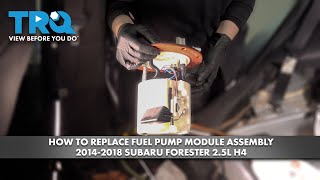
(OEM #42081SG000)— This is the primary sending unit for the 4th generation Forester, located with the fuel pump. It is a common failure item. 🎬 Watch: How to replace the fuel pump module on 2014-2018 models.
Trusted brands: Subaru (Genuine), Delphi, Spectra Premium
OEM price range: $95-$140
Aftermarket price range: $60-$100 - Fuel Sub Gauge Sending Unit (SJ: 2014-2018, 2.5L)
(OEM #42081FJ010)— This is the secondary sending unit for the 4th generation Forester (2.5L). It can fail independently of the main unit. This part is also used in the Impreza and Crosstrek of the same era.
Trusted brands: Subaru (Genuine)
OEM price range: $100-$150
Aftermarket price range: $70-$110 - Fuel Main Gauge Sending Unit (SH: 2010-2013)
(OEM #42081SC012)— This is the main sending unit for the 3rd generation Forester. It supersedes older part numbers 42081SC010 and 42081SC011.
Trusted brands: Subaru (Genuine)
OEM price range: $85-$125
Aftermarket price range: $50-$90 - Fuel Tank O-Ring / Gasket
(OEM #42025SC000 (for main pump assembly))— It is highly recommended to replace the large rubber gasket for any access panel that is opened to prevent fuel vapor leaks (EVAP codes) and ensure a proper seal.
Trusted brands: Subaru (Genuine)
OEM price range: $20-$30
Aftermarket price range: $10-$20
Related Codes That Often Appear With This One
- P0462 (Fuel Level Sensor 'A' Circuit Low Input)
- P0463 (Fuel Level Sensor 'A' Circuit High Input)
Platform-Specific Known Issues
- Owner Experience: 2014 Forester with P0460: An owner on a Reddit thread for a 2015 model (similar to 2014) described the fuel gauge being stuck. A technician advised that diagnosis is key to avoid replacing the wrong part. The repair involves removing the back seat, depressurizing the fuel system, and carefully removing the pump assembly to access the sender, noting it's an awkward process.
- DIY Repair on SubaruForester.org: A thread on subaruforester.org titled 'P0460 Fuel Level Sensor' details a user's diagnosis on a 2014 Forester. The user confirmed with a multimeter that the sub-level sensor had failed. After replacing the sub-level sending unit (driver's side), the code was cleared and the fuel gauge returned to normal operation. The user emphasized the importance of testing both sensors before ordering parts.
Mechanic-Grade Diagnostic Values
- Fuel Level Sensor Resistance (Main or Sub) — expected: Approximately 2-5 Ohms at Full, and 45-55 Ohms at Empty. The sweep should be smooth and monotonic.. Failure: Readings that are erratic, jump to very high resistance (e.g., >200 Ohms), or are stuck at one value indicate a faulty sensor.
- Fuel Level Sensor Live Data (Subaru Select Monitor) — expected: The 'Fuel Level' parameter should display a voltage between 0-5V that corresponds to the tank level.. Failure: A voltage that is stuck at 0V or 5V, or does not change when fuel is added, points to a circuit or sensor fault.
Real Owner Repair Stories
- YouTube video by user 'carsntoys' (2010 Subaru Impreza (shares similar sending unit design with Forester)) — Inaccurate fuel gauge.
✅ What actually fixed it The video demonstrates testing a faulty sending unit with a multimeter, showing its erratic resistance compared to a new part. The fix is replacing the faulty sending unit. The old unit showed erratic and very high resistance readings partway through its travel, while the new one swept smoothly.
OEM Part Supersession History
42081SC010, 42081SC011→42081SC012— Likely for improved reliability or minor design change. The older parts are no longer available from Subaru.
Heads up: The new part number (42081SC012) is a direct replacement for the older numbers and is fully compatible.
Diagnostic Flowchart
Other Known Issues on This Vehicle
Issues unrelated to this code that are worth knowing about as an owner of this generation:
- Excessive Oil Consumption (FB25 Engine) 🔴 High — Common in 2011-2015 models. A class-action lawsuit was settled, leading to extended warranties (8yr/100k miles) and potential engine component replacement for affected vehicles. (Ref: Class-action lawsuit settlement (No. 1:14-cv-02774))
- CVT Transmission Failure/Issues 🔴 High — Affects models throughout this period, with symptoms like shuddering, hesitation, or complete failure. Subaru extended the CVT warranty to 10 years/100,000 miles for many vehicles in response to complaints. (Ref: Subaru CVT Warranty Extension Program (e.g., TSB 16-107-17R))
- Rear Wheel Bearing Failure 🟠 Medium — A common wear item that often fails prematurely compared to other vehicles, typically noticeable by a loud humming or grinding noise from the rear of the vehicle that changes with speed.
- Failing Catalytic Converter 🟠 Medium — Can fail prematurely, often triggering a P0420 code. This can be a consequence of other issues like high oil consumption.
- Cracked Windshields 🟡 Low — Some owners, particularly of later models in this range, report a tendency for windshields to crack or chip easily, sometimes spontaneously.
Used vs. New Parts: Buying Guide for This Vehicle
When a used part is the smart pick: A used fuel level sending unit (main or sub) from a reputable salvage yard can be a cost-effective option, as it is a simple electro-mechanical part. This is only recommended if you can test the part before installation.
Donor-vehicle mileage cap: roughly under 80000 miles for the part to have meaningful remaining life.
What to inspect on the donor part:
- Ask for the mileage of the donor vehicle; lower is always better.
- Before purchasing, test the used unit with a multimeter. Connect the leads to the sensor pins and manually move the float arm through its full range of motion.
- The resistance reading should change smoothly without any sudden jumps or dropouts to OL (Open Loop).
- Visually inspect the resistor card for any signs of corrosion, dark spots, or worn-out traces where the wiper arm makes contact.
OEM-only on this vehicle (don't cheap out):
- While not strictly 'OEM-only', genuine Subaru sending units are recommended for the highest reliability and longest service life. The cost difference is often minimal compared to the labor of replacing it twice.
Aftermarket brands forum-validated for this vehicle:
- Delphi
- Spectra Premium
Brands owners have reported issues with on this vehicle:
- No-name or unbranded units from online marketplaces have a higher reported failure rate.
Real Owner Stories
Aggregated from forums and TSBs cited above. Mileages and costs reflect what owners reported in those sources.
2015 Subaru Forester
Symptoms: The fuel gauge was stuck.
What fixed it: Diagnosis confirmed a faulty sender, which requires removing the back seat, depressurizing the fuel system, and removing the fuel pump assembly to access and replace the part.
Source hint: Reddit thread for a 2015 model (similar to 2014)
2014 Subaru Forester
Symptoms: Check Engine Light on for code P0460 and an inaccurate fuel gauge.
What fixed it: The owner used a multimeter to confirm the sub-level sensor (driver's side) had failed. Replacing the sub-level sending unit cleared the code and restored normal fuel gauge operation.
Source hint: subaruforester.org thread titled 'P0460 Fuel Level Sensor'
Related OBD-II Codes
Frequently Asked Questions
Where are the two fuel level sensors located on my 2010-2018 Forester?
If I get a P0460 code, do I need to replace both the main and sub fuel sensors?
What are the correct resistance readings for a working fuel level sensor on this Forester?
Is it better to have a full or empty tank of gas when replacing a fuel level sensor?
My fuel gauge is stuck on my 2014 Forester. Is this a known issue?
I have a 2015 Subaru Crosstrek with a P0460 code. Is the diagnosis the same as the Forester?
What could cause P0460 besides a bad sending unit?
Helpful Videos
![How to Fix P0460 Engine Code in 2 Minutes [1 DIY Method / Only $11.9]](https://img.youtube.com/vi/gt5sdWRXypk/mqdefault.jpg)
We Have This Part in Stock


The information in this article is provided for general reference and educational purposes only. Vehicle specifications, procedures, and part compatibility can vary by production date, trim level, and region. Always consult your vehicle's factory service manual and verify part numbers before purchasing or performing repairs. Safety-critical components such as airbags, seat belts, and braking systems should be installed by a qualified professional.
- Subaru Forester:
- 🧭 Diagnostic Flowchart
- 🎬 Helpful Videos
- 🛍️ Shop This Part
- What's Unique About the 2010-2018 Subaru Forester
- Symptoms You May Notice
- Most Likely Causes
- Rare But Worth Checking
- Diagnosis Steps
- Parts You'll Likely Need
- Related Codes That Often Appear With This One
- Platform-Specific Known Issues
- Mechanic-Grade Diagnostic Values
- Real Owner Repair Stories
- OEM Part Supersession History
- Other Known Issues on This Vehicle
- Used vs. New Parts: Buying Guide for This Vehicle
- Real Owner Stories
- 2015 Subaru Forester
- 2014 Subaru Forester
- Related OBD-II Codes
- Frequently Asked Questions
- 🎟️ Get 5% Off