

P0461 on 2016-2022 Nissan Murano: Fuel Level Sensor Causes and Fixes
P0461 on a 2016-2022 Murano almost always indicates a faulty fuel level sensor in the gas tank, causing an erratic or incorrect fuel gauge. A Nissan Technical Service Bulletin (NTB22-026) confirms this issue across multiple models. The sensor (OEM Part #25060-5AA1A) can be replaced separately from the fuel pump, with the part costing around $125-$175, making the repair much more affordable than replacing the entire assembly.
- P0461 on a 2016-2022 Murano is a very common code pointing directly to a faulty fuel level sensor (OEM #25060-5AA1A).
- The primary symptom will be an erratic or inaccurate fuel gauge, often accompanied by the Check Engine Light.
- Nissan issued TSB NTB22-026 specifically for this issue, advising technicians to replace only the sensor, not the entire expensive fuel pump assembly.
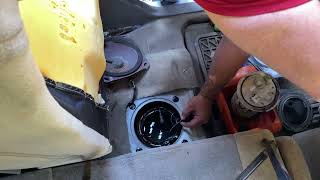
- The repair is moderately easy for a DIYer and involves accessing the top of the fuel tank from under the rear seat.
- Always replace the fuel tank O-ring (OEM #17342-EA000) at the same time to prevent fuel leaks or fumes.
What's Unique About the 2016-2022 Nissan MURANO
The 2016-2022 Murano (third generation) and its platform mates are known for this issue, to the point that Nissan issued a Technical Service Bulletin (TSB), #NTB22-026. [NTB22-026] The bulletin is explicit: "do not replace the entire 'Fuel Level Sensor Unit, Fuel Filter and Fuel Pump Assembly'... The fuel level sensor can be replaced separately." [NTB22-026] It even warns dealers that "Warranty claims referring to fuel level issues that result in the replacement of the entire fuel pump assembly will be charged back." [NTB22-026] This makes the repair significantly more affordable than on vehicles where the two components are a single, non-serviceable unit.
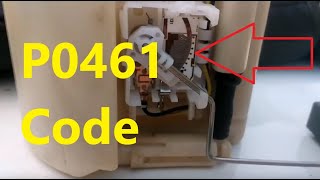
🎬 Watch: How to fix code P0461 without a full pump replacement.Diagnostic Flowchart
Tap your situation to follow the diagnostic path that matches what you're seeing on this vehicle.
Symptoms You May Notice
- Inaccurate or wildly fluctuating fuel gauge.
- Fuel gauge stuck on empty, full, or any position in between.
- Check Engine Light is illuminated.
- Low fuel warning light may stay on even with a full tank, or not turn on when the tank is empty.
- Replacing the entire fuel pump assembly. The provided Nissan TSB specifically notes that the fuel level sensor is a separate component and replacing the whole pump is unnecessary and costly. [NTB22-026] RepairPal estimates for replacing the entire 'sending unit' on a 2016 Murano can be over $2,200, demonstrating the high cost of this misdiagnosis compared to the correct, sensor-only repair.
Most Likely Causes
- Faulty Fuel Level Sensor (Sending Unit) 🔴 High Probability → Shop Fuel Tank Sending Unit This is a known issue acknowledged by Nissan's TSB #NTB22-026. The internal variable resistor on the sensor wears out over time, creating 'dead spots' or contamination on the contacts, which leads to an erratic signal. [NTB22-026, 31]
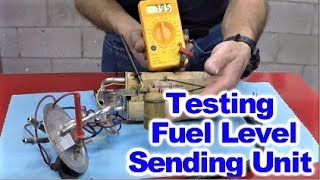
How to confirm: Use a scan tool to monitor the fuel level sensor's voltage or resistance. The reading will be erratic, stuck, or will not change smoothly as the fuel level changes (e.g., by rocking the vehicle or adding fuel). You can also test the sensor's resistance directly with a multimeter while moving the float arm; it should sweep smoothly without any sudden dropouts or spikes. A common resistance specification for Nissan sensors is approximately 2-3 Ohms at full and 81 Ohms at empty.
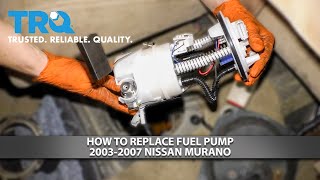
Typical fix: Replace the fuel level sensor inside the fuel tank. The sensor is typically accessed by removing the rear seat cushion to get to the access port on the top of the fuel tank. The correct OEM part is 25060-5AA1A.
Est. part cost: $125-$175 - Wiring or Connector Issues 🟡 Medium Probability The connector is located on top of the fuel tank, typically under the rear seat. This area can potentially trap moisture or the harness can be damaged from items stored under the seat or during other repairs, leading to corrosion or poor contact.
How to confirm: Visually inspect the wiring harness leading to the fuel pump module for any signs of damage, chafing, or corrosion at the connector. A voltage drop test can confirm high resistance in the circuit.
Typical fix: Repair the damaged section of wire or clean/replace the corroded connector.
Est. part cost: $5-$50 - Stuck or Damaged Sensor Float Arm ⚪ Low Probability
How to confirm: When the fuel pump module is removed, inspect the float arm. It should move freely throughout its range. If it is bent, binding, or has absorbed fuel and sunk, it is defective.
Typical fix: The float is part of the fuel level sensor assembly (25060-5AA1A) and will be replaced along with it.
Est. part cost: $125-$175
Rare But Worth Checking
- Instrument Cluster Failure: While rare, the physical gauge in the dashboard can fail. This is usually suspected if the fuel level sensor and wiring test perfectly fine, but the gauge still reads incorrectly. A gauge sweep test, which can be initiated through a hidden diagnostic menu on some models, can help diagnose this.
- Powertrain Control Module (PCM) Issue: → Shop Engine Control Module (ECM) This is extremely rare. A software glitch or internal hardware failure in the PCM could cause it to misinterpret the sensor's signal. This should only be considered after all other possibilities have been exhaustively ruled out by a professional.
Diagnosis Steps
- Connect an OBD-II scanner to confirm the P0461 code and check for any other related codes (like P0460, P0462, P0463).
- Use the scanner's live data function to observe the fuel level sensor voltage or percentage. Note if it is erratic, stuck, or doesn't correlate with the known fuel level. The voltage should typically be between 0.5V (Full) and 4.5V (Empty).
- Perform a visual inspection of the wiring harness and connector at the top of the fuel tank. Look for any obvious signs of damage, corrosion, or loose connections.
- Access the fuel level sensor, which is part of the fuel pump module located under the rear seat.
- Disconnect the sensor and use a multimeter to test its resistance. Manually sweep the float arm up and down. The resistance reading should change smoothly and consistently. For many Nissan models, the expected range is ~2-3 Ohms at full and ~81 Ohms at empty. Any sudden jumps to infinity (open) or zero indicate a faulty sensor.
- If the sensor tests good, check for proper voltage and ground at the sensor's electrical connector.
- If wiring and the sensor are confirmed to be good, the issue may lie with the instrument cluster or, very rarely, the PCM.
Parts You'll Likely Need
- Fuel Level Sensor
(OEM #25060-5AA1A)— This is the most common failure point for code P0461 on this vehicle, as confirmed by Nissan's service bulletin. It is the primary sending unit.
Trusted brands: Nissan OEM
OEM price range: $125-$175
Aftermarket price range: $80-$130 - Fuel Tank O-Ring / Seal
(OEM #17342-EA000)— This seal should always be replaced whenever the fuel pump module or sensor is removed from the tank to prevent fuel leaks and vapor smells.
Trusted brands: Nissan OEM, Mahle, Fel-Pro
OEM price range: $15-$30
Aftermarket price range: $10-$20
Related Codes That Often Appear With This One
- P0460 — This code relates to general fuel level sensor circuit malfunctions and is cited in the same TSB as P0461, indicating a 'slosh' or general rationality failure. [NTB22-026, 45]
- P0462 — This code indicates the fuel level sensor circuit input is low, suggesting a short or sensor failure. It is often seen with P0461 and is covered by the same TSB. [NTB22-026, 45]
- P0463 — This code indicates the fuel level sensor circuit input is high, suggesting an open circuit or sensor failure. It is also commonly associated with P0461 and covered by TSB NTB22-026. [NTB22-026, 45]
Technical Service Bulletins (TSBs) & Recalls
- NTB22-026: Addresses fuel level sensor codes including P0461 and confirms the fuel level sensor can be replaced separately from the fuel pump assembly. It applies to 2016-2022 Nissan models. [NTB22-026]
Platform-Specific Known Issues
- Nissan has issued Technical Service Bulletin #NTB22-026 for a range of vehicles including the 2016-2022 Murano, which addresses codes P0460, P0461, P0462, and P0463. It highlights that the fuel level sensor can be replaced independently of the fuel pump assembly and warns dealers against replacing the entire pump for this issue under warranty. [NTB22-026]
Mechanic-Grade Diagnostic Values
- Fuel Level Sensor Resistance — expected: ~2-3 Ohms (Full) to ~81 Ohms (Empty). Failure: Readings are erratic, infinite (open), zero (shorted), or do not change smoothly when moving the float arm.
- Fuel Level Sensor Voltage (Live Data) — expected: ~0.5V (Full) to ~4.5V (Empty). Failure: Voltage is stuck, erratic, or outside the expected range for the current fuel level.
Scan Tool Commands That Help
- Instrument Cluster: Self-Diagnosis Mode — To test if the instrument cluster gauges, including the fuel gauge, are mechanically functional. This helps rule out a faulty gauge if the sensor and wiring test good. The procedure typically involves a sequence of turning the ignition on/off while holding the trip meter button.
Wiring & Ground Locations
- Fuel Pump Ground — A wiring diagram for an earlier generation Murano shows a ground point for the fuel pump and sensor unit located behind the left rear seat (B20). While the exact designator may differ, the location is likely similar for the 2016-2022 models.. A poor ground connection for the fuel level sensor can cause erratic resistance readings and trigger a P0461 code. Verifying this ground is clean and secure is a key diagnostic step.
Real Owner Repair Stories
- Reddit user in r/MechanicAdvice (2018 Nissan Murano) — Fuel gauge suddenly dropped to empty and then returned to normal, followed by the Check Engine Light illuminating.
✅ What actually fixed it The consensus from mechanics in the thread was a failing fuel level sender unit, noting that the sensor was likely worn out and the issue would get progressively worse. This aligns with the known TSB for the vehicle.
Model Year Variations Within This Range
- 2019-2022: The Nissan Murano received a mid-cycle refresh for the 2019 model year, which included a revised front grille, new wheel designs, and updated interior trim. While the core engine and fuel system components related to P0461 remained the same, the refresh introduced new standard safety features like Rear Door Alert and Intelligent Driver Alertness, which integrate with the vehicle's information display and control modules. This could introduce variations in software or module communication compared to the 2016-2018 models.
Helpful Videos


We Have This Part in Stock


The information in this article is provided for general reference and educational purposes only. Vehicle specifications, procedures, and part compatibility can vary by production date, trim level, and region. Always consult your vehicle's factory service manual and verify part numbers before purchasing or performing repairs. Safety-critical components such as airbags, seat belts, and braking systems should be installed by a qualified professional.
- Nissan MURANO:
- 🧭 Diagnostic Flowchart
- 🎬 Helpful Videos
- 🛍️ Shop This Part
- What's Unique About the 2016-2022 Nissan MURANO
- Symptoms You May Notice
- Most Likely Causes
- Rare But Worth Checking
- Diagnosis Steps
- Parts You'll Likely Need
- Related Codes That Often Appear With This One
- Technical Service Bulletins (TSBs) & Recalls
- Platform-Specific Known Issues
- Mechanic-Grade Diagnostic Values
- Scan Tool Commands That Help
- Wiring & Ground Locations
- Real Owner Repair Stories
- Model Year Variations Within This Range
- 🎟️ Get 5% Off