

P0461 on 2016-2020 Nissan NV: Fuel Level Sensor Range/Performance Causes and Fixes
This code almost always indicates a faulty fuel level sensor inside the gas tank. A Nissan Technical Service Bulletin (NTB22-026) confirms this is a known issue across many Nissan models, including the NV. The sensor can be replaced separately from the entire fuel pump assembly, making the repair more affordable. The primary challenge is the labor involved in dropping the large fuel tank.
- P0461 on a 2016-2020 Nissan NV points directly to a problem with the fuel level sensor.
- The most common symptom is an erratic or non-functional fuel gauge.
- Do not replace the entire fuel pump assembly. Nissan has confirmed the sensor is the issue and is available as a separate part (OEM # 25060-9JJ0B for the NV).
- Repairing this code requires dropping the fuel tank, which can be a difficult and time-consuming DIY job. Always prioritize safety when working with fuel system components.
- Always replace the fuel tank O-ring seal when performing this repair to prevent future leaks.
What's Unique About the 2016-2020 Nissan NV
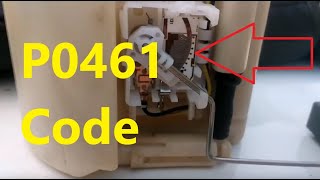
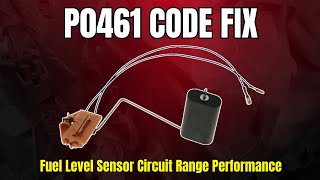
For the Nissan NV and other Nissan models of this era, P0461 is a well-documented problem. Nissan issued a Technical Service Bulletin (TSB), NTB22-026, specifically for this and related codes (P0460, P0462, P0463). 🎬 Watch: Understanding P0461 causes and common sensor circuit fixes. The bulletin advises technicians to replace only the fuel level sensor, not the entire fuel pump assembly, which is a common and more expensive misdiagnosis. 🎬 See why you shouldn't replace the entire fuel pump assembly. This makes the repair significantly more cost-effective for NV owners, as the primary cost shifts from a very expensive part to the labor of accessing it.
Diagnostic Flowchart
Tap your situation to follow the diagnostic path that matches what you're seeing on this vehicle.
Symptoms You May Notice
- Inaccurate or erratic fuel gauge (e.g., jumping from full to empty)
- Fuel gauge stuck on full or empty
- Check Engine Light is on
- Inaccurate Distance-to-Empty (DTE) calculation
- Low fuel light may be on or flashing constantly.
- Replacing the entire fuel pump assembly when only the serviceable fuel level sensor is at fault. The TSB for this vehicle specifically advises against this and warns that warranty claims for this unnecessary repair will be denied.
- Replacing the instrument cluster before thoroughly testing the fuel level sensor and its circuit.
Most Likely Causes
- Faulty Fuel Level Sensor 🔴 High Probability → Shop Fuel Tank Sending Unit This is a known issue acknowledged by Nissan in TSB NTB22-026. The sensor's resistive potentiometer contacts can wear out or get corroded over time, especially from prolonged exposure to fuel, leading to incorrect signals.
How to confirm: Use a scan tool to monitor the fuel level sensor's voltage or resistance. If the reading is erratic or doesn't change smoothly as the vehicle is rocked, the sensor is likely bad. The definitive test is to remove the unit from the fuel tank and test its resistance sweep with a multimeter. The resistance should change smoothly without any dropouts or spikes as the float arm is moved.
Typical fix: Replace the fuel level sensor. The sensor is located on the fuel pump assembly inside the fuel tank but can be purchased and replaced separately. This repair requires dropping the fuel tank, which is a significant job due to the tank's size and weight, especially when it contains fuel.
Est. part cost: $150-$400 - Wiring or Connector Issue 🟡 Medium Probability The wiring harness leading to the fuel tank is exposed under the vehicle and can be susceptible to corrosion from road salt and moisture, or physical damage over time.
How to confirm: Visually inspect the wiring harness and connector at the top of the fuel tank for any signs of corrosion, chafing, or loose pins. This inspection is best done after partially lowering the tank for access. Perform a voltage drop test on the signal and ground circuits if the sensor itself tests good.
Typical fix: Repair the damaged section of the wiring harness or clean/replace the corroded connector. Ensure all chassis grounds are clean and secure.
Est. part cost: $10-$50 - Stuck or Damaged Float Arm ⚪ Low Probability While less common, debris in the fuel tank or physical damage during previous service could potentially cause the float arm to bind, preventing it from moving with the fuel level.
How to confirm: This can only be confirmed by removing the fuel pump assembly from the tank and visually inspecting the float for free and smooth movement throughout its range.
Typical fix: Free the stuck float arm. If the arm or float is damaged, the fuel level sensor assembly must be replaced.
Est. part cost: $150-$400
Rare But Worth Checking
- Instrument Cluster or Body Control Module (BCM) Fault: While rare, a software glitch or internal failure in the instrument cluster or BCM can misinterpret a correct signal from the sensor. This should only be considered after the sensor and wiring have been proven to be good. Some Nissan models have had software updates to address similar issues, so it's worth checking for any applicable campaigns. A professional scan tool can perform an 'actuation test' to command the gauge to sweep, confirming if the gauge motor itself is functional.
Diagnosis Steps
- Confirm the P0461 code is present using an OBD-II scanner. Check for other related codes (P0460, P0462, P0463). Note any freeze frame data.
- Use the scanner's live data function to observe the fuel level sensor voltage or percentage. Rock the vehicle to slosh fuel and see if the reading changes. An erratic, stuck, or nonsensical reading points to a problem with the sensor or float.
- If a professional scan tool (like Nissan CONSULT) is available, perform an 'Actuation Test' on the 'Fuel Meter Operation'. This commands the gauge to sweep through its range (empty, 1/4, 1/2, full). If the gauge sweeps correctly, the instrument cluster is likely good, and the fault is in the sender or wiring.
- Perform a visual inspection of the wiring harness and connector leading to the fuel tank. Look for any obvious signs of damage, chafing, or corrosion.
- If wiring appears intact, the next step is to access the fuel pump assembly. On the Nissan NV, this requires dropping the fuel tank. It is highly recommended to drain as much fuel as possible before starting. Use a transmission jack or floor jack with a wide support to safely support and lower the tank.
- Lower the tank just enough to access and disconnect the electrical connector and fuel lines.
- Once the tank is removed, unbolt the fuel pump assembly retaining ring and lift the assembly out.
- Disconnect the fuel level sensor from the assembly and use a multimeter set to Ohms to measure the resistance across the sensor's terminals.
- Manually move the float arm from the empty to full position. The resistance reading should change smoothly without any dropouts or spikes. On similar Nissan platforms like the Titan, the expected range is approximately 80 Ohms at empty and 2-4 Ohms at full. If the reading is erratic, open, or stuck, the sensor is bad.
- If the sensor fails the resistance test, it needs to be replaced. If the sensor tests good, the fault lies in the wiring or, rarely, the BCM/ECM.
Parts You'll Likely Need
- Fuel Level Sensor
(OEM #25060-9JJ0B)— This is the most common failure point for the P0461 code on this vehicle, as confirmed by Nissan's own service bulletin NTB22-026. The part number 25060-9JJ0B is listed for the full-size NV with the 5.6L engine.
Trusted brands: Nissan (OEM)
OEM price range: $75-$110
Aftermarket price range: $50-$90 - Fuel Tank O-Ring / Seal
(OEM #17342-1HJ0A)— This seal should always be replaced whenever the fuel pump assembly is removed from the tank to prevent fuel leaks and EVAP system codes. It is cheap insurance against having to do the job twice.
Trusted brands: Nissan (OEM), Mahle, Fel-Pro
OEM price range: $15-$30
Aftermarket price range: $10-$20
Related Codes That Often Appear With This One
- P0460 — Both codes relate to the fuel level sensor. P0460 is a more general circuit malfunction code, often set along with P0461.
- P0462 — Indicates the fuel level sensor circuit input is low. This often appears with P0461 as the sensor fails and the signal drops out.
- P0463 — Indicates the fuel level sensor circuit input is high. This can also appear with P0461 if the sensor circuit has an open or high resistance fault.
Technical Service Bulletins (TSBs) & Recalls
- NTB22-026: Advises that for a P0461 code, only the fuel level sensor should be replaced, not the entire fuel pump assembly. It applies to 2016-2022 Nissan vehicles.
- NTB21-004: Provides the specific part number for the serviceable fuel level sensor on the related NV200 platform, confirming it is available separately from the pump.
Platform-Specific Known Issues
- Nissan has issued TSB NTB22-026, which applies to a wide range of their vehicles including the NV, for inaccurate fuel gauges accompanied by codes P0460, P0461, P0462, or P0463. The bulletin explicitly states to replace the fuel level sensor separately and warns that warranty claims for replacing the entire fuel pump assembly for this issue will be denied.
- Unlike many sedans or even the smaller NV200 van, there is no access panel under the seats or floor to get to the fuel pump on the full-size Nissan NV. The fuel tank must be dropped to perform this service, making it a more labor-intensive job.
Mechanic-Grade Diagnostic Values
- Fuel Level Sensor Resistance — expected: Approx. 2-4 Ohms (Full) to 80 Ohms (Empty). Resistance should sweep smoothly as the float arm is moved.. Failure: Readings are open (OL), shorted (near 0 ohms regardless of position), stuck, or jump erratically during the sweep test.
- Fuel Level Sensor Live Data Voltage — expected: Approx. 0.5V (Full) to 4.5V (Empty).. Failure: Voltage is stuck, outside of this range, or does not change smoothly as fuel sloshes in the tank.
Scan Tool Commands That Help
- Nissan CONSULT or advanced bidirectional scanner: Work Support / Active Test for Instrument Cluster -> 'Fuel Meter Operation' — Use this test to rule out a faulty instrument cluster. The command forces the fuel gauge needle to sweep to predefined positions (Empty, 1/4, 1/2, Full). If the gauge responds correctly, the gauge itself is working, and the problem is in the wiring or the fuel level sensor.
Wiring & Ground Locations
- Fuel Pump Relay & Fuse — Located in the IPDM E/R (Intelligent Power Distribution Module Engine Room), which is in the right rear of the engine compartment.. The fuel pump and fuel level sensor share a harness. Power issues originating from the IPDM could potentially affect the sensor circuit. The fuse for the fuel pump control module is Fuse #48 (15 amp) in this box.
- Fuel Pump Control Module — Mounted on the fuel tank.. This module receives power from the IPDM and controls the fuel pump. The wiring for the fuel level sensor passes through the same main connector, making this area a key point for inspection for corrosion or damage after dropping the tank.
- Fuel Pump Assembly Connector — On top of the fuel pump module, accessible after lowering the fuel tank.. This is the primary connector where diagnostic tests (voltage, ground, resistance) for the fuel level sensor circuit are performed. It is designated as B44 on the related NV200 platform.
Real Owner Repair Stories
- Reddit user on r/NissanTitan (2011 Nissan Titan PRO-4X (similar platform and V8 engine)) — Vehicle ran out of fuel even though the gauge showed 1/4 tank and the distance-to-empty display showed 90 miles remaining. Another user reported their gauge would get stuck at 1/2 tank.
❌ Tried (didn't work) One user had the fuel pump replaced twice, thinking the first replacement was faulty, but the problem persisted (gauge stuck at 1/2 tank).
✅ What actually fixed it The consensus and stated plan was to replace the fuel level sensor specifically, as it was identified as the component failing and providing incorrect resistance readings to the computer and gauge.
Helpful Videos

We Have This Part in Stock


The information in this article is provided for general reference and educational purposes only. Vehicle specifications, procedures, and part compatibility can vary by production date, trim level, and region. Always consult your vehicle's factory service manual and verify part numbers before purchasing or performing repairs. Safety-critical components such as airbags, seat belts, and braking systems should be installed by a qualified professional.
- Nissan NV:
- 🧭 Diagnostic Flowchart
- 🎬 Helpful Videos
- 🛍️ Shop This Part
- What's Unique About the 2016-2020 Nissan NV
- Symptoms You May Notice
- Most Likely Causes
- Rare But Worth Checking
- Diagnosis Steps
- Parts You'll Likely Need
- Related Codes That Often Appear With This One
- Technical Service Bulletins (TSBs) & Recalls
- Platform-Specific Known Issues
- Mechanic-Grade Diagnostic Values
- Scan Tool Commands That Help
- Wiring & Ground Locations
- Real Owner Repair Stories
- 🎟️ Get 5% Off