

P0461 on 2016-2022 Nissan Rogue: Fuel Level Sensor Causes and Fixes
On a 2016-2022 Nissan Rogue, code P0461 is almost always caused by a faulty fuel level sensor in the gas tank. Nissan issued a Technical Service Bulletin (NTB22-026) advising technicians to replace only the sensor, not the entire fuel pump assembly. The correct OEM part number varies by the vehicle's manufacturing location (e.g., 25060-4BA0B, 25060-6FK5A). Expect to pay around $150 for the part, with a DIY difficulty of 3/5.
- P0461 on a 2016-2022 Rogue points directly to a problem with the fuel level sensor's signal.
- The most probable cause is a faulty fuel level sensor, which is a known issue addressed by Nissan TSB NTB22-026.
- Do not replace the entire fuel pump assembly. The sensor is available as a separate, less expensive part, and Nissan specifically advises against replacing the whole unit for this code.
- Symptoms are limited to an incorrect fuel gauge and a Check Engine Light; the vehicle remains safe to drive, but with the risk of running out of fuel.
- The repair involves accessing the fuel tank from under the rear seat and can be performed by a DIYer with moderate experience using a special lock ring tool.
What's Unique About the 2016-2022 Nissan ROGUE
This issue is common enough on the Nissan Rogue and other Nissan models that the manufacturer released a specific Technical Service Bulletin (TSB), NTB22-026, on April 5, 2022. The bulletin explicitly states that for P0461 and related codes (P0460, P0462, P0463), technicians should replace the fuel level sensor separately, not the entire fuel pump assembly. This is a key detail, as it makes the repair significantly cheaper and confirms the sensor itself is the intended point of failure and service. Nissan has noted that warranty claims for replacing the entire pump assembly for this issue will be charged back.
🎬 Watch: How to fix P0461 without replacing the whole pump.Diagnostic Flowchart
Tap your situation to follow the diagnostic path that matches what you're seeing on this vehicle.
Generation note: This year range covers two generations of the Nissan Rogue: the second generation (T32, 2016-2020) and the third generation (T33, 2021-2022). Both generations are built on the Renault-Nissan CMF-C/D platform. The cause and fix for P0461, specifically a faulty fuel level sensor, are common to both generations and are covered under the same TSB, NTB22-026.
Symptoms You May Notice
- Check Engine Light is on.
- Fuel gauge fluctuates erratically, is stuck on full or empty, or gives an incorrect reading (e.g., shows empty after a fill-up).
- Low fuel warning light may stay on or flash, even with a full tank.
- The 'distance to empty' calculation on the trip computer is inaccurate or stuck on one number.
- Replacing the entire fuel pump assembly. Nissan's TSB NTB22-026 specifically warns against this, as the sensor is the typical point of failure and is available separately, making this an unnecessarily expensive repair.
Most Likely Causes
- Faulty Fuel Level Sensor 🔴 High Probability → Shop Fuel Tank Sending Unit This is a known issue acknowledged by Nissan via TSB NTB22-026. The sensor's internal variable resistor wears out over time, causing it to send incorrect, jumpy, or out-of-range voltage signals to the ECM.
How to confirm: Access the fuel pump assembly under the rear seat. Disconnect the sensor and measure its resistance with a multimeter while manually moving the float arm. The resistance should change smoothly and linearly. Some service documents specify a range of approximately 31 ± 2 Ohms when full to 247 ± 3 Ohms when empty. A jumpy, open (infinite), or non-existent reading confirms a bad sensor.
Typical fix: Replace the fuel level sensor. The sensor is located on the fuel pump module but can be purchased and replaced separately per Nissan's TSB.
Est. part cost: $100-$170 - Wiring or Connector Issues ⚪ Low Probability While less common than sensor failure, the connector at the top of the fuel tank is exposed to the elements under the car, and the wiring under the rear seat can be disturbed.
How to confirm: Visually inspect the wiring harness and connector at the top of the fuel tank for any signs of damage, corrosion, or loose pins. Check for continuity and proper voltage at the connector using a multimeter and a vehicle-specific wiring diagram.
Typical fix: Repair the damaged section of the wiring harness or clean/replace the corroded connector.
Est. part cost: $10-$50
Rare But Worth Checking
- Stuck or Damaged Float Arm: The float arm can become bent from improper handling during a fuel pump replacement or, rarely, get stuck on debris inside the tank, preventing it from moving with the fuel level. This is a mechanical failure rather than an electrical one.
- Instrument Cluster or ECM Fault: In very rare cases, the problem may not be in the tank at all, but with the instrument cluster that displays the reading or the ECM that processes the signal. This should only be considered after the sensor and wiring have been definitively ruled out. A dealership may need to re-flash the software to resolve it.
Diagnosis Steps
- Scan the vehicle for OBD-II codes to confirm P0461 and any other related codes are present.
- Check for any applicable Technical Service Bulletins (TSBs). For this vehicle, NTB22-026 is highly relevant.
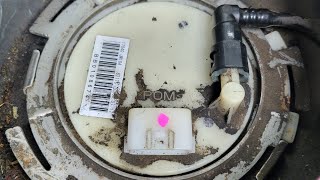
- Gain access to the top of the fuel tank, which is typically under the rear seat cushion. This involves removing two 16mm bolts at the base of the seat.
- Disconnect the battery.
- Remove the fuel pump access cover, which is often held by several 90-degree turn fasteners.
- Inspect the electrical connector and wiring for any visible signs of corrosion, damage, or loose connections.
- If wiring looks good, test the sensor. Disconnect the connector and use a multimeter set to Ohms to measure the resistance across the sensor's pins.
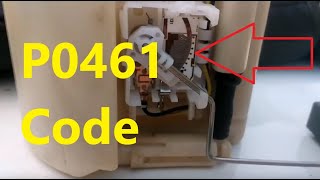
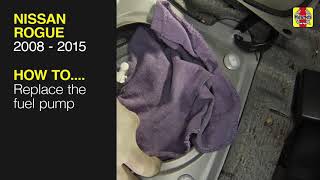
- Carefully remove the fuel pump assembly to access the float. This requires a special lock ring tool, though some DIYers use a brass punch and hammer. Manually move the float arm up and down while observing the multimeter. The resistance reading should change smoothly and consistently, for example, from ~31 Ohms at full to ~247 Ohms at empty. If it jumps, drops out, or doesn't change, the sensor is faulty.
- If the sensor tests good, the issue may be in the wiring harness or, rarely, the instrument cluster or ECM.
Parts You'll Likely Need
- Fuel Level Sensor
(OEM #Varies by VIN (manufacturing location). Examples: 25060-4BA0B, 25060-4BA4B, 25060-6FK5A. It is critical to verify the correct part number with the vehicle's VIN.)— This is the most common failure point for code P0461 on this vehicle, as confirmed by owner experiences and a Nissan TSB.
Trusted brands: Nissan (OEM)
OEM price range: $140-$170
Aftermarket price range: $100-$150 - Fuel Tank O-Ring / Seal — It is highly recommended to replace the large O-ring seal for the fuel pump assembly whenever it is removed to prevent fuel leaks and vapor smells.
Trusted brands: Nissan (OEM), Aftermarket
OEM price range: $15-$25
Aftermarket price range: $10-$20
Related Codes That Often Appear With This One
- P0460 — This code for 'Fuel Level Sensor Circuit' is often triggered alongside P0461 as they both relate to general malfunctions from the same sensor.
- P0462 — Indicates 'Fuel Level Sensor Circuit Low Input', meaning the ECM is seeing a lower-than-expected voltage. This can happen if the sensor's resistor fails and shorts.
- P0463 — Indicates 'Fuel Level Sensor Circuit High Input', meaning the ECM is seeing a higher-than-expected voltage. This can happen if the sensor's circuit has an open or high resistance.
Technical Service Bulletins (TSBs) & Recalls
- NTB22-026: Published April 5, 2022, this bulletin instructs technicians that if a fuel level sensor is diagnosed as sending an incorrect signal with DTCs P0460, P0461, P0462, or P0463, the sensor should be replaced separately from the fuel pump assembly. It warns that warranty claims for the full assembly will be charged back.
Platform-Specific Known Issues
- Nissan issued TSB NTB22-026 due to the high frequency of this issue. The bulletin applies to a wide range of models, including the 2016-2022 Rogue, and advises replacing only the fuel level sensor for codes P0460, P0461, P0462, and P0463.
Mechanic-Grade Diagnostic Values
- Fuel Level Sensor Voltage (Live Data) — expected: ~0.5V (Empty) to ~4.5V (Full). Failure: Voltage is stuck, jumps erratically, or is consistently outside the expected range.
- Fuel Level Sensor Resistance — expected: A smooth, consistent change from high resistance at empty to low resistance at full. A common range is ~250 Ohms (Empty) to ~20 Ohms (Full).. Failure: Readings are erratic, jump to infinite (open circuit), or do not change as the float is moved.
- Example Nissan Resistance Range (from a different model) — expected: Full: ~4-6 Ω, Half: ~27-34 Ω, Empty: ~73-85 Ω. Note that resistance is not linear and is higher when empty.. Failure: Readings do not fall within the expected ranges for a given fuel level or are stuck at one value.
Wiring & Ground Locations
- Fuel Pump Module Connector — Under the rear passenger seat cushion, beneath a circular metal access panel. The panel is often secured with several clips or screws.. This is the primary connection point for the fuel level sensor. Inspecting this connector for corrosion, moisture, or pushed-out pins is a critical first step after confirming the code.
- Sensor Ground Wire — The ground for the fuel level sensor is typically integrated into the main fuel pump module connector and is grounded through the vehicle's body harness, eventually connecting to a chassis ground.. A poor ground connection can cause erratic voltage readings, mimicking a faulty sensor. While less common than sensor failure, checking for a clean, tight ground path is essential for diagnosis.
Real Owner Repair Stories
- YouTube channel 'Car Problems' (Nissan vehicle (specific model not a Rogue, but demonstrates a common failure mode)) — Fuel gauge was reading incorrectly and was not matching the actual fuel level in the tank.
❌ Tried (didn't work) Scanning the codes was the first step, which confirmed a fuel level sensor issue.
✅ What actually fixed it Upon removing the fuel pump assembly, the technician discovered the plastic frame holding the float arm was physically broken on one side. This caused the float to sit at an incorrect angle, sending a false reading. The technician repaired the broken plastic frame instead of replacing the entire unit, which restored correct gauge function.
OEM Part Supersession History
25060-4BA0A→25060-4BA0B— Standard part revision or improvement by the manufacturer.
Heads up: Applies to US-built models (VIN starting with '5N1'). The new part is a direct replacement for the old one.
Model Year Variations Within This Range
- 2016-2022: The correct fuel level sensor part number depends on the vehicle's country of manufacture, identified by the first 3 digits of the VIN. VINs starting with '5N1' are US-built, 'JN8' are Japan-built, and 'KNM' are Korean-built. Using the wrong part can result in incorrect readings even if it physically fits.
- 2016-2022: All-Wheel Drive (AWD) models feature a 'saddle' style fuel tank to accommodate the driveshaft. This design requires a secondary 'sub fuel level sensor' on the opposite side of the tank from the main fuel pump module. Code P0461 refers to Sensor 'A', which is the primary sensor. A failure of the secondary sensor may cause similar symptoms but could trigger a different code.
Helpful Videos


The information in this article is provided for general reference and educational purposes only. Vehicle specifications, procedures, and part compatibility can vary by production date, trim level, and region. Always consult your vehicle's factory service manual and verify part numbers before purchasing or performing repairs. Safety-critical components such as airbags, seat belts, and braking systems should be installed by a qualified professional.
- Nissan ROGUE:
- 🧭 Diagnostic Flowchart
- 🎬 Helpful Videos
- What's Unique About the 2016-2022 Nissan ROGUE
- Symptoms You May Notice
- Most Likely Causes
- Rare But Worth Checking
- Diagnosis Steps
- Parts You'll Likely Need
- Related Codes That Often Appear With This One
- Technical Service Bulletins (TSBs) & Recalls
- Platform-Specific Known Issues
- Mechanic-Grade Diagnostic Values
- Wiring & Ground Locations
- Real Owner Repair Stories
- OEM Part Supersession History
- Model Year Variations Within This Range
- 🎟️ Get 5% Off