

P0461 on 2004-2009 Toyota Prius: Fuel Gauge Problems and Fixes
This code almost always means the fuel level sending unit inside the gas tank has failed. Your fuel gauge will be erratic or incorrect, but the car will drive fine. The fix is to replace the fuel level sensor, which is part of the fuel pump assembly. This is a very common failure on high-mileage Gen 2 Priuses.
- P0461 on a 2004-2009 Prius means your fuel gauge is unreliable because the fuel level sensor in the tank is failing.
- The car is safe to drive, but you must use your trip odometer to track fuel and avoid running out.
- The most common fix is to replace the entire fuel pump module assembly, which is accessed from under the rear seat.
- Before buying parts, inspect the wiring connector on top of the fuel tank for corrosion or damage, as this can sometimes be a simpler fix.
What's Unique About the 2004-2009 Toyota Prius
The 2004-2009 Prius (second generation, XW20) uses a flexible, bladder-style fuel tank. While the tank itself is unique, the cause of P0461 is typical of many vehicles: the fuel level sending unit's electrical contacts wear out over time. The sending unit is integrated into the fuel pump module, so the entire assembly is usually replaced. A specific nuance is that the bladder can sometimes make it difficult for the gauge to read the last few gallons accurately, but this is separate from the P0461 fault, which indicates a clear electrical failure of the sender.
Symptoms You May Notice
- Fuel gauge fluctuates erratically or reads inaccurately.
- Fuel gauge is stuck on Full or Empty.
- Check Engine Light is on.
- Low fuel warning light may be on even with a full tank.
- Inconsistent fuel gauge readings after filling up; may not show 'full' or may drop quickly after a fill-up.
- Replacing the instrument cluster first. The fuel sending unit is a far more common failure point than the gauge cluster itself for this specific code.
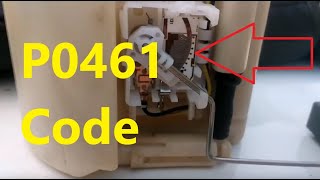
- Replacing the fuel pump. While the sending unit is part of the fuel pump assembly, the pump itself is likely working fine. The code relates to the level sensor, not fuel pressure or flow. 🎬 Watch: Learn more about P0461 causes and fixes
Most Likely Causes
- Faulty Fuel Level Sending Unit 🔴 High Probability → Shop Fuel Tank Sending Unit The sending unit is a mechanical component with a float and a variable resistor (potentiometer). The resistor's contacts wear down over many years and millions of sweeps from the float arm, causing erratic voltage signals. This is the most common failure point by a wide margin for P0461 on this vehicle.
How to confirm: Access the fuel pump assembly under the rear seat. With the key on, measure the voltage at the sensor's signal wire while manually moving the float arm. The voltage should change smoothly, typically from around 0.5V (empty) to 4.5V (full). If it jumps, drops out, or doesn't change, the sender is bad. Alternatively, measure the resistance (ohms) across the sender's terminals; it should sweep smoothly without any dead spots.
Typical fix: Replace the fuel pump module assembly, which includes the fuel level sending unit. The sender is not typically sold separately.
Est. part cost: $150-$400 - Wiring or Connector Issue 🟡 Medium Probability The connector on top of the fuel pump assembly is under the rear seat cushion and can be disturbed or corrode over time. Wires can also become chafed or damaged, particularly where they pass through the body.
How to confirm: Visually inspect the wiring harness and connector going to the fuel pump assembly for any signs of corrosion, damage, or loose pins. Perform a wiggle test on the connector while observing the fuel gauge or live data on a scan tool to see if the reading changes. A forum user on PriusChat documented a dangerous, incorrect 'repair' where a bypass wire was run through the fuel tank seal, causing a major evaporative leak; this highlights the importance of inspecting for previous tampering.
Typical fix: Clean the corroded connector terminals or repair the damaged section of the wiring harness. The fuel pump wiring harness connector is available as a separate part if needed, such as Toyota P/N 77785-12010.
Est. part cost: $20-$50
Rare But Worth Checking
- Instrument Cluster (Combination Meter) Failure: The Gen 2 Prius is known for a separate issue where the entire combination meter (the main dashboard display) can go dark. While this is a well-known problem, it is not typically associated with generating a P0461 code specifically. However, if the sending unit and wiring are confirmed to be good, a fault within the instrument cluster's circuitry that interprets the fuel level signal is a remote possibility.
- Engine Control Module (ECM) Fault: → Shop Engine Control Module (ECM) In very rare cases, the ECM's internal circuit for interpreting the fuel level signal can fail. This should only be considered after all other possibilities have been exhaustively ruled out.
Diagnosis Steps
- Read the code with an OBD-II scanner to confirm P0461 is present.
- Using the scanner's live data function, observe the 'Fuel Level Input' reading. See if it corresponds to your estimated fuel level. Add some gas and see if the reading changes predictably.
- Access the fuel pump assembly by removing the rear seat bottom cushion and the metal service cover.
- Inspect the electrical connector on top of the fuel pump assembly for corrosion, moisture, or damaged pins. Check for signs of previous, improper repairs.
- If the connector looks good, use a multimeter to check for proper voltage and ground at the connector according to your vehicle's service manual. Expect to see a 5V reference on one pin.
- If power and ground are good, the most likely cause is the sending unit itself. Remove the fuel pump assembly from the tank.
- Test the sending unit by measuring its resistance (ohms) while slowly moving the float arm up and down. The resistance should change smoothly without any jumps, dead spots, or open readings. If the sender is faulty, the entire assembly needs to be replaced.
- If the sender tests good, the problem is likely a wiring issue between the tank and the ECM, or a very rare ECM/cluster fault.
Parts You'll Likely Need
- Fuel Pump Module Assembly
(OEM #77020-47041)— This assembly contains the fuel level sending unit, which is the most common point of failure for code P0461. The sensor is not sold separately from the pump module for this vehicle.
Trusted brands: Denso (OEM supplier), Bosch, Delphi, Spectra Premium
OEM price range: $350-$500
Aftermarket price range: $150-$300
Technical Service Bulletins (TSBs) & Recalls
- While there are no widespread TSBs specifically for P0461 on this model, Toyota did issue TSB EL010-00 for other models like the 4Runner for similar erratic fuel gauge behavior, indicating a history of sending unit issues in this era.
- As a cross-manufacturer reference, Toyota Bulletin #T-SB-0206-12 notes that other models with specific engines may exhibit a MIL "ON" condition with DTC P0461 (Fuel Level Sensor "A" Circuit Range/Performance) specifically after a recent fuel refill.
Platform-Specific Known Issues
- The bladder-style fuel tank can make it difficult to get a completely full reading on the gauge even when the system is working perfectly. Many owners report the gauge dropping from 'Full' very quickly. This is a characteristic of the car and not related to the P0461 fault.
- Access to the fuel pump is relatively easy, located under the rear passenger-side seat cushion. No need to drop the fuel tank. 🎬 Watch: Gen 2 Prius fuel pump and tank replacement
Mechanic-Grade Diagnostic Values
- Fuel Level Sender Resistance — expected: Approximately 4 Ω when full, and approximately 110 Ω when empty.. Failure: An open circuit (infinite resistance), or a reading that jumps, gets stuck, or is significantly outside the 4-110 Ω range when moving the float arm.
- Fuel Level Sensor Signal Voltage — expected: A smooth sweep from approximately 0.5V (empty) to 4.5V (full) when testing the signal wire.. Failure: Voltage that is stuck, erratic, or does not correspond to the movement of the float arm.
Scan Tool Commands That Help
- Toyota Techstream: Live Data > Fuel Level Input — This is the primary function used for diagnosis. It allows you to monitor the value the ECM is seeing from the sender in real-time. Rocking the vehicle or adding fuel should cause this value to change smoothly. There are no specific bidirectional active tests for the sender itself, as it is a passive component.
Wiring & Ground Locations
- F14 — The main electrical connector on top of the fuel pump assembly, accessible under the rear passenger-side seat.. This is the primary connection point for testing the fuel level sender's resistance and voltage without removing the unit from the tank. The sender signal is on pins 5 and 6.
- EC — A ground point located at the rear of the engine.. Wiring diagrams indicate this is a key ground point for the fuel pump circuit. A poor connection here could potentially cause erratic behavior, although it is a less common cause than the sender itself.
Real Owner Repair Stories
- PriusChat user Mountweasel64 (Gen 2 Prius) — Fuel gauge read empty when the tank was still half full (about 6 gallons remaining). The low fuel light would blink after only 150 miles, but the car could be driven over 300 more miles.
❌ Tried (didn't work) Considering a 'YouTube calibrate trick' but was advised against it being the solution.
✅ What actually fixed it The community consensus and accepted outcome was that the sending unit inside the tank had failed. Due to the high cost of replacing the entire tank/pump assembly on an older car, the recommended 'fix' was to ignore the faulty gauge and use the trip odometer to track mileage, filling up every 375 miles or so. - PriusChat user (2007 Prius) — Fuel gauge always shows empty, even after filling the tank.
❌ Tried (didn't work) Performed the inclination sensor reset procedure., Disconnected the 12-volt battery for 30 minutes.
✅ What actually fixed it The thread confirms that these common reset procedures did not work, reinforcing that the issue is a physical failure of the sending unit, which requires replacement of the fuel pump assembly.
Model Year Variations Within This Range
- 2004-2005 vs 2006-2009: The fuel tank design and related EVAP components were changed for the 2006 model year refresh. While the fuel pump assembly part number (77020-47041) appears to cover the whole generation, forum members report that installing a fuel tank from a 2006-2009 model into a 2004-2005 car can trigger EVAP-related trouble codes due to differences in the engine computer wiring harness expectations. This is critical when sourcing a used fuel tank assembly.
Diagnostic Flowchart
Other Known Issues on This Vehicle
Issues unrelated to this code that are worth knowing about as an owner of this generation:
- Combination Meter (Dashboard Display) Failure 🟠 Medium — Very common, especially on earlier 2004-2005 models. The display will fail to light up intermittently or permanently. (Ref: Toyota offered a Warranty Enhancement Program, but it has since expired.)
- Hybrid Inverter Coolant Pump Failure 🔴 High — Extremely common. Failure leads to inverter overheating (P0A93 code) and vehicle shutdown. (Ref: Subject of multiple recalls and service campaigns (e.g., LSC A0N, Recall C0U) to replace the pump.)
- Brake Actuator Assembly Failure 🔴 High — Common failure, results in warning lights and changes in brake pedal feel or performance. (Ref: Toyota issued a Warranty Enhancement Program (ZG1) extending coverage to 10 years/150,000 miles.)
- Excessive Oil Consumption 🟠 Medium — Frequently reported on higher-mileage vehicles (100k+ miles), with consumption rates of 1 quart per 1000-2000 miles being common. Often linked to piston ring design or a clogged PCV valve.
- Hybrid Battery (HV) Degradation 🔴 High → Shop Vehicle Battery — Inevitable with age and mileage. Onset typically after 10 years or 150,000+ miles, resulting in P0A80 code and reduced performance/MPG. (Ref: Standard warranty was 8 years/100k miles or 10 years/150k miles in CARB states.)
- HID Headlight Ballast/Bulb Failure 🟡 Low — Common for models equipped with HID headlights to experience flickering or failure of the expensive bulbs and/or ballasts.
Used vs. New Parts: Buying Guide for This Vehicle
When a used part is the smart pick: A used fuel pump assembly can be a cost-effective option given the high price of a new OEM unit, but it is risky since the sending unit is a known wear item. It only makes sense if it comes from a very low-mileage donor vehicle and is significantly cheaper than a new aftermarket part.
Donor-vehicle mileage cap: roughly under 75000 miles for the part to have meaningful remaining life.
What to inspect on the donor part:
- Verify the donor vehicle's mileage is low.
- Inspect the electrical connector on the assembly for any signs of corrosion, melting, or broken pins.
- If possible, test the resistance of the used sender before purchase. Move the float arm and ensure the resistance sweeps smoothly between ~4 and ~110 ohms.
- Look for a clean, rust-free unit. Heavy corrosion on the exterior may suggest a hard life or exposure to road salt.
Aftermarket brands forum-validated for this vehicle:
- Denso (OEM supplier, highly recommended)
- Bosch
- Delphi
Brands owners have reported issues with on this vehicle:
- While brands like Spectra Premium, Carter, and Airtex are widely available, forum discussions suggest sticking with the OEM supplier (Denso) or other major OE manufacturers (Bosch, Delphi) for the highest probability of a long-lasting repair without compatibility issues.
Real Owner Stories
Aggregated from forums and TSBs cited above. Mileages and costs reflect what owners reported in those sources.
2004-2009 Toyota Prius
Symptoms: Fuel gauge malfunction and erratic readings; previous owner had performed a dangerous repair by running a bypass wire through the fuel tank seal.
What fixed it: Inspection of the sending unit and wiring; the improper bypass wire was noted to have caused major evaporative leaks.
Source hint: PriusChat: A thread titled 'Fuel Gauge malfunction and fuel sending unit' includes a horror story of a used car with a dangerously bypassed wire at the sending unit, causing EVAP leaks (P0455/P0441) and highlighting the need for careful inspection. URL: https://priuschat.com/threads/fuel-gauge-malfunction-and-fuel-sending-unit.179905/
2004-2009 Toyota Prius
Symptoms: Fuel gauge failure is listed as one of the top common problems for this generation.
What fixed it: Replacement of the fuel sending unit.
Source hint: 1A Auto (YouTube): In a 'Top 5 Problems' video for the Gen 2 Prius, the fuel gauge failure is listed as a common issue, confirming the sending unit as the cause. URL: https://www.youtube.com/watch?v=e-y0gC5s9sM
Related OBD-II Codes
Frequently Asked Questions
Is there a TSB for the P0461 code on my 2004-2009 Prius?
Can I replace just the fuel level sending unit to fix P0461?
Why does my fuel gauge drop so quickly from 'Full' even though I don't have a code?
Where is the fuel pump located on the 2004-2009 Prius, and do I need to drop the tank?
What brand of fuel pump should I use for the repair?
Could my P0461 code be caused by a wiring issue instead of the sensor?
Helpful Videos
We Have This Part in Stock


The information in this article is provided for general reference and educational purposes only. Vehicle specifications, procedures, and part compatibility can vary by production date, trim level, and region. Always consult your vehicle's factory service manual and verify part numbers before purchasing or performing repairs. Safety-critical components such as airbags, seat belts, and braking systems should be installed by a qualified professional.
- Toyota Prius:
- 🧭 Diagnostic Flowchart
- 🎬 Helpful Videos
- 🛍️ Shop This Part
- What's Unique About the 2004-2009 Toyota Prius
- Symptoms You May Notice
- Most Likely Causes
- Rare But Worth Checking
- Diagnosis Steps
- Parts You'll Likely Need
- Technical Service Bulletins (TSBs) & Recalls
- Platform-Specific Known Issues
- Mechanic-Grade Diagnostic Values
- Scan Tool Commands That Help
- Wiring & Ground Locations
- Real Owner Repair Stories
- Model Year Variations Within This Range
- Other Known Issues on This Vehicle
- Used vs. New Parts: Buying Guide for This Vehicle
- Real Owner Stories
- 2004-2009 Toyota Prius
- 2004-2009 Toyota Prius
- Related OBD-II Codes
- Frequently Asked Questions
- 🎟️ Get 5% Off