

P0462 on 2007-2017 Mercedes-Benz E-Class: Fuel Level Sensor Circuit Low Causes and Fixes
On a 2007-2017 Mercedes E-Class, code P0462 is almost always caused by a failed fuel level sensor (sender unit). These cars have two sensors; this code usually points to the primary one located with the fuel pump on the right side of the saddle tank. Expect to replace the entire fuel pump/sender assembly for around $150-$400 in parts. The repair is accessible under the rear seat.
- P0462 on your E-Class means the primary fuel level sensor has failed or has a wiring issue.
- The main symptom will be a fuel gauge that reads empty or is completely unreliable.
- The most common fix is to replace the right-side fuel pump/sender assembly, which is accessible from under the rear seat.
- Always use a new fuel tank seal when replacing the pump to prevent dangerous fuel leaks.
- While you can drive with this code, you risk running out of fuel. Keep track of your mileage manually until it's fixed.
What's Unique About the 2007-2017 Mercedes-Benz E-Class
The Mercedes-Benz E-Class from this era (W211, W212) uses a 'saddle' style fuel tank that straddles the driveshaft tunnel. To measure fuel accurately across this split design, it requires two separate fuel level sensors: a primary sensor ('A') integrated with the fuel pump on the right (passenger) side, and a secondary sensor ('B') integrated with the fuel filter on the left (driver) side. The P0462 code specifically points to a problem with the primary 'A' sensor circuit. The signals from both sensors are processed by the Rear SAM (Signal Acquisition Module), which then communicates the final fuel level to the instrument cluster. Because the main sensor is part of the fuel pump module, the entire assembly is the standard replacement part to fix this issue.
Generation note: The 2007-2017 range covers three E-Class generations: the end of the W211 (2007-2009), the full W212 (2010-2016), and the first year of the W213 (2017). While the underlying cause is the same across these generations, the specific part numbers for the fuel sensors and pump assemblies are different. The repair procedure is broadly similar, involving access under the rear seat cushion. The W211 and W212 are most commonly associated with this failure.
Symptoms You May Notice
- Fuel gauge is stuck on empty, regardless of how much fuel is in the tank.
- Fuel gauge reads inaccurately or fluctuates wildly, sometimes falling to zero after starting the car.
- The 'distance to empty' calculation on the trip computer is incorrect or shows '---'.
- The low fuel warning light is always on, or does not illuminate when the tank is actually low.
- Check Engine Light is illuminated.
- Replacing only the left-side (secondary) fuel level sender/filter unit. The P0462 code specifically refers to the 'A' circuit, which is the right-side primary unit integrated with the pump.
- Replacing the fuel pump without confirming the sensor has failed. While they are often one unit, if the issue is wiring or the Rear SAM, a new pump will not solve the problem.
- Assuming the fuel gauge itself is broken. The physical gauge in the instrument cluster is rarely the point of failure; the problem is almost always the signal it's receiving.
Most Likely Causes
- Failed Primary Fuel Level Sensor/Sender Unit 🔴 High Probability → Shop Fuel Tank Sending Unit The sensor's resistive strip can wear out or become contaminated over time from fuel additives and impurities, leading to an internal electrical short or an open circuit that the Rear SAM interprets as a low voltage fault. This is a common wear item.
How to confirm: Access the right-side fuel pump assembly under the rear seat. Disconnect the sensor and use a multimeter set to Ohms (Ω) to test its resistance while manually moving the float arm. The resistance should change smoothly through its range. If it reads zero, infinite (OL), or jumps erratically, the sensor has failed. A Mercedes-specific scanner can also read the live data from each sensor individually to confirm the right-side sensor is the one 🎬 Watch a professional troubleshoot the P0462 code and fuel gauge. reporting an invalid reading.
Typical fix: For the W211 and W212, the primary sensor ('A') is integrated with the fuel pump. The most common and recommended repair is to replace the entire right-side fuel pump and sender assembly. It is also highly recommended to replace the fuel tank seal at the same time.
Est. part cost: $150-$450 - Damaged Wiring or Corroded Connector 🟡 Medium Probability The wiring and connectors are located under the rear seat cushion, where they can be disturbed or damaged by passengers or spilled liquids. Moisture ingress is a common cause of corrosion on the connector pins for the fuel pump assembly, leading to a short or high resistance. A melted connector on the fuel pump module 🎬 See how a faulty connector can cause fuel pump issues. is also a known issue.
How to confirm: Visually inspect the wiring harness and the top of the fuel pump module connector after removing the access panel. Look for any frayed wires, breaks in insulation, melted plastic, or green/white corrosion on the connector pins. Check for a solid reference voltage at the connector with the key on.
Typical fix: Repair the damaged section of wire with a new piece of wire and heat-shrink butt connectors. Clean corroded connectors with an electrical contact cleaner and a small brush. If the connector or terminal pins are badly damaged or melted, the connector pigtail may need to be replaced.
Est. part cost: $10-$60
Rare But Worth Checking
- Faulty Rear Signal Acquisition and Actuation Module (SAM): The Rear SAM processes signals from the fuel level sensors. Water damage in the trunk area is a known cause of SAM failure, which can lead to a host of electrical issues, including an incorrect fuel gauge reading. A user on a forum reported that after replacing a water-damaged SAM, the fuel gauge was still inaccurate until the new SAM was properly coded with a Mercedes-specific scanner for the correct fuel tank sensor type. This fault is usually accompanied by other rear-end electrical problems (e.g., tail lights, trunk lock).
- Faulty Instrument Cluster: → Shop Instrument Cluster In very rare cases, a fault within the instrument cluster itself can cause it to misinterpret a correct signal from the Rear SAM. This is highly unlikely to be the cause if P0462 is the only code present. Diagnosis would involve testing the cluster with a specialized scanner after all other components in the fuel level circuit have been proven to be good.
Diagnosis Steps
- Confirm the code P0462 is present using an OBD-II scanner.
- Use a Mercedes-specific scanner (like iCarsoft or Xentry) to read the fuel level values in liters or gallons from both the left and right sensors. This can definitively confirm the right ('A') sensor is providing an incorrect, low-voltage reading.
- Disconnect the negative battery terminal and wait at least 15 minutes.
- Remove the rear seat cushion. This is typically done by pressing release clips located at the front edge of the cushion.
- Remove the sound insulation and then the metal access cover for the right-side (passenger side in LHD cars) fuel pump assembly (typically held by four screws).
- Thoroughly clean the area with a vacuum and compressed air before opening the tank to prevent debris from falling in.
- Disconnect the electrical connector and inspect for corrosion, melted plastic, or damaged pins.
- If wiring looks good, test the sensor. Reconnect the battery temporarily. With the key on, measure the voltage on the signal wire. A reading near zero or below 0.5 volts confirms the 'low input' condition.
- If confirmed, disconnect the battery again. Relieve fuel pressure. Carefully disconnect the fuel lines (use a rag to catch residual fuel) and the large plastic lock ring. A specialized tool is recommended, but careful use of a brass punch and mallet is a common alternative.
- Gently lift the fuel pump/sender assembly out of the tank, being careful not to bend the float arm.
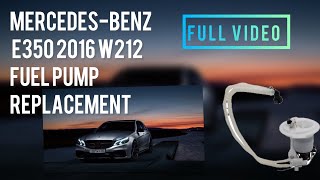
- Replace the fuel pump/sender assembly, install a new tank seal (critical to prevent leaks and fumes), and reassemble in reverse order. 🎬 Watch this step-by-step walkthrough of the W212 fuel pump replacement. Torque the lock ring correctly.
Parts You'll Likely Need
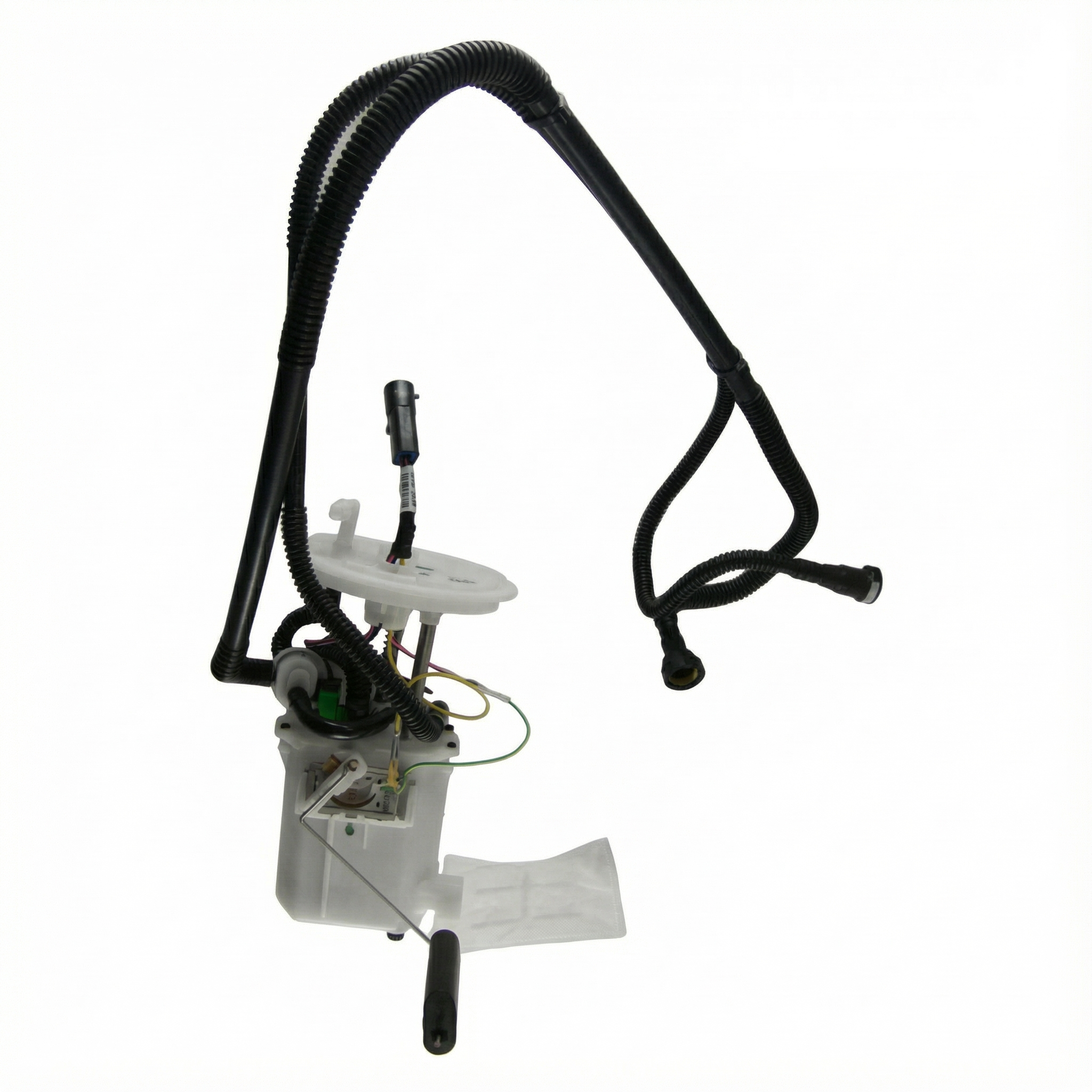
- Fuel Pump and Sender Assembly (Right Side)
(OEM #A2184700394 (W212 example, superseded), A2124701394)— This assembly contains the primary fuel level sensor ('A') which is the most common failure point for code P0462. Replacing the whole unit is the standard repair.
Trusted brands: Bosch, VDO (OEM), Continental, Hella
OEM price range: $350-$500
Aftermarket price range: $150-$350 - Fuel Tank Seal / Gasket
(OEM #A2114710579 (W211 example))— The large rubber gasket that seals the fuel pump assembly to the tank should always be replaced whenever the unit is removed to prevent dangerous fuel leaks and vapor smells. It is often included with a new pump assembly but should be verified.
Trusted brands: Elring, Vaico, Genuine Mercedes-Benz
OEM price range: $20-$40
Aftermarket price range: $10-$25
Related Codes That Often Appear With This One
- P0463 — Fuel Level Sensor 'A' Circuit High Input. This can occur if the wiring fault is intermittent, causing the voltage to swing from too low (P0462) to too high (P0463).
- P0461 — Fuel Level Sensor 'A' Circuit Range/Performance. This code indicates the sensor's signal is erratic or not plausible, which can be a precursor to a complete failure that sets P0462.
- P2066 — Fuel Level Sensor 'B' Circuit Performance. While P0462 points to sensor 'A', issues in the saddle tank system can sometimes cause faults related to the secondary sensor ('B') as well, especially if there are fuel transfer problems between the two halves of the tank.
Platform-Specific Known Issues
- Fuel Gauge Drops to Zero After Repair: A user on MBWorld.org with a 2010 E550 reported that after replacing both fuel senders, the gauge worked for a day and then began dropping to zero after startup. This can indicate an intermittent connection issue or a problem with fuel transfer between the tank halves, where the main pump side runs dry if the venturi pump system isn't working correctly.
- Incorrect Fuel Reading After Refueling: Multiple owners on MBWorld.org for the W212 platform have reported the issue starting immediately after refueling. One 2016 E350 owner filled up from a low level, and the gauge then read empty and threw a check engine light. This sudden failure is characteristic of the sensor's electronics failing.
- Running Out of Fuel with 1/4 Tank Showing: A W212 owner reported running out of fuel twice when the gauge showed just under 1/4 of a tank and the trip computer showed over 100km to empty. This indicates a significant calibration error caused by the failing sender unit.
Mechanic-Grade Diagnostic Values
- Fuel Level Sensor 'A' Signal Voltage — expected: 0.5V (empty) to 4.5V (full). Failure: A consistent reading below 0.5V indicates a 'Circuit Low' fault.
- Fuel Level Sensor Resistance (General GM/Ford, similar principle) — expected: Approx. 40 Ohms (empty) to 250 Ohms (full). Note: Mercedes-specific values can vary.. Failure: Reading of 0 Ohms (short), OL/infinite Ohms (open), or erratic jumps when moving the float arm.
- Fuel Level Sensor Resistance (European Spec) — expected: 0 Ohms (empty) to 190 Ohms (full). Failure: Readings outside this range or that do not change smoothly indicate a failed sender.
- Ground Circuit Resistance (at sensor connector to chassis) — expected: < 1 Ohm. Failure: Resistance greater than 5 Ohms indicates a poor ground connection, which can cause this code.
Scan Tool Commands That Help
- Xentry/DAS (Mercedes Dealer Tool): Rear SAM (N10/2) -> Actual Values -> Fuel Level Sensors — To view the raw resistance (Ohms) and calculated fill level (liters) reported by the right (B4/2) and left (B4/1) sensors independently. This is the fastest way to confirm that the right-side sensor is the one sending an implausible low reading, directly confirming the 'A' circuit fault.
- Xentry/DAS (Mercedes Dealer Tool): Rear SAM (N10/2) -> Control Unit Adaptations -> Tank characteristic curve — This should be checked if the Rear SAM has been replaced. If the incorrect tank type is coded, the module will misinterpret the sensor signals, potentially causing fuel gauge errors even with new, working sensors.
Wiring & Ground Locations
- N10/2 — The Rear SAM (Signal Acquisition Module) is located in the trunk, typically on the left side behind the trunk liner.. This module receives and processes the voltage signals from both the left and right fuel level sensors before sending the data to the instrument cluster. A failure in this module can mimic a sensor failure.
- N118 — The Fuel System Control Unit (FSCU), also called the Fuel Pump Control Unit (FPCU), is located under the right rear seat, near the door.. This module directly powers the fuel pump. While not directly part of the sensor circuit, its wiring is bundled with the sensor wiring at the pump assembly, and issues with its power or ground can sometimes affect the sensor readings.
- W15/1 — Right front footwell ground point.. This is the designated ground point for the Fuel Pump Control Unit (N118). A corroded or loose ground here can cause various fuel system electrical issues.
- Fuse F42 — In the rear fuse box located in the trunk.. This 25A fuse provides power to the Fuel Pump Control Unit (N118). While a blown fuse would typically cause a no-start condition, intermittent issues with the fuse or its contacts could potentially cause voltage fluctuations affecting the entire fuel pump assembly's electronics.
Real Owner Repair Stories
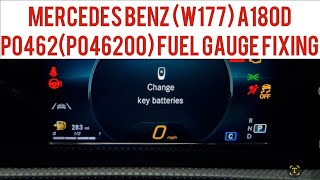
- YouTube user 'STANHOPE AUTO REPAIR CENTRE WARDAK' (2018 Mercedes-Benz A180d (W177) - Note: Newer model but demonstrates an identical failure pattern.) — Faulty fuel gauge and trouble code P046200 stored in the Fuel Pump Control Module (FSCU).
❌ Tried (didn't work) The video focuses directly on diagnosis, not on previously failed repairs.
✅ What actually fixed it Upon inspecting the electrical connector at the fuel pump module under the rear seat, the technician found that three wires had melted together, causing a short circuit. The fix was to cut out the damaged section and splice in new pieces of wire to repair the harness. - YouTube user 'Carboage' (Vehicle not specified, but a Mercedes with a saddle tank.) — Fuel gauge jumping all over, code P0462.
❌ Tried (didn't work) A previous shop had already replaced both the left and right fuel pumps, but the problem returned intermittently after about 30 miles.
✅ What actually fixed it The technician diagnosed an issue with the wiring for the leveling sensor. The video points to checking the circuit at the main fuel pump connector (wires 1 and 3 for the level sensor) as the problem area, implying a wiring fault rather than a component failure was the ultimate cause.
OEM Part Supersession History
A2044700394→A2124701394, A2184700394— Standard part evolution and updates by the manufacturer.
Heads up: While these parts are often listed as compatible for W212/W204, it is critical to verify the correct part number against the vehicle's VIN. Using the wrong pump assembly can lead to incorrect fuel level readings or fuel transfer problems in the saddle tank.
Model Year Variations Within This Range
- 2007-2009 (W211): The W211 E-Class has a similar saddle tank design but uses different part numbers for the fuel pump and sender assemblies compared to the W212. While the diagnostic principle is identical, the physical parts are not interchangeable. The electrical connector for the pump is on the left side access panel, even though the pump is on the right.
- 2010-2016 (W212): This is the most common platform for this issue. The right-side pump/sender assembly (e.g., A2124701394) and left-side filter/sender are specific to this generation. The wiring for both senders and the pump motor are routed through connectors under both the left and right rear seat access panels.
- 2021-2023 (Various Models including E-Class): Newer Mercedes models were subject to a major fuel pump recall for a defective impeller that could cause the pump to shut down, leading to engine stalling. While this is a different failure mode (mechanical pump failure vs. sensor circuit fault), it's a notable issue with fuel pumps on later E-Class generations.
Diagnostic Flowchart
Other Known Issues on This Vehicle
Issues unrelated to this code that are worth knowing about as an owner of this generation:
- Sensotronic Brake Control (SBC) Pump Failure (W211) 🔴 High — Affects 2003-2009 W211 models. The pump has a pre-programmed service life based on brake actuations, after which it deactivates. Failure can result in significantly reduced braking power. (Ref: Mercedes-Benz extended the warranty on the SBC hydraulic unit to 25 years with unlimited mileage in the USA, covering replacement.)
- M272/M273 Engine Balance Shaft Gear Wear 🔴 High — Common on V6 (M272) and V8 (M273) engines from roughly 2004-2008. The sprocket material was too soft and wears prematurely, causing timing issues, rattling noises, and Check Engine Lights (P0016, P0017). Repair is labor-intensive. (Ref: A class-action lawsuit led to a settlement for some owners. The replacement parts use a hardened material.)
- 7G-Tronic (722.9) Conductor Plate Failure 🟠 Medium — Affects many models from the mid-2000s to mid-2010s. Internal speed sensors on the conductor plate (part of the valve body) fail, causing harsh shifting, getting stuck in gear, or going into limp mode.
- Airmatic Suspension Leaks and Failures 🟠 Medium — Common on vehicles equipped with optional Airmatic suspension. The rubber air springs develop leaks with age, causing the vehicle to sag (usually overnight). Leaks can overwork the compressor, leading to its failure as well.
- Rear SAM (Signal Acquisition Module) Water Damage 🟠 Medium — The Rear SAM is located in the trunk and is susceptible to water intrusion from leaking trunk seals or tail light gaskets. Failure causes a wide range of bizarre electrical problems in the rear of the car, including for the fuel pump and gauge.
Used vs. New Parts: Buying Guide for This Vehicle
When a used part is the smart pick: A used fuel pump assembly is generally NOT recommended for this repair. The primary failure mode of the P0462 code is the wear and tear of the sensor's resistive strip. A used part from a donor vehicle will have an unknown amount of wear and may fail soon after installation, forcing you to do the labor-intensive job again.
Donor-vehicle mileage cap: roughly under 40000 miles for the part to have meaningful remaining life.
What to inspect on the donor part:
- Verify the part number exactly matches your vehicle's required part via VIN.
- Inspect the electrical connector pins for any signs of melting, corrosion, or heat stress.
- Ask for the mileage of the donor vehicle; lower is always better, but the risk of premature failure remains high.
- Ensure the float arm is not bent and moves freely.
OEM-only on this vehicle (don't cheap out):
- Fuel Pump / Sender Assembly
Aftermarket brands forum-validated for this vehicle:
- VDO (often the Original Equipment Manufacturer)
- Bosch
- Continental
Brands owners have reported issues with on this vehicle:
- Unnamed or generic 'white box' brands from online marketplaces. Forum users and mechanics report a very high failure rate for non-reputable fuel pump assemblies, with some failing in less than a year or even a few hundred miles. The labor involved in the replacement makes it worthwhile to use a quality part.
Real Owner Stories
Aggregated from forums and TSBs cited above. Mileages and costs reflect what owners reported in those sources.
2016 E350
Symptoms: After filling the tank from a low level, the fuel gauge immediately read empty and the check engine light came on.
What fixed it: The sudden failure was characteristic of the sensor's electronics failing, requiring replacement of the fuel sender unit.
Source hint: MBWorld.org owner report on W212 platform
2010 E550
Symptoms: After having both fuel senders replaced, the gauge worked correctly for one day and then started dropping to zero shortly after starting the car.
What fixed it: The issue was suspected to be an intermittent connection problem or an issue with the fuel transfer system between the two halves of the tank.
Source hint: MBWorld.org user report
W212 E-Class
Symptoms: The owner ran out of fuel on two separate occasions when the gauge was indicating just under a 1/4 tank and the trip computer showed over 100km of remaining range.
What fixed it: This indicated a significant calibration error caused by a failing sender unit, which needed to be replaced.
Source hint: W212 owner report
Related OBD-II Codes
Frequently Asked Questions
Where is the fuel level sensor that causes code P0462 located on my E-Class?
To fix P0462, do I have to replace the entire fuel pump?
Is there anything else I should replace while I'm fixing the fuel sender?
Can I tell for sure which fuel sensor is bad before taking the car apart?
My fuel gauge is acting erratically but the Check Engine Light isn't on yet. Could it still be the sensor?
I have a 2008 E-Class with a Check Engine Light. Could it be the common balance shaft issue?
Does this P0462 issue also affect the CLS-Class?
Helpful Videos
Used OEM Parts in Stock
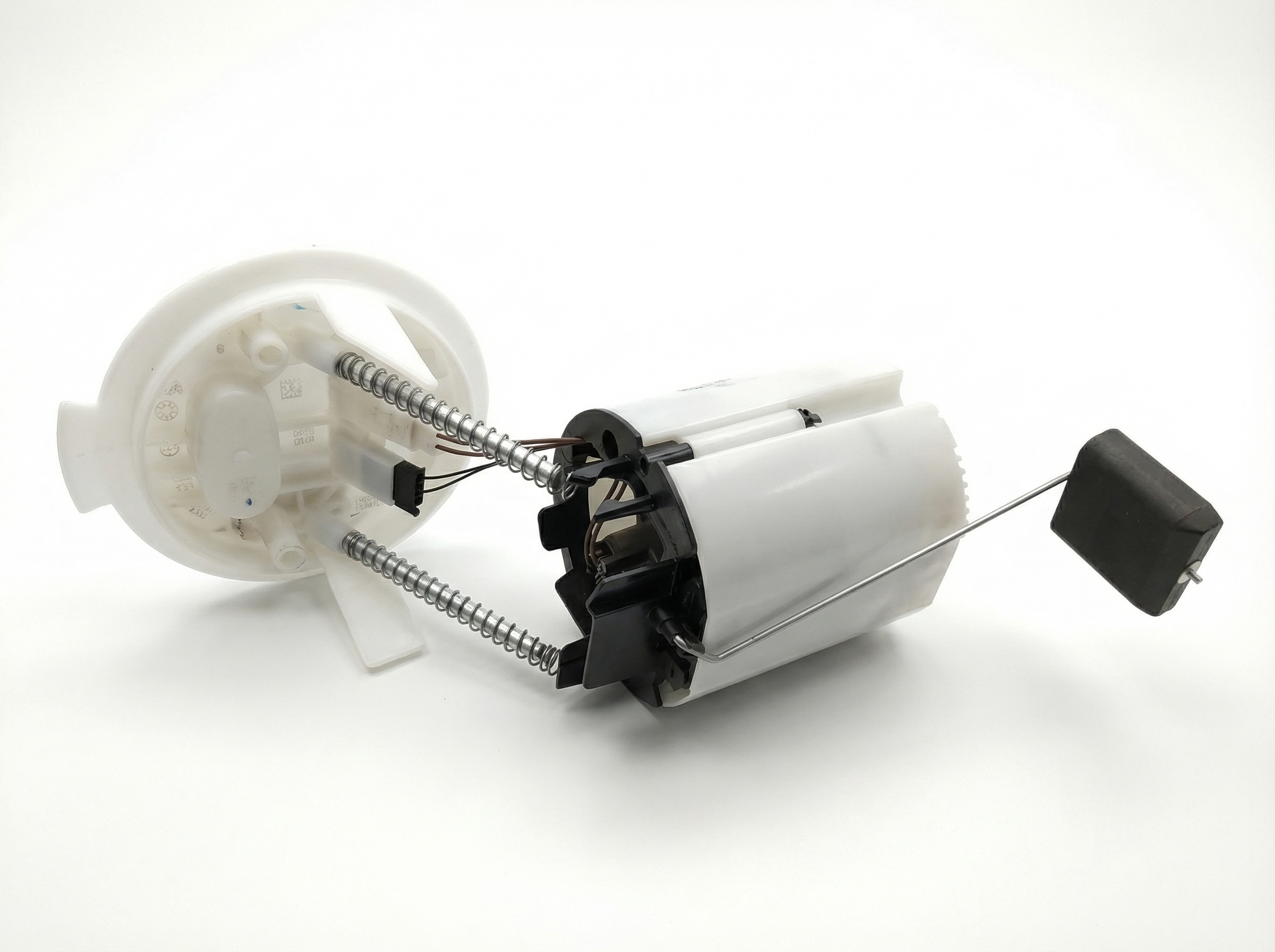
New Aftermarket Parts Available
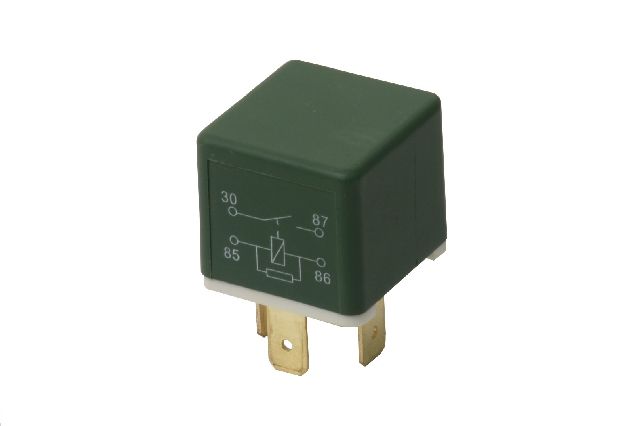
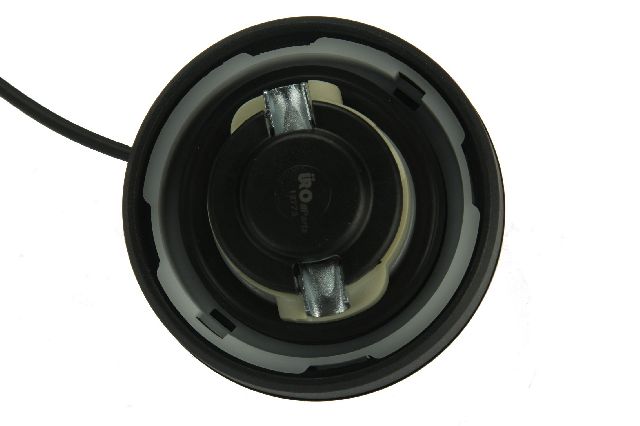

The information in this article is provided for general reference and educational purposes only. Vehicle specifications, procedures, and part compatibility can vary by production date, trim level, and region. Always consult your vehicle's factory service manual and verify part numbers before purchasing or performing repairs. Safety-critical components such as airbags, seat belts, and braking systems should be installed by a qualified professional.
- Mercedes-Benz E-Class:
- 🧭 Diagnostic Flowchart
- 🎬 Helpful Videos
- 🛍️ Shop This Part
- What's Unique About the 2007-2017 Mercedes-Benz E-Class
- Symptoms You May Notice
- Most Likely Causes
- Rare But Worth Checking
- Diagnosis Steps
- Parts You'll Likely Need
- Related Codes That Often Appear With This One
- Platform-Specific Known Issues
- Mechanic-Grade Diagnostic Values
- Scan Tool Commands That Help
- Wiring & Ground Locations
- Real Owner Repair Stories
- OEM Part Supersession History
- Model Year Variations Within This Range
- Other Known Issues on This Vehicle
- Used vs. New Parts: Buying Guide for This Vehicle
- Real Owner Stories
- 2016 E350
- 2010 E550
- W212 E-Class
- Related OBD-II Codes
- Frequently Asked Questions
- 🎟️ Get 5% Off