

P0462 on 2018-2024 Volkswagen Jetta: Causes and Fixes for Fuel Level Sensor Circuit Low
P0462 on a 2018-2024 VW Jetta indicates a 'low voltage' signal from the fuel level sensor, almost always caused by a faulty sensor. The sensor is part of the in-tank fuel pump assembly, and replacing the entire unit is the most common fix. In some 2019+ models, a software update for the instrument cluster could be a fix if no hardware fault is found. Expect to pay between $550 and $740 for a professional repair.
- P0462 on your Jetta means the fuel gauge is unreliable due to a fault in the fuel level sensor's circuit.
- The most likely culprit is the fuel level sensor itself, which is part of the fuel pump assembly in the gas tank.
- While you can continue driving, you risk running out of gas. Use your trip meter to track fuel usage as a precaution.
- For 2019+ models, a rare but possible fix could be a software update for the instrument cluster if no hardware fault is found.
What's Unique About the 2018-2024 Volkswagen JETTA
On modern Jettas (A7/Mk7, 2019+), the fuel level sensor is integrated into the main fuel pump assembly inside the tank. While the code itself is generic, Volkswagen has issued internal analysis requests for P0462 and P0463 on 2023-2024 models, indicating it's a known issue they are tracking. Furthermore, VW TSB 20-23-01 (though not directly for P0462) addresses inaccurate fuel gauge readings on 2019-2021 models with a potential instrument cluster software update, suggesting that not all fuel gauge issues on this platform are hardware-related. The link to P0442 (EVAP leak) in TSBs also points to the complexity of the integrated fuel tank system.
Diagnostic Flowchart
Tap your situation to follow the diagnostic path that matches what you're seeing on this vehicle.
Generation note: This year range includes the end of the A6 (Mk6) generation (2018) and the full run of the A7 (Mk7) generation (2019-2024). The meaning of the code is the same, but repair costs and part numbers differ significantly. The 2018 Mk6 Jetta uses a PQ35 platform fuel pump assembly (e.g., Part No. 1K0919051DB), while the 2019+ Mk7 Jetta uses an MQB platform assembly (e.g., Part No. 5Q0919051BH or 5QM919051B). RepairPal estimates show a much higher replacement cost for the 2018 model compared to the 2019-2024 models.
Symptoms You May Notice
- Check Engine Light is on
- Fuel gauge reads empty or is stuck in one position, often with the low fuel light on.
- Fuel gauge fluctuates erratically, sometimes dropping to zero intermittently.
- The low fuel warning light is always on
- Inaccurate or non-functional distance-to-empty calculation.
- Fuel gauge does not read full immediately after filling the tank.
- Replacing only the fuel pump motor when the issue is the integrated sending unit.
- Replacing the instrument cluster before properly testing the sensor and wiring with a multimeter.
- Assuming the new fuel pump assembly is good. Low-quality aftermarket parts can be faulty out of the box, leading to the same P0462 code after replacement.
Most Likely Causes
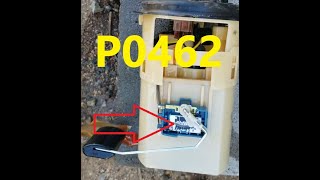
- Faulty Fuel Level Sending Unit 🔴 High Probability → Shop Fuel Tank Sending Unit The sending unit is a wear item. Its internal variable resistor can fail, develop dead spots from fuel contaminants, or the float arm can get bent or stuck. This is the most common failure point for P0462. 🎬 Watch: A breakdown of common causes and solutions for P0462.
How to confirm: Access the sensor's electrical connector and measure its resistance with a multimeter while moving the float arm. The resistance should change smoothly. For many VW models, the range is approximately 40-250 ohms or 50-300 ohms. An open circuit (infinite resistance/OL) or a short (near zero resistance) confirms failure. A live data scan showing voltage stuck below 0.5V also points to a failed sensor or shorted circuit.
Typical fix: Replace the fuel level sending unit. On all 2018-2024 Jettas, this means replacing the entire fuel pump module it is attached to.
Est. part cost: $400-$1000 - Damaged Wiring or Corroded Connector 🟡 Medium Probability The wiring and connector are located on top of the fuel tank, typically under the rear seat, where they can be exposed to moisture, physical damage during other repairs, or rodent damage. Corrosion can create a short to ground, causing the low voltage reading.
How to confirm: Visually inspect the wiring harness leading to the fuel tank for any signs of chafing, breaks, or rodent damage. Unplug the connector and check for green or white corrosion on the pins. Perform a short-to-ground test on the signal wire; with the sensor disconnected, resistance from the signal wire to the chassis ground should be infinite (OL). A reading near zero ohms indicates a short.
Typical fix: Repair the damaged section of wire or clean the connector pins with a wire brush and apply dielectric grease to prevent future corrosion.
Est. part cost: $10-$50
Rare But Worth Checking
- Faulty Instrument Cluster: → Shop Instrument Cluster If the sensor and wiring test perfectly, the instrument cluster itself could be failing to interpret the signal correctly. This is uncommon but possible, and for 2019-2021 models, VW has a TSB (20-23-01) that addresses inaccurate fuel readings with a software update, making this a more plausible cause than on older vehicles. A cluster diagnostic test can sometimes identify a faulty gauge. 🎬 Watch: How to perform a VW fuel gauge calibration.
- Faulty Powertrain Control Module (PCM): This is the least likely cause. The PCM's internal circuit for reading the fuel level could fail, but all other possibilities, including wiring shorts and sensor failure, must be exhausted before condemning the PCM.
Diagnosis Steps
- Verify the P0462 code is present using an OBD-II scanner. Note any other codes, especially P0463 or P0442.
- Using the scanner's live data function, observe the 'Fuel Level Sensor' voltage. A reading consistently near or at 0 volts strongly suggests a short to ground or a failed sensor.
- Gain access to the top of the fuel tank, which is typically under the rear passenger seat cushion. This requires removing the seat bottom.
- Visually inspect the fuel pump module's electrical connector and wiring harness for any obvious damage, corrosion, or loose connections.
- Using a wiring diagram, identify the signal and ground wires for the fuel level sensor.
- Disconnect the connector. Use a multimeter to test the resistance of the fuel level sensor through its pins on the fuel pump module. A good sensor should show a changing resistance, typically between approximately 40 Ohms and 250 Ohms, as you manually move the float arm (if possible). An erratic, zero, or infinite (OL) reading indicates a bad sensor.
- If the sensor tests good, check for a short to ground on the signal wire in the harness between the fuel pump module and the ECM. Resistance between the signal wire and a known good ground should be infinite (OL).
- If no hardware faults are found on a 2019+ model, investigate TSBs related to instrument cluster software updates for fuel gauge inaccuracy.
Parts You'll Likely Need
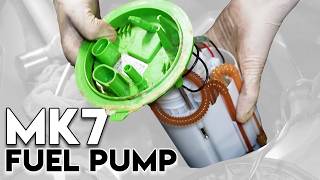
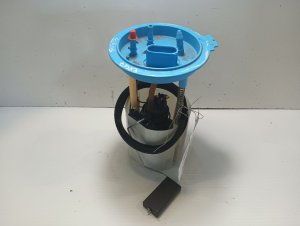
- Fuel Pump and Sending Unit Assembly (A7/Mk7)
(OEM #5QM919051B, 5Q0919051BH)— For 2019-2024 Jetta models, this is the most common cause of failure. The sending unit is integrated and not sold separately by VW.
Trusted brands: Genuine VW, VDO, Bosch
OEM price range: $600-$1100
Aftermarket price range: $300-$500 - Fuel Pump and Sending Unit Assembly (A6/Mk6)
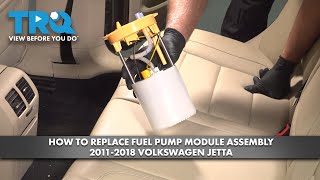
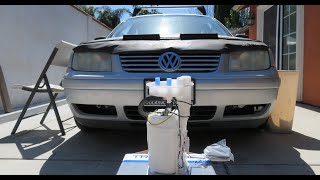
(OEM #1K0919051DB)— For the 2018 Jetta, a different part is used due to the older platform. 🎬 See this step-by-step fuel pump replacement for 2011-2018 Jettas. The sending unit is also integrated.
Trusted brands: Genuine VW, VDO, Hitachi
OEM price range: $500-$900
Aftermarket price range: $250-$450
Related Codes That Often Appear With This One
- P0463 — This code means 'Fuel Level Sensor Circuit High'. Seeing it with P0462 suggests an intermittent fault in the sensor or wiring, causing the voltage to swing from too low to too high. VW internal documents confirm these codes often appear together.
- P0442 — This code indicates a small EVAP system leak. Its appearance alongside P0462 is mentioned in manufacturer TSBs and internal documents, suggesting a potential fault in the greater fuel tank assembly, which incorporates both the fuel pump/sender and EVAP components.
Technical Service Bulletins (TSBs) & Recalls
- VIN4APIN20240523: Mentions customer complaints of MIL-on with P0462 and/or P0463 stored, and fuel gauge issues.
- VIN4APIN20240410: Also cites MIL-on with P0462/P0463 and fuel gauge not reading full after a fill-up.
- VW Internal Document (March 13, 2024): Lists P0462/P0463 on 2023-24 Jetta/Taos as a topic for on-car analysis, confirming it's a known issue.
- TSB 20-23-01: While for Mitsubishi, this TSB number is referenced in the context of VW issues in some databases and discusses inaccurate gauge readings, highlighting a potential software fix path for similar issues on VW platforms. A search for VW-specific TSBs on gauge inaccuracy is recommended.
Platform-Specific Known Issues
- NHTSA Technical Service Bulletins for recent VW models mention customer complaints of the check engine light on with P0462 and/or P0463 stored, along with the fuel gauge not reading correctly after filling up. [VIN4APIN20240523, VIN4APIN20240410]
- An internal VW document from March 2024 shows that VW is actively analyzing P0462/P0463 codes on 2023-2024 Taos and Jetta models, indicating this is a known and current issue for the manufacturer.
- For some 2019-2021 models, TSB 20-23-01 was issued for inaccurate fuel gauge readings, which could be resolved with an instrument cluster software update, presenting an alternative to hardware replacement.
Mechanic-Grade Diagnostic Values
- Fuel Level Sensor Signal Voltage — expected: 0.5V (Empty) to 4.5V (Full) on a 5V reference system.. Failure: A voltage reading consistently below 0.5V will trigger P0462.
- Fuel Level Sensor Resistance (Older VW Style) — expected: Approximately 10 Ohms at Full to 73 Ohms at Empty. The reading should change smoothly.. Failure: Infinite resistance (OL), near-zero resistance, or erratic jumps in the reading while moving the float.
- VCDS Instrument Cluster Adaptation Value — expected: Default value is 128. Adjustable range is typically 120-136.. Failure: An incorrect value can cause the gauge to read inaccurately even with a good sensor. This value may need adjustment after sensor replacement or if the gauge is off.
Scan Tool Commands That Help
- VCDS (or equivalent VW diagnostic tool): Instrument Cluster Output Test (Controller 17, Function 03) — To verify the physical operation of the fuel gauge needle. The test commands a full sweep of all gauges, confirming if the gauge motor itself is functional or stuck.
- VCDS (or equivalent VW diagnostic tool): Fuel Gauge Adaptation (Controller 17, Adaptation - 10, Channel 30) — To correct a fuel gauge that is consistently inaccurate after a repair or if the vehicle runs out of fuel before the gauge reads empty. This allows for fine-tuning the needle's position by adjusting the resistance offset.
- VCDS (or equivalent VW diagnostic tool): Advanced Measuring Values (for UDS controllers, 2019+) — To view the live resistance (Ohms) being reported by the fuel level sensor. This is the primary method for diagnosing if the sensor signal received by the instrument cluster is rational.
Wiring & Ground Locations
- Fuel Pump Connector Pigtail — On top of the fuel pump assembly, under the rear seat.. This connector (Part No. 1K0 919 231) is a common point for corrosion or damage, which can cause a short to ground and trigger P0462.
- Ground Point 50 — On the left side of the luggage compartment.. This is a major body ground point in the rear of the vehicle. A loose or corroded connection here could potentially affect the fuel pump module's ground path, leading to erratic sensor readings.
- Main Engine/Gearbox Ground Strap — Varies by engine, but typically from the engine block or transmission case to the vehicle frame rail.. While less direct, a poor main ground can cause floating voltages and unpredictable electrical issues across many systems, including the instrument cluster and its sensor readings.
Real Owner Repair Stories
- DTech Engineering YouTube Channel (Volkswagen (model not specified, but applicable principle)) — Car stalled and would not restart. Owner discovered it had run out of fuel even though the gauge needle was still above the reserve mark.
❌ Tried (didn't work) Initial diagnosis pointed towards a fuel delivery problem like a bad fuel pump.
✅ What actually fixed it The technician drained the tank completely, then used a diagnostic scanner to access the Instrument Cluster (17) and perform an Adaptation (10) on the fuel gauge. This recalibrated the gauge's 'empty' position to match the actual empty tank, resolving the inaccurate reading without replacing any parts. - Ross-Tech Forum User (2012 VW Jetta S) — Fuel gauge suddenly started showing empty even with fuel in the tank. No fault codes were found.
❌ Tried (didn't work) Mechanic's VCDS scan could not pull diagnostic data from the instrument cluster., VW Dealership diagnostic tool also failed to properly communicate and denied a problem existed.
✅ What actually fixed it The issue was identified as a corrupted ASAM dataset within the instrument cluster itself. This prevented diagnostic tools from reading the fuel sender's resistance values. The root cause was a faulty instrument cluster, not the fuel sender or wiring. The fix would be to replace the instrument cluster.
"I Checked Everything" — The Actual Cause
- In the context of this electrical code, the equivalent of a 'clean smoke test' is when the fuel level sensor and wiring harness test perfectly with a multimeter. One real-world example involved a VW that ran out of fuel while the gauge still showed a reserve. The sensor and wiring were not faulty; the instrument cluster's calibration for 'empty' had drifted. The fix was not a part replacement, but a recalibration of the gauge using a diagnostic tool's adaptation function.
- Another case involved a Jetta where the gauge read empty, but no fault codes were stored. Standard multimeter tests on the sender and wiring would have likely passed. The true cause was a corrupted firmware (ASAM dataset) in the instrument cluster, which made it unable to process the sender's signal correctly. This required replacing the instrument cluster.
OEM Part Supersession History
1K0-919-051-AQ, 1K0-919-051-BH, 1K0-919-051-CL→1K0-919-051-DB— Standard part revision and consolidation for the PQ35 platform (Mk6 Jetta).
Model Year Variations Within This Range
- 2019-2024: These Mk7 Jettas use the UDS diagnostic protocol. When using VCDS to view live sensor data, technicians must use 'Advanced Measuring Values' instead of the older 'Measuring Blocks' function, which will be grayed out.
Helpful Videos

Used OEM Parts in Stock
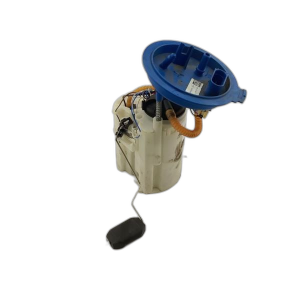
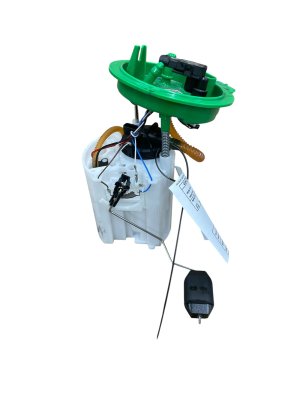
New Aftermarket Parts Available
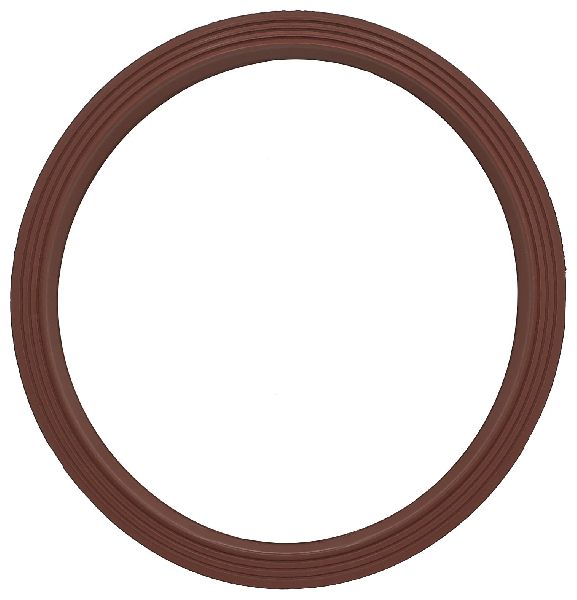

The information in this article is provided for general reference and educational purposes only. Vehicle specifications, procedures, and part compatibility can vary by production date, trim level, and region. Always consult your vehicle's factory service manual and verify part numbers before purchasing or performing repairs. Safety-critical components such as airbags, seat belts, and braking systems should be installed by a qualified professional.
- Volkswagen JETTA:
- 🧭 Diagnostic Flowchart
- 🎬 Helpful Videos
- 🛍️ Shop This Part
- What's Unique About the 2018-2024 Volkswagen JETTA
- Symptoms You May Notice
- Most Likely Causes
- Rare But Worth Checking
- Diagnosis Steps
- Parts You'll Likely Need
- Related Codes That Often Appear With This One
- Technical Service Bulletins (TSBs) & Recalls
- Platform-Specific Known Issues
- Mechanic-Grade Diagnostic Values
- Scan Tool Commands That Help
- Wiring & Ground Locations
- Real Owner Repair Stories
- "I Checked Everything" — The Actual Cause
- OEM Part Supersession History
- Model Year Variations Within This Range
- 🎟️ Get 5% Off