

P0463 on 2009-2017 Audi Q5: Fuel Level Sensor Circuit High Input Explained
P0463 on an Audi Q5 indicates a 'high input' from the fuel level sensor, usually causing the fuel gauge to read full. The most common cause is a failed fuel level sending unit, which is often part of the fuel pump assembly. On Quattro models with a saddle tank, there are two senders, and P0463 typically points to the primary one. Replacing the unit is the typical fix.
- P0463 on a 2009-2017 Audi Q5 means the fuel level sensor is sending a 'high' voltage signal, usually making the fuel gauge read 'Full'.
- The most probable cause is a failed fuel level sending unit inside the fuel tank.
- On this vehicle, the sending unit is often part of the complete fuel pump assembly, making the part cost relatively high.
- While you can drive with this code, you risk running out of gas unexpectedly. It's best to keep the tank topped off and track mileage manually until it's fixed.
- Due to the fire hazard of working with fuel system components, professional repair is strongly recommended.
What's Unique About the 2009-2017 Audi Q5
The Audi Q5, particularly with the Quattro all-wheel-drive system, uses a saddle-shaped fuel tank that requires two separate fuel level sending units to get an accurate reading. Code P0463 typically refers to an issue with the primary sensor, designated as 'Sensor A', which is located on the main fuel pump module on the right (passenger) side of the tank. The secondary sensor is on the left (driver) side. On these vehicles, the sending unit is often integrated into the main fuel pump module, which can make the repair more complex and costly than on vehicles where the sensor is a standalone component.
Symptoms You May Notice
- Fuel gauge reads full, regardless of the actual fuel level
- Fuel gauge fluctuates erratically or is stuck on empty
- Check Engine Light is on
- Low fuel warning light may illuminate despite a full tank
- In rare cases, engine may hesitate or stall if the fuel level is actually empty when the gauge reads otherwise
- Replacing the entire fuel pump when only the sending unit has failed (though they are often sold as one assembly).
- Replacing the fuel level sensor when the actual problem is a simple wiring issue or a bad ground connection.
Most Likely Causes
- Failed Fuel Level Sending Unit 🔴 High Probability → Shop Fuel Tank Sending Unit The variable resistor on the sending unit can wear out or develop an open circuit over time, leading to an impossibly high voltage signal. This is a common failure point in many modern fuel systems.
How to confirm: Test the sensor's resistance with a multimeter while manually moving the float arm. The resistance should change smoothly. An open circuit or infinite resistance (often displayed as 'OL') indicates a failed sensor. For many GM vehicles, a common range is 40 ohms empty and 250 ohms full; Audi-specific values should be checked in a service manual.
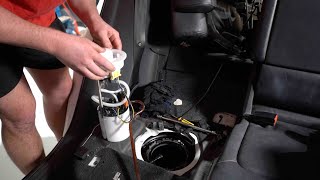
Typical fix: Replace the fuel level sending unit. On the Q5, this often requires replacing the entire fuel pump module it is integrated with. 🎬 Watch: Audi Q5 fuel pump replacement tutorial The OEM part number for the sending unit is often cited as 8R0-919-673-D for gasoline models, which is noted as being included with the fuel pump assembly.
Est. part cost: $250-$1600 - Wiring or Connector Issue 🟡 Medium Probability Wiring running to the top of the fuel tank can be susceptible to damage or corrosion over time, especially at the connector on the fuel pump assembly. Road salt in colder climates can accelerate this corrosion.
How to confirm: Visually inspect the wiring harness and connector for breaks, corrosion, or loose pins. Perform a voltage and ground test at the sensor connector. With the key on, the signal wire should read 0 volts when disconnected; a 5V or 12V reading indicates a short to power.
Typical fix: Repair the damaged section of wiring or replace the faulty connector. Aftermarket fuel pump wiring harnesses are available. 🎬 Watch: How to fix code P0463 quickly
Est. part cost: $10-$50 - Poor Ground Connection ⚪ Low Probability
How to confirm: Check the ground strap for the fuel tank and sensor circuit for corrosion or looseness. Test resistance between the sensor's ground terminal and a known good chassis ground; it should be very low (under 1-5 ohms).
Typical fix: Clean the grounding point on the chassis and re-secure the connection.
Est. part cost: $0-$5
Rare But Worth Checking
- Faulty Instrument Cluster: → Shop Instrument Cluster While uncommon, the instrument cluster itself can fail, leading to incorrect gauge readings even with a good signal from the sensor. This is usually accompanied by other gauge or display issues. A cluster self-test or scan tool output test can help diagnose this.
- Faulty Powertrain Control Module (PCM): A failure within the PCM is very rare but possible. This should only be considered after all other possibilities (sensor, wiring, grounds) have been exhaustively ruled out.
Diagnosis Steps
- Scan the vehicle with an OBD-II scanner to confirm P0463 is the primary code.
- Use the scanner's live data function to observe the fuel level sensor voltage. A reading consistently high (e.g., near 5 volts) confirms the fault condition.
- Gain access to the top of the fuel tank, which is typically under the rear seat on the passenger side for the primary sensor ('A').
- Visually inspect the wiring and connector going to the fuel pump/sending unit assembly for any obvious damage, corrosion, or loose connections.
- Disconnect the sensor and check for voltage and ground at the connector with a multimeter to ensure the circuit integrity from the PCM is good. Check for a short to power on the signal wire.
- If the wiring is confirmed to be good, remove the fuel pump/sending unit assembly from the tank, taking extreme care with fuel and vapors.
- Test the sending unit's resistance with a multimeter while moving the float arm through its range of motion. The resistance should change smoothly. If it's erratic or shows an open circuit (infinite resistance), the sending unit is faulty.
- If the sensor and wiring test good, the issue may lie with the instrument cluster or PCM, which requires more advanced diagnostics.
Parts You'll Likely Need
- Fuel Level Sending Unit / Fuel Pump Module
(OEM #8R0-919-673-D (sender, often included with pump assembly))— This is the most common component to fail and directly cause the P0463 code. It is often integrated with the a.
Trusted brands: Genuine Audi, Bosch, VDO, Continental
OEM price range: $400-$1600
Aftermarket price range: $270-$600
Related Codes That Often Appear With This One
- P0461 — This code indicates a 'Range/Performance' issue with the same fuel level sensor. A sensor that is beginning to fail might trigger P0461 before it fails completely and sets a P0463.
- P0462 — This is the opposite code, indicating 'Circuit Low Input.' It points to the same component but suggests a short to ground rather than an open circuit or short to power.
- P0460 — A general 'Fuel Level Sensor Circuit Malfunction' code that may be set if the PCM detects a problem but cannot isolate it as specifically high or low.
Platform-Specific Known Issues
- Dual Sending Unit Confusion: Because the Quattro models have two fuel level senders, it's important to confirm P0463 corresponds to the correct one ('A', typically the primary unit on the passenger side) before ordering parts. A different code would be present for the secondary sender.
Mechanic-Grade Diagnostic Values
- Fuel Level Sensor 1 (G) Resistance — expected: 56 to 68 Ohms (Full) and 295 to 305 Ohms (Empty).. Failure: An infinite resistance reading (OL) indicates an open circuit in the sensor. A reading outside the specified range indicates a faulty sensor.
- Fuel Level Sensor Signal Voltage — expected: A healthy sensor should read between 0.5V (empty) and 4.5V (full).. Failure: A reading consistently above 4.8V indicates a high-circuit condition, which triggers P0463.
Scan Tool Commands That Help
- VCDS (VAG-COM): Instrument Cluster (17) -> Measuring Value Blocks (MVB) -> Group 004 — To view live data from both fuel level senders. Group 004 displays the fuel level in liters and the sensor resistance in Ohms for both Sensor 1 (G) and Sensor 2 (G169), allowing a technician to see the raw data the cluster is receiving.
- VCDS (VAG-COM): Instrument Cluster (17) -> Output Tests (03) — To perform a gauge sweep test. This command tells the instrument cluster's processor to move all the needles through their full range of motion. If the fuel gauge needle sweeps correctly, it confirms the gauge motor itself is working, pointing the diagnosis towards the sensor or wiring.
- VCDS (VAG-COM): Instrument Cluster (17) -> Adaptation (10) -> Channel 30 (Tank Characteristic) — This is used for fine-tuning or calibrating the fuel gauge after replacing a sender. The value can be adjusted from a standard of 128. This should only be used after a repair to correct small inaccuracies and is not a fix for a P0463 code caused by a hard fault.
Wiring & Ground Locations
- Ground Connection 663 — Located in the right rear side panel, behind the trim/seatback area.. This is a primary chassis ground point in the vicinity of the fuel tank and fuel pump assembly. A corroded or loose connection here can cause a floating ground for the fuel level sender, leading to the high voltage reading of a P0463 code.
- Fuel Pump/Sender Connector — On top of the fuel pump assembly, accessed under the rear passenger seat.. The brown wire (BR) in the harness is the ground wire for the fuel pump and sender circuit. Checking for good continuity from this wire's pin to the chassis is a critical diagnostic step.
Real Owner Repair Stories
- Ross-Tech Forums User (2006 VW New Beetle (related VAG platform)) — Fuel gauge was wandering all over, then after replacing the sender, it was stuck on empty with a warning light.
❌ Tried (didn't work) Replacing the fuel pump/sender assembly with a new part., Running VCDS gauge sweep tests (which passed)., Checking VCDS measuring blocks (which showed correct Ohms from the sender).
✅ What actually fixed it The replacement fuel pump assembly, although new, came with the incorrect sender unit for that specific model year. VW/Audi is known for changing sensor resistance ranges within model years. The problem was solved by ordering a new sender unit using the official VW part number, which was physically different from the one supplied with the pump.
OEM Part Supersession History
8R0919673→8R0-919-673-D— Standard part revision by the manufacturer, likely for improved reliability or minor design changes.
Model Year Variations Within This Range
- 2009-2012 (Pre-facelift B8) vs 2013-2017 (Facelift B8.5): While the fundamental fuel system design remained the same, the B8.5 facelift introduced engine updates (e.g., the 3.0T supercharged V6 became more common). However, for the P0463 code, the dual-sender saddle tank and the primary cause (failed sender on the pump assembly) are consistent across the entire 2009-2017 generation.
Diagnostic Flowchart
Other Known Issues on This Vehicle
Issues unrelated to this code that are worth knowing about as an owner of this generation:
- Excessive Oil Consumption (2.0T TFSI) 🔴 High — Very common in early models (approx. 2009-2012). Caused by faulty piston rings and/or PCV system. Can become apparent around 60,000 miles. (Ref: Multiple TSBs issued, including TSB 101103, which involved replacing the crankcase pressure-regulating valve and front crankshaft seal. A class-action lawsuit led to warranty extensions and repairs for some owners.)
- Timing Chain Tensioner Failure (2.0T TFSI) 🔴 High — Common in models from 2009-2013. The original tensioner can fail, leading to chain slack, jumping timing, and potentially catastrophic engine damage. A rattling noise on cold starts is a key warning sign. (Ref: Audi issued updated tensioner parts. A class-action lawsuit also addressed this issue for certain models.)
- Water Pump Failure (3.0T Supercharged V6) 🟠 Medium — A known weak spot, particularly in 2010-2012 models, leading to coolant leaks. Later models used an improved design. Failure can cause overheating. (Ref: A class-action lawsuit resulted in a warranty extension for the water pump to 8 years/80,000 miles for some vehicles. TSB 2070349 also addresses coolant leaks in this area.)
- Leaking Sunroof Drains 🟠 Medium — Common across 2011-2017 models. Clogged sunroof drains can cause water to leak into the cabin, potentially damaging electrical components, including the side airbag inflator canister, which prompted a recall. (Ref: Audi issued a recall to address the issue of water corroding the side airbag inflator canister.)
- Carbon Buildup on Intake Valves (Direct Injection Engines) 🟠 Medium — A common issue for all direct-injection engines (2.0T, 3.2L, 3.0T). Over time, carbon deposits build up on the intake valves, leading to misfires, rough idle, and loss of power. Typically requires cleaning every 60,000-80,000 miles.
- DSG/S-Tronic Mechatronic Unit Failure 🔴 High — The 7-speed dual-clutch transmission can experience jerky shifts or failure of the mechatronic unit, which controls the clutches. This can be an expensive repair. Regular fluid changes are critical for longevity.
Used vs. New Parts: Buying Guide for This Vehicle
When a used part is the smart pick: A used fuel pump/sender assembly can be a cost-effective option if sourced from a reputable auto recycler. Given that the failure is electronic (the resistor strip), it's a gamble, but can save hundreds of dollars. It makes most sense for a DIY repair where the labor cost is zero, mitigating the risk of a premature failure of the used part.
Donor-vehicle mileage cap: roughly under 80000 miles for the part to have meaningful remaining life.
What to inspect on the donor part:
- Verify the part number on the used unit matches your original exactly.
- Inspect the electrical connector pins for any signs of corrosion, melting, or damage.
- If possible, ask the recycler for the mileage of the donor vehicle.
- Check for any physical damage to the float arm or the plastic housing.
OEM-only on this vehicle (don't cheap out):
- While aftermarket options exist, the fuel pump and sending unit are critical components. Using a Genuine Audi/VW part or a direct OEM supplier like Bosch or VDO is strongly recommended to avoid premature failure or incorrect resistance ranges, which can cause the code to return.
Aftermarket brands forum-validated for this vehicle:
- Bosch
- VDO
- Continental
Brands owners have reported issues with on this vehicle:
- Unbranded, no-name parts from online marketplaces should be avoided, as their internal resistors may not match OEM specifications, leading to inaccurate readings or immediate failure.
Real Owner Stories
Aggregated from forums and TSBs cited above. Mileages and costs reflect what owners reported in those sources.
2017 Audi A4 (B9) Platform Mate
Symptoms: Owner experienced the P0463 code on a platform-mate vehicle, indicating the fuel level sensor circuit high input issue is a shared architecture fault.
What fixed it: Diagnosis of the fuel level sensor circuit (P0463).
Source hint: Reddit r/Audi - "OBD2 Code P0463 Help!"
Audi A6 (C5) Related Platform
Symptoms: Owner inquired about the difficulty of a DIY replacement for a failed fuel sending unit.
What fixed it: Replacing the fuel sending unit; noted as a relatively easy DIY job if the tank is near empty and fuel safety precautions are followed.
Source hint: AudiWorld Forums - "How hard is it to replace the fuel sending unit? DIY?"
Related OBD-II Codes
Frequently Asked Questions
Where is the fuel level sensor located on my Audi Q5 Quattro?
Can I replace just the sensor, or do I need the whole fuel pump assembly?
Is there a TSB for the fuel gauge reading full when it's not?
Could my P0463 code be related to the sunroof leak recall?
What should the resistance readings be for a healthy Audi Q5 fuel sender?
Helpful Videos

![How to Fix P0463 Engine Code in 2 Minutes [1 DIY Method / Only $11.5]](https://img.youtube.com/vi/vmZ6y3GoXH4/mqdefault.jpg)
Used OEM Parts in Stock
New Aftermarket Parts Available


The information in this article is provided for general reference and educational purposes only. Vehicle specifications, procedures, and part compatibility can vary by production date, trim level, and region. Always consult your vehicle's factory service manual and verify part numbers before purchasing or performing repairs. Safety-critical components such as airbags, seat belts, and braking systems should be installed by a qualified professional.
- Audi Q5:
- 🧭 Diagnostic Flowchart
- 🎬 Helpful Videos
- 🛍️ Shop This Part
- What's Unique About the 2009-2017 Audi Q5
- Symptoms You May Notice
- Most Likely Causes
- Rare But Worth Checking
- Diagnosis Steps
- Parts You'll Likely Need
- Related Codes That Often Appear With This One
- Platform-Specific Known Issues
- Mechanic-Grade Diagnostic Values
- Scan Tool Commands That Help
- Wiring & Ground Locations
- Real Owner Repair Stories
- OEM Part Supersession History
- Model Year Variations Within This Range
- Other Known Issues on This Vehicle
- Used vs. New Parts: Buying Guide for This Vehicle
- Real Owner Stories
- 2017 Audi A4 (B9) Platform Mate
- Audi A6 (C5) Related Platform
- Related OBD-II Codes
- Frequently Asked Questions
- 🎟️ Get 5% Off