

P0463 on 2004-2012 GMC Canyon: Fuel Level Sensor Circuit High Input Causes and Fixes
On a 2004-2012 GMC Canyon, code P0463 almost always means the fuel level sending unit has failed. Since it's part of the fuel pump module inside the tank, the most common fix is replacing the entire module. Expect to pay $250-$450 for an OEM part and 2-3 hours of labor. Before replacing the pump, check the ground points under the hood, as poor grounds are a known issue on this platform.
- P0463 on your Canyon means the fuel gauge is not to be trusted.
- The cause is almost certainly a failed fuel level sensor inside your gas tank, but check the under-hood grounds first as a free potential fix.
- The fix requires accessing the top of the fuel tank to replace the fuel pump module assembly.
- On non-Crew Cab models, tilting the bed is a popular DIY method; on Crew Cabs, you must drop the tank.
- Do not replace the instrument cluster; the problem is at the tank or in its related wiring/grounds.
- Be prepared to replace the fuel pump lock ring, as it will likely be rusted and destroyed during removal.
What's Unique About the 2004-2012 GMC Canyon
On this generation of GMC Canyon and its platform mates (Chevy Colorado, Isuzu i-Series), the fuel level sensor is integrated into the fuel pump module inside the fuel tank. This design means a simple sensor failure requires the labor-intensive job of either lowering the fuel tank or removing/tilting the truck bed for access. Due to the high labor involved and the potential for the fuel pump motor to fail later, most owners and shops replace the complete fuel pump module as a preventative measure. Furthermore, on Crew Cab models, the cab overlaps the fuel pump access point, making dropping the tank the only viable repair method 🎬 Watch: Crew Cab fuel pump replacement tutorial, unlike on regular and extended cabs where bed removal is an option.
Symptoms You May Notice
- Check Engine Light is on
- Fuel gauge reads full, regardless of the actual fuel level
- Fuel gauge reads empty, even with fuel in the tank.
- Fuel gauge fluctuates erratically or drops to empty intermittently
- Low fuel warning light may be on constantly.
- Replacing the instrument cluster or fuel gauge, when the issue is almost always at the tank or in the wiring.
- Replacing the fuel pump for a drivability issue when the code only relates to the fuel level reading.
- Assuming the sensor is bad without first checking the notorious under-hood ground packs (SP105/SP106), which can cause identical symptoms.
Most Likely Causes
- Failed Fuel Level Sensor (Sending Unit) 🔴 High Probability → Shop Fuel Tank Sending Unit The variable resistor contacts on the sensor arm wear out over time, creating an open circuit. This is a very common failure. Corrosion from sulfur and other contaminants in gasoline can accelerate this wear. The contacts are small, spring-loaded fingers that ride on a resistor strip, and they can break off.
How to confirm: After verifying the wiring and grounds are intact, this is the most likely cause. The sensor's resistance can be tested directly with a multimeter by sweeping the float arm through its range of motion; it should read around 40 ohms when empty and 250 ohms when full, with no dropouts or spikes. However, since the tank must be dropped or the bed lifted for access, it's often diagnosed by elimination. NHTSA ODI #10371391 notes that P0463 indicates the variable resistor is showing high input instead of a typical small value.
Typical fix: Replace the entire fuel pump module, which includes the new sensor, pump, and housing. While the sensor is sometimes available separately, replacing the whole module is recommended due to the high labor involved and the age of the original fuel pump.
Est. part cost: $250-$450 for an OEM (ACDelco) module, $50-$100 for a sensor-only kit. - Damaged Wiring or Corroded Connector 🟡 Medium Probability The main wiring harness connector on top of the fuel pump module is exposed to moisture and road salt, leading to corrosion on the pins. Additionally, the harness runs along the frame rail and can be susceptible to chafing or damage from road debris. For 2004-2005 models, GM issued an updated connector pigtail due to the original's susceptibility to problems.
How to confirm: Visually inspect the wiring harness from the frame to the fuel tank. Unplug the connector at the top of the fuel pump module and check for green or white crust, bent, or broken pins. Use a multimeter to check for a 5V reference on the signal wire (purple) and a good ground (black/white wire) at the connector with the key on.
Typical fix: Clean the connector pins with an electrical contact cleaner. If the connector itself is damaged, a new pigtail connector may need to be spliced in. Repair any broken sections of the wiring harness.
Est. part cost: $15-$50 for a new connector pigtail or wiring repair supplies. - Poor Ground Connection ⚪ Low Probability The first-generation Canyon/Colorado platform is known for having poor body and frame ground points that corrode over time, causing a wide range of electrical issues, including fuel gauge problems. The primary ground splice packs (SP105 and SP106, often referred to as G105 and G106) are located under the hood 🎬 See: How to fix Colorado ground issues on the driver and passenger side fender aprons and are known to cause issues.
How to confirm: Locate the main chassis ground points under the hood and ensure they are clean, tight, and free of corrosion. Test for high resistance between the ground pin at the pump connector and a known good chassis ground; it should be less than 1 ohm. A high resistance reading indicates a bad ground.
Typical fix: Disassemble, clean the rust or corrosion from the ground point and all terminals with a wire brush, and re-secure the connection. Applying dielectric grease can prevent future corrosion.
Est. part cost: $1-$10 for cleaning supplies and hardware.
Rare But Worth Checking
- Faulty Powertrain Control Module (PCM): This is extremely rare. The PCM should only be considered after all other possibilities, including the sensor and all wiring, have been thoroughly tested and ruled out. A diagnostic test involves jumping the signal and ground wires at the pump connector; if the scan tool reading changes appropriately, the PCM is likely good.
Diagnosis Steps
- Verify the code with an OBD-II scanner. Observe the fuel level voltage on the scanner's live data; for P0463, it will likely be stuck at or near 5.0 volts. 🎬 Watch: P0463 code causes and fixes explained
- Check the fuel gauge behavior. Does it read full, empty, or move randomly? Note the symptoms.
- Crucial Step for this Platform: Inspect and clean the main under-hood ground splice packs, specifically SP105 (driver's side near battery) and SP106 (passenger side behind airbox). Poor grounds are a known cause of erratic electrical behavior, including this code. Retest after cleaning.
- Gain access to the top of the fuel tank. On Regular/Extended Cabs, you can remove the six bed bolts and tilt the bed up for access. On Crew Cab models, the tank must be dropped.
- Disconnect the main electrical connector to the fuel pump module. Inspect for corrosion or damage.
- With the key on, use a multimeter to check for approximately 5 volts on the fuel level signal wire (typically a purple wire on GM vehicles).
- Check the ground wire at the same connector (typically black/white) for good continuity to the chassis (should read less than 1 ohm).
- If you have 5 volts on the signal wire and a good ground, the wiring and PCM are likely okay. The fault is inside the tank with the fuel level sensor.
- If you do not have 5 volts, or the ground is bad, trace the wiring back toward the PCM to find the break or short.
- If the wiring is confirmed good, the fuel pump module/sending unit is the faulty component and should be replaced.
Parts You'll Likely Need
- Fuel Pump Module Assembly
(OEM #ACDelco MU1611 (2004-2006), MU1857 (2007), MU1385 (2008-2012) - verify by VIN)— This is the most common fix because the faulty fuel level sensor is integrated into this assembly. Replacing the entire unit also renews the fuel pump, reducing the chance of another fuel-tank-out repair in the near future. Given the high labor cost, this is considered best practice.
Trusted brands: ACDelco (OEM), Delphi
OEM price range: $250-$450
Aftermarket price range: $150-$300 - Fuel Pump Module Lock Ring — The original steel lock ring that holds the fuel pump module in the tank is often severely rusted and can be destroyed during removal. It is highly recommended to have a new one on hand before starting the job.
Trusted brands: ACDelco, Dorman
OEM price range: $15-$30
Aftermarket price range: $10-$20
Related Codes That Often Appear With This One
- P0462 — This code means 'Fuel Level Sensor Circuit Low Input.' It can appear intermittently with P0463 if the wiring is shorting to ground as well as having an open, indicating a severely damaged harness or a sensor resistor that is failing across its range.
- P0461 — This code means 'Fuel Level Sensor Circuit Range/Performance.' It can be stored if the sensor's signal is erratic or irrational, which is a common symptom of a failing sending unit before it fails completely open (P0463) or shorted (P0462).
Technical Service Bulletins (TSBs) & Recalls
- While no TSBs directly address P0463 on this platform, many electrical TSBs for the Canyon/Colorado point back to correcting poor ground connections as a root cause for various issues.
- NHTSA ODI #10362931 notes that there are many complaints regarding DTC codes P2135 and P0463, and references GMC technical service bulletins regarding fuel system problems.
Platform-Specific Known Issues
- RepairPal has noted that failure of the fuel level sensor is a common problem on the GMC Canyon, often leading to erratic fuel gauge operation.
- On Crew Cab models, the bed cannot be simply lifted for access; the entire fuel tank must be dropped because the cab body overlaps the pump location.
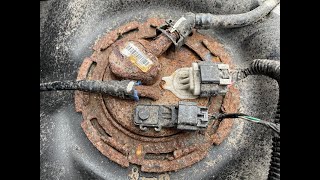
- The steel lock ring for the fuel pump is notoriously prone to rusting, making removal difficult and often requiring destruction of the old ring. In severe cases, the tank itself can rust around the opening, preventing a new pump from sealing, which may require tank replacement.
- NHTSA ODI #10551564 describes a known issue where after using about 5 gallons of fuel, the gauge fluctuates from Full to Empty every few minutes before triggering P0463.
Mechanic-Grade Diagnostic Values
- Fuel Level Sensor Resistance — expected: Approximately 40 ohms at empty and 250 ohms at full. The reading should change smoothly with no spikes or dropouts as the float arm is moved.. Failure: An infinite resistance reading (open circuit) or erratic jumps in resistance indicates a failed sensor.
- Fuel Level Sensor Signal Voltage (at pump connector) — expected: A variable voltage between approximately 0.5V (empty) and 4.5V (full) with the key on.. Failure: A reading stuck at or near 5.0V indicates an open circuit, which triggers P0463.
- Fuel Pump Connector - Signal Wire Voltage — expected: ~5V reference from the PCM with the connector unplugged, key on.. Failure: 0V indicates a break in the signal wire between the PCM and the tank.
- Fuel Pump Connector - Ground Wire Continuity — expected: Less than 1.0 ohm of resistance between the ground pin and a clean chassis ground point.. Failure: High resistance (e.g., > 1.0 ohm) indicates a poor ground connection, which can cause this code.
Scan Tool Commands That Help
- Tech2 / GDS2 (GM Dealer Tool): Instrument Cluster Sweep / Actuator Test — This command can be used to force the instrument cluster gauges, including the fuel gauge, to sweep through their full range of motion. This helps rule out a faulty gauge or instrument cluster itself. If the gauge sweeps correctly but reads incorrectly during normal operation, the fault is confirmed to be in the sensor, wiring, or PCM/BCM.
Wiring & Ground Locations
- Fuel Pump Connector — On top of the fuel pump module, accessible by dropping the tank or lifting the truck bed.. This is the primary connection point for the fuel level sensor. The Purple wire is the sensor signal, and the Black/White wire is the sensor ground. Corrosion or damage here is a common cause of P0463.
- SP105 (G105) — Under the hood, on the driver's side inner fender, near the battery and ABS module.. This is a major ground splice pack. The fuel pump and fuel level sender are grounded through this point. Corrosion here can create high resistance, causing P0463 and other electrical issues.
- SP106 (G106) — Under the hood, on the passenger's side inner fender, behind the engine airbox.. While SP105 is more directly related to the fuel pump, corrosion on SP106 can cause a host of seemingly unrelated electrical problems due to poor overall system grounding. It should be cleaned at the same time as SP105 as a best practice on this platform.
Real Owner Repair Stories
- YouTube user comment on a P0463 diagnostic video (GM Vehicle (Silverado, similar system to Canyon)) — P0463 code, fuel gauge stuck on empty.
❌ Tried (didn't work) Using a fuel system cleaner (like Techron) in the gas tank, which is sometimes suggested to clean sulfur deposits from the sensor contacts.
✅ What actually fixed it The owner ultimately had to replace the entire fuel pump module assembly because the fuel level sensor had a broken internal contact, which the cleaner could not fix. - coloradofans.com / 355nation.net forum consensus (2004-2012 Chevrolet Colorado / GMC Canyon) — P0463 code, erratic or non-functional fuel gauge.
❌ Tried (didn't work) Replacing only the instrument cluster., Clearing the code without addressing the root cause.
✅ What actually fixed it The overwhelming majority of successful repairs involved one of two fixes: 1) Cleaning the under-hood ground splice packs (SP105/SP106) or 2) Replacing the entire fuel pump module assembly. Many users report doing both preventatively. - NHTSA ODI #10513803 (GMC Envoy, similar system) — An owner reported a failed fuel sending unit resulting in code P0463. The failure was described as a scary situation that could have led to a fatal accident.
- NHTSA ODI #10520340 (GMC Envoy XL) — A report indicates that P0463 was produced due to an inaccurate fuel reading, requiring a dealer repair for the fuel system.
OEM Part Supersession History
Original fuel pump connector (2004-2005 models)→Updated pigtail connector kit— The original small, square connector was prone to corrosion and poor pin contact, leading to various fuel pump and level sensor codes.
Heads up: When replacing an original 2004-2005 fuel pump with a newer module, it is often necessary to cut off the old vehicle-side connector and splice in the new, more robust pigtail that comes with the replacement pump assembly.
Model Year Variations Within This Range
- 2004-2006, 2007, 2008-2012: The specific ACDelco part number for the fuel pump module changes across these year ranges (MU1611, MU1857, MU1385). While the core function is the same, there may be subtle differences in the pump, sensor calibration, or connector. It is critical to verify the correct part number by VIN before purchasing.
Diagnostic Flowchart
Other Known Issues on This Vehicle
Issues unrelated to this code that are worth knowing about as an owner of this generation:
- Cylinder Head Valve Seat Failure (3.5L L52 / 3.7L LLR) 🔴 High — Very common on 2004-2006 3.5L engines. Less common but still occurs on 2007+ 3.7L engines. Leads to P0300 random misfire codes. (Ref: GM TSB #06-06-01-017 / PIP4013D)
- Passlock Anti-Theft System Failure 🟠 Medium — Common across all years. Causes an intermittent crank-no-start condition where the security light flashes. Often requires waiting 10 minutes to restart.
- Intermediate Steering Shaft Clunk 🟡 Low — A common annoyance where a clunking or rattling noise is heard and felt through the steering wheel when going over bumps. Caused by a lack of grease in the collapsible shaft. (Ref: PIT5489C (for later models, but same issue applies))
- Blower Motor Resistor and Connector Failure 🟠 Medium — Extremely common. Results in fan speeds not working (e.g., only high works). The resistor fails and often melts the electrical connector, requiring both to be replaced.
- Cracked Exhaust Manifold (5-Cylinder Engines) 🟠 Medium — The exhaust manifold is prone to cracking, causing an exhaust leak that sounds like a ticking noise, especially when the engine is cold.
- Poor Under-hood Ground Connections 🟡 Low — Corrosion at the main ground packs (G105/G106) on the fender aprons is a frequent source of various, seemingly unrelated electrical gremlins.
Used vs. New Parts: Buying Guide for This Vehicle
When a used part is the smart pick: For this repair, a used part is almost never a smart choice. The fuel level sensor fails from wear and age, and a used part has unknown remaining life. The labor to drop the tank or lift the bed is significant, so installing a used part that might fail in 6-12 months is a major risk that negates any initial cost savings.
What to inspect on the donor part:
- Not applicable. Do not use a junkyard fuel pump module for this repair.
OEM-only on this vehicle (don't cheap out):
- Fuel Pump Module Assembly - While not strictly 'OEM-only', using a high-quality OEM (ACDelco) or reputable Tier 1 aftermarket (like Delphi) part is strongly recommended. The cost of a repeat repair due to a cheap, unreliable aftermarket pump failing is very high.
Aftermarket brands forum-validated for this vehicle:
- ACDelco (OEM)
- Delphi
Brands owners have reported issues with on this vehicle:
- Unbranded, 'white box' parts from online marketplaces. These often have high failure rates for both the pump motor and the level sensor, leading to doing the job twice.
Real Owner Stories
Aggregated from forums and TSBs cited above. Mileages and costs reflect what owners reported in those sources.
2004-2012 GMC Canyon
Symptoms: The fuel gauge was acting erratically and the P0463 code was triggered. Owners on 355nation.net and coloradofans.com noted this is a frequent occurrence.
What fixed it: In most cases, the issue was resolved by replacing the failed fuel sending unit, though some found the under-hood ground packs to be the culprit.
Source hint: 355nation.net / coloradofans.com
2004-2012 GMC Canyon
Symptoms: Fuel gauge reads full regardless of actual level, or drops to empty intermittently with the low fuel light on.
What fixed it: Replacing the entire fuel pump module, as the resistor contacts on the sensor arm had worn out or broken off.
Source hint: RepairPal
Related OBD-II Codes
Frequently Asked Questions
Is there a specific TSB for the P0463 code on my GMC Canyon?
Can I access the fuel level sensor on my 2004-2012 Canyon without dropping the fuel tank?
Why is my fuel gauge reading full even though I know the tank isn't?
Should I replace just the sensor or the whole fuel pump module?
What specific wiring should I check for the P0463 code on a 2004-2005 model?
Where are the ground points located that might cause my fuel gauge to act erratically?
Helpful Videos

![How to Fix P0463 Engine Code in 2 Minutes [1 DIY Method / Only $11.5]](https://img.youtube.com/vi/vmZ6y3GoXH4/mqdefault.jpg)
We Have This Part in Stock


The information in this article is provided for general reference and educational purposes only. Vehicle specifications, procedures, and part compatibility can vary by production date, trim level, and region. Always consult your vehicle's factory service manual and verify part numbers before purchasing or performing repairs. Safety-critical components such as airbags, seat belts, and braking systems should be installed by a qualified professional.
- GMC Canyon:
- 🧭 Diagnostic Flowchart
- 🎬 Helpful Videos
- 🛍️ Shop This Part
- What's Unique About the 2004-2012 GMC Canyon
- Symptoms You May Notice
- Most Likely Causes
- Rare But Worth Checking
- Diagnosis Steps
- Parts You'll Likely Need
- Related Codes That Often Appear With This One
- Technical Service Bulletins (TSBs) & Recalls
- Platform-Specific Known Issues
- Mechanic-Grade Diagnostic Values
- Scan Tool Commands That Help
- Wiring & Ground Locations
- Real Owner Repair Stories
- OEM Part Supersession History
- Model Year Variations Within This Range
- Other Known Issues on This Vehicle
- Used vs. New Parts: Buying Guide for This Vehicle
- Real Owner Stories
- 2004-2012 GMC Canyon
- 2004-2012 GMC Canyon
- Related OBD-II Codes
- Frequently Asked Questions
- 🎟️ Get 5% Off