

P0463 on 2016-2024 Mazda MX-5: Fuel Level Sensor 'A' Circuit High Causes and Fixes
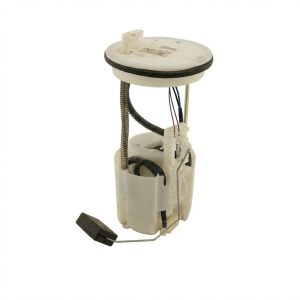
On a 2016-2024 Mazda MX-5, code P0463 is most often caused by a failed fuel level sending unit, which is part of the in-tank fuel pump module. The fuel gauge will read incorrectly, usually stuck on full. Replacing the sender unit is the typical fix. For 2018-2019 models, first check for the open fuel pump recall (NHTSA 21V875000) as this replacement is free.
- P0463 on a 2016-2024 MX-5 means the fuel level sensor circuit has a high voltage fault, usually causing the fuel gauge to be stuck on 'Full'.
- The most common fix is to replace the fuel level sending unit (OEM Part N270-60-960), which is located inside the fuel tank as part of the fuel pump module.
- For 2018-2019 models, check if the vehicle has an open safety recall for the fuel pump assembly, as this repair would be performed for free by a dealer.
What's Unique About the 2016-2024 Mazda MX-5
The 2016-2024 Mazda MX-5, known as the 'ND' generation, routes the fuel level signal through the Body Control Module (BCM) before it goes to the instrument cluster and PCM. While P0463 itself doesn't typically indicate a fuel pump failure, it's important to be aware of a major safety recall (NHTSA 21V875000, Mazda recall 5321K) for the low-pressure fuel pump on 2018-2019 models. The recall addresses an impeller inside the pump that can crack and deform, causing the engine to stall. Since the fuel level sender is part of the fuel pump assembly that is replaced under this recall, any diagnostic work should begin by checking if this recall is open for the vehicle.
Symptoms You May Notice
- Check Engine Light is illuminated.
- Fuel gauge reads inaccurately, often stuck on 'Full'.
- Fuel gauge may fluctuate erratically or read empty.
- Low fuel warning light may be on constantly.
- Replacing the fuel pump when only the sending unit has failed. While they are in the same assembly, sometimes only the sender needs replacement, which is a cheaper part. However, many shops and DIYers replace the entire module for reliability.
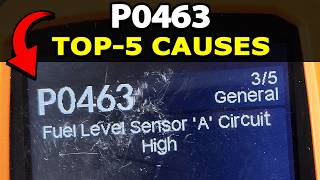
- Replacing the fuel gauge in the instrument cluster before properly testing the sender and wiring. 🎬 Watch this breakdown of common causes and fixes for P0463.
Most Likely Causes
- Faulty Fuel Gauge Sending Unit 🔴 High Probability → Shop Fuel Tank Sending Unit The sending unit is a variable resistor that is submerged in fuel and can wear out or fail over time. The internal contacts can degrade, causing its electrical resistance to go out of range (open circuit), which the PCM interprets as a high voltage signal.
How to confirm: Access the fuel pump module connector. Using a multimeter set to Ohms, measure the resistance across the sender unit's terminals. The resistance should change smoothly as the float arm is moved. An open circuit (infinite resistance) or a reading outside of the manufacturer's specification confirms a bad sender. For modern Mazdas, the approximate range is 2-4 ohms (full) to 107-113 ohms (empty). A P0463 code is typically caused by a reading far above the 'empty' resistance, indicating an open circuit.
Typical fix: Replace the fuel gauge sending unit. It is often sold as part of the complete fuel pump module.
Est. part cost: $45-$70 for the sender only; $250-$450 for a complete fuel pump module. - Wiring Harness or Connector Issue 🟡 Medium Probability The wiring runs from the fuel tank to the BCM. A wire could be damaged, or a connector pin could corrode, creating an open circuit or a short to power, which the PCM interprets as a high voltage signal.
How to confirm: Visually inspect the wiring harness for damage. Disconnect the connectors at the fuel pump module and the BCM and check for continuity and for shorts to power or ground on the signal wire using a multimeter. The Mazda service manual outlines checking for a short to power supply in the harness between fuel gauge sender unit terminal D and BCM terminal 2Q.
Typical fix: Repair the damaged section of the wiring harness or clean/replace the faulty connector.
Est. part cost: $5-$50 for wiring repair supplies. - Body Control Module (BCM) Malfunction ⚪ Low Probability
How to confirm: This is diagnosed by exclusion. If the sending unit and all wiring between it and the BCM test perfectly, the BCM itself may be the issue. This requires advanced diagnostics, often with a dealer-level scan tool. The Mazda factory service manual lists BCM malfunction as a possible cause.
Typical fix: Replace and reprogram the Body Control Module.
Est. part cost: $300-$600
Rare But Worth Checking
- Instrument Cluster or PCM Malfunction: → Shop Instrument Cluster The Mazda factory manual lists the instrument cluster and PCM as potential, but very rare, causes of this fault. These should only be considered after all other possibilities have been thoroughly ruled out by a professional.
Diagnosis Steps
- Scan for Codes: Use an OBD-II scanner to confirm P0463 is the only code present. Note the freeze frame data, which captures sensor values at the moment the fault occurred.
- Check for Recalls: Enter the vehicle's VIN on the NHTSA website or call a Mazda dealer to check for open recalls, specifically the fuel pump recall (NHTSA 21V875000, Mazda recall 5321K) for 2018-2019 models.
- Inspect Connectors: Access the fuel pump module connector under the package tray behind the seats. Disconnect it and inspect for corrosion, moisture, or damaged pins.
- Test the Circuit for a Short to Power: With the key on and the sender unit disconnected, use a multimeter to check for voltage on the signal wire to the BCM (Terminal D at the sender connector). There should be no voltage; if there is, a short to power exists in the harness.
- Test the Sending Unit: Disconnect the battery. Measure the resistance of the fuel level sending unit at its connector. It should be within the specified range (approx. 2-113 ohms for modern Mazdas). If the reading is infinite (Open Line), the sender has failed.
- Test the Wiring Harness: If the sender tests good, check for continuity on the signal and ground wires between the fuel pump connector and the BCM connector to rule out an open circuit. Also check for a short to ground.
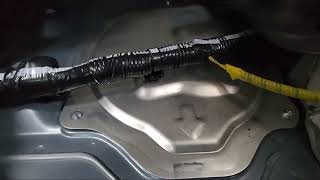
- Isolate the Fault: Based on the test results, replace the faulty component. The most likely part is the fuel level sending unit, available as a standalone part or as part of the complete fuel pump module assembly. 🎬 Watch: This step-by-step guide shows how to replace the ND fuel pump.
Parts You'll Likely Need
- Fuel Gauge Sending Unit
(OEM #N270-60-960)— This is the sensor that fails most frequently, causing the P0463 code. It is a variable resistor that wears out over time. This part number is confirmed for 2016-2024 models.
Trusted brands: Mazda Genuine
OEM price range: $45-$70
Aftermarket price range: $30-$60 - Fuel Pump Module Assembly
(OEM #N2Y1-13-35X (Example for 2018-2019, check VIN))— The sending unit is part of the fuel pump module. Many technicians prefer to replace the entire assembly to prevent future failure of the pump motor itself. This is required if the vehicle is part of the 2018-2019 fuel pump recall (NHTSA 21V875000).
Trusted brands: Mazda Genuine, Denso
OEM price range: $350-$450
Aftermarket price range: $200-$350
Platform-Specific Known Issues
- A recall (NHTSA Campaign Number: 21V875000, Mazda recall 5321K) was issued for 2018-2019 Mazda MX-5 models for a faulty low-pressure fuel pump that could fail and cause the engine to stall. The impeller inside the pump can crack, leading to failure. The fuel level sender is part of this assembly. Always verify if this recall has been performed on an affected vehicle by checking the VIN on the NHTSA website.
Mechanic-Grade Diagnostic Values
- Fuel Gauge Sending Unit Resistance — expected: Approximately 3-4 Ω when full and 109-110 Ω when empty. The resistance should change smoothly when moving the float arm.. Failure: An infinite resistance reading (Open Line or O.L. on a multimeter) indicates an open circuit within the sender, which is the direct cause of a P0463 code. 🎬 See how to diagnose and fix the P0463 circuit high code.
- Fuel Level Sensor Signal Voltage (at BCM) — expected: A variable voltage that corresponds to the resistance. A high voltage (approaching 5.0V) indicates an empty tank or an open circuit.. Failure: A reading stuck at or near 5.0V regardless of fuel level indicates a high input fault, consistent with P0463.
- Continuity Check: Sender to BCM — expected: Continuity (near 0 Ω resistance) should be present on the signal and ground wires between the sender and the BCM.. Failure: No continuity (infinite resistance) on the wire between fuel gauge sender terminal D and BCM terminal 2Q, or between sender terminal C and BCM terminal 2R, indicates an open circuit in the harness.
Scan Tool Commands That Help
- Mazda M-MDS (or capable aftermarket scanner): Instrument Cluster Actuator Test / Gauge Sweep — To verify if the instrument cluster's fuel gauge is physically capable of moving through its full range. This helps isolate the problem to the sender/wiring/BCM if the gauge itself works correctly during the test.
- Mazda M-MDS: BCM Configuration (Read/Write Function) — This is required when replacing the Body Control Module (BCM). It reads vehicle specification and personalization data from the old BCM and writes it to the new one. Failure to do this may result in incorrect operation of various body functions.
Wiring & Ground Locations
- Fuel Pump/Sender Connector — Under an access panel on the parcel shelf, located behind the driver's side seat, beneath the carpet.. This is the primary access point for testing the fuel sending unit's resistance and checking voltage on the circuit without dropping the fuel tank.
- Body Control Module (BCM) — Located behind the driver's side kick panel and front side trim, under the dashboard.. The BCM is the destination for the fuel level sensor's signal. Its connectors are the second major test point for diagnosing a wiring harness issue between the tank and the BCM.
- BCM Terminal 2Q — On one of the main connectors of the Body Control Module.. This is the specific terminal that receives the fuel level signal from terminal D of the sender unit. The workshop manual specifies checking for a short to power on the wire leading to this pin.
- BCM Terminal 2R — On one of the main connectors of the Body Control Module.. This is the specific terminal for the fuel sensor ground circuit, connected to terminal C of the sender unit. The workshop manual specifies checking for an open circuit on the wire leading to this pin.
OEM Part Supersession History
N270-60-960→N/A— No supersession found.
Heads up: Part number N270-60-960 appears to be stable and correct for all 2016-2024+ Mazda MX-5 models.
Model Year Variations Within This Range
- 2018-2019: These model years are subject to NHTSA recall 21V875000 for a faulty low-pressure fuel pump. Since the sending unit is part of the recalled assembly, this is the most critical model-year specific variation for this code. The diagnosis is the same, but the first step should always be to check the recall status.
- 2019-2024 (ND2): The ND2 revision introduced a significantly updated engine and other features like a telescoping steering wheel. However, for the purposes of diagnosing P0463, the fuel level sending unit, its part number (N270-60-960), and its communication path through the BCM remain the same as the ND1 (2016-2018).
Diagnostic Flowchart
Other Known Issues on This Vehicle
Issues unrelated to this code that are worth knowing about as an owner of this generation:
- Early Manual Transmission Failure (ND1) 🔴 High — Common on early 2016 models, particularly those driven aggressively or tracked. Failures of 2nd/3rd gear and synchros can occur at low mileage (under 30k miles). Mazda issued TSB 05-007/16 and later revised the transmission design. (Ref: TSB 05-007/16)
- Automatic Transmission Sudden Downshift 🔴 High — Affects 2016-2019 models with automatic transmissions. A software error could cause an unexpected downshift, leading to sudden deceleration. (Ref: NHTSA Recall 19V-072 (Mazda Campaign 3019A))
- Mazda Connect Infotainment Glitches 🟡 Low — Widespread across many Mazda models of this era, including the MX-5. Symptoms include random reboots, freezing, 'ghost touch' (phantom inputs), and connectivity issues. A class-action lawsuit was filed regarding these issues. (Ref: Subject of class-action lawsuit; various TSBs exist for specific symptoms (e.g., SSPB6, 09-037/21 for other models).)
- Thin Paint / Easy Chipping 🟡 Low — A very common complaint among owners, especially for colors like Soul Red Crystal. The paint is perceived as soft and prone to chipping from minor road debris. (Ref: Multiple TSBs exist regarding paint warranty claims and repair guides, such as 09-003/21 and 09-005/19, but no recall.)
- Soft Top Rubbing / Wear 🟡 Low — On early soft-top models, the fabric roof could rub against the roll hoop covers, causing scuffing. Dealers reportedly installed spacers to address this.
Used vs. New Parts: Buying Guide for This Vehicle
When a used part is the smart pick: A used part is generally not recommended for this repair due to the low cost of a new OEM sending unit. If the entire fuel pump module must be replaced and cost is a major factor, a used assembly from a very low-mileage donor vehicle (<30,000 miles) could be considered. A used Body Control Module (BCM) might be a cost-effective option if it is confirmed to be the fault, but it will require professional reprogramming.
Donor-vehicle mileage cap: roughly under 30000 miles for the part to have meaningful remaining life.
What to inspect on the donor part:
- For a used fuel pump assembly, inspect the electrical connector for any signs of melting, browning, or corrosion.
- Ensure the float arm is physically intact, not bent, and moves freely.
- Verify the part number on the used assembly matches the original part to ensure compatibility.
OEM-only on this vehicle (don't cheap out):
- Fuel Gauge Sending Unit (N270-60-960): The OEM part is inexpensive, making aftermarket alternatives an unnecessary risk.
- Body Control Module (BCM): Due to complex programming and vehicle integration, a new OEM part or one from a highly reputable specialist rebuilder is strongly advised over a typical junkyard part.
Aftermarket brands forum-validated for this vehicle:
- Denso: Denso is an original equipment manufacturer for Mazda, and their complete fuel pump module assemblies are considered a reliable alternative to dealer-sourced parts.
Brands owners have reported issues with on this vehicle:
- No-name or unbranded fuel pump assemblies from online marketplaces. The labor to replace the unit is significant, and failure of a cheap pump can leave you stranded, making it a poor area to cut costs.
Real Owner Stories
Aggregated from forums and TSBs cited above. Mileages and costs reflect what owners reported in those sources.
2018 Mazda MX-5 SKYACTIV-G 2.0
Symptoms: The low-pressure fuel pump was prone to failure due to a cracked impeller; the fuel level sender is integrated into this same assembly.
What fixed it: Replacement of the fuel pump assembly under Mazda recall 5321K (NHTSA 21V875000).
Source hint: vehicle_specific_issues citing NHTSA Campaign Number: 21V875000
2016 Mazda MX-5 SKYACTIV-G 2.0 — ~25000 miles
Symptoms: While not directly a P0463 issue, owners of early ND1 models reported significant manual transmission failures involving 2nd and 3rd gear synchros at low mileage.
What fixed it: Mazda issued TSB 05-007/16 and revised the transmission design to address these mechanical failures.
Source hint: Miata.net Forum threads regarding early ND1 manual transmission failures
Related OBD-II Codes
Frequently Asked Questions
Is there a recall for the fuel pump on my 2018 Mazda MX-5 that might be related to P0463?
What is the expected resistance range for the fuel sending unit on a modern ND Miata?
Where is the fuel pump module connector located on the 2016-2024 MX-5?
Can a Body Control Module (BCM) failure cause the P0463 code on my Mazda?
My fuel gauge is stuck on 'Full' but I have a P0463 code; is this common for the MX-5?
Helpful Videos

We Have This Part in Stock

The information in this article is provided for general reference and educational purposes only. Vehicle specifications, procedures, and part compatibility can vary by production date, trim level, and region. Always consult your vehicle's factory service manual and verify part numbers before purchasing or performing repairs. Safety-critical components such as airbags, seat belts, and braking systems should be installed by a qualified professional.
- Mazda MX-5:
- 🧭 Diagnostic Flowchart
- 🎬 Helpful Videos
- 🛍️ Shop This Part
- What's Unique About the 2016-2024 Mazda MX-5
- Symptoms You May Notice
- Most Likely Causes
- Rare But Worth Checking
- Diagnosis Steps
- Parts You'll Likely Need
- Platform-Specific Known Issues
- Mechanic-Grade Diagnostic Values
- Scan Tool Commands That Help
- Wiring & Ground Locations
- OEM Part Supersession History
- Model Year Variations Within This Range
- Other Known Issues on This Vehicle
- Used vs. New Parts: Buying Guide for This Vehicle
- Real Owner Stories
- 2018 Mazda MX-5 SKYACTIV-G 2.0
- 2016 Mazda MX-5 SKYACTIV-G 2.0 — ~25000 miles
- Related OBD-II Codes
- Frequently Asked Questions
- 🎟️ Get 5% Off